



CMS set the 2026 Ambulance Inflation Factor at 2.0%, effective for services furnished on or after January 1, 2026. The figure comes straight from CMS’s own published update, calculated as CPI-U minus the annual productivity adjustment, and it applies directly to national ambulance fee schedule base rates and payment limits. Every billing and finance team running Medicare ambulance claims needs this number loaded into their rate models before the new year starts.
TL;DR:
- The 2.0% Ambulance Inflation Factor applies to all claims starting January 1, 2026, but billing systems must update by January 5 to reflect this change.
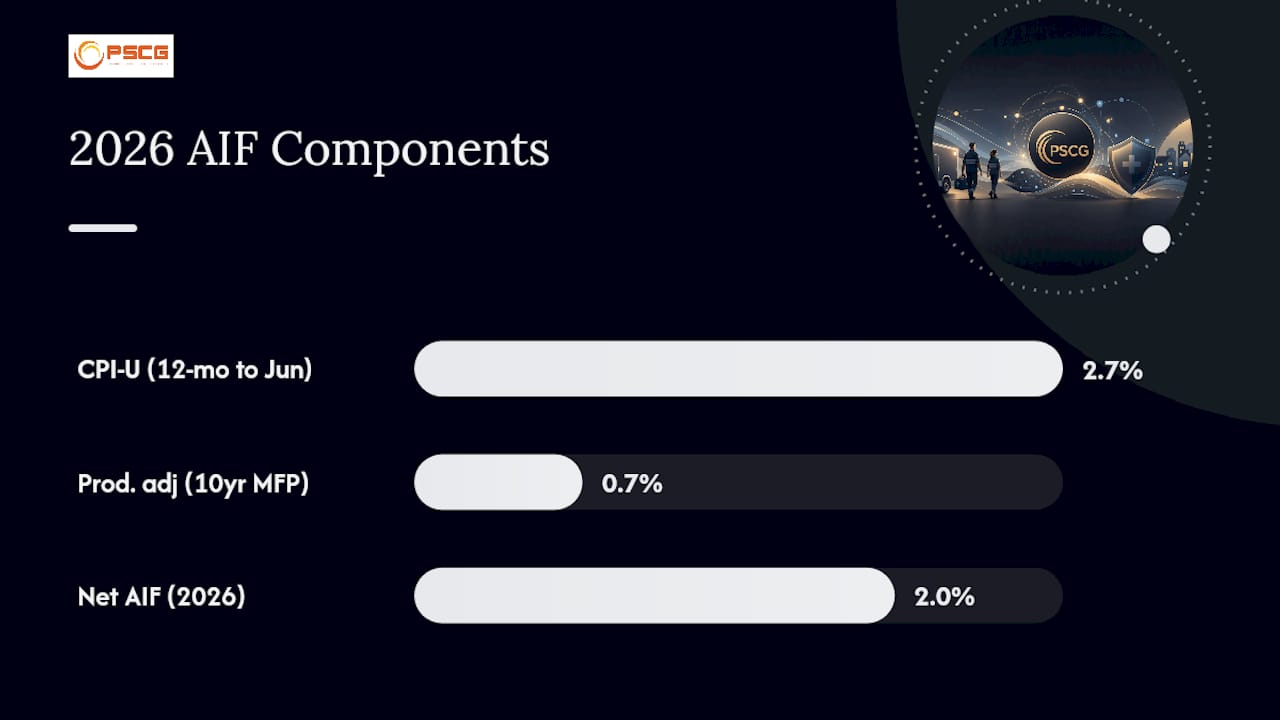
- CMS calculates the AIF by subtracting a 0.7% productivity adjustment from the CPI-U inflation rate, which was 2.7% for 2026.
- Locality-specific GPCIs and rural bonuses significantly influence final ambulance payments, causing variability across regions even with the same AIF.
- Billing teams should verify updated fee schedules, crosswalk files, and local adjustments before submitting claims to prevent underpayment.
- Agencies must audit their highest-volume codes and coordinate with contractors to ensure system updates and local rate calculations align with the new 2.0% adjustment.
Table of Contents
- Where CMS Published the 2026 Ambulance Inflation Factor
- How CMS Calculated the 2.0% Ambulance Inflation Factor
- How the 2026 AIF Changes Your Ambulance Fee Schedule Payments
- What Should Billing and Finance Teams Do Before January 1?
- Why the Same 2.0% AIF Produces Different Results Across Municipalities
- What Should EMS Leaders Prioritize Right Now?
- Where to Find the Official 2026 AIF Documents
- Sources
- FAQ
Where CMS Published the 2026 Ambulance Inflation Factor
The 2.0% figure did not arrive as a press release or a rumor circulating through billing forums. CMS manualized it through Change Request R13464CP (CR 14269), a transmittal that updates Publication 100-04, the Medicare Claims Processing Manual, chapter 15, section 20.4. That section is the permanent home for AIF guidance, and every year’s update gets folded into the same place so contractors and billing systems have one consistent reference point.
The transmittal carries two dates that matter for your operations calendar:
Effective date: January 1, 2026 — this is when the 2.0% AIF applies to ambulance claims for services rendered.
Implementation date: January 5, 2026 — this is when Medicare Administrative Contractors (MACs) must have their systems updated to process claims using the new factor.
That four-day gap between effective and implementation dates is not a technicality you can ignore. Claims for January 1 through January 4 services may hit MAC systems before the update is fully live, which sometimes triggers a short reprocessing window rather than a clean first pass. CMS also releases updated Ambulance Fee Schedule Public Use Files (PUFs) alongside the transmittal, and those files are what actually carry the new base rates into your billing engine or clearinghouse.
Most practice management systems and clearinghouses pull updated fee schedule data on a scheduled cycle rather than the moment CMS posts it. If your organization uses a third-party clearinghouse, confirm directly with them when their system reflects the 2026 AIF rather than assuming it happens automatically on January 1. We have seen agencies get caught underpaid for weeks simply because nobody checked the propagation timeline.
How CMS Calculated the 2.0% Ambulance Inflation Factor
The math behind the 2026 AIF is not complicated once you know the two inputs. CMS starts with the Consumer Price Index for All Urban Consumers (CPI-U), measured over the 12 months ending in June of the prior year, then subtracts a productivity adjustment tied to the 10-year moving average of economy-wide multifactor productivity (MFP), sometimes labeled total factor productivity (TFP) in older guidance.
AIF = CPI-U − Productivity Adjustment
That arithmetic is confirmed directly on CMS’s AIF page for calendar year 2026, and it is worth sitting with for a moment because this formula is not unique to ambulances. It mirrors the productivity-adjustment mechanism Congress applied across several Medicare fee schedules after the Affordable Care Act (ACA).
Here is the breakdown of the two inputs:
- CPI-U component (2.7%): Reflects broad consumer price inflation over the relevant 12-month measurement period, capturing everything from fuel to medical supplies that EMS agencies purchase.
- Productivity adjustment (0.7%): A downward reduction Congress mandated to reflect expected efficiency gains across the economy, regardless of whether an individual ambulance agency actually achieved those gains.
The statutory authority for this mechanism traces to Section 1834(l)(3)(B) of the Social Security Act, which established the annual update formula for the Ambulance Fee Schedule, and to Section 3401 of the Affordable Care Act, which layered in the productivity adjustment starting in 2011. If you ever need to explain to a city council or a finance director why the ambulance rate increase is smaller than raw inflation numbers might suggest, this is the clause to point to. The productivity offset is baked into law, not a CMS discretionary cut.
One nuance billing teams often miss: the productivity adjustment can occasionally push the AIF below zero in a low-inflation year, though that has not happened in the recent AIF cycle. For 2026, the 2.7% CPI-U figure was large enough that even after the 0.7% offset, agencies still see a net positive adjustment.
How the 2026 AIF Changes Your Ambulance Fee Schedule Payments
A 2.0% national adjustment does not mean every ambulance claim in your jurisdiction goes up by exactly 2.0% in dollar terms. The AIF adjusts the national base rate, but the final payment for a specific claim runs through several more layers before it reaches your remittance advice.
The sequence works like this: CMS applies the AIF to the national base rate for each service level, then multiplies by the relevant Relative Value Unit (RVU) for that HCPCS code (ground mileage, advanced life support, basic life support, air ambulance, and so on), then applies the Geographic Practice Cost Indices (GPCIs) specific to your locality. Only after all three steps does the number reflect what your agency will actually see on a claim.
- Urban ground ambulance rates use one base-rate and RVU combination, adjusted by the urban GPCI for that locality.
- Rural ground ambulance rates use a separate formula variant, often carrying a rural bonus percentage on top.
- Air ambulance rates (fixed-wing and rotary-wing) follow their own base-rate structure entirely, distinct from ground transport math.
- Mileage rates scale per loaded mile and carry their own locality adjustments, which is why our mileage billing rules guide exists as a standalone resource.
All of these formulas, along with the ZIP-code-to-locality crosswalk files, live in the Ambulance Fee Schedule PUFs. If you want to reproduce CMS’s exact math for your own service area rather than trusting a summary table, the PUFs are the primary document to pull.
Rural and super-rural bonuses deserve their own callout because they trip up a lot of otherwise careful billing teams. These add-ons, including the super-rural bonus (a documented 22.6% multiplier on the rural base rate for qualifying ZIP codes in current PUF examples), are separate statutory payments layered on top of the AIF-adjusted base rate.
Pro Tip: Pull the previous year’s PUF alongside the 2026 version and run a side-by-side diff on your five highest-volume HCPCS codes before you touch your master rate table. That single comparison usually surfaces GPCI locality changes that have nothing to do with the AIF but will still move your bottom line.
What Should Billing and Finance Teams Do Before January 1?
Getting the 2026 AIF right in your systems is a sequencing problem more than a math problem. Here is the order we recommend to EMS billing and finance teams every fee schedule cycle:
- Download the updated PUFs from the CMS Ambulance Fee Schedule page and re-run your local rate models using the 2.0% factor applied to national base rate inputs, not to last year’s already-adjusted dollar figures.
- Refresh your ZIP-to-locality and GPCI crosswalk files. Locality boundaries and index values shift periodically independent of the AIF, and an outdated crosswalk will misprice claims even with the correct inflation factor loaded.
- Confirm your clearinghouse or billing engine has posted the update. Ask for a specific propagation date rather than assuming January 1 coverage, particularly if you use a third-party vendor for claims scrubbing.
- Audit your highest-volume HCPCS codes for variance. Set a dollar or percentage threshold, flag anything outside expected range, and route those exceptions to a supervisor before mass billing resumes.
- Coordinate with your Medicare Administrative Contractor (MAC) for any locality-specific guidance, and watch for correction notices in the weeks following implementation, since minor technical corrections to PUF data are common in Q1.
Our guide to computing local Medicare ambulance rates walks through the six-step process for teams that want to build this into a repeatable annual workflow rather than a scramble every December.
Pro Tip: Schedule your rate model refresh for the same week every year, tied to the CMS PUF release rather than the calendar, so the update becomes routine instead of a January fire drill.
Why the Same 2.0% AIF Produces Different Results Across Municipalities
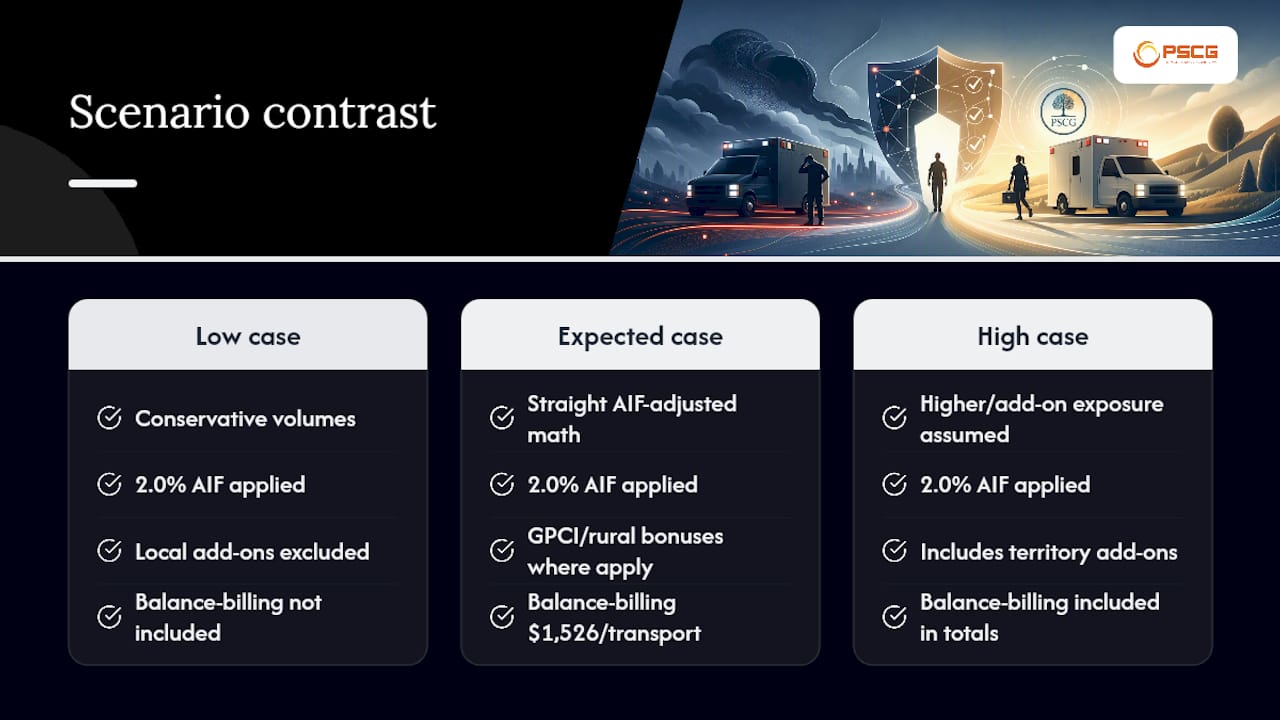
The AIF is a single national number, but GPCIs are locality-specific, and rural or super-rural bonuses only apply where the ZIP codes qualify.
That gap is exactly why we tell municipal clients to build three scenarios rather than one flat projection: a low case using conservative volume assumptions, an expected case using the straight AIF-adjusted math, and a high case that accounts for any add-on exposure specific to your service territory. Our Ambulance Service Cost Analysis guide for municipalities walks through this scenario structure in more detail, and it pairs well with balance-billing data. We have documented average balance-billing exposure of $1,526 per transport in prior analysis, a figure worth having in hand when you present the full financial picture to a city council rather than the AIF number in isolation.
A 2.0% national adjustment sounds simple until you overlay it on a locality map full of GPCI variation, rural bonuses, and super-rural multipliers. Two agencies can apply the same federal number and walk away with genuinely different budget realities.
A few internal notification triggers we recommend building into your process: any variance above your set threshold on a top-ten HCPCS code, any locality boundary change flagged in the updated crosswalk file, and any claim denial pattern that emerges in the first two weeks of the new rate period. If two or more of those trip simultaneously, that is usually the point where bringing in outside reimbursement expertise pays for itself faster than trying to troubleshoot internally. Our team at Thepscgroup works through exactly these scenarios with municipal clients across Connecticut and beyond, and you can review our approach to reimbursement consulting for EMS agencies when the internal math stops adding up.
What Should EMS Leaders Prioritize Right Now?
The 2026 AIF is a small number attached to a large operational responsibility. Get the base math right, update your PUFs and GPCI files before claims start flowing under the new rate, and audit your highest-volume codes rather than trusting that a national percentage translates cleanly to your local reality. Agencies that skip the locality-level verification step are the ones who call us in March wondering why their revenue does not match their January projections.
If your team wants a second set of eyes on the modeling before the January 1 effective date, our municipal EMS strategy resources are a good starting point, and we’re glad to talk through your specific locality math directly.
— Mike
Where to Find the Official 2026 AIF Documents
The primary sources below are worth bookmarking rather than relying on secondhand summaries:
- CMS Transmittal R13464CP / CR 14269 — the official change request manualizing the 2026 AIF into the Medicare Claims Processing Manual, with effective and implementation dates.
- Ambulance Fee Schedule PUFs and ZIP/locality files on cms.gov — the working files billing teams use to compute actual locality-specific payment amounts.
You can reach Thepscgroup directly through our contact page if you need help interpreting how these files apply to your specific service area.
FAQ
Why Do Ambulance Bills Often Exceed $2,000?
Ambulance costs reflect base rates, mileage, service-level RVUs, locality GPCI adjustments, and rural or super-rural add-ons stacked together, not a single flat fee, which is why total charges can vary widely, especially for advanced life support or longer-distance transports.
What Is the Average Ambulance Bill in the United States?
Average ambulance bills vary widely by locality, service level, and transport distance, and no single national figure applies uniformly. Agencies and patients should reference their specific fee schedule and locality GPCI rather than a generic average.
Does the 2.0% AIF Apply Evenly Across All Localities?
No.