



TL;DR:
- EMS clinical protocols are evidence-based guidelines that standardize pre-hospital assessment and treatment, overseen by medical direction.
- Updated every two to three years, they include structured domains such as assessment, medical, trauma, and operational procedures, with local variations documented and approved.
EMS clinical protocols are standardized, evidence-based guidelines that govern every assessment and treatment decision EMS professionals make in the pre-hospital environment. The 2026 PHECC 8th Edition replaces all previous versions to strengthen pre-hospital care quality across regions, signaling a broader industry shift toward tighter evidence integration and measurable outcomes. The Ontario Ministry of Health similarly updated its Basic Life Support Patient Care Standards to address high-stakes interventions including cardiac arrest management and stroke bypass protocols. For EMS professionals and healthcare administrators, understanding how these frameworks are structured, implemented, and evolving is the difference between a system that performs and one that merely responds.
How are EMS clinical protocols structured and categorized?
EMS clinical protocols organize pre-hospital care into distinct functional domains, each addressing a specific category of patient need or operational requirement. This structure allows agencies to train systematically, audit performance by domain, and update individual sections without overhauling an entire protocol set.
The Ontario Ministry of Health standards detail specific high-stakes interventions across domains that typically include:
- General patient assessment: Scene safety, primary and secondary surveys, vital sign acquisition, and documentation standards
- Medical protocols: Cardiac arrest management, stroke bypass criteria, respiratory distress, diabetic emergencies, and toxicological presentations
- Trauma protocols: Hemorrhage control, spinal motion restriction, burn management, and pediatric trauma pathways
- Medication guidelines: Drug indications, contraindications, dosing by weight and age, and administration routes
- Operational procedures: Inter-facility transfer standards, mass casualty incident activation, and documentation requirements
Most jurisdictions maintain between 30 and 70 individual protocol sections, with larger urban systems sometimes exceeding that range to address specialized populations or service lines. The table below illustrates how a typical protocol set is organized across domains:
| Domain | Example Protocols | Primary Purpose |
|---|---|---|
| General assessment | Scene size-up, patient history, triage | Standardize initial patient contact |
| Medical emergencies | Cardiac arrest, stroke, anaphylaxis | Guide time-sensitive treatment decisions |
| Trauma care | Hemorrhage control, spinal restriction | Reduce preventable trauma mortality |
| Pharmacology | Epinephrine, naloxone, aspirin | Define safe medication administration |
| Operational | Mass casualty, documentation, transfer | Support system-level coordination |

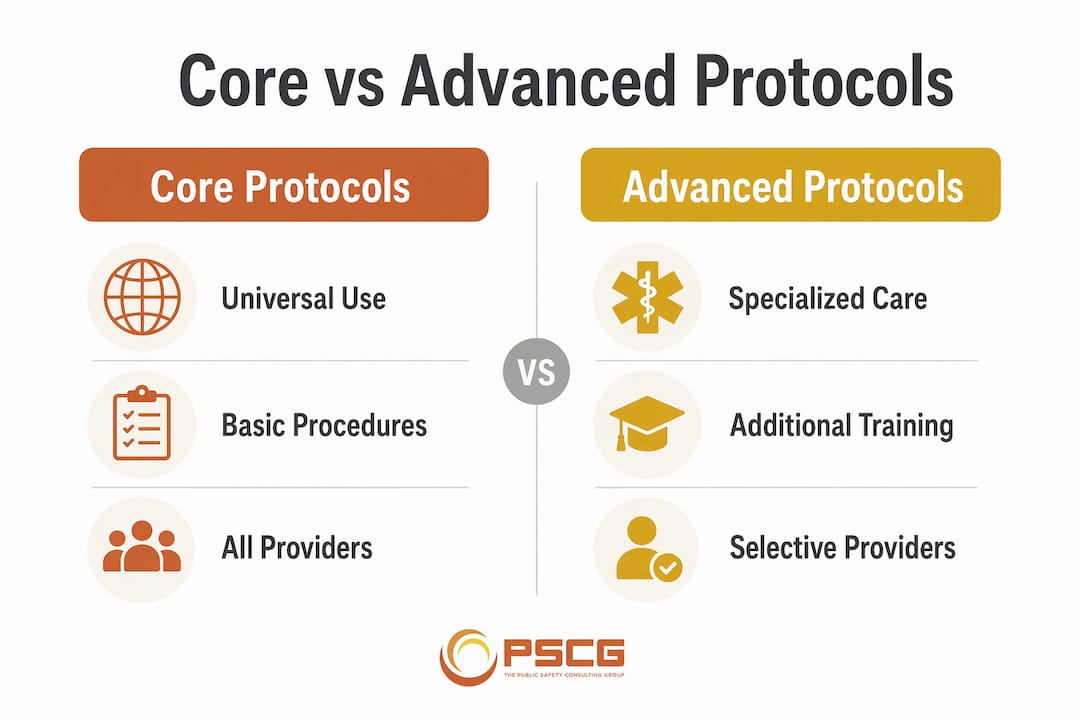
One pattern consistent across jurisdictions is the separation of core protocols from non-core or advanced protocols. Non-core protocol designations allow EMS systems to tailor response capacity and operational efficiency without compromising care quality. Not every provider at every certification level needs access to every protocol, and this tiered structure reflects that operational reality.
What are the key elements for effective EMS protocol implementation?
Effective ems protocol implementation depends on far more than distributing a document to field personnel. The Arizona Emergency Medical Systems Red Book makes clear that local variations are permitted when documented and when they satisfy medical direction requirements. That flexibility is a feature, not a loophole, but it requires deliberate administrative infrastructure to work safely.
The critical elements for successful protocol adoption include:
- Medical direction linkage: Every protocol set must be formally tied to a physician medical director who reviews, approves, and takes accountability for the clinical standards. This is not optional. Medical oversight is the legal and clinical foundation on which protocols rest.
- Competency-based training: Possessing protocols alone does not ensure compliance or quality care. Personnel must demonstrate the skills and knowledge required to execute each protocol safely before applying it in the field.
- Documentation of local variations: When an agency adapts a state or regional standard to fit local resources or patient populations, that adaptation must be formally documented and approved by medical direction. Undocumented variation is the source of most protocol compliance failures.
- Ongoing certification and skill maintenance: High-risk protocols, particularly those involving airway management or pharmacological intervention, require recurrent skills verification. Annual or biennial recertification cycles are the minimum standard for most jurisdictions.
- Clear delineation of core versus non-core protocols: Agencies must define which protocols apply to all personnel and which require additional credentialing. This prevents both under-use of available interventions and unsafe application of advanced procedures by undertrained providers.
Pro Tip: When onboarding new protocols, build a competency checklist tied directly to each protocol section rather than relying on general skills assessments. This creates a direct audit trail from training to field application and supports medical director accountability.
Research on prehospital emergency anesthesia reinforces this point. Standardized, high-quality training is the critical factor for executing high-risk protocols safely, and that standard applies across the full spectrum of EMS treatment protocols, not just the most complex procedures.
How are evolving patient care models transforming EMS protocols?
The traditional EMS protocol model was built around a single outcome: transport the patient to the emergency department as quickly as possible. That model is being replaced. The Ontario Ministry of Health’s Treat and Refer and Treat and Discharge standards shift the focus from transport speed to appropriate destination and on-scene resolution. This is one of the most significant structural changes in emergency medical services guidelines in the past decade.
These models require EMS agencies to rethink protocol design from the ground up. On-scene treatment and referral pathways demand:
- Approved medical directives that explicitly authorize non-transport decisions
- Robust patient consent documentation processes
- Formal coordination agreements with community health partners, primary care providers, and mental health services
- New performance metrics that measure on-scene resolution rates and follow-up compliance rather than response time alone
“Transitioning to Treat and Refer or Discharge models requires new operational frameworks, including advanced directives, documentation, and multi-agency coordination.” — Ontario Patient Care Model Standards
The Ontario model is instructive because it demonstrates what system-wide implementation actually requires. Protocols must support safe discharge and referral pathways as part of coordinated, system-wide care. That means EMS agencies cannot develop these protocols in isolation. They require active partnerships with hospitals, public health departments, and community-based organizations.
For healthcare administrators, the operational implications are significant. Performance measurement systems built around response time benchmarks and transport volume will not capture the value these models generate. Administrators need to build new data collection frameworks that track patient outcomes at 24, 48, and 72 hours post-encounter to demonstrate the clinical effectiveness of on-scene resolution. This is where municipal EMS best practices become directly relevant to protocol design decisions.
What are best practices for EMS protocol compliance and quality?
Protocol compliance is not synonymous with rigid, inflexible adherence. Clinical protocols serve as a dynamic standard of care that must adapt regionally, with documented, justified deviations accepted for patient-specific or operational reasons. The distinction between non-compliance and a clinically justified deviation is one that every EMS administrator and medical director must understand and communicate clearly to field personnel.
Pro Tip: Build a formal deviation documentation process into your electronic patient care reporting system. When providers document the clinical rationale for departing from a protocol, you generate quality improvement data rather than a compliance violation record.
Maintaining protocol quality across an EMS system requires attention to several interconnected factors:
- Audit mechanisms: Regular case review against protocol benchmarks identifies both compliance gaps and opportunities to update protocols based on real-world performance data.
- Differentiation of mandatory versus advanced protocols: Agency leaders must distinguish mandatory protocols from advanced interventions requiring additional competency-based training. Treating all protocols as equally mandatory creates confusion and undermines the credibility of the entire framework.
- Personnel engagement: Field providers who understand the evidence behind a protocol are more likely to follow it consistently. Protocol education should explain the “why,” not just the “what.”
- Medical director involvement: Quality assurance reviews conducted with active medical director participation carry more clinical authority and produce more meaningful protocol refinements than administrative-only reviews.
- Scheduled protocol review cycles: Emergency care standards evolve as new evidence emerges. Agencies that review their full protocol set on a defined cycle, typically every two to three years, stay aligned with current evidence and reduce liability exposure.
The EMS medical oversight function is the structural mechanism that makes all of this work. Without a physician medical director who is actively engaged in protocol development, training oversight, and quality review, even well-written protocols will underperform in the field.
Key takeaways
Effective EMS clinical protocols require structured design, competency-based training, active medical oversight, and adaptive patient care models to deliver consistent, high-quality pre-hospital care.
| Point | Details |
|---|---|
| Structure drives performance | Organize protocols into functional domains covering assessment, medical, trauma, pharmacology, and operations. |
| Training is the compliance mechanism | Competency-based training, not document distribution, determines whether protocols are followed safely. |
| Local variation requires documentation | Permitted deviations must be formally approved by medical direction to remain within the standard of care. |
| Evolving care models demand new metrics | Treat and Refer and Treat and Discharge protocols require outcome-based performance measurement, not just response time data. |
| Medical oversight is non-negotiable | Active physician medical director engagement in protocol development and quality review is the foundation of any compliant EMS system. |
Why protocol quality is the most underrated variable in EMS system performance
I have worked with EMS agencies across a wide range of operational contexts, from small volunteer services managing a handful of calls per day to high-volume urban systems processing thousands of encounters per month. The single most consistent finding is this: the agencies that perform best clinically are not necessarily the ones with the most advanced equipment or the largest budgets. They are the ones with the clearest, most current protocols and the most disciplined training programs built around those protocols.
What surprises most administrators is how much protocol quality affects operational efficiency, not just clinical outcomes. When providers are confident in their protocols, they make faster decisions, document more accurately, and generate fewer quality improvement flags. When protocols are outdated, inconsistent, or poorly communicated, you see hesitation in the field, documentation gaps, and medical director reviews that consume hours of administrative time without producing meaningful improvement.
The shift toward Treat and Refer and Treat and Discharge models is the most consequential change I have seen in clinical practices in EMS in the past decade. It requires agencies to build entirely new protocol infrastructure, including consent frameworks, referral pathways, and community health partnerships. Agencies that approach this as a documentation exercise will struggle. Agencies that treat it as a system design challenge, with protocols, training, and partnerships developed in parallel, will see real gains in patient outcomes and resource utilization.
The 2026 updates from PHECC and the Ontario Ministry of Health are not administrative housekeeping. They reflect a genuine evolution in the evidence base for pre-hospital care. Agencies that align their local protocols with these updated standards, and invest in the training infrastructure to support them, are positioning themselves for the next generation of EMS performance measurement.
— Mike
How Thepscgroup supports EMS protocol development and system design

Thepscgroup works directly with EMS agencies and municipal leaders to develop, review, and implement clinical protocol frameworks that meet current emergency care standards while reflecting local operational realities. Whether your agency is updating an existing protocol set, transitioning to a Treat and Refer model, or building a new medical oversight structure from the ground up, PSCG brings the consulting depth to move from planning to execution. Explore the Municipal EMS Strategy Guide for a structured approach to protocol integration and service delivery improvement. You can also review EMS system design examples that demonstrate how leading agencies have built protocol-compliant systems. Contact Thepscgroup at thepscgroup.net to start the conversation.
FAQ
What are EMS clinical protocols?
EMS clinical protocols are standardized, evidence-based guidelines that direct pre-hospital assessment, treatment, and transport decisions for emergency medical services personnel. They are developed under physician medical direction and updated regularly to reflect current clinical evidence.
How often should EMS protocols be updated?
Most EMS agencies review and update their full protocol set every two to three years, with interim updates issued when significant new evidence or regulatory changes require it. The 2026 PHECC 8th Edition and Ontario Ministry of Health updates are examples of scheduled, evidence-driven revision cycles.
Can EMS providers deviate from established protocols?
Yes. Justified deviations are permitted when documented and clinically warranted for patient-specific or operational reasons. The key requirement is formal documentation of the rationale, which distinguishes a clinical decision from a compliance failure.
What is the difference between core and non-core EMS protocols?
Core protocols apply to all providers at a given certification level, while non-core protocols require additional credentialing or competency verification before use. This distinction allows agencies to tailor their response capabilities without creating uniform requirements that exceed the training of all personnel.
How do Treat and Refer models change EMS protocol requirements?
Treat and Refer models require agencies to develop approved medical directives for non-transport decisions, formal patient consent documentation, and coordination agreements with community health partners. These models shift performance measurement from transport volume and response time to on-scene resolution rates and patient follow-up outcomes.