



TL;DR:
- Designing an EMS system involves organizing agencies, communication networks, staffing, and protocols for reliable emergency response. Effective governance, evidence-based staffing, and comprehensive performance metrics are essential for sustainability and equity. A structured, collaborative approach with continuous measurement ensures long-term system resilience and high-quality care.
Designing an EMS system is the process of organizing agencies, communication networks, dispatch infrastructure, clinical protocols, and human resources to deliver timely, reliable, and high-quality emergency medical response. Done well, this process determines whether your community receives the right care at the right time. Done poorly, it creates gaps that cost lives. This guide walks public safety administrators through the core architecture, governance structures, staffing models, and operational best practices required to build a system that performs under pressure and holds up over time. Thepscgroup has worked with municipalities across Connecticut and beyond to apply exactly this kind of structured, evidence-based approach.
How to design an EMS system: core components and governance
EMS system design begins with governance. State EMS agencies set the legal framework, certification standards, and statewide protocols, while regional and local bodies handle day-to-day planning, resource deployment, and performance oversight. This two-tier model is the foundation of most U.S. EMS systems. When state and local roles overlap or conflict, the result is a governance mismatch that undermines both compliance and operational performance.
The core components of any EMS system include:
- Agency structure: Paid, volunteer, combination, and third-service models each carry distinct funding and staffing implications.
- Medical direction: A physician medical director provides clinical oversight, protocol authorization, and quality assurance.
- Resource management: Unit deployment, System Status Management, and peak-demand coverage planning.
- Communications: Dispatch centers, Computer-Aided Dispatch (CAD) systems, and interoperability with fire and law enforcement.
- Transportation networks: Ground ambulance, air medical, and mutual aid agreements.
- Clinical protocols: Evidence-based treatment guidelines aligned with state and regional standards.
Governance design is often underappreciated, but it has outsized importance in sustaining operational changes and quality improvements over time. A system with excellent field providers but weak governance will struggle to maintain consistency, accountability, and long-term growth.
International research reinforces this complexity. An expert consensus study using Delphi methodology identified 227 essential components across 11 operational domains for Emergency Medical Dispatch systems alone. That finding illustrates just how many interdependent parts must align for a system to function at a high level.

| EMS System Domain | Key Elements |
|---|---|
| Governance and Oversight | State certification, regional planning bodies, medical director authority |
| Dispatch and Communications | CAD, AVL, call-taker protocols, multi-agency coordination |
| Clinical Operations | Treatment protocols, quality improvement, outcome tracking |
| Workforce and Staffing | Deployment models, credentialing, retention programs |
| Infrastructure and Funding | Readiness funding, reimbursement structures, capital planning |
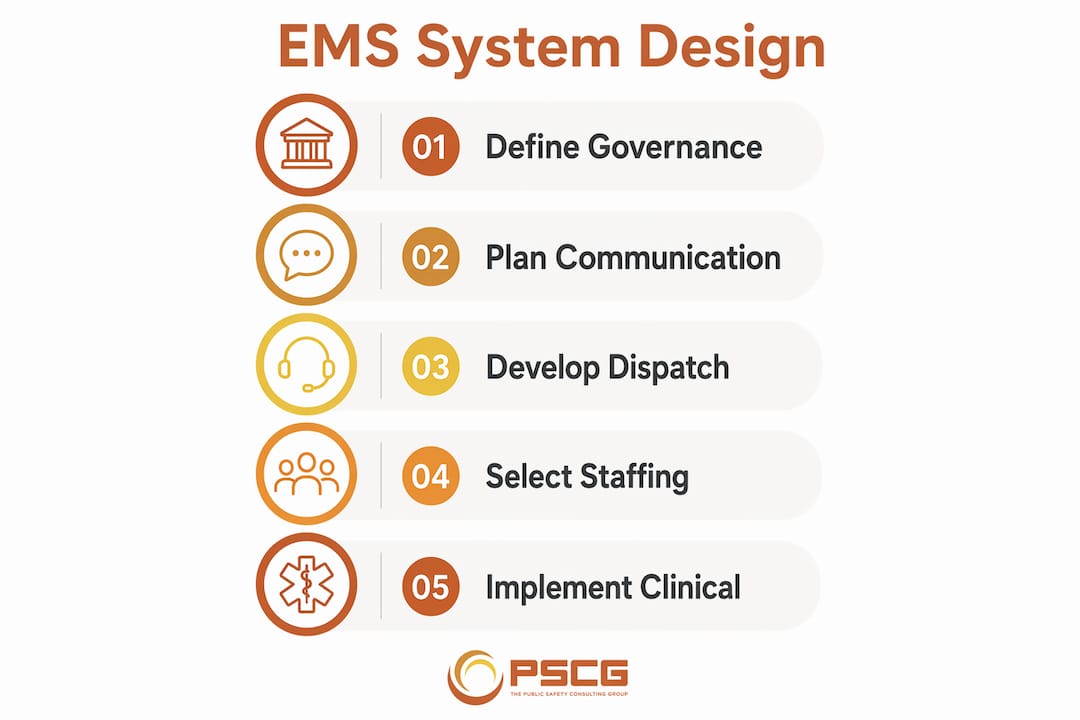
What does an EMS system design step by step look like?
A structured EMS system development process follows a clear sequence. Skipping steps creates gaps that surface later as performance failures or compliance deficits.
Conduct a baseline assessment. Map your current call volume, response time data, unit deployment patterns, and clinical outcome metrics. Identify where performance gaps exist before proposing solutions. Thepscgroup recommends a formal EMS needs assessment as the starting point for any redesign effort.
Engage stakeholders early. Include fire chiefs, hospital administrators, municipal officials, medical directors, and frontline providers. Stakeholder alignment at the design stage prevents resistance during implementation.
Define system requirements. Specify coverage zones, response time benchmarks, staffing ratios, and technology needs. These requirements should reflect your community’s risk profile, geography, and call mix, not a generic national template.
Select and configure your dispatch system. Research warns against treating call-taker scripts alone as a complete dispatch system. Full operational maturity requires structured call-taking, triage, pre-arrival instructions, resource tracking, and integrated governance functions.
Design your deployment model. Choose between fixed-station deployment, System Status Management, or a hybrid approach based on your geography and call density. Review EMS deployment models to match the right structure to your community’s needs.
Build your performance measurement framework. Modern EMS design requires metrics beyond response time, including clinical effectiveness, patient safety, equity of access, and workforce retention. Define these measures before go-live, not after.
Implement, monitor, and adjust. Launch with a defined quality improvement cycle. Set review intervals, assign accountability, and build in a formal process for protocol updates and staffing adjustments.
Pro Tip: Document every design decision with the rationale behind it. When leadership changes or funding is challenged, that documentation becomes your strongest defense for maintaining system integrity.
Which staffing models and technologies build a resilient EMS system?
Staffing is where EMS system design either holds together or falls apart. The NAEMT 2025 white paper draws on 31 peer-reviewed articles and joint position statements to make the case for evidence-based staffing redesign. The central argument is that deployment and staffing decisions affect patient outcomes through mechanisms well beyond minutes to first unit arrival.
Diversified staffing models outperform single-model systems in most municipal environments. The most effective structures include:
- Career/paid staff for high-volume urban and suburban systems requiring consistent availability.
- Combination systems that blend paid and volunteer providers to extend coverage without proportional cost increases.
- Community Paramedicine programs that deploy paramedics in non-emergency roles to reduce unnecessary 911 activations and hospital readmissions.
- Tiered response models that match unit type and staffing level to call acuity, preserving advanced life support resources for true emergencies.
For a detailed comparison of current options, the best EMS staffing models resource from Thepscgroup provides a practical breakdown of each approach.
Technology amplifies the effectiveness of any staffing model, but only when implemented correctly. Automatic Vehicle Location (AVL) integrated with CAD systems enables dynamic unit deployment and reduces response times in high-demand periods. Real-time tracking and automated unit recommendation tools reduce dispatcher cognitive load and improve resource allocation. A modern 911 dispatch system must integrate real-time mapping, multi-agency coordination, and multi-channel mass notification to support effective emergency response.
The most common technology pitfall is purchasing software without aligning it to operational workflows. A CAD system that does not match your unit deployment model creates friction, not efficiency. Involve frontline dispatchers and field supervisors in every technology selection decision.
Pro Tip: Before purchasing any dispatch or tracking technology, map your current workflow in detail. The technology should fit the workflow. If the vendor insists you change the workflow to fit the software, that is a warning sign worth taking seriously.
What are the best practices and common challenges in EMS system design?
The best-designed EMS systems share one characteristic: alignment. Governance, clinical protocols, and operational deployment all point in the same direction. When those three elements conflict, performance suffers regardless of how much funding or technology is in place.
Equity is a design variable, not an afterthought. Resource allocation decisions must account for community risk profiles across geography, demographics, and socioeconomic factors. A system optimized for average response times may still leave high-need populations underserved. Building equity metrics into your performance framework from the start is a mark of mature EMS system design.
Data sharing and interoperability remain persistent challenges. Many EMS agencies operate with electronic patient care reporting (ePCR) systems that do not communicate with hospital electronic health records or regional health information exchanges. Closing that gap requires both technical integration and formal data-sharing agreements between agencies.
“Effective certification, protocol oversight, and inter-agency coordination determine long-term EMS outcomes far more than any single technology purchase.” — Architecture of State and Local EMS Systems
Funding structure is the most underaddressed design challenge. The EMS Blueprint makes a compelling case for funding EMS readiness infrastructure separately from clinical encounter reimbursements. Treating EMS like a fee-for-service business creates coverage instability, particularly in rural and low-volume systems. Municipalities that treat EMS readiness as public infrastructure, similar to roads or water systems, build more stable and sustainable services.
Common challenges in EMS system development include:
- Inter-agency coordination gaps that create confusion during multi-unit or multi-jurisdictional responses.
- Workforce pipeline shortages driven by inadequate recruitment, training investment, and retention programs.
- Technology integration failures when new systems are layered onto outdated infrastructure without proper planning.
- Surge capacity limitations that become visible only during mass casualty events or public health emergencies.
Building adaptability into your system design from the start is the most cost-effective way to address surge capacity. Mutual aid agreements, pre-negotiated contracts with private ambulance providers, and cross-trained personnel all contribute to a system that can scale when demand spikes.
Key takeaways
Effective EMS system design requires aligned governance, evidence-based staffing, and performance metrics that go well beyond response time to deliver sustainable, equitable emergency medical care.
| Point | Details |
|---|---|
| Start with governance | Define state and local roles clearly before addressing operations or technology. |
| Use a structured design process | Follow a step-by-step approach from baseline assessment through performance measurement. |
| Diversify staffing models | Combine career, volunteer, and community paramedicine roles to match community needs. |
| Measure beyond response time | Track clinical effectiveness, equity, safety, and workforce retention as core metrics. |
| Fund readiness separately | Treat EMS infrastructure funding as a public service, not a fee-for-service business model. |
What experience has taught me about designing EMS systems that last
When I look at EMS systems that struggle, the problem is rarely a shortage of good intentions. The problem is almost always a design that was built around what was politically convenient rather than what the evidence supports. Governance gets treated as paperwork. Staffing decisions get made based on budget cycles rather than call data. Technology gets purchased to signal progress rather than solve a defined problem.
The systems that perform well over time share a different starting point. They begin with an honest assessment of where they are, not where they wish they were. They involve the people doing the work in the design process, because frontline providers and dispatchers see failure modes that no consultant or administrator sees from a desk. And they treat performance measurement as a continuous obligation, not a one-time exercise.
The shift from response time as the primary metric to a broader set of outcomes including clinical quality, equity, and workforce health is not just a policy preference. It reflects what the research actually shows about what drives patient survival and system sustainability. The NAEMT staffing white paper makes that case with rigor. Public safety leaders who build their systems around that evidence will be ahead of the curve, not chasing it.
— Mike
How Thepscgroup supports EMS system design for safer communities
Thepscgroup brings deep expertise in EMS system design, municipal strategy, and operational performance to public safety leaders who need more than generic advice.

Whether you are building a new EMS system from the ground up or redesigning an existing one, we work alongside your team to assess current performance, define system requirements, and build a governance and operational framework that delivers results. Our work is grounded in the same evidence base referenced throughout this guide, and tailored to the specific needs of your community.
Explore our EMS system design examples to see how public safety leaders have applied these principles in practice. For cities and municipalities ready to take the next step, our EMS system design consulting services provide the structured support your team needs. Reach us directly at thepscgroup.net.
FAQ
What is EMS system design?
EMS system design is the structured process of organizing agencies, governance, dispatch infrastructure, staffing, and clinical protocols to deliver reliable emergency medical response. It covers everything from state certification frameworks to unit deployment models and performance measurement.
How long does it take to design an EMS system?
A full EMS system design process typically takes 6–18 months depending on system size, stakeholder complexity, and the scope of changes required. Baseline assessment and stakeholder engagement alone can take several months in larger jurisdictions.
What metrics should an EMS system track beyond response time?
Modern EMS systems should track clinical effectiveness, patient safety outcomes, equity of access across demographics and geography, and workforce retention rates. The NAEMT 2025 white paper provides an evidence-based framework for expanding performance measurement beyond response time benchmarks.
What is the biggest mistake in EMS system development?
The most common mistake is purchasing technology or changing staffing structures before completing a baseline performance assessment and governance review. Solutions applied without a clear diagnosis of the problem rarely produce lasting improvement.
How does governance affect EMS system performance?
Governance determines how protocols are set, how performance is monitored, and how inter-agency coordination is managed. Weak governance structures undermine even well-funded and well-staffed systems by creating accountability gaps and inconsistent clinical oversight.