



TL;DR:
- Implementing evidence-based guidelines, structured team handoff communication, active medical oversight, and outcome monitoring significantly enhance EMS patient care. Consistent application of these pillars improves clinical decision-making, reduces errors, shortens treatment times, and promotes a culture of continuous quality improvement. Leadership and accountability are essential for translating strategies into measurable, sustainable improvements across emergency medical services.
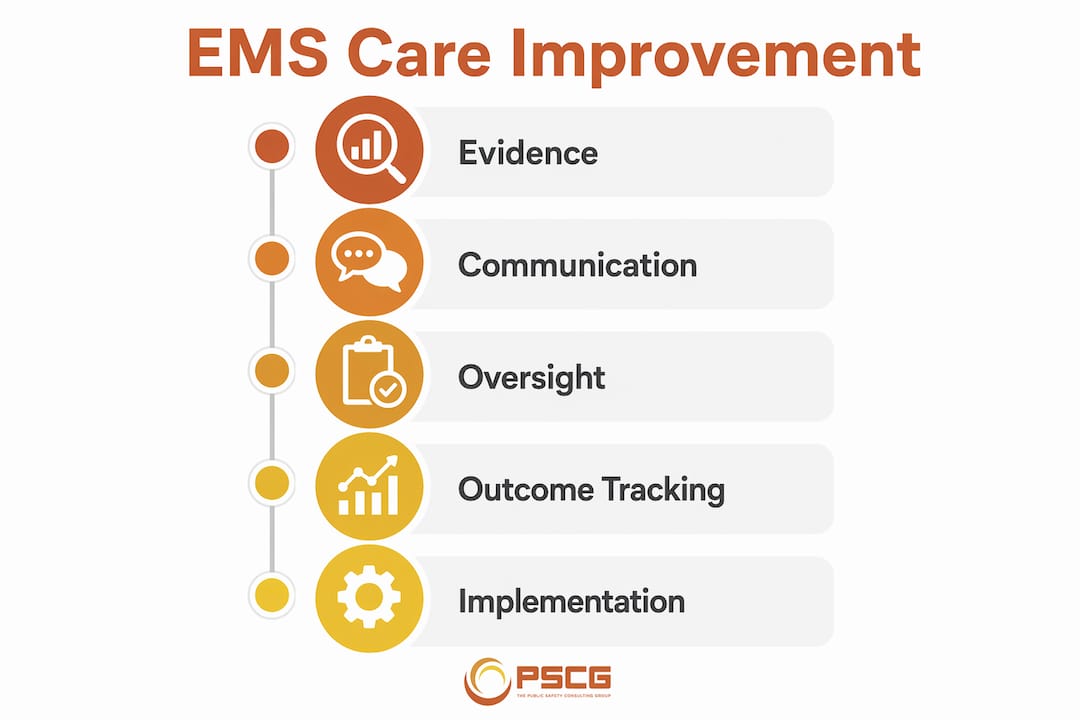
Improving EMS patient care is defined by four integrated pillars: evidence-based guidelines, structured handoff communication, active medical oversight, and continuous outcome monitoring. When EMS agencies apply all four consistently, clinical decision-making improves, errors decrease, and patients receive safer, faster care. This guide breaks down each pillar with specific frameworks, data, and practical steps that EMS medical directors, agency leaders, and field supervisors can act on immediately. The strategies here reflect current best practices for EMS drawn from peer-reviewed research, federal guidance from EMS.gov, and clinical governance standards recognized across the prehospital care community.
How to improve EMS patient care with evidence-based guidelines
Evidence-based guidelines, commonly called EBGs, are the scientific foundation of quality EMS protocol development. The National Prehospital Evidence-Based Guideline Model Process supports protocol development across conditions including hemorrhage control, pain management, and fatigue-related impairment. EBGs replace tradition-based practice with treatments that reflect current clinical research, which is a meaningful shift for any agency still operating on protocols written a decade ago.
EMS medical directors use EBGs to build local protocols that align prehospital care with hospital-level clinical standards. That alignment matters because it creates a consistent reference base across the entire care continuum, from the scene to the emergency department. When paramedics and EMTs operate from the same evidence base that receiving physicians use, clinical handoffs become more coherent and treatment gaps shrink.
Implementing EBGs in your agency involves three concrete steps:
- Review national model guidelines published by EMS.gov and national consensus bodies, then map them against your current local protocols to identify gaps.
- Engage your medical director in a formal protocol review cycle, ideally annual, to incorporate new evidence as it emerges.
- Train field providers on updated protocols before implementation, using scenario-based exercises rather than passive reading assignments.
The process of adopting EBGs requires medical director leadership and a structured review cycle. Agencies that treat protocol development as a one-time event rather than an ongoing process tend to fall behind clinically. EBGs give you a repeatable mechanism to stay current.
Pro Tip: When introducing a new EBG-based protocol, run a tabletop exercise with field supervisors before full deployment. This surfaces practical barriers early and builds buy-in from the providers who will use the protocol daily.
How can EMS improve patient handoff communication?

Patient handoff communication is one of the highest-risk moments in emergency care. Information lost between EMS and the emergency department directly delays treatment and increases the chance of clinical error. The solution is moving from opportunity-based, asynchronous reporting to team-based synchronous reporting, where the entire receiving ED team hears the handoff simultaneously.
A 2025 study published in BMJ Open Quality found that team-based reporting reduced time-to-disposition by 55 minutes compared to asynchronous reporting. That is not a marginal improvement. It represents a fundamental shift in how quickly patients move through the ED after EMS arrival, which affects both patient outcomes and department throughput.
Structured frameworks make synchronous reporting consistent and complete. The two most widely used are:
- MIST (Mechanism, Injuries, Signs, Treatment): Best suited for trauma patients where mechanism of injury drives clinical decision-making.
- SBAR (Situation, Background, Assessment, Recommendation): Well suited for medical patients where clinical context and provider assessment are central to the handoff.
- Closed-loop communication: The receiving physician or charge nurse verbally confirms each critical data point as it is delivered, reducing the risk of missed information.
- Designated listener protocol: One ED team member is assigned solely to receive the EMS report without performing simultaneous tasks, which improves information retention.
- Pre-arrival notifications: For time-sensitive conditions including STEMI, stroke, major trauma, and pediatric critical patients, pre-arrival notifications activate hospital resources before the patient arrives, compressing the time between arrival and definitive treatment.
The table below compares the two primary handoff models:
| Feature | Asynchronous Reporting | Team-Based Synchronous Reporting |
|---|---|---|
| Audience | One or two staff members | Full receiving team |
| Information retention | Lower, prone to relay errors | Higher, confirmed in real time |
| Time-to-disposition | Longer | Reduced by up to 55 minutes |
| Shared mental model | Rarely established | Consistently built |
| Best use case | Low-acuity transfers | All emergency presentations |
Synchronous handoffs build shared mental models between EMS and ED teams, which reduces downstream delays in care. That shared understanding is what separates a handoff that transfers a patient from one that transfers a clinical picture.
Pro Tip: Record a sample team-based handoff during a training session and review it with your crew. Providers often do not realize how much critical information they omit until they hear the gap themselves.
What role does EMS medical oversight play in care quality?
Medical oversight is the governance structure that keeps EMS clinical quality accountable over time. Without it, even well-designed protocols drift in practice. EMS medical directors carry responsibility for skills review, remediation, credential management, and the quality assurance programs that connect individual provider performance to system-wide outcomes.
Active medical oversight includes several specific functions that directly affect patient care quality:
- Quality assurance and quality improvement (QA/QI) programs: Regular case review identifies patterns in clinical errors, protocol deviations, and documentation gaps. QA/QI programs are the mechanism through which oversight becomes learning.
- Continuing medical education (CME): Structured CME tied to identified performance gaps is more effective than generic training. When education responds to real data, providers improve faster.
- Ride-alongs and field supervision: Active field involvement by medical directors builds rapport with providers and gives directors direct visibility into how protocols perform in real conditions.
- Credential management: Tracking certifications, skills competencies, and recertification deadlines protects both patients and the agency from the risks of lapsed qualifications.
- Remediation pathways: When a provider’s performance falls below standard, a clear remediation process protects patient safety while supporting the provider’s professional development.
The integration of education, QA, and medical direction into a continuous feedback loop is what separates reactive oversight from a genuine quality culture. Agencies that invest in EMS medical oversight as a leadership function rather than a compliance requirement see measurably better clinical outcomes over time.
How does monitoring patient outcomes enhance EMS services?
Outcome monitoring closes the feedback loop between what EMS providers do in the field and what actually happens to patients afterward. Non-conveyance decisions, where patients are assessed and treated on scene but not transported, carry measurable risk that agencies must track systematically.
A 2025 register-based study found that non-conveyed patients experienced a 4.7% EMS reassessment rate, a 4.9% hospital admission rate, and a 0.08% mortality rate within 48 hours of the initial encounter. Those numbers confirm that non-conveyance is not a low-risk default. They also provide a clear framework for which patient populations require the most careful on-scene assessment before a leave-in-place decision is made.
The table below outlines key risk factors that should inform non-conveyance protocol design:
| Risk Factor | Clinical Implication |
|---|---|
| Advanced age | Higher baseline risk of deterioration after EMS contact |
| Abnormal vital signs at scene | Strongest predictor of 48-hour adverse outcomes |
| Chest pain or dyspnea | Elevated hospital admission rates post-non-conveyance |
| Altered mental status | Requires heightened reassessment before release |
| Pediatric patients | Low tolerance for clinical uncertainty; transport preferred |
Tracking outcomes by complaint type and patient characteristics allows agencies to refine non-conveyance guidelines with real data rather than assumption. This is the difference between a protocol that reflects what providers hope is safe and one that reflects what the data shows is safe.
What steps can EMS agencies take to implement these improvements?
Translating evidence into practice requires a structured implementation plan, not just good intentions. The following steps give EMS agency leaders a concrete path forward for improving emergency patient care across all four pillars.
- Audit your current protocols against national EBGs. Use the EMS.gov model process as your benchmark and document every gap. This audit becomes your protocol development work plan.
- Train on structured handoff frameworks before expecting field use. Run MIST and SBAR drills in your simulation environment and evaluate providers against a standardized checklist.
- Establish a QA/QI cycle with your medical director. Monthly case review is the minimum. Quarterly performance reports tied to CME topics make education responsive to real gaps. Explore EMS quality improvement consulting if your agency lacks internal capacity for this work.
- Build a non-conveyance tracking system. Link EMS patient care reports to 48-hour outcome data from receiving hospitals or regional health information exchanges. Even a basic tracking spreadsheet is better than no data.
- Invest in continuing education that responds to your QA findings. Generic annual refreshers do not move the needle. Targeted education tied to identified performance gaps does. Learning management systems designed for EMS training providers can help agencies organize and track provider education efficiently.
The most common implementation barrier is not resources. It is the absence of a designated owner for each initiative. Assign a specific person to lead each pillar, set a 90-day milestone, and review progress at your next leadership meeting.
Pro Tip: Start with handoff communication training. It produces visible results quickly, builds cross-agency relationships with your receiving hospitals, and creates momentum for the harder work of protocol revision and outcome tracking.
Key takeaways
Improving EMS patient care requires evidence-based protocols, structured handoff communication, active medical oversight, and systematic outcome monitoring working together as a unified quality system.
| Point | Details |
|---|---|
| Evidence-based guidelines drive protocol quality | Use the EMS.gov National Prehospital EBG Model Process to audit and update local protocols annually. |
| Team-based handoffs reduce time-to-disposition | Synchronous reporting with MIST or SBAR frameworks cut ED disposition time by up to 55 minutes. |
| Medical oversight requires active engagement | QA/QI programs, CME, and field ride-alongs are the core tools of effective clinical governance. |
| Non-conveyance carries measurable risk | A 4.9% hospital admission rate within 48 hours means non-conveyance decisions require systematic outcome tracking. |
| Implementation needs designated ownership | Assign a specific leader to each improvement pillar and set 90-day milestones to maintain accountability. |
What i’ve learned about EMS care quality after years in the field
The hardest thing to change in EMS is not a protocol. It is the culture that decides whether a protocol gets followed. I have worked with agencies that had excellent written guidelines and poor clinical outcomes because no one was closing the loop between what providers were doing and what the data showed. The guidelines sat in a binder. The outcomes data sat in a spreadsheet no one reviewed.
What actually moves the needle is when medical directors treat oversight as a relationship, not an audit. When a medical director rides along, reviews cases with providers, and connects CME to real errors the team made last month, something shifts. Providers stop seeing quality review as a threat and start seeing it as support. That cultural shift is what makes every other improvement sustainable.
The handoff communication research from BMJ Open Quality confirmed something I had observed for years: the ED does not receive a patient, it receives a story. When that story is told to the whole team at once, with closed-loop confirmation, the patient’s care continues without a gap. When it is whispered to one nurse while the rest of the team is setting up equipment, critical information disappears. The fix is not complicated. It requires discipline and training, and it requires leadership that holds the standard consistently.
My honest recommendation is to start with the two things that cost the least and produce the most: structured handoffs and a monthly QA case review. Build from there. The agencies that improve fastest are not the ones with the biggest budgets. They are the ones with the clearest accountability structures and the most honest conversations about where care fell short.
— Mike
How Thepscgroup supports EMS agencies in raising care standards

Thepscgroup works directly with EMS agencies and municipal leaders to translate the strategies in this guide into operational reality. From clinical protocol development grounded in current EBGs to QA/QI program design and medical oversight structure, we bring the expertise and the process discipline that agencies need to move from intention to measurable improvement. Our team has supported EMS systems across Connecticut and beyond in building the governance frameworks that make quality care consistent, not occasional.
If your agency is ready to strengthen its clinical foundation, explore our EMS system design examples to see how structured system design translates into better patient outcomes. You can also reach our team directly at thepscgroup.net to discuss where your agency stands and what the right next step looks like for your specific context.
FAQ
What are evidence-based guidelines in EMS?
Evidence-based guidelines are structured clinical recommendations built from peer-reviewed research and national consensus processes. The EMS.gov National Prehospital EBG Model Process provides the framework EMS agencies use to develop and update local protocols.
How does team-based reporting improve EMS handoffs?
Team-based synchronous reporting delivers the EMS patient report to the full receiving ED team simultaneously, using frameworks like MIST or SBAR. A 2025 BMJ Open Quality study found this approach reduced time-to-disposition by 55 minutes compared to asynchronous reporting.
What is the risk of non-conveyance in EMS?
Non-conveyance carries measurable clinical risk. A 2025 register-based study found that 4.9% of non-conveyed patients were admitted to a hospital within 48 hours, with a 0.08% mortality rate, underscoring the need for systematic outcome tracking.
What does an EMS medical director do to improve care quality?
EMS medical directors manage QA/QI programs, conduct skills reviews, oversee CME, perform field ride-alongs, and manage provider credentials. According to StatPearls, active medical director engagement is the primary driver of clinical accountability and continuous care improvement.
How do EMS agencies start improving patient care outcomes?
The most practical starting point is a protocol audit against current EBGs, paired with structured handoff communication training. Agencies should then establish a monthly QA case review cycle and assign a designated leader to each improvement initiative to maintain accountability.