

TL;DR:
- EMS plays a vital role in disaster response by coordinating triage, treatment, and transport across multiple agencies. Its effectiveness relies on pre-established systems, trained leadership, and continuous communication with hospitals and command frameworks like NIMS and ICS. Proper integration of tactical operations, medical oversight, and proactive planning ensures a resilient and coordinated mass casualty response.
Emergency Medical Services (EMS) is defined as the frontline prehospital care system that delivers triage, treatment, and transport during disasters, making it the cornerstone of every effective mass-casualty response. The role of EMS in disaster response extends well beyond the ambulance call. It spans command integration, hospital surge coordination, and specialized tactical operations in hostile environments. EMS operates as an integrated prehospital system that connects scene-level care directly to hospital capacity management. Understanding how that system functions, and where it can break down, is what separates a coordinated disaster response from a chaotic one.
How does EMS integrate within NIMS and ICS frameworks?
The role of EMS in disaster response depends heavily on two national frameworks: the National Incident Management System (NIMS) and the Incident Command System (ICS). NIMS provides five core components: preparedness, communications and information management, resource management, command and management, and ongoing maintenance. ICS sits within the command and management component and gives EMS a defined structure for coordinating with fire, law enforcement, and public health partners at any incident scale.
EMS agencies align their operations with Incident Action Plans (IAPs) generated at the command level. These plans assign resource priorities, establish communication protocols, and define geographic zones of operation. The result is that an EMS crew arriving at a large-scale disaster knows exactly where to report, who commands them, and how to request additional resources without creating communication bottlenecks.
The flexibility built into NIMS is one of its most underappreciated features. Emergency Operations Plans (EOPs) are designed to scale up or down based on incident complexity. A single-vehicle accident and a multi-building collapse both use the same ICS architecture, which means EMS personnel trained on the system can function effectively regardless of incident type.
- Unified Command: EMS, fire, and law enforcement share command authority at complex incidents, preventing jurisdictional conflicts.
- Resource tracking: NIMS standardizes how EMS agencies request mutual aid, track unit deployment, and document resource utilization.
- Interoperability: NIMS aligns EMS documentation and command roles with partner agencies, maximizing coordination across disciplines.
- Scalability: EOPs can expand to incorporate state and federal EMS assets without restructuring the command hierarchy.
Pro Tip: If your agency’s EMS personnel have not completed ICS-100, ICS-200, and IS-700 within the last three years, your disaster integration capability has a measurable gap. Treat those credentials as operational requirements, not optional training.
What are EMS roles in mass casualty incidents?
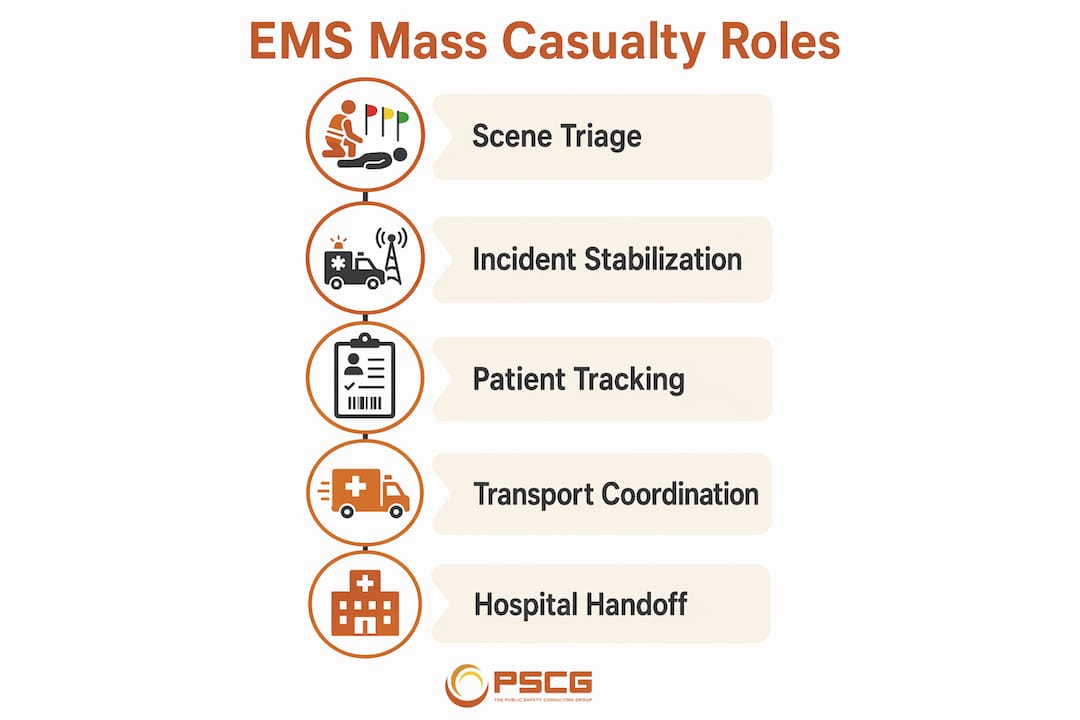
EMS disaster management in mass casualty incidents (MCIs) follows a structured sequence that begins at scene triage and ends at hospital surge coordination. Each phase has defined responsibilities, and failure at any one point cascades through the entire response.
Prehospital triage: START and JumpSTART
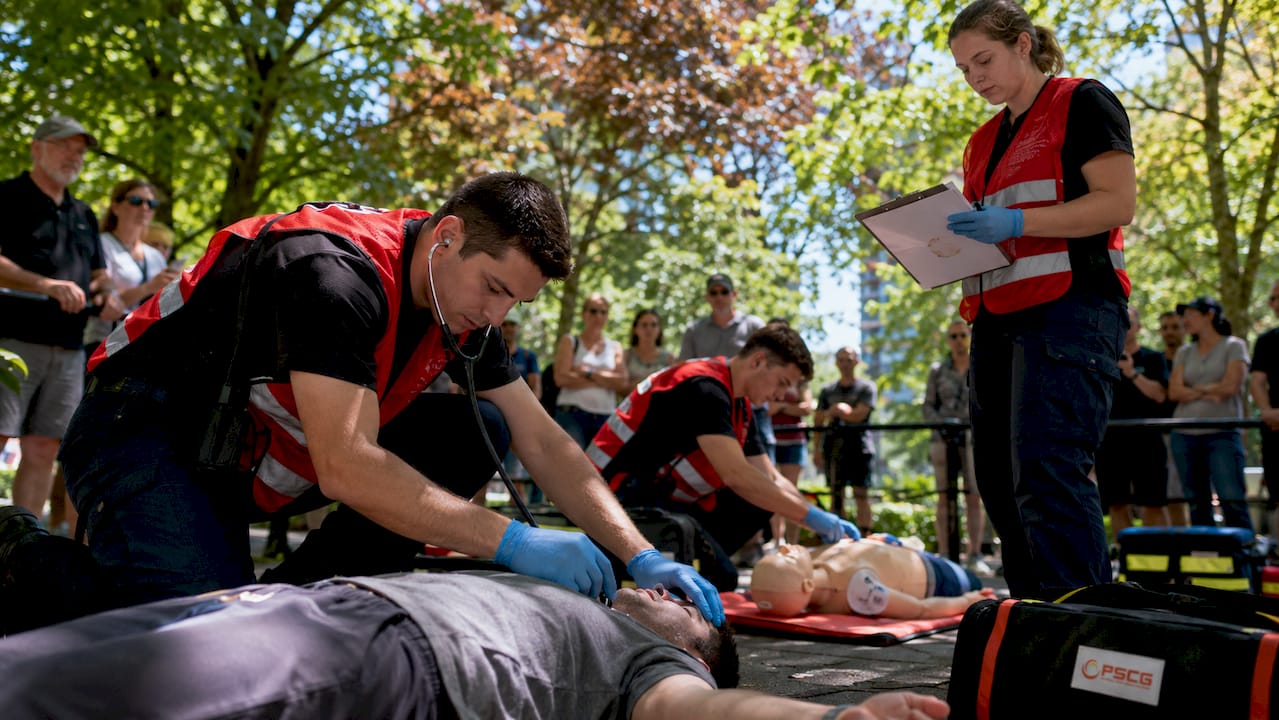
Triage is the first and most consequential decision EMS makes at an MCI. The START (Simple Triage and Rapid Treatment) system categorizes adult patients by respiratory status, perfusion, and mental status in under 60 seconds per patient. JumpSTART adapts the same framework for pediatric patients, accounting for differences in respiratory rate and physiological response. START and JumpSTART triage are the two most widely used prehospital systems in the United States, and their consistent application directly determines how efficiently patients move from scene to definitive care.
Casualty collection points and patient flow
Casualty Collection Points (CCPs) are the operational hubs where triaged patients are gathered, reassessed, and prepared for transport. EMS personnel at CCPs perform secondary triage, initiate treatment within scope, and coordinate with transport units. The critical operational requirement at CCPs is communication frequency. Patient category counts reported every 15 minutes to hospital incident command allow receiving facilities to activate surge protocols before patient arrival rather than after. That timing difference prevents emergency department overload.
The table below outlines the primary EMS operational domains in an MCI:
| EMS Domain | Primary Function | Key Output |
|---|---|---|
| Scene Triage | START/JumpSTART categorization | Patient priority assignments |
| Casualty Collection Point | Secondary triage and treatment | Stabilized patients ready for transport |
| Transport Coordination | Unit assignment and hospital selection | Balanced patient distribution |
| Hospital Surge Interface | Category count reporting to command | Proactive ED capacity management |
- Establish scene safety before any triage begins. EMS cannot function if responders become casualties.
- Assign a Triage Officer immediately. One person owns triage decisions; everyone else executes transport.
- Open CCPs early. Waiting until patient volume overwhelms the scene creates irreversible bottlenecks.
- Communicate category counts every 15 minutes to hospital incident command without exception.
- Reassess red-tagged patients at the CCP. Physiological status changes, and a patient triaged black at the scene may be salvageable with intervention.
Pro Tip: Pre-designate your CCP locations during tabletop exercises, not during the incident. Familiarity with site geography cuts setup time by a significant margin when seconds matter.
How does tactical EMS differ in hostile environments?
Tactical EMS (TEMS) is a specialized discipline that delivers prehospital care in environments where standard civilian EMS protocols cannot safely apply. The core difference is not skill level. It is the operational context. Civilian EMS operates in a secured scene. TEMS operates where the threat is still active.
TEMS care requires strict zone discipline, with responders trained to categorize their environment into hot, warm, and cold zones. Interventions in the hot zone are limited to life-threatening hemorrhage control and airway positioning. More complex care, including IV access, mechanical ventilation, and blood transfusion, occurs in the warm or cold zone once extraction is complete.
Key operational distinctions in TEMS and hazardous environment response include:
- Delayed intervention: TEMS providers accept that definitive treatment is deferred until the patient reaches a safer zone. This is a deliberate protocol, not a failure of care.
- PPE requirements: CBRNE incidents require strict PPE protocols and zone discipline to prevent responder contamination, with lifesaving procedures prioritized before decontamination when feasible.
- Tactical extraction: Trained extraction techniques move injured personnel through hostile zones using instinctive carry methods coordinated between tactical teams and civilian EMS resources staged at the perimeter.
- Advanced interventions post-extraction: Blood transfusion, needle decompression, and mechanical ventilation are performed once the patient reaches the cold zone and clinical conditions allow.
- Interagency coordination: TEMS units work directly with law enforcement tactical teams, requiring pre-incident planning and shared communication channels.
The importance of EMS in emergencies involving CBRNE threats cannot be overstated. Responders who enter a contaminated scene without proper PPE become patients themselves, compounding the casualty count and depleting the very resources needed to manage the incident.
What leadership and medical oversight structures drive EMS effectiveness?
EMS effectiveness in disaster scenarios is a direct product of the leadership and medical oversight structures built into the system before the incident occurs. Strong EMS medical oversight is not a regulatory checkbox. It is an operational asset.
EMS Medical Directors carry specific responsibilities that directly affect disaster response quality:
- Protocol development: Medical Directors author the clinical protocols EMS personnel follow during disasters, including mass casualty triage criteria and scope-of-practice expansions for declared emergencies.
- Real-time guidance: Medical directors provide on-scene support and telephone consultation during active incidents, supporting consistent clinical decision-making when field conditions are dynamic.
- Post-run review: After-action analysis of disaster calls identifies protocol gaps, training deficiencies, and documentation failures before the next incident.
- Crew education: Ongoing training programs led or supervised by Medical Directors maintain clinical competency across the agency.
The table below compares the roles of EMS Medical Directors and EMS Agency Leadership in disaster operations:
| Role | Medical Director | Agency Leadership |
|---|---|---|
| Protocol authority | Owns clinical protocols and scope expansions | Implements protocols operationally |
| On-scene function | Clinical consultation and quality oversight | Incident command integration and resource management |
| Training focus | Clinical competency and medical decision-making | Operational readiness and system coordination |
| Post-incident role | Run review and clinical quality improvement | After-action reporting and system performance analysis |
Functional EMS system design that integrates medical oversight, training, and incident command synergy improves responsiveness across regional systems. Agencies that treat medical direction as a part-time administrative role consistently underperform during disasters compared to those with engaged, operationally active Medical Directors.
The EMS strategic planning process that connects leadership development to disaster preparedness produces measurable improvements in response time benchmarks and clinical outcomes. Agencies that invest in that planning before a disaster are the ones that perform well during one.
Key takeaways
EMS effectiveness in disaster response depends on pre-built systems, trained leadership, and continuous communication between scene operations and hospital command.
| Point | Details |
|---|---|
| NIMS and ICS integration | EMS must align with national frameworks to coordinate resources and command roles across agencies. |
| START and JumpSTART triage | Consistent triage protocol application at scene determines patient flow and hospital surge load. |
| 15-minute category reporting | Timed patient count communication to hospital command prevents emergency department overload. |
| TEMS zone discipline | Tactical EMS requires strict hot, warm, and cold zone protocols to protect responders and patients. |
| Medical Director engagement | Active medical oversight drives clinical consistency and protocol quality during dynamic disaster scenarios. |
What i’ve learned about EMS disaster coordination after years in the field
The gap between agencies that perform well in disasters and those that struggle is rarely about equipment. It is almost always about preparation and communication architecture built long before the incident.
The most common failure I see is the assumption that ICS training is sufficient preparation. It is not. ICS gives you a structure. What fills that structure is relationships, pre-negotiated mutual aid agreements, practiced communication protocols, and Medical Directors who are genuinely embedded in their agencies rather than available only on paper. Agencies that treat medical direction as a part-time administrative role consistently underperform when conditions get complex.
The other pattern worth naming is the underestimation of hospital coordination. EMS providers are trained to move patients. The discipline of communicating category counts every 15 minutes to hospital incident command feels administrative until you watch an emergency department go on diversion because no one told them 40 patients were inbound. That communication is a clinical intervention. Treat it as one.
The emerging trend I find most promising is the integration of EMS continuity of operations planning into routine agency design rather than treating it as a separate disaster preparedness exercise. Agencies that build resilience into their daily operations do not have to shift gears during a disaster. They are already running the right system.
— Mike
How Thepscgroup helps agencies build disaster-ready EMS systems
Thepscgroup works directly with EMS agencies and municipalities to design systems that perform under pressure. Our work spans EMS system design, medical oversight structuring, and disaster preparedness planning grounded in the same NIMS and ICS frameworks that define effective disaster response.
If your agency is evaluating its disaster response capability, the right starting point is a structured assessment of your current system design. Thepscgroup’s EMS system design consulting identifies the gaps between your current operational posture and the performance standards your community requires. We also offer municipal EMS strategy guidance that connects leadership development, medical oversight, and incident command integration into a single, coherent plan. Contact us at thepscgroup.net to start the conversation.
FAQ
What is the primary role of EMS in disaster response?
EMS delivers prehospital triage, treatment, and transport during disasters while serving as the communication link between scene operations and hospital surge management. The role spans START triage, casualty collection point management, and real-time patient category reporting to hospital incident command.
How does ICS support EMS coordination in disasters?
ICS provides EMS with a scalable command structure that aligns resource requests, communication protocols, and operational zones with fire, law enforcement, and public health partners. NIMS embeds ICS within a five-component framework that standardizes interoperability across all responding agencies.
What is the difference between START and JumpSTART triage?
START is designed for adult patients and categorizes them by respiratory status, perfusion, and mental status in under 60 seconds. JumpSTART adapts the same framework for pediatric patients, accounting for age-specific physiological differences.
When is tactical EMS used instead of standard EMS?
Tactical EMS is deployed in active threat environments, including law enforcement operations and CBRNE incidents, where standard EMS cannot safely access patients. TEMS zone discipline limits hot-zone interventions to hemorrhage control and airway management, with advanced care delivered after extraction.
Why does hospital coordination matter in mass casualty events?
Resource constraints across jurisdictions can deplete EMS capacity rapidly during mass casualty events, making proactive hospital coordination critical. Timed category count reporting every 15 minutes allows hospitals to activate surge protocols before patient arrival, preventing emergency department overload.