

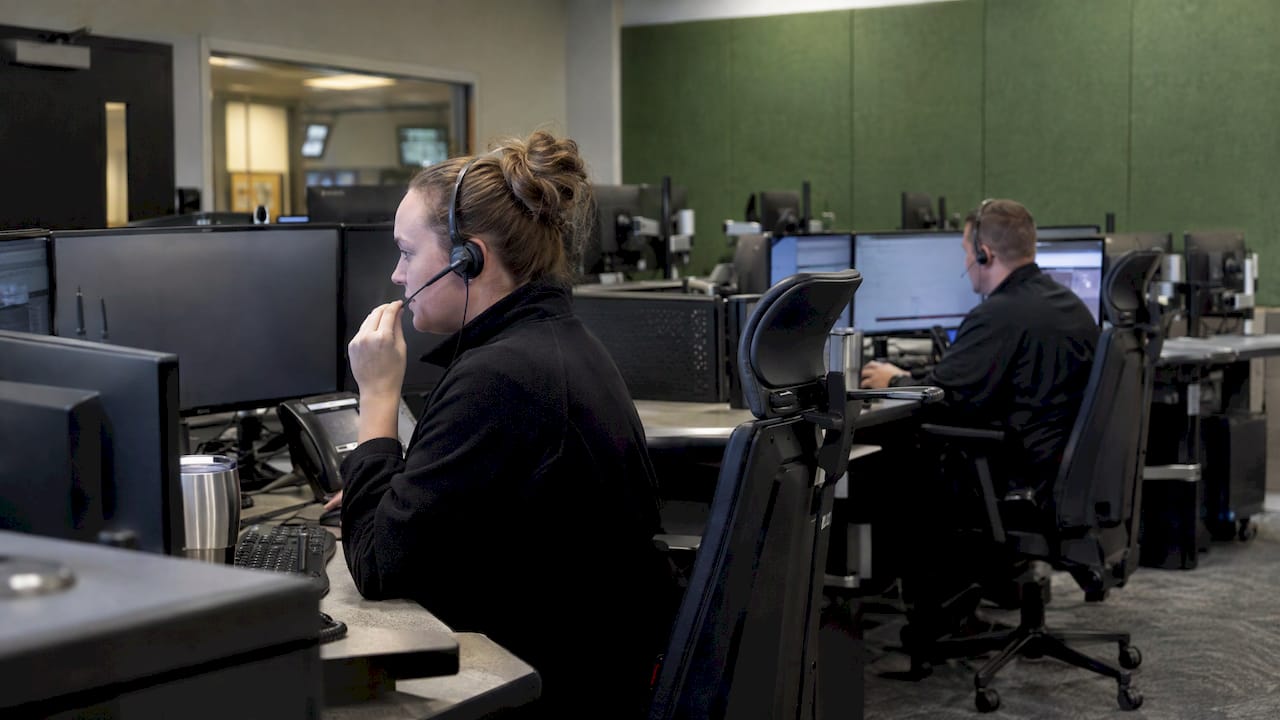
911 call processing time is the interval between a call taker answering a 911 call and the moment response information starts moving to the responding units. It is separate from how long the phone rings and separate from how long the ambulance drives. The national benchmarks ask for 90% of high-priority calls to be processed within 60 seconds, and most centers have room to improve. For EMS chiefs, dispatch managers, town leaders and attorneys, this is the interval you can measure, manage and change.
TL;DR
- Call processing time starts when the call is answered and ends when response information begins going out to units. Answering time and travel time are counted separately.
- NENA’s standard sets 15 seconds for answering 90% of calls. NFPA 1221 sets 60 seconds for processing 90% of high-priority emergency alarms.
- Staffing, difficult callers, language barriers and location problems are the delays dispatch professionals report most.
- Callers do not slow help by answering questions. Good centers dispatch while the call taker keeps gathering information.
- You cannot improve what you do not time. Tie answer times to incident numbers and review the 90th percentile, not the average.
Table of Contents
- How 911 call processing time is measured
- National benchmarks for answering and processing
- What slows a 911 call down
- Does answering questions delay help?
- What callers should do when 911 does not answer
- Where EMS leaders can move the number
- Our perspective
- How we can help
- FAQ
- Sources
How 911 call processing time is measured
The word “processing” means different things in different places, which is why two agencies can report very different numbers for the same call. The most useful way to keep it straight is to break the whole timeline into segments.
The District of Columbia’s Fire and EMS Department lays out a clear sequence in its Response Time Evaluation Plan:
| Segment | Starts | Ends |
|---|---|---|
| Alarm answering time | Alarm is received at the communications center | Alarm is acknowledged there |
| Alarm processing time | Call is acknowledged | Response information begins to be transmitted to units or facilities |
| Turnout time | Notification begins | Travel begins |
| Travel time | Unit is en route | Unit arrives on scene |
| Total response time | Alarm is received at the primary PSAP | First unit begins action or intervention |
The plan also notes that, following NFPA 1710, answering time is measured from when the 911 line begins to ring until the call taker answers, and processing time runs from that answer until the communicator dispatches the call to emergency vehicles.
NFPA 450, the guide for EMS and systems, offers two definitions of call processing. One is the total time from call intake at the dispatching agency to response unit notification. The other is the process that begins when the phone first rings at the first PSAP and ends when responding units acknowledge the event. John Kinsley’s analysis for FEMA and the U.S. Fire Administration quotes both. The practical lesson: before you compare your center to any benchmark or to another agency, confirm where each clock starts and stops.
Local definitions differ too. The Los Angeles Fire Department, for example, defines its Call Processing Time as the interval from when a fire dispatcher creates the call in CAD until the initial fire or EMS unit is dispatched. That is narrower than the NFPA language, and it is a legitimate choice for that agency. It also shows why a written, shared definition belongs in every performance report and every contract.
National benchmarks for answering and processing
Two numbers carry most of the weight.
Answering. NENA Standard STA-020.1-2020 says 90% of calls arriving at a PSAP shall be answered within 15 seconds, and 95% should be answered within 20 seconds. The interval runs from call arrival to call answer, when two-way communication can begin. NFPA 1221 (2019 edition) carries the same figures, as cited in the Massachusetts NSR911 Key Performance Indicators document.
Processing. The same Massachusetts document reports that NFPA 1221 Section 7.4 calls for 90% of emergency alarm processing to be completed within 60 seconds for high-priority events. The list includes trauma, neurologic emergencies, cardiac-related events, unconscious or unresponsive patients, allergic reactions, a patient not breathing, choking, structure fires and explosions.

These standards are not a patchwork. NENA worked with both NFPA and APCO so its 2020 call-processing standard would be harmonized with theirs, and it combined earlier NENA standards on call answering and emergency call processing protocols. For a municipal leader, that means a single, defensible yardstick rather than competing ones.
How centers actually perform
Meeting the benchmark is harder than writing it down. An NFPA Research Foundation study, An Analysis of Public Safety Call Answering and Event Processing, found that PSAPs reached the minimum NFPA 1225 time standards about 40 to 50% of the time. Among agencies that said they followed NFPA 1225, the 90th percentile for call processing was more than twice the recommended time.
The same study found that very few participating PSAPs routinely collect call answering times and attach them to unique incident numbers in their dispatching software. That is a measurement gap before it is a performance gap. A center that cannot tie an answer time to an incident cannot show a pattern, defend a staffing request or answer a records demand.
Older local data tells the same story from the ground. Kinsley’s analysis of Montgomery County, Maryland found a 90% fractile call processing time of 183 seconds for time-critical ALS events, and the communications center missed total ALS response time standards for 14% of ALS events. The agency measured, saw the problem and could act on it. That is the point.

What slows a 911 call down
APCO and the Center for Security Studies and Research surveyed 772 emergency communications professionals for their 2020 report, Incident Handling in PSAPs. The share of centers reporting each factor as a source of delay:
| Factor | Centers reporting delay |
|---|---|
| Challenging callers | 78.5% |
| Language barriers | 74.5% |
| Difficult location determination | 72.0% |
| Staffing levels | 65.4% |
The report also lists staff experience and weather. The NFPA study adds staffing limits, insufficient funding and technology limitations as the common concerns it heard from PSAPs.
Location is the quiet delay
In the wireless era, finding the caller can take longer than understanding the emergency. A U.S. Senate hearing, Locating 911 Callers in a Wireless World, noted that Assisted GPS works generally well outdoors but depends on line of sight to satellites, so indoor wireless calls come with significantly less accurate location data. The rebidding process used to refresh a location adds time to call taking and dispatching, and for indoor calls even a rebid may not give responders enough to find the caller quickly.
The problem has not gone away. A September 2026 TIME article, America’s 911 System Is Dangerously Out of Date, reports that a 911 professional can often trace a call only to the receiving cell tower, which may be far from the caller. It says as many as 20% or more of calls may be traced to the wrong tower, and that carrier location updates arrive at 20 to 30 second intervals. Researcher Rebecca Neusteter argues in that piece that even a few extra seconds spent figuring out where to send help can cost lives.
This is where “how long does it take 911 to trace a call” gets its honest answer: it depends on the device, the carrier, the building and the technology your PSAP has deployed. For dispatch managers, the lever is to train call takers for location-first questioning and to review how often calls require rebids.
More devices, more complexity
GovTech quotes Lauren Kravetz of Intrado, a co-author of an NG911 report, noting that calls now come from smartwatches, IoT devices and car crash detection systems. She said this complexity is compounded by a lack of shared understanding between providers and PSAPs about each other’s technologies and constraints. The same article reports more than 240 million 911 calls a year in the U.S., about 657,000 a day, with roughly 80% from mobile phones. That volume is the backdrop to every staffing and technology decision a center makes.
Does answering questions delay help?
No, in a well-run center. This is the most common worry from callers, and leaders should be able to answer it plainly. The City of Raleigh’s emergency communications page, What to Expect When Calling 911, explains that its computer-aided dispatch system lets the call taker enter information and send the call while continuing to ask questions. While you answer, a telecommunicator is dispatching help.
That design only works when the call taker and the dispatcher are coordinated, the CAD workflow allows early release, and the questioning protocol puts the dispatch-determining questions first. Those are design choices. They are also choices a municipality can audit, which matters when a family, a council member or an attorney asks why a call took as long as it did.
What callers should do when 911 does not answer
Public education is part of your processing time. Montgomery County, Maryland tells residents that if the center is extremely busy and a call is not answered within about 15 seconds, the caller will hear a recording that operators are busy. They should stay on the line and not hang up to call back, because redialing sends the call to the back of the queue and adds to the load.
It is worth putting that message in your own town’s materials. It costs little and keeps abandoned and repeat calls down.
Where EMS leaders can move the number
Processing time is shaped by decisions leaders control. Here is where we would start.
- Fix the clock first. Write down where each interval starts and stops, and make sure your CAD and phone system capture answer time on the same incident number as dispatch time. Without it, nothing else is defensible.
- Report the 90th percentile. Averages hide the long calls that families and attorneys remember. The benchmarks are percentile-based for a reason.
- Split high-priority from routine. Use the 60-second processing measure for the categories NFPA names, and track the remainder separately so one does not mask the other.
- Staff to the demand curve. Call volume is not flat across the day. Match call-taker and dispatcher schedules to the peaks, the same way you would match ambulance hours to demand. Our piece on peak demand staffing tactics covers the approach on the field side.
- Train for the hard calls. Challenging callers, language access and location questioning are the delays your peers report most. Build scenarios, scripts and interpreter access around them.
- Look at the whole chain. A fast processing time followed by a slow turnout or a stretched system is still a late arrival. Our guide to response time analysis shows how the segments fit together.
If you are designing or rebuilding a center, how to design a high-performance 911 dispatch center goes deeper, and how to assess emergency communications centers lays out a review process. For the dispatcher’s place in the wider system, see the role of dispatch in EMS.
Why attorneys and town leaders care
A processing interval is a record. In litigation or a public hearing, the questions are specific: when was the call answered, when did the protocol say to dispatch, when did the unit get notified, and who reviewed it. Agencies that can answer those questions from their own data are in a stronger position, and they are also better placed to ask for the staffing and technology funding that closes the gap.
Our perspective
Every public safety leader we work with wants the same thing: a person in the worst moment of their life gets help quickly. Call processing is the part of that promise that happens before anyone is in a vehicle, which makes it the part residents never see and leaders too often never measure.
Over more than 32 years in the field, we have learned that processing time is rarely a people problem. It is a system problem: how calls are answered, how the protocol is built, how CAD releases a call, how many people are on the floor at 5 p.m. when volume peaks. When those pieces are designed together, the numbers move.
That is why we do not treat dispatch as a separate conversation from EMS system design, staffing and deployment. A response is one chain, and we work alongside your team from identifying the issue through deployment, so the improvement shows up in the data and on the street.
Michael A. Loiz
How we can help
The Public Safety Consulting Group is a Connecticut-based EMS and public safety consulting firm. We help municipalities, EMS agencies, fire departments and dispatch leaders find where time is being lost, from response time improvement analysis and System Status Management to deployment plan design and peak-load staffing. If your concern is risk and exposure, our operational risk reduction work is built for that. For communications specifically, see dispatch center consulting.

You can see how we approach engagements on our work page, then contact us to talk through your center’s numbers. Call us for more information. We will tell you plainly where we think we can help.
FAQ
How long should it take to answer a 911 call?
NENA’s standard says 90% of calls should be answered within 15 seconds and 95% within 20 seconds, measured from call arrival to the point where two-way communication can begin. NFPA 1221 uses the same figures. Your center should report against both the 90th and 95th percentile.
What is a good call processing time for a medical emergency?
NFPA 1221 calls for 90% of high-priority alarm processing, including cardiac events, an unresponsive patient, a patient not breathing and choking, to be completed within 60 seconds. Check how your agency defines the start and end of the interval before comparing.
How many 911 calls are made in the U.S. every day?
GovTech reports more than 240 million calls a year, around 657,000 a day, with about 80% from mobile phones. Volume varies sharply by hour and by community, so use your own data for staffing.
Does answering the dispatcher’s questions delay help?
Not in a center built for it. Raleigh’s 911 center explains that its CAD system lets the call taker send the call while still asking questions, so help is on the way as you answer. Callers should stay on the line and answer clearly.
Sources
- Response Time Evaluation Plan, DC Fire and EMS
- Analysis of 9-1-1 Call Processing Times, FEMA/USFA
- How We Calculate Results, Los Angeles Fire Department
- NENA Standard STA-020.1-2020
- Key Performance Indicators, Massachusetts NSR911
- New Call-Processing Standard Now Available, NENA
- An Analysis of Public Safety Call Answering and Event Processing, NFPA Research Foundation
- Incident Handling in PSAPs, APCO and CSSR
- Locating 911 Callers in a Wireless World, U.S. Senate hearing
- America’s 911 System Is Dangerously Out of Date, TIME
- Legacy Tech, Lack of Teamwork Among Nationwide NG911 Hurdles, GovTech
- Make The Right Call, Montgomery County, Maryland
- What to Expect When Calling 911, City of Raleigh