

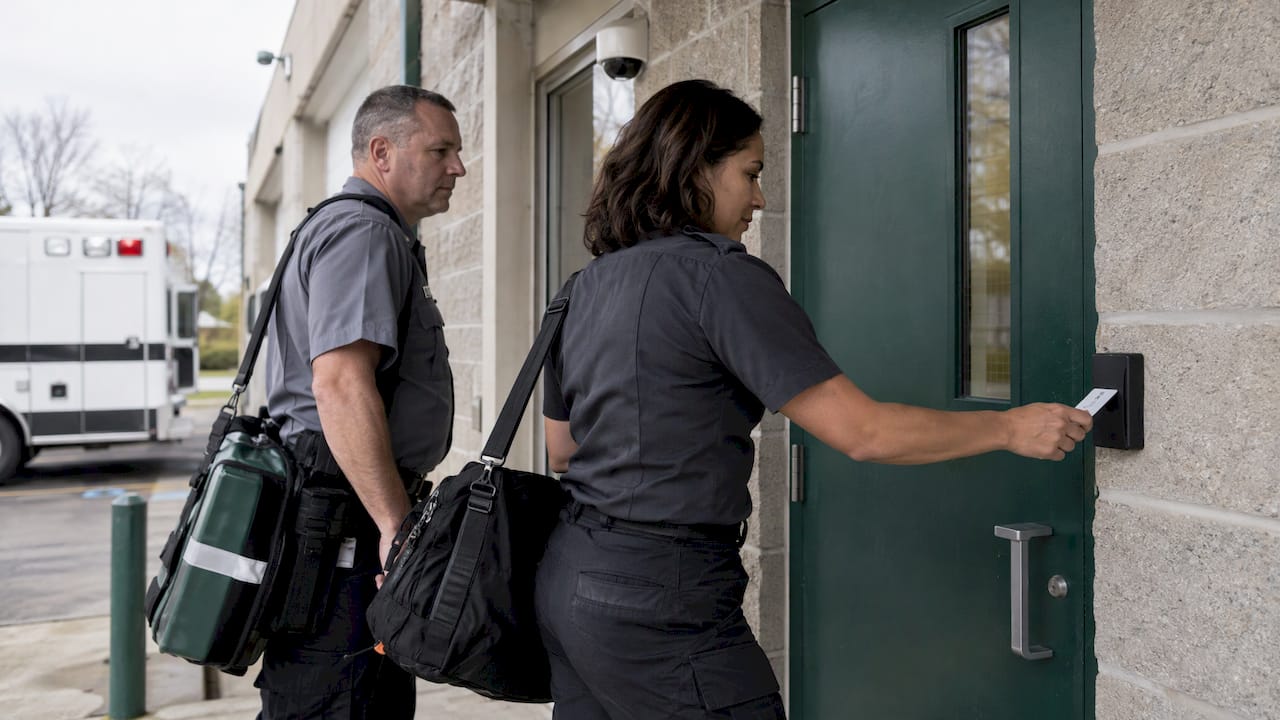
Workplace violence in EMS is not an occasional hazard. It is a predictable feature of the job that agencies can measure, plan for and reduce. The research shows that most EMS clinicians will be verbally or physically assaulted at some point in their careers, and that most incidents never reach an official report. If you lead an EMS agency, a dispatch center or a municipality that funds one, the question is not whether your crews are exposed. The question is whether your policies, training, data and dispatch practices are built around that exposure.
This guide is written for EMS chiefs, town leaders, dispatch managers and the attorneys who advise them. It covers what counts as violence, what the best U.S. studies measure, what it costs your people and your system, and how to build a prevention program that holds up operationally and legally.
TL;DR
- Career exposure to verbal or physical violence among EMS responders is estimated at 57 to 93 percent, and patients are the most common perpetrators.
- Official reporting captures a small fraction of events. In one large multistate agency, only 2.7% of violent runs identified through the patient record were reported through formal channels.
- A written program built on OSHA’s five building blocks, with dispatch, scene, reporting and recovery elements, is the most defensible response.
- Verbal violence and stress injuries count. Treating them as reportable is part of prevention, not an afterthought.
- Call us at The Public Safety Consulting Group to assess your risk exposure and build a plan that fits your system.
Table of Contents
- What Counts as Workplace Violence in EMS
- How Common Is It: What the U.S. Data Shows
- Who and What Raises the Risk
- What Violence Costs Your Crews and Your System
- Building a Prevention Program That Works
- After an Incident: Reporting, Support and Return to Service
- Laws, Liability and Legislative Advocacy
- Our Perspective
- How We Can Help
- Frequently Asked Questions
- Sources
What Counts as Workplace Violence in EMS
The CDC and NIOSH define workplace violence as violent acts, including physical assaults and threats of assault, directed at people at work or on duty. The World Health Organization’s definition is broader and includes abuse, threats or assaults connected to work, including commuting. EMS researchers have sorted the problem into verbal abuse, physical abuse, property damage or theft, sexual harassment, sexual assault and intimidation.
That breadth matters for policy. Many agencies write their definitions around punches and weapons. A crew member who is cursed at for twenty minutes, threatened in a stairwell or spat on has experienced violence under the research definitions, and so has a paramedic who is sexually harassed by a patient. If your policy only recognizes injuries that need treatment, you will undercount the events that wear crews down.
Medically driven aggression
Not every violent event is a crime. The IAFF EMS Violence Protection Toolkit notes that incidents driven by medical conditions, such as postictal states or hypoglycemia, often go unreported. A patient who strikes a medic while confused is still a hazard to the crew. Good policy separates intent from exposure: it protects the worker, supports clinical care and keeps the legal analysis for the people qualified to do it.
How Common Is It: What the U.S. Data Shows
No single number describes the problem, because studies measure different things over different periods. Some ask about a career, some about the last twelve months, some about the last month. Results cannot be compared directly, and a careful leader reads them as a range, not a rate. Even so, the pattern is consistent.
| Study | What it measured | Finding |
|---|---|---|
| Systematic review of EMS violence | Career exposure, 104 articles assessed | 57 to 93 percent of responders experienced at least one verbal and/or physical violent act |
| Same review, LEADS study of 1,789 registered EMTs | Prior 12 months | 69% experienced violence, 44% physical violence |
| National occupational hazards survey | 13,218 respondents, past 12 months | 64% reported violence |
| Multistate agency cohort | 102,632 runs over 12 months | 843 runs (0.86 per 100) involved workplace violence |
The same review estimates that the range of verbal violence ever experienced is between 21 and 88 percent, and physical violence between 23 and 90 percent, with patients the most common perpetrator.
What crews actually face
The national hazards survey broke down the forms of violence. Among respondents who reported violence, the most frequent were cursing (62%), punching (28%), spitting (25%), biting (8%), being struck with an object (8%), stabbing (2%) and shooting-related violence (1%). Most of what crews experience is not dramatic. It is constant, and it is the kind that never makes a report.
A one-year pilot of the EMERG surveillance system across three fire departments collected 126 events. Verbal violence appeared in 81% of reports, patients were the assailant in 73%, and the most common injury was emotional stress at 70%.
The reporting gap
The multistate cohort study is the number to bring to your next board or council meeting. Researchers identified violence through the electronic patient record and found that just 2.7% of those runs had been reported through official processes. If your agency’s incident log shows few events, that is more likely a reporting problem than a safety record.
Who and What Raises the Risk
The same cohort study identified risk factors that dispatch and operations leaders can act on. Male patient gender was associated with higher odds of violence (adjusted odds ratio 1.45). A Richmond Agitation-Sedation Scale score above 1 carried an adjusted odds ratio of 16.97. Emergent and urgent priority 9-1-1 runs were associated with higher risk, while older patients and runs between 0601 and 1200 hours, compared with overnight runs, were associated with lower risk (McGuire et al., 2024).
Three operational lessons follow.
- Dispatch is the first line of defense. Call-taking questions about agitation, intoxication, weapons and scene safety can flag a high-risk call before a unit arrives. Our piece on dispatch accountability shows why call-center practice and field safety are linked.
- Overnight and high-acuity calls deserve deliberate planning. Staging, a second unit or law enforcement co-response on flagged calls is a deployment decision, not only a tactical one.
- Risk is not evenly distributed. A worksite analysis that maps your own calls by time, type and location will tell you more than any national average.
What Violence Costs Your Crews and Your System
The human cost is well documented. NIOSH reports that more than 22,000 EMS workers visit emergency departments each year for work-related injuries, with approximately 2,000 injured each year due to violence or assaults. A review of model policies for fire-based EMS notes that annual non-fatal injury rates among U.S. paramedics are five times the national average for all workers, and that paramedics had 14-fold higher odds of violent injuries than firefighters in one injury study.
The psychological toll is just as serious. The same source cites a national survey of 4,000 EMS responders in which 86% reported critical stress, 37% reported suicidal ideation and 7% reported attempting suicide. The authors also note that EMS carries stressors such as inadequate sleep, shiftwork and trauma exposure, and that PTSD prevalence among EMS workers exceeds 20 percent. Violence adds to that load. The EMERG authors point out that verbal violence as a contributor to responder stress is often underestimated.
For a municipal leader, those individual costs become system costs: lost work days, workers’ compensation claims, turnover and units out of service. They also become legal exposure, which we return to below.

Building a Prevention Program That Works
OSHA’s voluntary guidelines for healthcare and social service workers (OSHA 3148) were not written specifically for EMS, but they give leaders a recognized structure. They identify five building blocks of an effective program, and state that a written program incorporated into the organization’s overall safety and health program offers an effective approach to reduce or eliminate the risk.
The five building blocks, applied to EMS
- Management commitment and employee participation. The chief and the governing body put the commitment in writing, and field crews help design the response. Crews know which addresses, which times and which call types are dangerous.
- Worksite analysis. Review incident reports, patient records, dispatch data and crew interviews. Look for patterns by location, time and call type. Our guide to why risk assessment in EMS matters explains how this analysis supports safer operations.
- Hazard prevention and control. This covers dispatch protocols, scene safety procedures, protective equipment, staffing and co-response arrangements, and the physical security of stations and facilities.
- Safety and health training. Training should be built for the mobile prehospital environment, not borrowed from a lobby or a hospital ward.
- Recordkeeping and program evaluation. Track events, review them regularly and change the program based on what the data shows.
OSHA also advises anyone developing a program to check applicable state requirements, since several states have passed their own workplace violence rules.
The SAVER checklist as a policy model
The SAVER Systems-Level Checklist, developed by Drexel University and the IAFF for fire-based EMS, offers a concrete outline. Its elements include a mission statement declaring zero tolerance, unified definitions of violence, dispatch communication procedures, scene assessment, procedures during patient care including tactical withdrawal and PPE, return-to-service readiness, anonymous reporting and mental and physical health support. The authors expect such policies to improve burnout, job engagement and satisfaction while decreasing assaults and injuries.
It is a useful template for any agency, fire-based or not. Each element maps to a decision someone in your organization has to make: who defines violence, what dispatchers say to crews, when a crew may withdraw, and what happens before a unit returns to service.
Training that fits the job
The systematic review authors observe that available violence prevention training tends to be generic, not tailored to the prehospital environment, and often focuses on self-defense more than prevention (Taylor et al.). NIOSH recommends that employers provide risk management, de-escalation and self-defense training. In the national hazards survey, de-escalation training was associated with lower odds of experiencing violence (odds ratio 0.87).
For EMS educators, building scene awareness and communication skills into initial and continuing education is part of the answer. Our article on best practices for EMS instructors covers how instruction shapes field behavior.
Facilities and physical security
Crews are also exposed at stations, in shared lots and at hospital ambulance bays. Physical measures such as facility security upgrades, including access control and camera coverage, belong in the same plan as policy and training, so that a safe response in the field is matched by a secure place to return to.
After an Incident: Reporting, Support and Return to Service
A program that ends at the scene is incomplete. NIOSH tells employers to promote a culture of safety, maintain a reporting system that captures injuries and near misses, and provide access to mental health services while supporting their use.
The IAFF toolkit recommends that reporting of verbal violence and stress injuries be normalized and that systems such as NERIS and EMERG be adopted to fill data gaps. In practice, that means:
- Make reporting short. A form that takes ten minutes after a twelve-hour shift will not be used. Anonymous options, as the SAVER checklist suggests, lower the barrier further.
- Report all forms of violence. Verbal threats and spitting belong in the record, because that is how patterns appear.
- Close the loop. Tell crews what changed after a report. People stop reporting when nothing visibly happens.
- Support the person, then the unit. Offer behavioral health access, and confirm readiness before a crew returns to service.
- Flag the address. Share hazard information with dispatch so the next crew is warned.
Laws, Liability and Legislative Advocacy
There is no uniform federal law protecting EMS personnel from assault in the way laws protect law enforcement. The IAFF toolkit explains that 18 U.S.C. § 111 provides general protection for federal employees and typically does not apply to municipal or private EMS workers unless they are acting under federal authority. Protection comes largely from state law.

The state picture is active. A 2026 analysis found that as of June 2024, 48 states had at least one workplace violence law, 45 had laws penalizing perpetrators, 27 had prevention laws and 23 had remediation laws, while only 17 covered all three. Before 2015, close to half of workplace violence legislation targeted emergency response services or emergency departments exclusively. By June 2024, nearly three-quarters broadly covered all health care settings, which means EMS-specific language is not always present.
For leaders and attorneys, this has practical consequences:
- Know your state’s penalty and prevention statutes. Enhanced penalties for assaulting emergency workers vary by state, and so do definitions of who is covered.
- Align your written program with state requirements. OSHA’s guidance itself directs program developers to check them.
- Document your prevention efforts. A written program, training records and incident reviews show that the agency identified a hazard and acted on it. We work with attorneys who need that record, and our expert witness support draws on field experience in EMS operations.
- Use your voice. Front-line clinicians and chiefs are credible witnesses on why EMS belongs explicitly in state protections. Read our perspective on field providers and legislative engagement.
Law varies by state and changes. Attorneys should confirm current statutes for their jurisdiction before relying on any summary, including this one.
Our Perspective
Every chief I have worked with wants the same thing: for every crew member to go home whole after every shift. Violence is where that goal meets the hardest reality. The studies describe a workforce that expects to be cursed at, threatened and sometimes hurt, and that has learned reporting changes little.
We see prevention as a system design question, not only a training question. Dispatch questions, unit deployment, staffing at peak load, reporting and the way a department treats its people after a bad call all shape whether violence is contained or normalized. A town that funds an ambulance service is funding all of those decisions, whether it knows it or not.
That is why we approach operational risk reduction alongside system design, staffing and policy. We work alongside your team, from identifying the issue through deployment, using more than 32 years of field experience in EMS and public safety. Good data is the starting point. If your reports look quiet, that is the first thing to examine, and the first place we would help.
Michael A. Loiz
How We Can Help
Prevention works best when it is part of how a system is designed and managed, not a standalone policy binder. Our Operational Risk Reduction work helps EMS agencies and municipalities assess exposure, align policies with recognized frameworks and build practical procedures. Related work in Municipal EMS Strategy and dispatch and communication center evaluation addresses the system around the crew.

See how we have supported agencies on our work page, then contact us or call us for more information. Our wider risk toolkit is in the risk reduction strategies list for EMS and municipal leaders.
Frequently Asked Questions
Does verbal abuse count as workplace violence in EMS?
Yes. Research definitions include verbal abuse, intimidation and sexual harassment alongside physical assault. In one pilot, verbal violence appeared in 81% of reported events, and emotional stress was the most common injury. Agencies should make verbal incidents reportable.
Why do so many incidents go unreported?
In the multistate cohort study, only 2.7% of violent runs found through the patient record were reported officially. The IAFF toolkit adds that medically driven aggression is often seen as part of the job and goes unreported. Short forms, anonymous options and visible follow-up help.
Is there a federal law that protects EMS workers from assault?
According to the IAFF toolkit, no federal law explicitly protects EMS personnel the way laws protect law enforcement. Protection depends mostly on state statutes, which vary. Ask your agency’s attorney about your state’s current penalties and prevention requirements.
What is the first step for an agency that has no program?
Start with a written commitment from leadership and a worksite analysis of your own call and incident data, following OSHA’s building blocks. Then add dispatch protocols, scene safety procedures, training and a reporting system. We can help you sequence those steps, so call us.
Sources
- A Systematic Review of Workplace Violence Against Emergency Medical Services Responders (PMC)
- A Systematic Review of Workplace Violence Against Emergency Medical Services Responders (SAGE)
- Workplace Violence Against Emergency Medical Services, Prehospital Emergency Care
- National examination of occupational hazards in emergency medical services
- EMERG-ing data: Multi-city surveillance of workplace violence
- Model Policies to Protect U.S. Fire-Based EMS Responders
- OSHA 3148: Guidelines for Preventing Workplace Violence for Healthcare and Social Service Workers
- NIOSH: Emergency Medical Services Workers, How Employers Can Prevent Injuries and Illnesses
- IAFF EMS Violence Protection Toolkit
- State laws that address workplace violence in health care
- Facility security upgrades