


The Public Safety Consulting Group (PSCG) | thepscgroup.net
EMS culture change is the work of moving an agency from “tough it out” and blame toward trust, learning and support, and it only lasts when leaders change the systems that shape daily behavior. Speeches and slogans do not do it. Schedules, reporting rules, supervision, deployment and how you treat a crew after a bad call do. This article lays out what the research says, where agencies tend to go wrong, and a practical sequence for municipal leaders, chiefs and EMS directors.
We have spent more than 32 years working with public safety agencies, and the pattern is consistent. Culture is not a separate project that sits next to operations. It is the visible result of how an organization is designed and led.
TL;DR
- Culture shapes retention. A 2025 study of more than 30,000 U.S. EMS clinicians found that supportive, collaborative “clan” cultures were the only type that did not significantly raise attrition risk.
- Pay alone rarely fixes it. Schedule, workload, and how people are treated after hard calls carry real weight.
- A Just Culture, where errors are reported and analyzed instead of punished, is the backbone of a safety culture.
- Culture change is structural. It needs leadership behavior, system design, data and follow-through together.
- We work alongside agencies from issue identification through deployment. Start at thepscgroup.net.
Table of Contents
- What EMS culture change actually means
- Why now: the workforce numbers
- What the research says about culture and turnover
- The old-school culture and its human cost
- Just Culture: the engine of a safety culture
- Safety culture: six elements leaders can measure
- Why culture change fails
- A practical sequence for municipal and agency leaders
- Perspective: what we see in the field
- Where PSCG can help
- Comparing approaches: internal effort and outside support
- FAQ
- Sources
What EMS culture change actually means
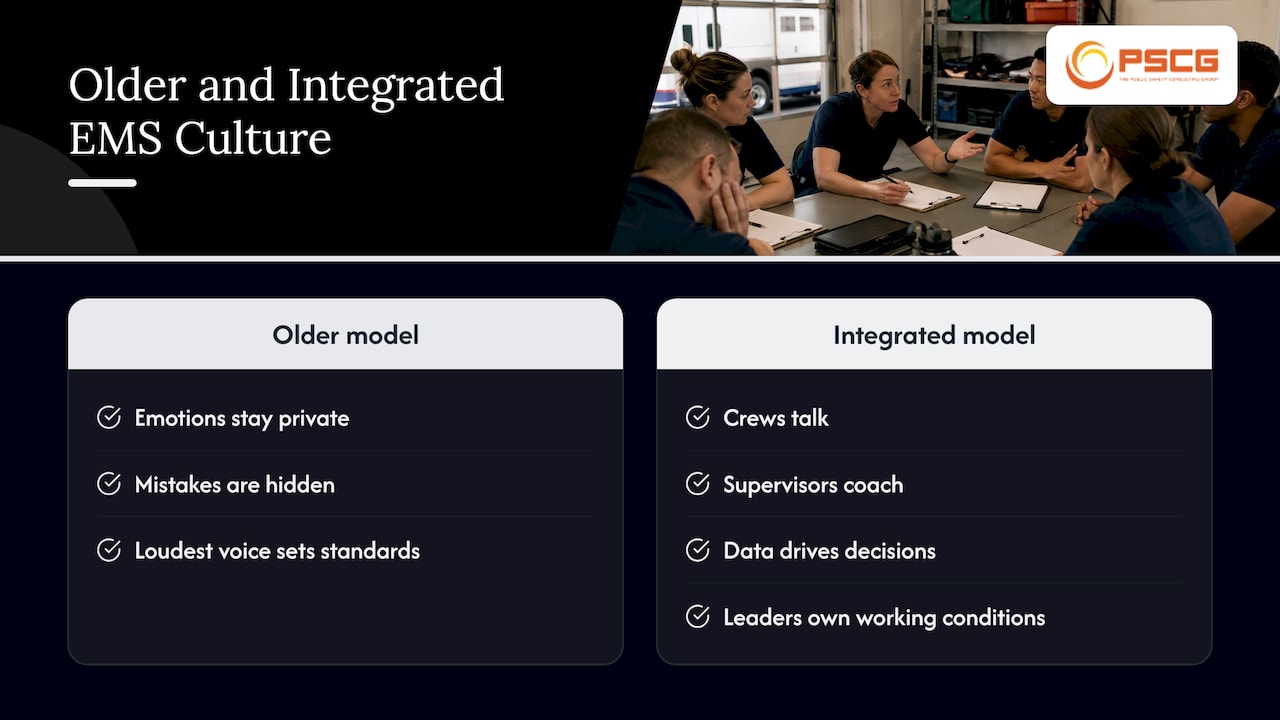
In plain terms, it is the shift from an old-school, isolationist way of operating to one where people share the load. In that older model, emotions stay private, mistakes are hidden and the loudest voice sets the standard. The newer model is integrated: crews talk, supervisors coach, data drives decisions, and leaders own the conditions they create.
The EMS profession did not arrive at its current shape by design. The federal Draft Model State EMS System document quotes an Institute of Medicine finding that emergency and trauma care systems across states and regions show substantial variation. That fragmentation matters for culture. Agencies inherit structures, funding streams and habits that were never planned as a whole, and those habits become “the way we do things here.”
That is the first thing leaders should accept. If the culture is struggling, it is rarely because individuals are weak. It is usually because the system asks too much and offers too little in return. Changing the people without changing the system is a good way to lose both.
Why now: the workforce numbers
The urgency is not abstract. A 2024 letter from NAEMT summarizing a federal workforce report notes that an estimated 40,000 additional full-time emergency medical personnel would be needed by 2030. The same document points out that only 13 states classify EMS as an essential service, which can limit access to public funding and grants.
Here is what those two facts mean together. Demand for people is rising while the funding picture is uneven. Agencies that cannot hold on to the clinicians they have will not hire their way out. Retention is therefore the most practical lever most leaders have, and retention runs straight through culture.
What the research says about culture and turnover
The 2025 study published in PMC examined the association between organizational culture and EMS clinician turnover across more than 30,000 clinicians. It sorted agency cultures into types and compared them. Three findings are worth a leader’s attention:
- Collaborative, supportive “clan” cultures were the only type that did not significantly increase attrition risk.
- Innovative, fast-moving “adhocracy” cultures and structured “hierarchy” cultures were both associated with higher intention to leave.
- About 7.1% of EMTs and 7.9% of paramedics said they were likely to leave within 12 months. The authors also note that annual turnover estimates vary widely, from roughly 6% to 30%.
Two cautions. First, a study of association is not a recipe. It tells you which environments people tend to stay in, not that copying a template will guarantee results. Second, hierarchy is not the enemy. EMS needs command structure on a scene. The point is that a hierarchy with no collaboration, no voice and no support is the version people leave.
Pay matters, but it is not the whole story
Compensation shows up in every survey, and it should. Underpaying people is a choice with consequences. But a common leadership mistake is to treat a pay raise as the entire retention plan. The same research points to work-life balance and schedule flexibility as strong drivers of whether people stay. A raise paired with mandatory overtime, unpredictable shifts and a supervisor who never listens will not hold a crew together.
We would put it this way: pay gets people through the door, and the culture decides whether they are still there in three years.
The old-school culture and its human cost
Culture is not only about retention numbers. It is also about what happens to a person after a bad call.
A qualitative study of shame and guilt in EMS, published in 2022, looked at how prehospital clinicians experience the shame reaction, which prior research has linked to long-term harm to clinicians’ mental health. Participants described a perceived culture shift away from the “old school,” where sharing emotions was not done. They also described shifting toward a more collaborative environment where sharing feelings with colleagues was encouraged, and many saw that as a more effective way to cope.
That has a direct management implication. A crew that has just worked a hard case needs a supervisor who knows how to open a conversation, a peer who will listen and an organization that treats asking for support as normal. None of that requires a large budget. It requires a decision, training and consistency.
What leaders can do this quarter
- Make post-incident check-ins routine, not reserved for “major” events.
- Train supervisors to recognize and respond to shame, guilt and withdrawal, and to know where to refer a crew member.
- Say out loud, and model, that talking about hard calls is part of the job.
- Connect people to your employee assistance and peer support resources and confirm they are easy to reach on every shift.
If a clinician is struggling now, the right step is a licensed mental health professional or your agency’s employee assistance program. Leaders can build the conditions for that conversation, but they should not try to be the counselor.
Just Culture: the engine of a safety culture
The PSNet perspective on safety culture in EMS defines a Just Culture as one that supports transparent and honest error reporting, with the goal of learning from errors to improve quality. It also notes that safety practices vary across EMS systems, which means there is room for agencies to do better.
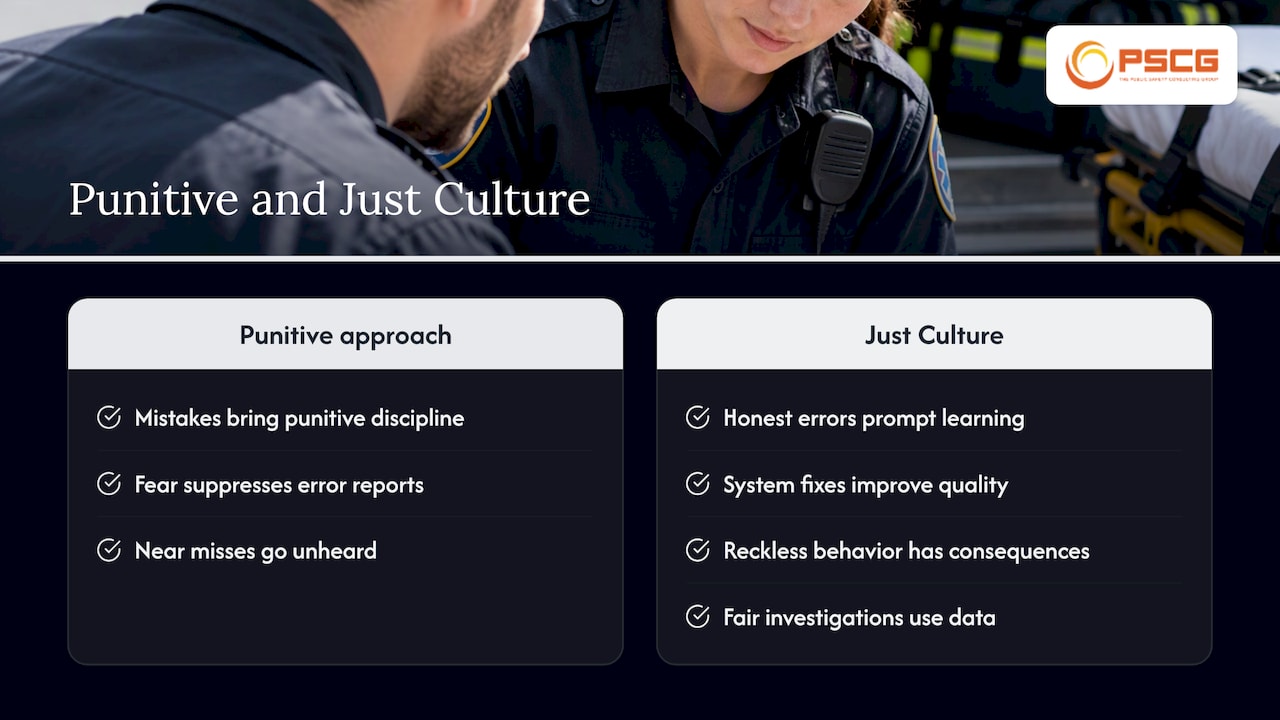
The contrast with the traditional approach is stark. JEMS describes how punitive discipline for mistakes fosters a fear-based culture in which members underreport errors and the agency loses chances to improve. If people expect punishment, you will not hear about the near miss. And the near miss you never hear about is the one that comes back as a serious event.
A Just Culture does not mean no accountability. It means the response fits the behavior. Honest mistakes lead to learning and system fixes. Reckless behavior still has consequences. The skill is in telling them apart, and that takes data, a fair process and supervisors who are trained to investigate without prejudging.
A simple test for your reporting system
Ask five people on different shifts what happens when they report a near miss. If the answers differ, or if anyone says they would rather not, you have found your first priority. Complex reporting forms, unclear follow-up and fear of blame are all barriers, and all of them can be redesigned.
Safety culture: six elements leaders can measure
The U.S. Fire Administration’s EMS Safety Practices publication, developed with several national fire and EMS organizations, describes six elements of a strong safety culture:
| Element | What it looks like in practice |
|---|---|
| Support from senior management | Chiefs and directors visibly back safe behavior, including when it costs time or money |
| No barriers to safety behaviors | Workload, equipment and paperwork do not push crews to cut corners |
| Clean, orderly worksite | Stations, rigs and equipment are maintained and organized |
| Minimal conflict | Disagreements are resolved without lingering hostility |
| Frequent safety feedback and training | Crews hear about safety often, not only after an incident |
| PPE and engineering controls available | The right equipment is on hand and in working order |
The stakes are real. The same publication reports that EMS workers’ injury rates are three times higher than those of the average private-industry worker. That is a cultural fact as much as a clinical one: how an agency lifts, drives, restocks, staffs and reports determines who goes home hurt.
There is also a lesson here about mandates. A policy handed down from the top often fails if frontline staff see it as disconnected from the reality of a high-stress shift. Remove the structural barrier first, such as the workload, the missing equipment or the clumsy reporting system. Then ask for the behavior.
Why culture change fails
We see the same failure modes again and again.
- It is treated as a campaign. A kickoff meeting, a banner and a values statement, followed by no change in scheduling, supervision or discipline. Crews notice the gap within a week.
- It targets the front line only. Culture is set by what leaders tolerate and reward. If command staff are exempt from the new standard, the standard does not exist.
- It ignores the system. Peak-load demand, thin staffing and long unit-hour stretches create stress that no values statement will absorb. Culture and deployment are connected.
- It has no measures. Without turnover, overtime, injury, reporting and engagement data, nobody can tell whether anything improved, and the effort quietly dies.
- It leans on pay alone. As discussed, compensation is necessary and not sufficient.
The common thread is that culture change is systemic, not local. A single station or shift can be a bright spot, but without the structure behind it, the bright spot fades when the leader moves on.
A practical sequence for municipal and agency leaders
This is the order we encourage leaders to work in. It is not magic, and each step is something your team can see and test.
- Listen first. Run confidential surveys and structured interviews across shifts, ranks and roles. Ask what makes people stay and what pushes them out. NAEMT’s national engagement and satisfaction survey is a useful reference for the kinds of questions worth asking, since it treats satisfaction and engagement as the measures that drive retention.
- Establish a baseline. Gather turnover, overtime, sick leave, injury, complaint and response-time data. You need the starting line before you can show progress.
- Find the structural barriers. Look at workload, unit-hour utilization, shift design, equipment and reporting processes. Fix what is fixable fast and show people you did.
- Define the behaviors. Translate values into specific, observable expectations for supervisors and crews, including how mistakes are handled.
- Train and coach leaders. Supervisors carry culture to the street. Give them practical skills in feedback, debriefing, fair investigation and peer support.
- Build the feedback loop. Share results back with the workforce. When people see their input change something, trust compounds.
- Measure and adjust. Revisit the baseline every six to twelve months and publish what moved.
Notice that only some of this is about attitudes. Most of it is about design: schedules, data, process and leadership practice.
Perspective: what we see in the field
We approach culture the way we approach any system problem. Start with what is actually happening, find the cause, and design a fix that people on the street can live with.
In our experience, when an agency says it has a culture problem, there is almost always an operational problem underneath it. It might be a deployment plan that stacks demand on the same crews, a schedule that leaves no recovery time, a billing and funding gap that keeps staffing thin, or a reporting process that teaches people to stay quiet. The culture is the symptom people feel. The system is the cause leaders can change.
That is why we do not treat culture as a soft topic. We look at it next to response time benchmarks, peak-load staffing, System Status Management and financial performance, because they are connected. A crew that is stretched thin by a poor deployment model will not feel supported by a values poster. A crew that sees leadership fix the deployment model, listen and follow through will.
We also hold that leaders owe their people two things at once: high standards and real support. Accountability without support breeds fear. Support without accountability breeds drift. A Just Culture, built on data and fairness, is how you hold both.
If your agency is ready to start, we will work alongside your team, from identifying the issue through deployment, and we will be straightforward about what we find.
— Mike
Where PSCG can help
Culture work goes furthest when it is tied to the way your system is designed and led. Our consulting work covers the areas that most often sit underneath a culture challenge:
- EMS organizational development and leadership development for chiefs, directors and supervisors.
- EMS system design, including System Status Management, peak-load staffing modeling and deployment plan design.
- Operational risk reduction to help agencies align safety expectations with field realities.
- Quality improvement consulting to build the data and feedback loops a Just Culture depends on.
- Strategic planning to carry changes beyond a single leader’s tenure.
We serve municipal leaders, EMS agencies, fire departments, law enforcement, emergency managers, attorneys and private ambulance companies nationwide. To talk through your situation, visit thepscgroup.net and contact us.
Comparing approaches: internal effort and outside support
Many agencies ask whether to lead culture work in-house or bring in outside help. Both can work, and each has real strengths.
| Led internally | Supported by outside consultants | |
|---|---|---|
| Strengths | Deep knowledge of your people and history; no added cost beyond staff time; builds ownership | Outside perspective; experience across many agencies; time and structure when leaders are stretched |
| Watch-outs | Staff may hesitate to be candid with their own chain of command; leaders are busy running operations | Needs a clear scope and real leadership buy-in; recommendations only help if the agency acts on them |
| Best fit | Smaller, well-defined changes with strong internal champions | System-wide change touching deployment, finance, policy and leadership at once |
Many agencies do best with a blend: internal champions who own the work every day, and an outside partner who brings data, method and candid assessment.
FAQ
What does culture change mean in EMS?
It means moving from a blame-oriented, isolating, “tough it out” environment to one built on trust, learning and mutual support. It shows up in how mistakes are handled, how crews are treated after hard calls and how leaders make decisions. It lasts only when systems such as scheduling, reporting and supervision change with it.
Why are people leaving EMS?
There is no single reason. The 2025 turnover study points to organizational culture as a significant factor, and workload, schedule flexibility and pay all play a part. Agencies that treat turnover as a pay issue alone often miss the day-to-day conditions that drive people out.
What are the six elements of an EMS safety culture?
The U.S. Fire Administration’s EMS Safety Practices lists support from senior management, absence of barriers to safety behaviors, a clean and orderly worksite, minimal conflict, frequent safety feedback and training, and available PPE and engineering controls. Agencies can assess themselves against each one.
How long does EMS culture change take?
Expect a multi-year effort. Early wins, such as simpler reporting or better debriefs, can show within months. Deeper shifts in trust and behavior take sustained leadership and regular measurement. We would be cautious of anyone who promises a fast, guaranteed result.
Sources
- Association Between Organizational Culture and EMS Clinician Turnover (PMC, 2025)
- NAEMT letter on EMS workforce shortages, April 30, 2024
- Draft Model State EMS System (ems.gov)
- Shame and Guilt in EMS: A Qualitative Analysis of Culture and Attitudes
- Safety Culture in EMS (AHRQ PSNet)
- Just Culture in EMS (JEMS)
- EMS Safety Practices (U.S. Fire Administration)
- National Report on Engagement and Satisfaction Survey (NAEMT)