



TL;DR:
- Outdated EMS systems focus on response speed rather than patient outcomes, risking inefficiency.
- Consulting helps design tiered response models aligned with actual clinical needs and community demands.
- Success relies on outcome metrics like survival rates and system resilience, not just response times.
Every minute counts in emergency medical response, and municipalities that operate with outdated EMS system designs are putting residents at measurable risk. Response time impact on patient outcomes is well-documented, yet many cities still rely on reactive, one-size-fits-all models that strain budgets and underperform when it matters most. EMS system design consulting offers municipal leaders a structured, evidence-based path to closing those performance gaps. This guide walks you through understanding the core challenges, preparing your team, executing a redesign, and measuring what actually matters so your community gets the emergency response system it deserves.
Table of Contents
- Understanding EMS system challenges and consulting’s value
- Preparing your municipality for EMS system redesign
- Step-by-step: Working with EMS system design consultants
- Measuring success and avoiding common mistakes
- Why EMS system design consulting strategies need to evolve
- Connect with leading EMS consulting solutions
- Frequently asked questions
Key Takeaways
| Point | Details |
|---|---|
| Outcome-based design | Prioritize patient survival rates and complication reduction over just faster response times. |
| Data-driven preparation | Successful consulting depends on gathering current performance metrics and stakeholder input. |
| Collaborative execution | System redesign works best with cross-functional engagement, realistic timelines, and policy support. |
| Continuous measurement | Track a broad set of outcomes to ensure sustained improvement, not just one-time gains. |
Understanding EMS system challenges and consulting’s value
Most municipal EMS systems were built around a single priority: get there fast. That instinct is understandable, but speed alone does not equal better patient outcomes. The real measure of EMS performance is whether patients survive and avoid serious complications, not simply whether a unit arrived within a target window. When leaders treat response time as the primary goal, they often miss deeper structural problems that affect care quality, staff retention, and long-term cost sustainability.
One of the most persistent misconceptions in EMS management is the belief that aggressive, lights-and-sirens responses improve results across all call types. Research and operational data tell a different story. Traditional hot responses carry risks that outweigh their benefits for the majority of calls, including vehicle accidents, crew fatigue, and community safety hazards. High Performance EMS (HPEMS) models move away from this approach by using tiered response systems that match resource intensity to actual clinical need, improving both safety and efficiency.
This is exactly where EMS system design consulting delivers its most immediate value. Consultants bring objective, outside perspective to a system that municipal teams are often too close to evaluate clearly. They conduct performance gap analyses, benchmark your current operations against national best practices, and identify where funding structures are misaligned with actual service demands.
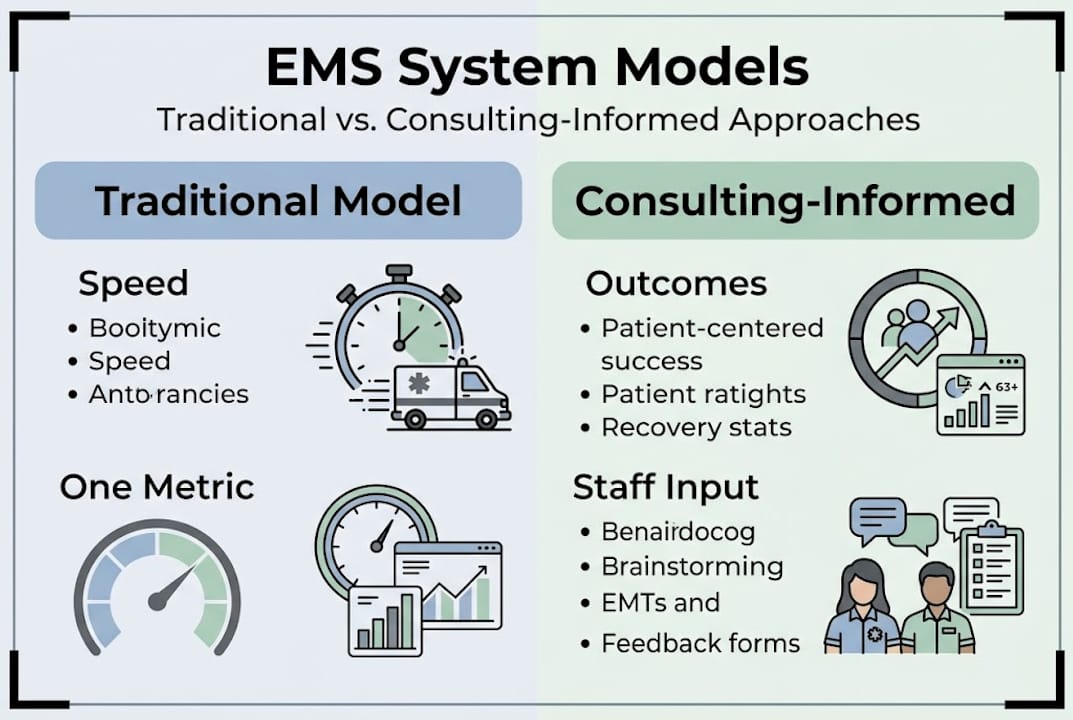
Here is a comparison of traditional EMS models versus consulting-informed, high-performance models:
| Factor | Traditional EMS model | Consulting-informed model |
|---|---|---|
| Primary metric | Response time | Patient survival and outcomes |
| Resource deployment | Uniform response | Tiered, need-based dispatch |
| Funding structure | Per-encounter payments | Readiness-based funding |
| Stakeholder input | Limited | Cross-departmental and community-wide |
| Performance review | Periodic and reactive | Continuous and outcome-driven |
The benefits of EMS consulting extend beyond operational fixes. A skilled consulting team also helps municipalities identify grant opportunities, align EMS strategy with public health goals, and build the internal capacity to sustain improvements over time.
Key areas where EMS consulting adds direct value include:
- Objective system assessments free from internal bias
- Benchmarking against regional and national performance standards
- Tiered response model design tailored to your call volume and geography
- Readiness funding strategies that reduce reliance on per-call revenue
- Staff and leadership development recommendations
“Response time is a process measure, not an outcome measure. The focus must shift to patient survival and complication rates to drive genuine system improvement.” — High Performance EMS
Understanding this distinction is the foundation for any successful EMS redesign effort.
Preparing your municipality for EMS system redesign
Before any consulting engagement can deliver results, your municipality needs to do its own groundwork. Consultants are most effective when they walk into an environment where data is accessible, stakeholders are aligned, and leadership has a clear sense of what success looks like. Preparation is not optional. It is what separates municipalities that see lasting change from those that cycle through improvement efforts without traction.
Start by gathering operational data across at least 12 to 24 months. The goal is to build a clear picture of your current system’s performance before any redesign begins.
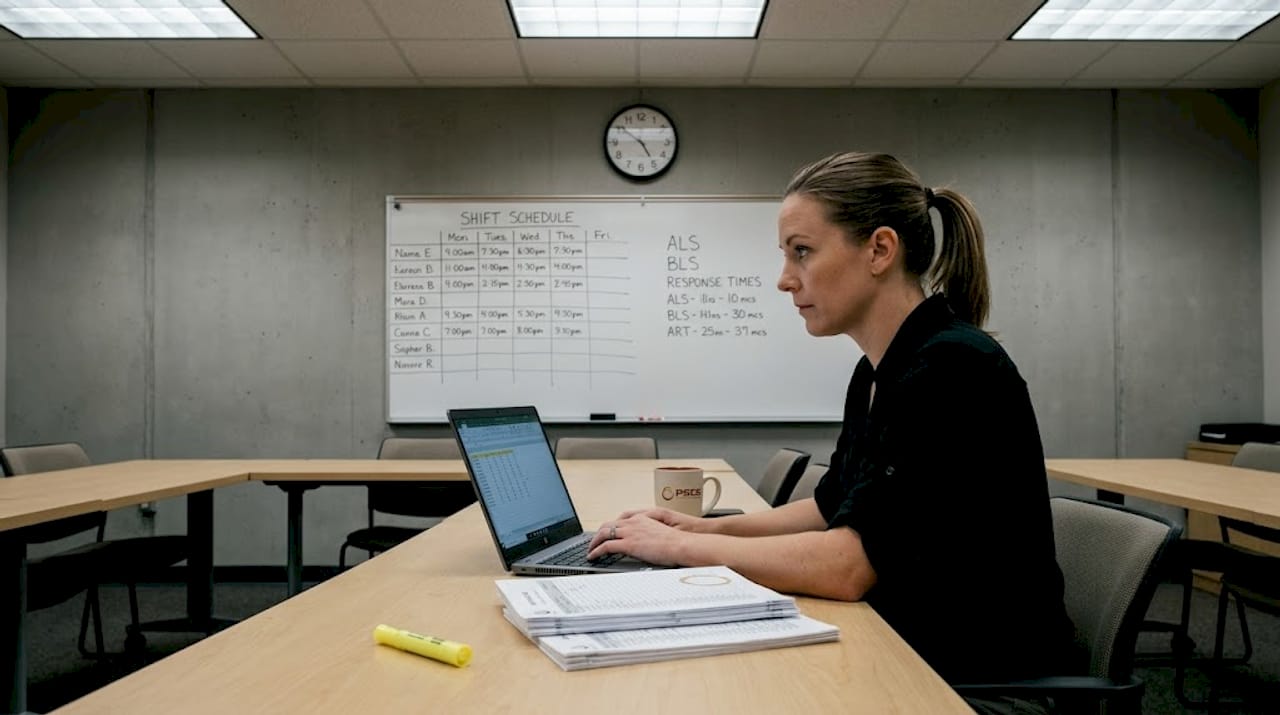
Here is a summary of the data categories you should compile:
| Data category | What to collect | Why it matters |
|---|---|---|
| Call volume and type | Total calls, acuity breakdown, time of day | Reveals demand patterns and resource gaps |
| Response times | By zone, shift, and call priority | Identifies geographic and operational disparities |
| Patient outcomes | Survival rates, hospital handoff quality | Connects operations to actual care results |
| Staffing metrics | Turnover, overtime, certification levels | Flags workforce sustainability issues |
| Financial data | Cost per call, revenue sources, budget gaps | Informs funding model recommendations |
Once your data is organized, work through these preparation steps before your first consulting session:
- Define your primary goals. Are you focused on reducing response times in underserved areas, improving cardiac arrest survival rates, or controlling operational costs?
- Identify your budget parameters and any constraints on capital investment or staffing changes.
- Map all relevant stakeholders, including public health, fire, police, finance, elected officials, and community representatives.
- Assess your organization’s readiness for change, particularly around tiered response models that may shift how units are deployed.
- Document any previous improvement efforts and their outcomes so consultants understand what has already been tried.
Pro Tip: Before engaging consultants, conduct an internal survey of frontline EMS staff. Their operational insights often surface problems that data alone cannot reveal, and their early involvement builds buy-in for later changes.
Taking time to assess your EMS needs thoroughly before the engagement begins will accelerate the consulting process and sharpen the quality of recommendations you receive. Reviewing the EMS system assessment steps used by experienced consultants can also help your team frame the right questions from the start.
Step-by-step: Working with EMS system design consultants
With your data compiled and stakeholders identified, the actual consulting engagement can begin. This process works best when it is treated as a genuine collaboration, not a vendor transaction. We work alongside your team at every phase, and the quality of the outcome depends heavily on the openness and engagement your leadership brings to the table.
Here is how a well-structured EMS system design consulting engagement typically unfolds:
- Kickoff and alignment. Establish shared objectives, confirm data access, agree on timelines, and clarify roles. This session sets the tone for the entire engagement.
- System performance analysis. Consultants review your operational data, compare it against national benchmarks, and identify specific performance gaps. This is where objective outside perspective is most valuable.
- Stakeholder engagement sessions. Cross-departmental input is gathered from fire, police, public health, finance, and community representatives. Broad input produces more durable solutions.
- Response model development. Consultants present tiered response proposals and alternative deployment strategies tailored to your community’s call profile and geography.
- Feedback and iteration. Draft recommendations are reviewed with leadership and frontline staff. Adjustments are made based on feasibility and community priorities.
- Policy and leadership alignment. Final recommendations are presented to decision-makers with supporting data. Securing policy backing at this stage is critical to implementation success.
The EMS strategy guide for municipal leaders provides additional context on how to align consulting outcomes with long-term public safety goals. Reviewing EMS system design examples from comparable municipalities can also help your team set realistic expectations for what redesign can achieve.
Key principles that should guide every phase of the engagement:
- Keep patient survival and outcomes as the primary measure of success, not response speed
- Ensure frontline staff are informed and consulted throughout, not just at the end
- Treat the consulting process as a capacity-building opportunity, not a one-time fix
Pro Tip: Assign a dedicated internal project lead to manage communication between your municipal team and the consulting firm. This single point of contact reduces delays and keeps the engagement on schedule.
Measuring success and avoiding common mistakes
Once the redesign is underway, the work of measuring and sustaining improvement begins. This phase is where many municipal efforts lose momentum. Leaders declare success too early, revert to familiar metrics, or fail to involve the right departments in ongoing review. Avoiding these patterns requires a deliberate, structured approach to performance monitoring.
The metrics that matter most in a redesigned EMS system are not the ones that are easiest to report. Response time as a process measure still has a role, but it should sit alongside deeper outcome indicators that reflect actual care quality and system health.
Track these core performance indicators on a regular basis:
- Patient survival rates by call type and acuity level
- Complication rates at hospital handoff
- Cost per call compared to pre-redesign baseline
- Staff satisfaction and retention rates
- Community perception through periodic surveys
- Unit utilization rates to assess deployment efficiency
Common mistakes that undermine EMS redesign success include:
- Overemphasizing rapid response for low-acuity and non-emergency calls, which drives up cost without improving outcomes
- Failing to update funding models to support system readiness rather than per-call revenue
- Excluding finance or public health departments from ongoing performance reviews
- Treating the consulting engagement as complete once the report is delivered
“Measuring what matters means tracking patient outcomes, not just how fast the truck arrived.”
Reviewing EMS best practices regularly helps leadership stay aligned with evolving standards. Ongoing attention to response model optimization ensures that the system continues to adapt as call volumes, community demographics, and resource availability shift over time.
Pro Tip: Schedule a formal six-month and twelve-month review with your consulting partner after implementation. These structured check-ins catch drift early and keep improvement efforts on track.
Why EMS system design consulting strategies need to evolve
After working with municipalities across the country, we have seen a consistent pattern: consulting projects stall not because of bad data or weak recommendations, but because leaders are still measuring success the wrong way. When a city invests in new dispatch technology or faster vehicles and calls it a redesign, they have missed the point entirely.
The most forward-thinking EMS consulting work we see today prioritizes system resilience and community equity over reactive speed. It asks harder questions: Who is being underserved? Where does the funding model create perverse incentives? How does this system perform when it is stressed?
Redesigning EMS as a public good with readiness funding separated from per-encounter payments is not just an operational improvement. It is a philosophical shift that changes how municipalities think about their obligation to residents. Sustainable EMS systems are built on inclusive planning and durable funding, not one-time consulting reports.
The EMS leadership lessons that endure are the ones rooted in community engagement and long-term accountability. That is the standard we hold ourselves to, and the one we encourage every municipal partner to adopt.
Connect with leading EMS consulting solutions
The insights in this guide reflect the kind of structured, outcome-focused thinking that drives real improvement in municipal EMS systems. But reading about best practices is only the first step.
At The Public Safety Consulting Group, we partner with municipal leaders to turn strategic goals into measurable public safety outcomes. Whether you are starting from scratch or refining an existing system, our team brings the expertise and practical experience to move your community forward. Explore our strategy guide for municipal EMS to see how other cities have approached redesign, and review our EMS design examples to understand what is possible. Contact us today to start the conversation.
Frequently asked questions
What is EMS system design consulting?
EMS system design consulting is expert guidance for municipalities to analyze, redesign, and optimize emergency medical service delivery based on data, best practices, and local needs. Consultants use tiered response frameworks and outcome-based metrics to build systems that perform under real-world conditions.
How can EMS consulting improve outcomes for cities?
Consulting helps implement tiered response models and outcome-driven metrics that boost survival rates and system efficiency. Cities that shift focus from speed to care quality consistently see stronger results across both patient and operational measures.
What common mistakes do cities make in EMS redesign?
Cities often focus only on response times or invest in expensive equipment without addressing readiness or holistic system needs. Funding models tied to per-encounter payments rather than system readiness are among the most common structural errors.
Which metrics should we track to measure EMS redesign success?
Track patient survival, complication rates, cost per call, staff satisfaction, and community perception to gauge meaningful change. Response time as a process measure still has value but should never be the sole indicator of system performance.