

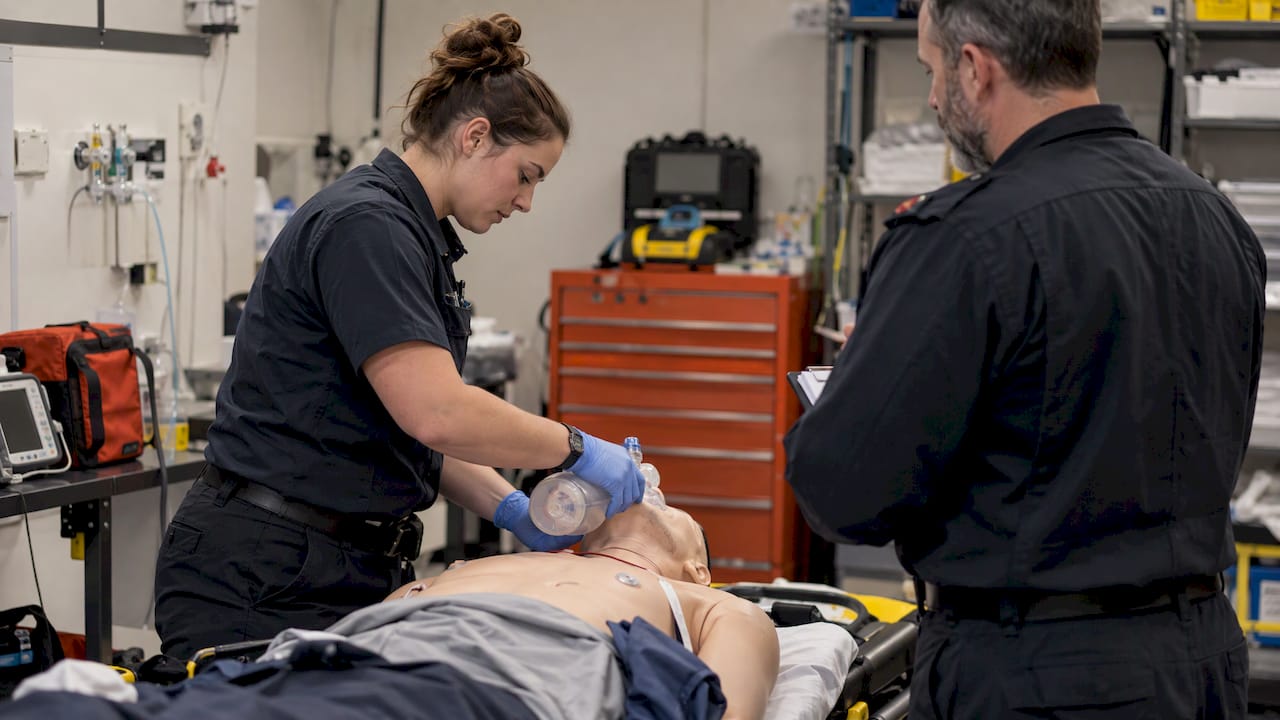
An annual EMS competency is a documented check that a clinician can still perform the skills in their scope of practice. It is not a class, and it is not recertification. For an EMS chief, a town leader or an attorney, the question is whether your agency can show who verified which skill, when, and under whose authority. We help agencies build that record, and the rest of this article explains how it works.
TL;DR
- Competency verification is separate from continuing education: it confirms skills in practice, and it is overseen locally by training officers and medical directors.
- Requirements vary by state, certification level and medical direction. There is no single national annual rule.
- Training officers attest for EMRs and EMTs. Medical directors attest for AEMTs and paramedics.
- Records are what protect an agency. Some states set retention at seven years.
- A program built on quality assurance data, direct observation and clear remediation holds up best in an audit or in court.
Table of Contents
- What an annual competency is, and what it is not
- Who sets the requirement
- Which competencies are commonly assessed
- Who validates, and how
- Building a program that holds up
- Why the paper trail matters to attorneys and town leaders
- How we can help
- Our perspective
- FAQ
- Sources
What an annual competency is, and what it is not
NREMT’s 2024 EMS Continued Competency Agenda for the Future treats continued competency as distinct from initial education and from continuing education. It covers lifelong learning, education on medical updates and changes, and assurance of competence in knowledge, skills and abilities. Training officers, quality assurance officers and medical directors oversee it, not program directors and classroom instructors.
Three terms are often mixed up:
- Continuing education (CE): hours of coursework toward renewal.
- Recertification: the periodic renewal of a certification or license. The National Continued Competency Program (NCCP) is part of National Registry recertification.
- Competency verification: a local sign-off that a provider has demonstrated each required skill, with remediation if they have not.
The distinction matters. A provider can finish every CE hour and still lack a documented skills check. Charlotte Hungerford Hospital, a Connecticut sponsor hospital, states in its EMS policies that no CE hours are awarded for its annual competencies. Those competencies are a separate obligation.
Who sets the requirement
There is no single national annual mandate. NREMT’s Recertification Handbook explains that state EMS officials hold the legal authority to grant the ability to practice. Some states run a separate license renewal in addition to National Registry requirements. Others require National Registry recertification, which renews the state license automatically. Credentialing is then a local check by the physician medical director that the clinician is qualified for the skills in their scope.

Local control stays strong even across state lines. Alaska’s 2026 relicensure guide says the agency and its medical director still control onboarding, competency, protocols and authorization to function, even under the EMS Compact.
How states differ in practice
| State | What the official guidance says |
|---|---|
| Connecticut | OEMS guidance requires each provider’s psychomotor skills to be verified and recorded in addition to NCCP education. A training officer may document EMR and EMT skills. A medical director physician or representative from an approved sponsor hospital documents AEMT and paramedic skills. |
| Washington | WAC 246-976-161 requires skill maintenance and annual practice of high-risk, low-frequency skills. Records are kept at least seven years. Paramedics demonstrate psychomotor skills annually to the medical program director or an approved delegate. |
| South Carolina | The December 2024 CEP manual makes the medical control director solely responsible for verifying skill competency. Verification evaluations go to each certified participant on the roster every two years. |
| Alaska | Verification is local. A training officer, medical director, approved instructor or local clinician may verify, but the verifier must be at or above the skill level assessed. |
| Mississippi | Title 15 rules require the off-line medical director to verify annually any skill approved beyond the National EMS Scope of Practice Model. |
The pattern: a state may require annual, biennial or per-cycle verification. Your agency’s own medical director may set a stricter standard than the state. Read your state rule and your medical director’s protocol together.
Which competencies are commonly assessed
The NREMT NCCP Training Officer Guide lists the skills to be verified by level.
- EMR: CPR.
- EMR and EMT: medical and trauma patient assessment, ventilatory management, AED cardiac arrest management, hemorrhage control and splinting, spinal immobilization, OB/gynecologic skills, radio communications, and report writing and documentation.
- AEMT and paramedic: supraglottic airways, IV/IO therapy and medication administration, among others.
- Paramedic additions: endotracheal intubation, transtracheal jet ventilation or cricothyrotomy, megacode and ECG recognition, and monitor and defibrillator knowledge.
Connecticut’s 2024 EMR recertification requirements show how a state turns this into a form. Skills validation is documented by an EMS instructor through call record review, laboratory demonstration or a skills exam. It covers medical and trauma assessment, airway and ventilation, AED use for all ages, and hemorrhage and shock management.
Notice what is on the list: radio communications and documentation. Operational skills count, not only hands-on clinical ones. Our guide to EMS documentation standards covers why the written record is part of the competency.
Who validates, and how
The NCCP guide names three acceptable methods: quality assurance or quality improvement review, direct observation in an actual setting, and other skill evaluation such as practical testing. The provider must be verified competent in every required skill, with remediation finished where needed.
The division of labor is deliberate:
- Training officers set up agency rosters, approve education and skills verification suited to certification levels, and attest for EMRs and EMTs.
- Physician medical directors provide clinical oversight, evidence-based protocols, and approve skills verification for AEMTs and paramedics.
Some medical directors delegate the evaluation but keep the signature. South Carolina’s manual says delegation to the training officer is allowed while signature verification remains the physician’s responsibility.
For advanced providers, the EHSF ALS provider skills verification guidance describes an initial assessment, then an annual credentialing assessment within 12 calendar months of the last one. An agency may not allow a provider at AEMT level or above to practice at that level without demonstrated competency, and it keeps assessment records for seven years.
Building a program that holds up
Here is a practical routine for the agency.
- Map the requirements. List the state rule, the sponsor hospital policy and your medical director’s protocol for each certification level. Use the strictest.
- Build the skill list by level. Start from the NCCP list, then add skills your protocols authorize beyond it.
- Choose the evidence. Use a mix of observed practice, QA chart review and simulation. High-risk, low-frequency skills such as advanced airway work rarely come up on calls, so they need scheduled practice. Our EMS quality assurance guide shows how QA data can feed this.
- Assign the right signer. Training officer for EMR and EMT, medical director for AEMT and paramedic, unless your state says otherwise.
- Write the remediation path. Define what happens when a skill is not demonstrated, who retrains, and when the provider is re-evaluated. Work from medical oversight principles so the physician’s authority is clear.
- Track and retain. Rosters, due dates and signed forms need a system. A guide to tracking training requirements online shows how a training officer can keep this organized. Keep records at least as long as your state requires. Seven years is the figure in Washington’s rule and in the EHSF guidance.
- Review the program yearly. Compare competency results with QA findings and adjust the next cycle.
NREMT’s guide stresses that self-assessment of strengths and weaknesses helps focus a provider’s education, and that targeted education can improve knowledge, skills and patient outcomes. Let results from the year drive the next year’s scenarios.
Why the paper trail matters to attorneys and town leaders
A competency record answers a plain question after an adverse event: was this clinician verified for this skill, by someone authorized to say so? Gaps in that answer are a liability. Missing signatures, a verifier below the skill level assessed, or records that cannot be produced all weaken an agency’s position. Our article on EMS documentation in court covers how records are examined, and our EMS compliance guide places competencies within the wider compliance picture.
For municipal leaders, the lesson is budget and time. Verification needs training officer hours, medical director availability and a records system. Fund them as part of the service, not as an afterthought.

How we can help
PSCG is a Connecticut-based EMS and public safety consulting firm with more than 32 years of expertise. We offer Operational Risk Reduction consulting, professional education services and performance gap analysis for EMS agencies, fire departments and municipalities. We work alongside your team from identifying the issue through deployment. You can see examples on our work page, and you can reach us through our contact page. Call us for more information.

For the full list of services, see our main site.
Our perspective
Competency is a leadership question before it is a training question. When a crew member is signed off, the agency is making a statement to patients, to the town and to a court: this person is ready.
We believe that statement should rest on evidence. That means observed practice, QA data, a medical director who is engaged, and a record any reviewer can follow. Agencies that treat the annual check as a form to be filled in tend to find the gaps at the worst moment.
Our approach is to work alongside chiefs, training officers and medical directors to turn requirements into a routine the crews respect. That includes tying skills verification to operational risk reduction, so the program protects patients and the municipality alike.
Michael A. Loiz
FAQ
Are annual EMS competencies required in every state?
No single national annual rule exists. State EMS officials hold the authority to grant the ability to practice, and requirements differ by state, certification level and medical direction. Check your state EMS office and your medical director’s protocols.
Is a competency the same as continuing education?
No. Continuing education is coursework hours. Competency verification confirms a provider can perform required skills, and it is signed locally by a training officer or medical director. Some sponsor hospitals award no CE hours for competency sessions.
Who signs off on competencies?
Under NREMT’s NCCP, training officers attest for EMRs and EMTs, and medical directors attest for AEMTs and paramedics. State rules can add detail, such as delegation with the physician keeping the signature.
How long should competency records be kept?
It depends on your state. Washington’s rule requires at least seven years, and EHSF guidance for ALS providers also names seven years. Confirm your own state’s period.
Sources
- EMS Continued Competency Agenda for the Future (NREMT, 2024)
- NREMT Recertification Handbook, Part 9: The EMS System
- NCCP Training Officer Guide (NREMT)
- 2026 Alaska EMS Relicensure Guide
- Connecticut OEMS Approval of EMS Continuing Education
- Connecticut 2024 Recertification Requirements
- Washington WAC 246-976-161
- South Carolina Training Officer Continuing Education Programs manual, December 2024
- Mississippi Title 15 EMS rules
- EHSF ALS Provider Skills Verification guidance
- Charlotte Hungerford Hospital EMS policies