



The Incident Command System (ICS) is a standardized, scalable framework for managing incidents of any size and planned events of any kind, built so responders from different agencies can work under one common structure. It gives responders a shared language, a unified chain of command, staffing that expands or contracts with the situation, and clearer decision-making when the stakes are highest. The Federal Emergency Management Agency (FEMA) and the National Incident Management System (NIMS) built ICS as the doctrine nearly every American public safety agency now trains to.
- Common language across agencies that have never worked together before
- One clear chain of command, even when a dozen organizations show up
- Staffing that scales up for a large fire and down for a fender-bender
- Decisions made faster because everyone knows who is calling the shots
Quick fact: ICS applies equally to a single-vehicle crash and a multi-state hurricane response, which is precisely why FEMA built it to scale.
Key Takeaways
ICS gives responders from different agencies a shared structure, shared language, and scalable staffing that only grows as large as the incident requires.
| Point | Details |
|---|---|
| Definition | ICS is a standardized, scalable framework for managing incidents and planned events of any size. |
| Core principles | Unity of command, span of control, modular organization, and common terminology hold the structure together. |
| Key roles | The Incident Commander sets objectives and approves the IAP; sections activate only as needed. |
| Unified Command | Multiple agencies share decision-making while keeping their own legal authority intact. |
| Training path | Start with FEMA EMI’s IS-100 and IS-200, then progress toward ICS-300 and ICS-400 for command roles. |
Table of Contents
- What Is the Incident Command System Used For?
- The Core Principles That Make ICS Work
- Who Does What: ICS Roles and Responsibilities
- The Five Functional Areas of ICS
- How ICS Scales: Modular Growth and Span of Control
- ICS in Action: Three Real-World Scenarios
- Where to Learn ICS: FEMA Training Resources
- Making ICS a Habit, Not a Scramble
- Why ICS Still Matters After All These Years
- Frequently Asked Questions About the Incident Command System
- Sources
What Is the Incident Command System Used For?
ICS was not designed for disasters alone. It shows up at single-vehicle accidents, wildland fires, mass gatherings like marathons and festivals, and multi-jurisdiction disasters where a dozen agencies converge on the same scene. The FEMA EMI course overview confirms the framework integrates personnel, facilities, equipment, and communications into one unified structure, regardless of incident type or scale.
Here is why that consistency matters: when a county fire department, a private ambulance service, and a state police unit arrive at the same scene, they often have never trained together. ICS gives them a shared hierarchy and shared vocabulary on day one, without anyone having to redesign how their home agency operates.
- Small incidents: single-vehicle crashes, medical calls, localized hazmat spills
- Large-scale events: wildfires, floods, multi-state disasters requiring mutual aid
- Planned events: parades, concerts, marathons with pre-positioned resources
Worth knowing: NIMS doctrine specifically credits routine ICS use with helping agencies “hone skills” they later rely on during large-scale events, which is a big reason FEMA pushes departments to use it daily, not just during crises.
If you want the full official doctrine behind this, FEMA’s NIMS reference documents lay out the scope in detail.
The Core Principles That Make ICS Work
ICS rests on a small set of principles, and every one of them earns its place. Skip one, and the whole structure gets shaky.
- Unity of command — each person answers to exactly one supervisor, which the FEMA EMI review document calls a cornerstone for reducing confusion and protecting responder safety.
- Chain of command — orders flow through a defined, predictable path
- Span of control — no supervisor manages more people than they can actually direct
- Modular organization — the structure builds only as large as the incident requires
- Management by objective — everyone works toward stated, measurable goals
- Common terminology — the same word means the same thing to every agency on scene
These principles let FEMA’s own training materials describe ICS as a system where outside resources can “plug in” without anyone rewriting their internal procedures.
Pro Tip: Use ICS on your routine, everyday calls, not just the big ones. Departments that practice ICS structure on minor incidents build the muscle memory that keeps them calm and organized when a major event finally hits.
Who Does What: ICS Roles and Responsibilities
Every ICS organization starts with one person: the Incident Commander. According to FEMA’s ICS organizational structure documentation, the Incident Commander sets objectives and strategy, ensures scene safety, approves the Incident Action Plan (IAP), and coordinates both Command Staff and General Staff.
Command Staff report directly to the Incident Commander and are activated as needed:
- Public Information Officer — manages media and public communications
- Safety Officer — monitors operations for hazards and stops unsafe actions
- Liaison Officer — coordinates with outside agencies and cooperating organizations
General Staff sections handle the operational work, and here is the key detail beginners often miss: a section only gets staffed if the incident actually requires it.
| ICS Element | Primary Role |
|---|---|
| Incident Commander | Sets objectives, approves the IAP, owns overall authority |
| Operations Section | Directs tactical response actions |
| Planning Section | Tracks resources and develops the IAP |
| Logistics Section | Supplies personnel, equipment, and facilities |
| Finance/Administration | Tracks costs, procurement, and compensation claims |
When multiple agencies share jurisdiction, none of them has to surrender authority to make joint decisions. Unified Command lets agency heads from different jurisdictions form one command structure, share a single set of incident objectives, and still keep their own legal authority intact. The Incident Management Handbook is explicit on this point: FEMA coordinates federal support but never assumes local incident command, which is exactly why Unified Command exists as a bridge rather than a takeover.
The Five Functional Areas of ICS
ICS organizes all incident work into a small number of functions, and the FEMA EMI reference guide confirms the structure covers five core areas, with a sixth added only when circumstances call for it.
| Function | Main Responsibility | Example Task |
|---|---|---|
| Command | Overall incident authority and objectives | Approving the Incident Action Plan |
| Operations | Executing tactical response | Directing fire suppression crews |
| Planning | Tracking status, forecasting needs | Building the next operational period’s IAP |
| Logistics | Supplying people, equipment, facilities | Ordering additional ambulances or fuel |
| Finance/Administration | Cost tracking and procurement | Processing overtime and mutual-aid billing |
A sixth function, Intelligence/Investigations, gets activated only when an incident calls for it, such as a criminal investigation running alongside a fire response. It can sit inside Planning, Operations, or stand on its own, depending on the incident’s needs.
The boundaries matter as much as the functions themselves. Operations executes the plan; Planning builds it. Logistics supplies the resources; Finance tracks what those resources cost. Blurring those lines in the field is one of the fastest ways to create duplicate orders and wasted effort.
How ICS Scales: Modular Growth and Span of Control
ICS expands from the top down, and only as far as the incident actually demands. A single engine company fire needs one Incident Commander and nothing else. A four-alarm fire might need a full Operations Section with multiple divisions underneath it.
Span of control is the practical limit that drives this growth. FEMA doctrine points to a recommended ratio of several direct reports per supervisor, with a moderate target number. Once a supervisor exceeds that range, it is time to add a layer, whether that means a new division, a branch, or an additional deputy.
- Start small: one Incident Commander handling every function
- Add General Staff sections only when workload demands it
- Add branches or divisions once span of control gets stretched thin
- Never staff every section immediately just because the incident feels big
Pro Tip: Resist the urge to build a large organization chart on arrival. A common field mistake is staffing every section right away; smart commanders add structure only when span of control or task complexity actually requires it.
ICS in Action: Three Real-World Scenarios
Seeing ICS applied side by side makes the structure click faster than any definition can.
A single-vehicle crash needs almost nothing beyond one Incident Commander, who often fills every General Staff role personally and works from a verbal plan rather than a written one. A multi-jurisdiction disaster, like a regional flood pulling in three counties and a state agency, calls for Unified Command, a fully expanded General Staff, and a formal written IAP that gets updated every operational period. A planned event, such as a marathon or a large festival, gets the benefit of advance planning: the ICS organization and every role assignment are decided weeks ahead of time.
| Scenario | Sections Activated | Command Arrangement |
|---|---|---|
| Single-vehicle crash | Minimal; IC fills most roles | Single Incident Commander |
| Multi-jurisdiction disaster | Full General Staff | Unified Command |
| Planned event | Pre-assigned per plan | Single IC or Unified Command |
Where to Learn ICS: FEMA Training Resources
Reading about ICS gets you started, but the Emergency Management Institute (EMI) offers the free courses that actually build competence.
- IS-100: Introduction to the Incident Command System, covering the basic structure, terminology, and principles every responder should know.
- IS-200: Basic ICS for Initial Response, which FEMA designed specifically for personnel likely to step into supervisory positions during an incident’s early stages.
Anyone expecting to lead a section or serve as Incident Commander should plan to continue toward ICS-300 and ICS-400 as their next steps. Pair those courses with FEMA’s NIMS doctrine for the full policy picture behind the training.
- Start with IS-100 and IS-200 through EMI’s free online platform
- Progress to ICS-300 and ICS-400 before accepting a command role
- Keep NIMS doctrine on hand as your reference when questions come up
Making ICS a Habit, Not a Scramble
The agencies that handle major incidents well are almost never the ones improvising ICS for the first time. They are the ones who used it on last Tuesday’s routine call.
Tabletop exercises, daily briefings that use ICS language deliberately, and short after-action reviews after routine calls all build the same muscle memory a large fire will demand later. Thepscgroup works with municipalities and EMS systems to turn ICS from a training-day exercise into a daily operating practice. Explore our emergency management consulting services to see how that work gets done.
- Run short tabletop exercises quarterly, not just annually
- Use ICS terminology in daily shift briefings, even on quiet days
- Conduct brief after-action reviews on routine calls, not only major incidents
Why ICS Still Matters After All These Years
We have spent years working alongside municipal leaders and EMS systems across Connecticut and beyond, and one pattern holds up every time: the departments that treat ICS as a living habit handle chaos better than the ones that treat it as a binder on a shelf. That is not a knock on any single agency. It is simply what the doctrine was built for, and what Thepscgroup specializes in helping public safety leaders operationalize, from EMS system design to leadership development. If your department wants a second set of eyes on how well ICS is actually working in practice, reach out through our contact page and let us know where you want to start.
Frequently Asked Questions About the Incident Command System
What is the Incident Command System in simple terms?
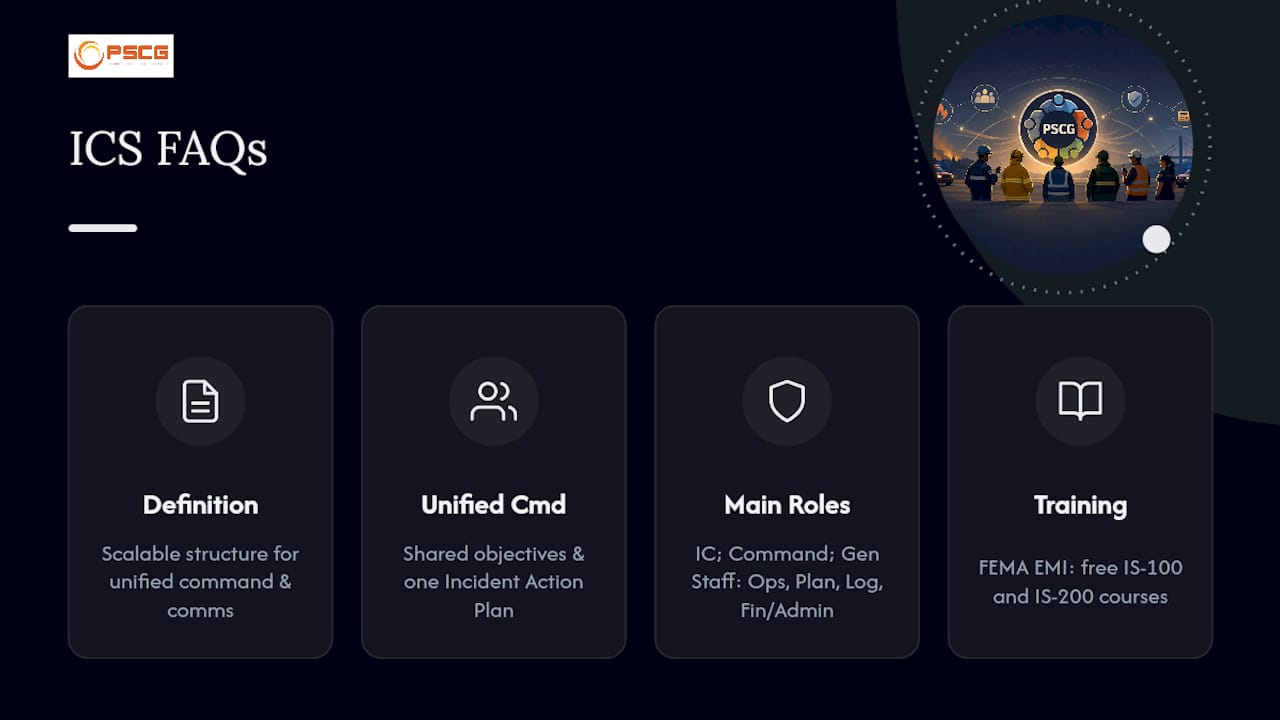
It is a standardized, scalable structure that organizes personnel, equipment, and communications so responders from different agencies can manage an incident under one common chain of command.
How does incident command work when multiple agencies respond together?
Agency leaders form a Unified Command, sharing one set of objectives and one Incident Action Plan while each retains its own legal authority.
What are the main ICS roles and responsibilities?
The Incident Commander leads overall strategy; Command Staff handle safety, public information, and liaison duties; General Staff run Operations, Planning, Logistics, and Finance/Administration.
Where can I find official ICS training resources?
FEMA’s Emergency Management Institute offers free courses, starting with IS-100 and IS-200, both accessible through the EMI training portal.
Do small incidents really need the full ICS structure?
No. A small incident might only need one Incident Commander filling every role with a verbal plan; the structure expands only as the incident grows.
Sources
Quick fact: IS-200 alone is built specifically for personnel likely to step into a supervisory ICS role during initial response, according to FEMA EMI’s course overview.