



Yes, you can sue for EMS negligence, but winning requires proving four specific things: duty, breach of the standard of care, causation, and actual harm. That framework, laid out in StatPearls’ guidance on EMS legal and ethical issues, governs nearly every ambulance negligence claim filed in the United States. The catch is immunity. Most states shield EMS agencies and providers from ordinary negligence claims, which means a plaintiff often has to show willful, wanton, or grossly negligent conduct just to get in the courthouse door.
The stakes are real. In 2024, a Limestone County, Alabama jury awarded $15 million to a family after finding that failures in ambulance care contributed to a patient’s death. Cases like that don’t happen often, but they show what’s possible when the four elements line up and the immunity defense fails.
- Duty, breach, causation, and harm must all be proven, not just alleged.
- Immunity statutes can block claims unless conduct rises to gross negligence or worse.
- Documentation quality frequently decides which side wins.
Key Takeaways
EMS negligence claims succeed only when plaintiffs prove duty, breach, causation, and harm while overcoming state immunity protections that shield most routine errors.
| Point | Details |
|---|---|
| Four elements are mandatory | Duty, breach, causation, and harm must each be proven, not just alleged, in every EMS negligence claim. |
| Immunity is the real battleground | Most claims survive only by showing willful, wanton, or gross misconduct under statutes like Ohio’s R.C. 4765.49. |
| Documentation decides outcomes | Run reports, dispatch logs, and credentialing files often matter more than witness testimony. |
| State law varies sharply | Immunity thresholds and public/private provider distinctions differ enough to change a case’s viability entirely. |
| Expert review strengthens both sides | Thepscgroup provides liability consulting and expert-witness support for attorneys and agencies handling EMS negligence matters. |
This article is general information, not a substitute for advice from a qualified lawyer. Consult a qualified legal professional about your own circumstances before acting on anything here.
Table of Contents
- Understanding EMS Negligence Cases: The Legal Foundation
- Common Defenses and Immunity Protections in EMS Litigation
- Preserving Evidence: A Documentation Checklist That Wins Cases
- What to Expect in the Legal Process and Timeline
- How Settlements and Verdicts Take Shape
- Differences in EMS Negligence Standards Across States
- Training, Protocols, and How They Shape Negligence Claims
- Steps to Take Right After an Alleged Negligent EMS Incident
- A Practitioner’s View on Reducing Risk and Strengthening Cases
- Contact Thepscgroup for Expert Review and Liability Consulting
- Sources
Understanding EMS Negligence Cases: The Legal Foundation
EMS negligence cases rest on ordinary tort law applied to an unusual setting: a moving ambulance, a chaotic scene, decisions made in minutes rather than hours. Courts don’t require proof of intent. What they require is proof that a provider fell short of what a reasonably trained EMT or paramedic would have done under the same circumstances.
1. Duty: establishing the provider-patient relationship
Duty attaches the moment EMS personnel begin assessing or treating a patient, and sometimes even earlier if dispatch protocols create an expectation of care. Refusal-of-care situations complicate this. If a patient declines transport, the agency still owes a duty to properly assess decision-making capacity before honoring that refusal. Skip that step, and the “duty” question often answers itself against the agency.
2. Breach: measuring against the standard of care
Breach means the provider’s actions fell below what a similarly trained professional would have done. Expert testimony almost always drives this analysis, since jurors rarely know what a paramedic should do when a patient presents with chest pain and a dropping blood pressure. This is where credentialed medical experts become indispensable, not decorative.
3. Causation and damages
Causation requires showing the breach actually caused the harm, both as a factual matter (but-for causation) and as a legal matter (proximate cause). Some jurisdictions also recognize loss-of-chance theories, where a delay reduced a patient’s odds of survival even if the outcome wasn’t guaranteed either way. Damages must be concrete: medical bills, lost income, pain and suffering, or wrongful death losses.
Pro Tip: If you’re evaluating a potential claim, request the full run report and dispatch timeline before doing anything else. Gaps in timestamps often reveal the breach before an expert ever reviews the chart.
Common Defenses and Immunity Protections in EMS Litigation
Immunity is the first wall plaintiffs hit, and it’s usually a thicker wall than in ordinary personal injury cases. Most states extend some form of protection to EMS agencies and individual providers, treating them more like government actors than private medical professionals.
Ohio’s statute is a clean illustration. R.C. 4765.49 grants immunity to EMS personnel and agencies unless the services were rendered in a manner that constitutes “willful or wanton misconduct.” That phrase, or something close to it, appears across dozens of state codes, and it’s the hinge on which most EMS malpractice lawsuits swing.
- Political-subdivision immunity often protects the employing agency separately from the individual provider.
- The willful/wanton/gross-negligence exception is where nearly every viable claim has to live.
- Federal protections, including the Volunteer Protection Act and, in specific public health emergencies, the PREP Act, add another layer for certain responders.
- Immunity is frequently raised early through dispositive motions that can end a case before discovery finishes.
A legal summary from the Network for Public Health Law confirms this pattern nationally: broad immunity, narrow exceptions, and outcomes that hinge on whether plaintiffs can create a genuine factual dispute about the provider’s state of mind. Beyond immunity, defense counsel also raise contributory negligence and assumption of risk, particularly when a patient refused transport or ignored medical advice before the incident.
Preserving Evidence: A Documentation Checklist That Wins Cases
Courts decide EMS negligence cases on paper as often as they decide them on testimony. The strength of the run report, the timestamps on the dispatch log, and the notes describing a refusal of care usually matter more than anything said on the witness stand.
Priority records to secure immediately:
- Dispatch and CAD logs showing call times, response times, and unit assignments
- The patient care report (PCR) and any late addenda or corrections
- Hospital records documenting the patient’s condition on arrival
- Personnel files, training records, and credentialing history for the crew involved
- Scene photos, bodycam footage, and witness statements
- Toxicology or drug-testing results where impairment is alleged
Late chart entries and missing capacity assessments for refusals sink more cases than any single act of clinical error. When a PCR is amended weeks after the call, or a refusal form lacks documentation of the patient’s mental status, that gap becomes the plaintiff’s strongest exhibit.
Preservation starts with a spoliation letter sent to the agency the moment litigation seems likely, since electronic dispatch data can be overwritten on routine schedules. A spoliation-inference explainer from Keller & Keller walks through how courts treat destroyed or missing records, and the inference can cut sharply against whichever side failed to preserve them. Early expert involvement matters just as much. Thepscgroup works with attorneys on both sides to interpret run reports, evaluate whether protocols were followed, and assess medical necessity documentation before a case theory hardens.
Pro Tip: Ask for the medical director’s credentialing file early. Negligent-supervision claims often surface when a director knowingly let a clinician who couldn’t safely perform a required skill keep working without restriction.
What to Expect in the Legal Process and Timeline
EMS malpractice lawsuits follow a fairly predictable sequence, though the pace varies by state and by how aggressively immunity gets litigated.
- Demand and filing. Counsel typically sends a pre-suit notice or demand, then files the complaint within the state’s statute of limitations, which can be shorter for claims against government entities.
- Discovery. Both sides exchange records, and EMS-specific requests should target dispatch data, training logs, protocol manuals, and prior complaints against the same crew.
- Expert reports. Plaintiffs and defendants each retain clinical experts to opine on the standard of care and causation, often the single most expensive phase of the case.
- Dispositive motions. This is where immunity usually gets decided. A successful immunity motion can end the case before a jury ever hears it.
- Settlement negotiation. Most surviving cases settle once liability and damages become clearer through discovery and expert reports.
- Trial. The minority of cases that don’t settle proceed to trial, typically eighteen months to three years after filing, depending on court backlog and appeals.
A well-argued expert report on causation, or a well-documented spoliation claim, can reshape settlement value long before trial ever becomes a real possibility.
How Settlements and Verdicts Take Shape
Most EMS negligence claims that survive immunity motions settle rather than go to a jury, since both sides usually have a clear read on liability once expert reports are exchanged. Cases proceed to trial when liability is genuinely contested, when damages are severe enough that neither side wants to compromise, or when an agency’s insurer takes a hard line on immunity.
Damages generally fall into a few buckets: medical expenses, lost income, pain and suffering, and in wrongful death cases, loss-of-consortium or survivorship damages. Punitive damages appear occasionally, mostly when the willful-or-wanton threshold is met.
- Egregious facts move juries more than technical breaches of protocol.
- Poor documentation reads as concealment even when it’s just sloppiness.
- The emotional weight of a preventable death case, like the Limestone County transport described in EMS1’s reporting, can push a jury toward an eight-figure award once liability is established.
For agencies, the practical lesson is that settlement discussions go better when documentation is clean and the crew’s conduct was defensible, even if imperfect.
Differences in EMS Negligence Standards Across States
State law is where EMS negligence claims get complicated fast, and the variation is bigger than most people expect. Some states apply near-total immunity to EMS personnel and agencies, requiring plaintiffs to prove conduct that’s essentially reckless. Others apply a lower bar closer to ordinary negligence, especially for privately operated ambulance services that don’t carry the same government-actor protections as municipal EMS.
Michigan offers a useful example of how fact-sensitive this gets in practice. Appellate guidance there shows that EMS Act immunity doesn’t automatically bar a claim if the plaintiff raises a genuine factual dispute about gross negligence, meaning the immunity question can survive into later stages of litigation rather than getting resolved on an early motion. That’s different from states where immunity gets decided quickly and decisively at the pleading stage.
The distinction between public and private EMS providers matters too. A municipal fire department running EMS calls may enjoy governmental immunity that a private ambulance contractor serving the same town doesn’t have. Attorneys handling multi-state EMS litigation, or families relocating a loved one across state lines for care, need to understand which framework applies before assuming a case is strong or weak based on the facts alone.
This fragmentation is exactly why jurisdiction-specific counsel and early expert review matter so much. A theory that works in one state’s courts can collapse entirely in a neighboring state with a stricter immunity statute. Thepscgroup’s work on EMS compliance touches on this patchwork regularly, since agencies operating near state borders often have to comply with two very different liability regimes at once.
Training, Protocols, and How They Shape Negligence Claims
Training records and protocol adherence sit at the center of almost every breach-of-duty argument. When a provider follows an agency’s written protocol exactly and the outcome is still poor, that protocol compliance becomes strong evidence against a finding of negligence. When a provider deviates from protocol, that deviation becomes the plaintiff’s roadmap.

Agencies with rigorous, well-documented training programs tend to fare better in litigation for a simple reason: they can produce a paper trail showing the provider was competent, current on required skills, and operating within an established scope of practice. Agencies with informal or inconsistent training documentation often can’t answer basic discovery questions about whether a crew member was even certified to perform a given intervention on the date in question.
Medical directors carry real exposure here. A StatPearls review of EMS medical director liability notes that negligent-supervision claims arise when a director knowingly allows a clinician who can’t safely perform required skills to keep working without restriction. Credentialing files, skills verification logs, and remediation records become central exhibits in these disputes.
Protocol design itself can become an issue too. If a written protocol is outdated relative to current clinical guidance, or if it’s ambiguous enough that reasonable providers interpret it differently, plaintiffs may argue the negligence traces back to the agency’s medical direction rather than the individual crew. Thepscgroup’s guidance on EMS medical oversight speaks directly to how agencies close these gaps before they become litigation exhibits.
Steps to Take Right After an Alleged Negligent EMS Incident
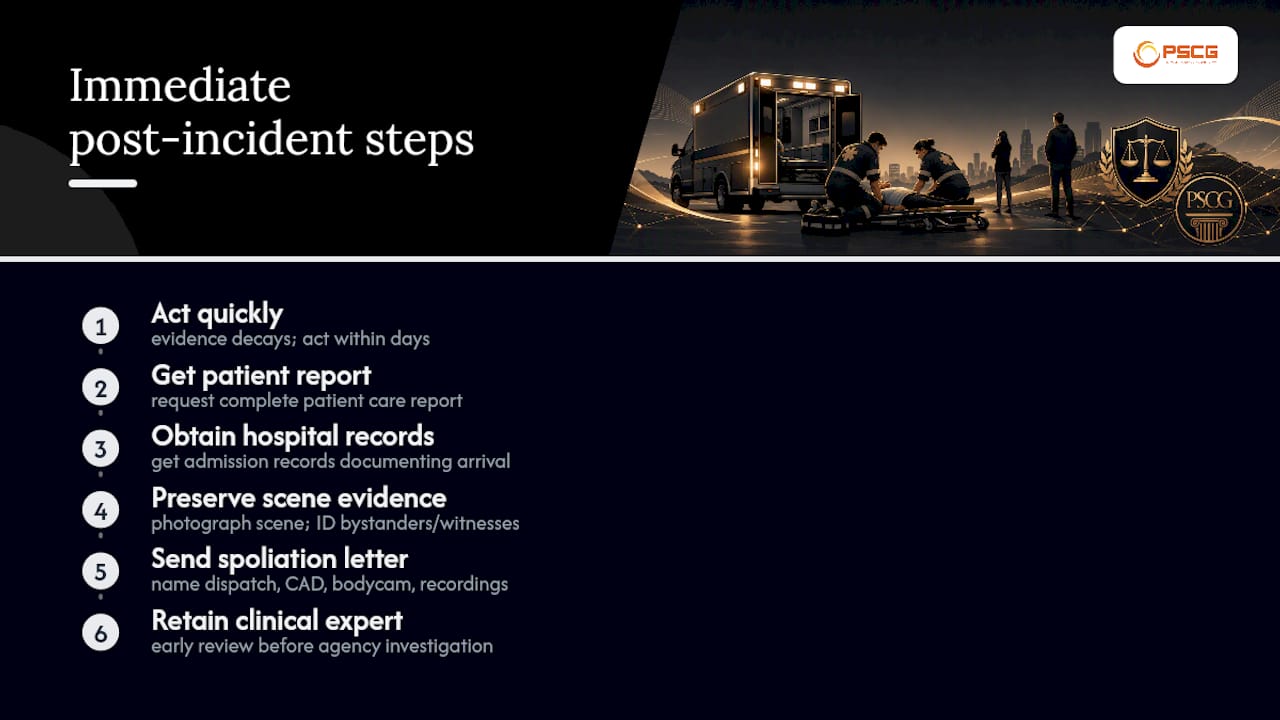
What happens in the first days after a suspected negligent EMS incident often determines whether a claim survives contact with an immunity motion. Evidence in EMS cases decays fast: dispatch data gets overwritten, memories fade, and equipment gets returned to service.
Families and injured patients should request a complete copy of the patient care report as soon as possible, along with hospital admission records that document the patient’s condition on arrival. That comparison, ambulance report against emergency department findings, often reveals the clearest picture of what went wrong during transport.
Photographing the scene, if it’s still accessible, and identifying any bystanders or family members who witnessed the response can preserve testimony that would otherwise be lost. If police responded to the same call, their report can corroborate or contradict the EMS narrative.
Attorneys should send a spoliation preservation letter to the responding agency within days, not weeks, specifically naming dispatch recordings, CAD logs, and bodycam footage if the jurisdiction uses it. Retaining a clinical expert early, before the statute of limitations pressure builds, allows that expert to review records while witnesses can still be interviewed and before an agency’s own investigation shapes the narrative. A Florida-focused guide on medical expert witness testimony outlines how admissibility standards for expert opinions can affect case strategy from the outset, which is worth understanding before selecting an expert.
A Practitioner’s View on Reducing Risk and Strengthening Cases
We’ve spent years helping agencies close the documentation gaps that turn defensible calls into indefensible lawsuits, and helping attorneys on both sides understand what a run report actually shows. The pattern is consistent: agencies with disciplined QA loops, rigorous credentialing, and clear medical-necessity documentation rarely end up on the losing side of a jury verdict, because their paper trail tells a coherent story.
For families and plaintiffs’ counsel, the lesson runs the other direction. If the documentation looks thin or inconsistent, that’s exactly when an expert review earns its cost.
Contact Thepscgroup for Expert Review and Liability Consulting
If you’re an attorney building or defending an EMS negligence claim, or an agency trying to close the gaps before they become litigation exhibits, Thepscgroup brings something most consulting firms and most solo expert witnesses can’t match: practitioners who’ve built EMS systems and reviewed the failures inside them from the operations side, not just the courtroom side.

We provide EMS liability consulting, expert-witness retention, and documentation and medical-necessity training for agencies, municipalities, and law firms working through EMS malpractice matters. Early involvement matters most: when causation is complex, when an agency needs a defensible risk assessment before a claim is even filed, or when counsel needs a credentialed expert who understands both the clinical protocol and the operational reality behind it. Explore how EMS system design choices affect liability exposure long before a lawsuit is filed, or reach out directly through Thepscgroup to discuss expert review for an active case.
Sources
- EMS Legal and Ethical Issues – StatPearls – NCBI Bookshelf
- Ala. EMS pays $15M over ‘chaotic and calloused transport’ and patient death
- Legal liability protections for emergency medical and public health responses (Network for Public Health Law)
- Section 4765.49 | Emergency medical personnel and agencies – immunity.