


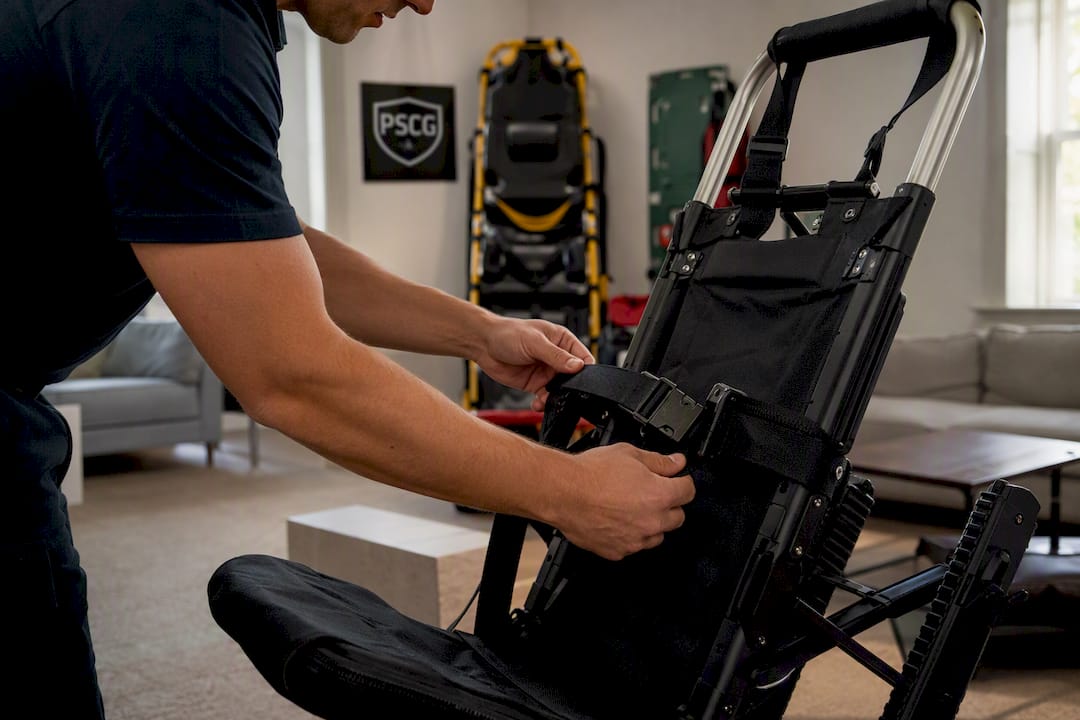
Pilot a minimal-lift program built on powered stretchers, load-assist systems, and a written no-lift policy paired with recurring training. That combination is the single most defensible investment an EMS agency can make right now, and the evidence backs it: one urban EMS system saw patient-handling injuries drop roughly 46 to 50 percent after adopting power-lift stretchers. The path forward starts small and scales fast.
- Audit last year’s lifting-related injury claims and lost work days by task type
- Select one or two units for a 90-day power-stretcher or load-assist pilot
- Draft a minimal-lift policy tied to the NIOSH 35-pound guideline
- Track injury rate, near-misses, and cost before and after the pilot
Key Takeaways
Minimal-lift programs that combine powered stretchers, written policy, and recurring training cut EMS patient-handling injuries by roughly half in documented field studies.
| Point | Details |
|---|---|
| Lead with a pilot | Test power-stretchers or load-assist systems on one or two units for 60 to 90 days before fleet-wide purchase. |
| Set a manual-lift threshold | Anchor policy to the NIOSH 35-pound guideline and require mechanical assistance above it. |
| Combine all three control types | Engineering, administrative, and training controls each address a different failure point. |
| Measure before and after | Track injury rate, lost work days, and near-misses to build the ROI case for scaling. |
| Bring in expert support | Thepscgroup offers pilot design, procurement support, and ROI modeling for agencies building these programs. |
Table of Contents
- What Causes Most Lifting Injuries in EMS?
- What Interventions Actually Reduce Lifting Injuries?
- Do Powered Stretchers Really Reduce Injuries?
- How Do You Roll Out a Lifting Injury Prevention Program?
- What Should Leaders Watch For When Rolling This Out?
- How Can Thepscgroup Help You Build This Program?
- Sources
What Causes Most Lifting Injuries in EMS?
Sprains and strains dominate EMS injury logs, and they rarely happen where people expect. A longitudinal claims analysis found that many lifting injuries occur during non-stretcher patient moves, not while wheeling a loaded cot down a hallway. Think of a paramedic pivoting a patient off a couch, hauling someone up a narrow stairwell, or bracing against a doorframe while sliding a stretcher into an ambulance. Loading and unloading the stretcher itself is the other major flashpoint, according to that same 18-year EMS injury-claim study.
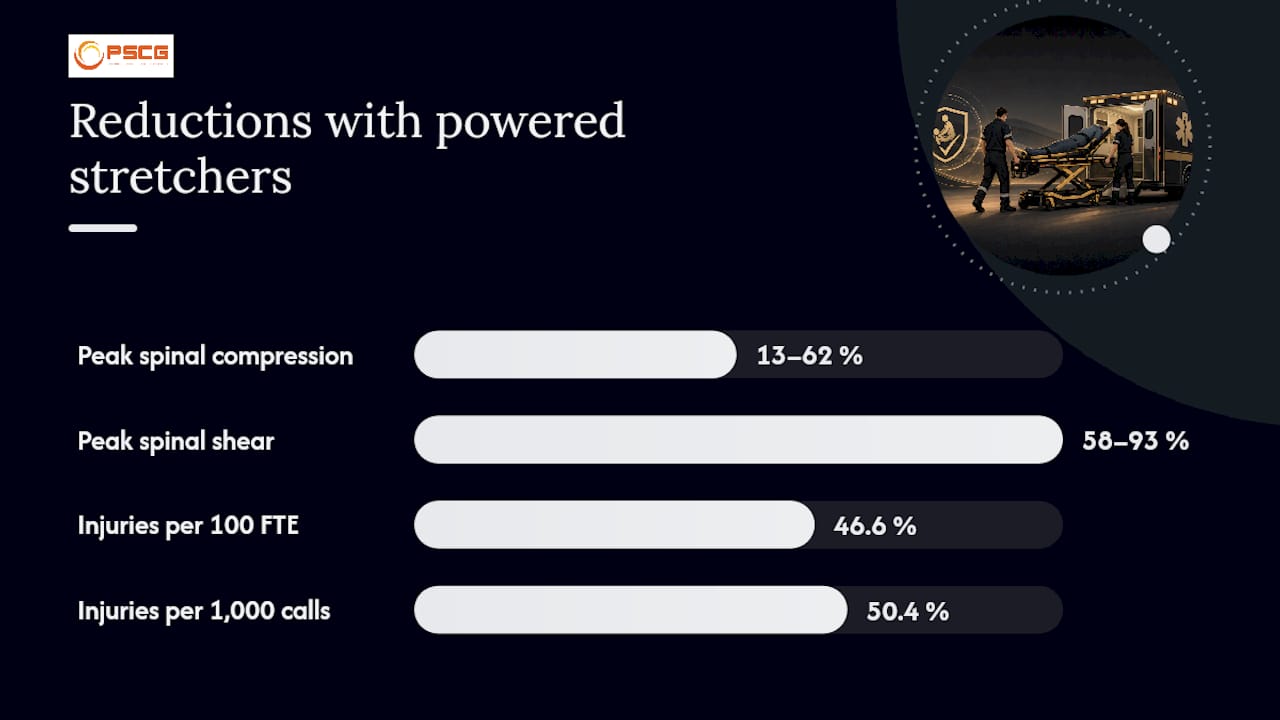
A single agency’s patient-handling injury rate can drop by nearly half within months of a properly implemented power-stretcher rollout, based on interrupted time series data from an urban EMS system that logged a 46.6 percent decline per 100 full-time employees and a 50.4 percent decline per 1,000 calls.
EMS crews face a different physical reality than hospital nursing staff. Nurses lift within controlled rooms with adjustable beds and clear floor space. Paramedics lift on gravel driveways, in cramped bathrooms, on stairs with no handrail, and into a vehicle with a bumper height that never changes. That variability is exactly why the field needs its own approach to safe patient handling, not a repurposed hospital protocol.
What Interventions Actually Reduce Lifting Injuries?
No single tool solves this. The agencies that see real, sustained reductions in injury rates combine three categories of intervention, and they treat all three as required, not optional.
Engineering controls remove the lift entirely or share the load mechanically:
- Powered stretchers with hydraulic or battery-assisted lift
- Powered load systems that raise and lower the cot into the vehicle
- Slide boards and lateral transfer devices for bed-to-stretcher moves
- Stair chairs with integrated track systems for multi-level buildings
- Bariatric-rated stretchers and additional crew protocols for high-weight patients
Administrative controls set the rules crews operate under: a written minimal-lift or no-lift policy, dispatch protocols that flag bariatric or high-acuity calls for additional personnel, and lift-team models that bring in a second unit for known difficult moves.
Training and competency keep the equipment from becoming shelf-ware. Initial device training, annual refreshers, and scenario-based practice on stairs, in tight hallways, and during vehicle loading close the gap between what a device can do and what a crew actually does under pressure; see our safety tips for hotel employees for practical examples of effective employee training programs.
Pro Tip: Run your stair-chair and lateral-transfer training as a scenario, not a lecture. Crews retain proper body mechanics far better after physically walking a mock patient down three flights than after watching a slideshow.
OSHA case studies of combined programs report injury and lost-work-day reductions of 30 to 70 percent, with capital costs often recovered within five years. That fiscal timeline matters as much to a finance director as the safety case does to an operations chief.
Do Powered Stretchers Really Reduce Injuries?
The biomechanical evidence is strong, though it comes with real-world caveats procurement teams should plan around before they sign a purchase order.
Controlled biomechanical trials measuring spinal load during stretcher loading and unloading found peak L4/L5 compressive force reductions of 13 to 62 percent and shear force reductions of 58 to 93 percent when crews used powered stretchers with load-assist compared to manual models. Field data tells a similar story at the injury-rate level, not just the lab bench.
| Evidence type | Finding | Source |
|---|---|---|
| Biomechanical trial | 13 to 62 percent lower peak spinal compression during loading | Sommerich et al. |
| Biomechanical trial | 58 to 93 percent lower peak spinal shear during loading | Sommerich et al. |
| Longitudinal field study | 46.6 percent decline in injuries per 100 FTE post-adoption | Prairie/Corbeil-style ITS analysis |
| Longitudinal field study | 50.4 percent decline in injuries per 1,000 calls post-adoption | Same urban EMS system |
Powered units run heavier than manual stretchers, which changes cornering and curb transitions and requires crew familiarization. Manual exposure doesn’t disappear either. Crews still perform non-stretcher moves, and a poorly maintained power-assist mechanism can slow a call down enough that crews revert to old habits under time pressure. None of that undercuts the case for adoption. It does mean training and maintenance planning need to travel with the purchase order, not follow it months later.
How Do You Roll Out a Lifting Injury Prevention Program?
A defensible pilot follows a sequence, not a single purchase decision. Skip a step and you lose the data you need to justify scaling.
- Baseline audit. Pull two to three years of workers’ compensation claims, lost work days, and near-miss reports specific to patient handling. Segment by task: stretcher loading, non-stretcher moves, stair transport.
- Pilot design. Choose one or two stations or units, involve frontline crews in equipment selection, and set clear acceptance criteria: time-on-task, crew satisfaction, and injury/near-miss rates over 60 to 90 days.
- Policy and training. Draft a minimal-lift policy anchored to the 35-pound manual-lift threshold, then build initial and recurring training around it, including scenario practice.
- Procurement and logistics. Confirm vehicle fit, onboard storage, and a maintenance and service agreement before the pilot equipment ever touches a call.
- Measurement. Track injury rate, lost work days, near-miss reports, and cost avoidance against your baseline, then feed those numbers into a payback calculation for leadership.
Pro Tip: Build your near-miss reporting form before the pilot starts, not after the first injury. A near-miss log with zero entries usually means crews don’t trust the process, not that nothing happened.
Procurement checklist for stretcher and load-system trials
Before signing a contract, run every candidate device through the same checklist during an on-site trial:
- Load capacity matches your bariatric protocol and typical call volume
- Unit integrates with existing ambulance mounts without a fleet-wide retrofit
- Power-assist behavior feels predictable on ramps, curbs, and uneven ground
- Controls are intuitive enough for a stressed crew to operate correctly on the first try
- Warranty terms, local service response time, and spare-parts availability are documented
- Total cost model includes capital outlay, annual maintenance, training hours, and projected injury-cost savings
What Should Leaders Watch For When Rolling This Out?
The agencies that get this right treat lifting injury prevention as governance work, not a procurement line item. That means naming a single program owner, getting finance and operations aligned on the ROI case before the pilot starts, and pulling crews into equipment decisions early rather than presenting them with a fait accompli. Thepscgroup builds pilot designs, procurement support, and ROI models for agencies working through exactly this sequence.
The most common pitfall isn’t buying the wrong stretcher. It’s buying any equipment without a pilot, skipping the maintenance plan until something breaks mid-shift, or launching a policy with no measurement plan attached. A program without numbers behind it is a policy memo, not a safety risk reduction strategy.
— Mike
How Can Thepscgroup Help You Build This Program?
Thepscgroup is the direct alternative to guessing your way through a stretcher purchase or writing a lift policy with no data behind it. We design the pilot, help you evaluate vendors against your actual call volume and vehicle fleet, model the ROI your finance director will ask for, and draft the minimal-lift policy your crews will actually follow.
Our team has worked through EMS system design engagements across municipal and private agencies, and lifting injury prevention fits squarely into that broader operational risk work. If your agency is ready to move past the injury-claim spreadsheet and into a structured pilot, schedule a scoping call through Thepscgroup’s homepage or review our step-by-step EMS design guide to see how a pilot fits into your existing operations before you commit budget.
Sources
- The effect of power stretchers on occupational injury rates in an urban emergency medical services system
- NIOSH guidance: safe patient handling (Revised NIOSH Lifting Equation context)
- Safe Patient Handling Programs: Effectiveness and Cost Savings (OSHA resources)
- Occupational Injury Claims Related to Patient Lifting and Moving in a Safety-Oriented Emergency Medical Services Agency
- Powered stretcher and load systems reduce biomechanical and psychophysical demands on paramedics (Sommerich et al.)