


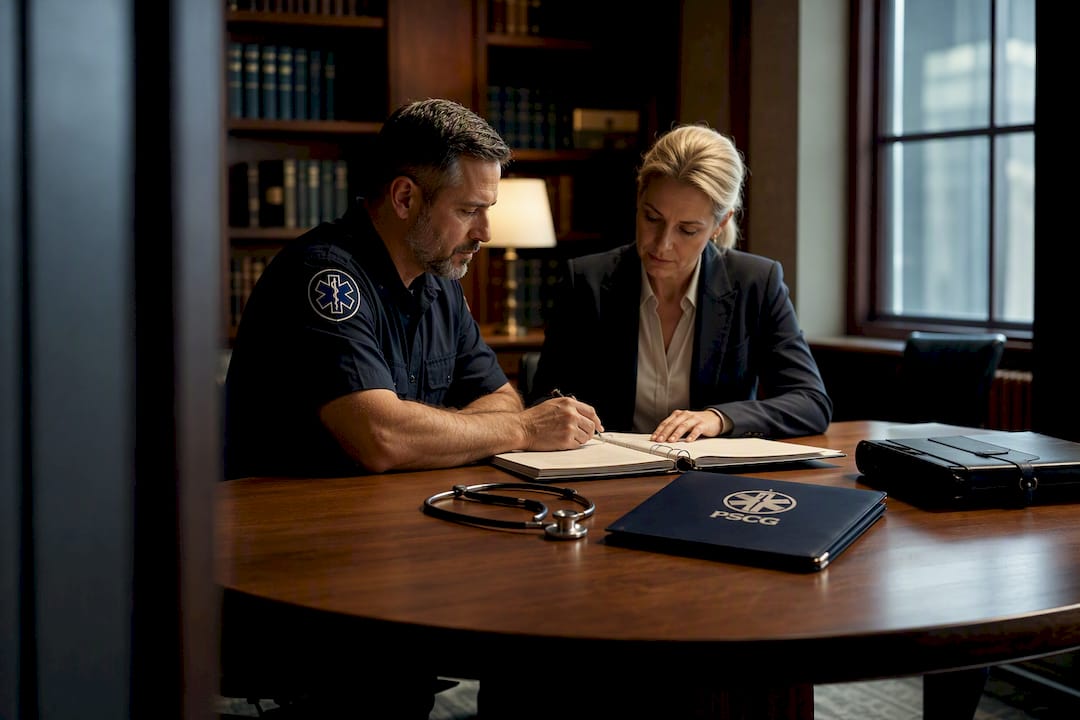
Under the amended Federal Rule of Evidence 702, the party offering EMS expert testimony must show by a preponderance that the testimony is reliable and directly applicable to the facts of the case, a standard confirmed in the current text of Rule 702. Courts expect clinically current experience, not a title on a resume. Paramedics, medical directors, and EMS systems experts who can document recent, relevant field or oversight work are the ones who typically clear that bar, so attorneys and EMS professionals alike should treat early preparation and documentation as the first order of business.
TL;DR:
- EMS experts must have current, relevant clinical or administrative experience directly related to the case, not just certifications or titles like medical director.
- The amended FRE 702 now requires parties to prove expert testimony’s reliability by a preponderance of evidence, emphasizing transparency in data and methodology.
- Local protocols, scope of practice, and specific incident dates must be thoroughly documented, especially when national guidelines differ or are outdated.
- Early retention allows the expert to review all case records and build a credible, well-supported opinion that can withstand Daubert or state law challenges.
- An expert’s credibility hinges on clear, objective explanations of methodology and how scene pressures influenced decision-making, not just on impressive credentials.
Table of Contents
- What EMS expert testimony covers and how it differs from lay witness testimony
- Checklist of qualifications: certifications, clinical currency, and systems experience
- How courts decide admissibility: FRE 702, Daubert, and state rules to check
- Establishing the applicable standard of care across jurisdictions
- Practical workflow and defensive strategies from retention to trial
- PSCG’s practitioner perspective on supporting EMS expert testimony
- Objectivity is the whole point of expert testimony
- How PSCG can help with expert witness and litigation support
- Sources
- FAQ
What EMS expert testimony covers and how it differs from lay witness testimony
EMS expert testimony exists to interpret events that a jury or judge cannot evaluate on their own. A fact witness, often the responding EMT or paramedic on scene, testifies to what happened: the timeline, the observations, the actions taken. An expert witness goes further, explaining whether those actions met the applicable standard of care, whether a protocol was followed correctly, or whether a systems-level failure, like understaffing or dispatch delay, contributed to a poor outcome.
That distinction matters because courts guard it closely. A treating paramedic can describe vital signs and interventions without qualifying as an expert, but the moment testimony shifts into judgment about whether those interventions were appropriate, the witness needs an expert designation and the qualifications to back it up. Attorneys who blur this line risk having testimony struck or limited at trial.
EMS experts commonly address:
- Standard of care, meaning what a reasonably prudent EMS provider would have done given the same information and conditions.
- Causation, connecting or disconnecting a provider’s actions from the patient’s outcome.
- Protocol compliance, evaluating whether local or state-approved protocols were followed.
- Systems-level failures, such as dispatch errors, staffing gaps, or response-time breakdowns.
- Medication administration, reviewing dosing, timing, and documentation of drugs given in the field.
- Triage decisions, particularly in mass-casualty or multi-patient scenes.
- Documentation adequacy, assessing whether the patient care report supports the treatment described.
These issues surface most often in medical malpractice claims against EMS agencies, wrongful death suits following delayed or incorrect treatment, municipal liability cases tied to response times or staffing decisions, and the ongoing wave of opioid crisis litigation, where EMS response to overdose calls has become a recurring evidentiary thread. In each of these, the expert’s job is not to relitigate the facts but to give the jury a framework for judging whether the EMS response was reasonable.
Checklist of qualifications: certifications, clinical currency, and systems experience
Credentials open the door, but they do not guarantee admissibility. National Registry of Emergency Medical Technicians certification confirms that a paramedic met a recognized standard of knowledge and skill, but the NREMT’s own paramedic overview is clear that national certification does not itself grant the right to practice. State licensure controls actual practice authority, and that distinction matters in court: an expert whose national certification lapsed years ago, or who never held the state license relevant to the jurisdiction in question, invites easy attacks on cross-examination.
The NAEMSP’s 2024 position statement on expert witness qualifications sharpens this further. It calls for experts to hold current, directly relevant clinical or administrative experience tied to the specific issues in the case, and it explicitly warns that a title like “medical director” is not enough on its own without demonstrable, active, contemporary practice or systems involvement.
For attorneys vetting a potential expert, or EMS professionals building a case to serve as one, the following sequence covers the ground courts and opposing counsel will probe:
- Confirm current NREMT or state certification and verify there is no gap between the certification period and the incident date at issue.
- Document recent field hours in the same care setting as the case, whether that is 911 response, critical care transport, or tactical medicine.
- Identify supervisory or medical director experience, especially any role that involved writing or approving the protocols relevant to the case.
- Compile teaching, protocol authorship, or publication history that demonstrates ongoing engagement with the field rather than a career that ended years ago.
- Assemble prior casework history, including how many times the expert has testified, for which side, and whether any prior opinions were excluded.
Pro Tip: A CV listing thirty years of experience means little to a judge if the most recent decade was spent entirely in administration; pair every credential with a date range showing when the hands-on work actually happened.
How courts decide admissibility: FRE 702, Daubert, and state rules to check
The amendments to FRE 702, effective December 1, 2023, changed more than wording. Before the amendment, many courts treated the reliability requirements as background conditions, often letting juries sort out weaknesses in an expert’s methodology. The revised rule makes clear that the proponent of the testimony carries the burden of proving, by a preponderance of the evidence, that the testimony rests on sufficient facts or data, applies reliable principles and methods, and applies those methods reliably to the facts of the case.

Amended FRE 702 moved reliability from an assumption to a burden the proponent must affirmatively meet, a shift explained in the federal rules of evidence pamphlet published by the U.S. Courts, which also lays out the surrounding Rules 701 through 706 governing witness competency and the basis of expert opinion. For an EMS expert, this means a report that simply asserts a conclusion, without walking through the data reviewed and the method applied to reach it, is now more vulnerable to a pretrial challenge than it would have been a few years ago.
The rule’s DNA traces back to the Supreme Court’s Daubert and Kumho Tire decisions, which established that judges act as gatekeepers rather than passing every expert opinion straight to the jury. In practice, that gatekeeping function focuses on a few recurring questions:
- Did the expert use a methodology that is testable and generally accepted in the EMS field, or an approach invented for the litigation?
- Does the expert’s opinion fit the specific facts of the case, or is it a generic statement about EMS practice that never connects to the incident?
- Can the expert explain the reasoning step by step, rather than resting on experience alone?
Attorneys should also check the relevant state’s evidence code early, since many states have adopted their own Daubert-style analogs while others retain older Frye-based standards. That difference can change what a report needs to include long before trial, so confirming the governing standard in the filing jurisdiction belongs at the top of the retention checklist, not an afterthought.
Establishing the applicable standard of care across jurisdictions
EMS practice is not uniform across the country, and an opinion that ignores that fact loses credibility fast. Every state sets its own scope of practice, every EMS system operates under its own medical director’s protocols, and many agencies layer additional training requirements on top of the state minimum. An expert who cites a national guideline without checking whether the local protocol matched, diverged from, or preceded that guideline at the time of the incident hands opposing counsel an easy opening.
The documentary record that grounds a defensible opinion typically includes:
- The agency’s protocols in effect on the date of the incident, not the current version if they have since been revised.
- Medical director standing orders that may modify or supplement state-level protocols.
- The state’s official scope of practice for the certification level involved.
- Agency policies covering documentation, equipment, and escalation procedures.
- Training curricula the provider completed, which can show what they were actually taught versus what a textbook assumes.
When national guidance and local protocol diverge, the expert’s job is to explain why, not to paper over the gap. A protocol that looks outdated next to a national consensus statement may still have been the legally controlling standard on the date in question, and an expert who can articulate that reconciliation, rather than simply asserting the national standard applies, holds up far better under cross-examination. PSCG’s own guide to scope of practice variation across states illustrates how widely these rules differ from one jurisdiction to the next, which is exactly why a one-size-fits-all opinion rarely survives scrutiny.
Practical workflow and defensive strategies from retention to trial
A defensible EMS expert opinion follows a sequence, and skipping steps under time pressure is one of the most common ways an otherwise qualified expert gets excluded or discredited.
- Retain the expert early, ideally before the statute of limitations pressures force a rushed report. Early retention lets the expert personally review the full record rather than relying on someone else’s summary.
- Build the record list, including the patient care report, dispatch logs, agency protocols in effect at the time, training records, and any prior statements from the crew involved.
- Conduct the scene and systems review, examining response times, staffing levels, and equipment availability alongside the clinical record.
- Draft the report, stating the factual basis reviewed, the methods applied, citations to the specific protocols and training relied upon, the opinions reached, their limitations, and any alternative explanations considered.
- Prepare for disclosure and deposition, anticipating the questions most likely to test methodology and credentials.
- Prepare trial exhibits, translating technical findings into visuals a jury can follow without oversimplifying the medicine.
Pro Tip: A report that lists what the expert did not review, and explains why it would not have changed the opinion, often survives a Daubert challenge better than a report that ignores the gap entirely.
Cross-examination tends to target three weak points: whether the methodology is reproducible and grounded in accepted practice, whether the expert’s own clinical currency matches the claims in the report, and whether the opinion accounts for real field conditions rather than a sanitized version of events. Commentary from EMS1 on legal trends and clinical standards notes that courts increasingly press experts to explain how extreme scene pressures shaped a decision, and experts who can narrate why a protocol was applied under those specific conditions tend to hold credibility better than those who only recite the textbook version. An expert who has personally worked calls under similar pressure has a real advantage here over one who has not been in the field in years.
PSCG’s practitioner perspective on supporting EMS expert testimony
Consulting groups with EMS field and systems experience provide background useful for attorneys when a case turns on whether a response met the standard the jurisdiction actually required. Litigation support that draws on operational knowledge used in EMS strategy and system design work can offer opinions grounded in how EMS systems actually function under pressure, not just in the textbook version of protocol compliance.
Services relevant to litigation support can include expert witness engagements covering standard of care, protocol compliance, and systems-level failure analysis; liability consulting to help agencies and their counsel identify and document risk; documentation review to assess whether patient care reports and agency records support a defensible narrative; and quality assurance and performance improvement analysis to connect case-specific findings to broader system patterns.
A typical engagement moves through record review, analysis, and report drafting before deposition and trial preparation, with deliverables scoped to the specific demands of the case. Readers can review author credentials and prior case experience through PSCG’s expert witness and consulting overview.
Objectivity is the whole point of expert testimony
The most persuasive EMS expert in the courtroom is not the one who argues hardest for the retaining side, but the one who explains the standard of care clearly enough that the jury trusts the reasoning even when it does not favor the client who hired them. The NAEMSP’s guidance is built around that principle, and it is worth taking seriously rather than treating as boilerplate ethics language.
Attorneys should hire for that quality as much as for credentials. An expert with an impressive resume who cannot explain a medication dosing decision in plain language under cross-examination will hurt a case more than help it. The goal is a witness who can withstand pressure without losing clarity, because that clarity is what actually persuades.
— Mike
How PSCG can help with expert witness and litigation support
Attorneys and EMS agencies working through litigation involving field response, protocol compliance, or systems-level failures do not have to build that case alone. PSCG combines decades of hands-on EMS operations experience with the kind of documentation review and standard-of-care analysis that holds up under a Daubert challenge, giving both sides of a case a clearer, more grounded picture of what actually happened on scene.
If you are evaluating an EMS expert witness for an active case, or you are an EMS professional preparing to testify, visit PSCG’s services overview to review our expert witness and consulting work, or reach out through our contact page to discuss your case directly.
Sources
- Rule 702. Testimony by Expert Witnesses — Federal Rules of Evidence (Cornell LII)
- Expert Witness Qualifications and Ethical Guidelines for Emergency Medical Services Litigation — NAEMSP (2024)
- Paramedic certification overview — National Registry of Emergency Medical Technicians (NREMT)
- Federal Rules of Evidence pamphlet (U.S. Courts) — Dec. 1, 2023
FAQ
What qualifies someone as an EMS expert witness?
Courts generally look for current, directly relevant clinical or administrative experience tied to the specific issues in the case, not just a certification or title. The NAEMSP’s 2024 position statement specifically warns that a role like medical director is insufficient without demonstrable, active, contemporary practice.
How does the amended FRE 702 change EMS expert admissibility?
The rule, amended effective December 1, 2023, requires the party offering the testimony to show by a preponderance of the evidence that the opinion is based on sufficient facts, applies reliable methods, and applies those methods reliably to the case, according to the current rule text. That shifted reliability from a background assumption to an affirmative burden the proponent must meet before trial.
Does NREMT certification alone qualify a paramedic as an expert?
National certification demonstrates a recognized level of knowledge and skill, but the NREMT’s own guidance confirms it does not itself grant the right to practice, since state licensure controls actual practice authority. Courts typically want to see both current certification and recent, relevant field or systems experience before treating someone as qualified.
What is the difference between a lay witness and an EMS expert witness?
A lay witness, often the responding crew member, testifies to observations, timeline, and actions taken on scene. An EMS expert witness goes further, offering an opinion on whether those actions met the applicable standard of care, connecting or disconnecting the response from the outcome.
When should an attorney retain an EMS expert in a case?
Retaining an expert early gives them time to personally review the full record, including protocols in effect at the time, dispatch logs, and training files, rather than relying on a rushed summary. Early retention also supports the methodology requirements under amended FRE 702, since the expert needs enough time to apply a reliable process rather than reaching a conclusion first and justifying it later.