


Yes, you can often sue after an ambulance crash, but the path depends heavily on who operated the vehicle. Get medical care first, then preserve evidence and determine whether the ambulance was government-operated, because notice deadlines and immunity rules can decide the outcome before your case ever reaches a courtroom. Contact an attorney quickly. Speed matters here in ways it does not in an ordinary car accident claim.
TL;DR:
- Liable parties often include ambulance drivers, their employers, maintenance contractors, equipment manufacturers, and third-party vehicle operators, making full investigation essential.
- Notice deadlines for government-operated ambulances can be as short as 90 days, requiring prompt identification of the agency and careful compliance to preserve your claim.
- Government immunity often protects ambulance crews unless conduct demonstrates gross negligence or reckless disregard, especially during non-emergency transports.
- Critical evidence such as dispatch records, vehicle telematics, dashcam footage, and witness contact information must be preserved quickly, as records may be overwritten within weeks.
- Damages can include medical costs, lost wages, pain and suffering, and wrongful-death compensation, but damage caps and fault rules may significantly limit recovery against public entities.
Table of Contents
- What ambulance crash litigation covers: incident types and legal theories
- Who can be sued: drivers, agencies, third parties, and contractors
- Deadlines and notice rules for government-operated ambulances
- Immunity defenses and when courts allow claims to proceed
- Evidence to collect and preserve after a crash (what matters most)
- Damages: what you can recover and limits when suing a government entity
- Timeline and the litigation process (investigation through resolution)
- How to pick a lawyer: questions to ask and what experience matters
- PSCG operational insights that support claims and prevention
- How insurance companies factor into ambulance crash claims
- Why speed after the crash changes everything
- PSCG’s role in ambulance crash prevention and litigation support
- Sources
- FAQ
What ambulance crash litigation covers: incident types and legal theories
Ambulance crash litigation is not one type of case. It covers several distinct fact patterns, and knowing which one applies to your situation shapes everything that follows.
A collision with a third-party vehicle is treated much like any traffic accident, with the added wrinkle of the ambulance’s emergency status. A patient injured inside the ambulance during transport, whether from a crash, a sudden stop, or an unsecured gurney, raises separate questions about restraint use and crew conduct. Maintenance and product liability claims arise when a mechanical failure, brake defect, or improperly serviced vehicle contributed to the crash. Wrongful-death suits follow when a crash proves fatal, whether to a patient, a bystander, or another motorist.
The legal theories overlapping these categories include ordinary negligence, vicarious liability for an employer’s actions, and product or maintenance liability against manufacturers or service contractors. One detail that trips up many claimants: some states treat ambulance crash claims as health-care liability matters requiring medical expert reports, while others classify them as ordinary negligence. A Texas appellate court addressed this directly, holding that ambulance crash claims are not always health-care liability claims, which meant the plaintiff did not need to meet the higher procedural bar that medical malpractice cases require. That distinction can determine whether your case survives early motions to dismiss.
For a deeper look at how negligence theories apply across ambulance operators, agencies, and transport companies, PSCG’s overview of EMS negligence litigation walks through the legal framework in more detail.
Who can be sued: drivers, agencies, third parties, and contractors
Ambulance crashes rarely have a single responsible party. Liability often spreads across several defendants, and identifying all of them early strengthens your position.
The driver bears direct responsibility for how the vehicle was operated, but employers typically carry vicarious liability for an employee’s conduct while on duty. That employer might be a private ambulance company or a municipal, county, or state EMS service, and the distinction matters enormously for procedure. Private carriers are sued like any commercial defendant. Government-operated services trigger a separate set of notice requirements and immunity defenses that can bar a claim outright if missed.
Beyond the ambulance itself, other parties may share fault:
- The driver of another vehicle involved in the collision.
- A maintenance contractor if poor upkeep contributed to a mechanical failure.
- An equipment manufacturer if a defective part, such as a faulty brake system or a restraint mechanism, played a role.
- A dispatch center if inaccurate routing or communication failures contributed to the crash.
Because these parties often carry different insurance coverage and different procedural rules, an attorney will typically investigate all of them before narrowing the claim. Missing a defendant early can mean missing a source of recovery later, particularly once statutory deadlines close that door for good.
Deadlines and notice rules for government-operated ambulances
This is the single most important procedural fact in ambulance crash litigation: if the ambulance was operated by a municipal, county, or state agency, you are not working under the standard personal injury statute of limitations. You are working under a shortened notice requirement that can bar your entire claim if you miss it.
Most states require a formal Notice of Claim before you can sue a government entity at all. These windows are often dramatically shorter than the two or three years typical of standard injury claims. Nevada, for example, requires a 180-day notice with a $200,000 statutory cap on damages against government defendants. Other states impose windows as tight as 90 days. The specific rules vary by state, and there is no substitute for confirming your jurisdiction’s exact requirement immediately after a crash.
A proper Notice of Claim typically needs to include:
- The date, time, and location of the crash.
- The name of the agency and, where known, the driver or crew involved.
- A description of the injury and the damages claimed.
- The claimant’s contact information and, in many states, a sworn statement or specific form required by that jurisdiction.
Beyond the notice window itself, many states cap total damages recoverable from government entities and limit or eliminate punitive damages altogether. These caps apply regardless of how severe the injury is, which makes early identification of the defendant’s status essential.
The fastest way to confirm whether you are dealing with a government provider is to check the ambulance’s agency markings, call the billing department listed on any paperwork, or ask your attorney to pull public records. Waiting even a few weeks to make that determination can cost you the right to sue at all, since notice windows often run shorter than the general statute of limitations that most people assume applies.

Immunity defenses and when courts allow claims to proceed
Government-operated ambulance services frequently raise immunity as their first line of defense, and it is often the most decisive legal battle in the entire case.
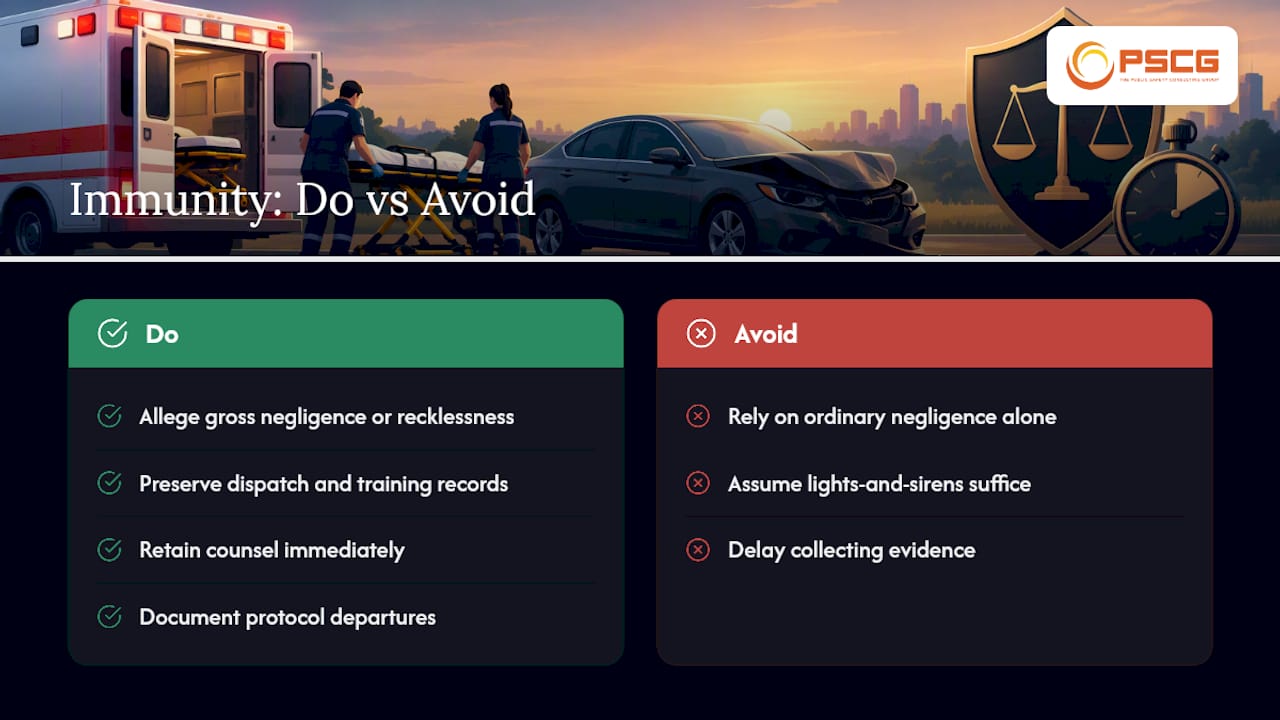
Sovereign immunity and governmental immunity generally shield public entities and their employees from lawsuits arising out of the performance of official duties. Many states extend a specific emergency-service privilege to ambulance crews responding to active calls, on the theory that split-second decisions made under pressure deserve legal protection. In practice, this means a plaintiff often cannot simply prove ordinary negligence. They must show the crew’s conduct crossed into gross negligence, recklessness, or willful and wanton misconduct.
Certain fact patterns tend to overcome immunity more often than others. A crash occurring during a non-emergency interfacility transfer, where lights and sirens were not active and no true emergency existed, is frequently treated differently than a true emergency response. Operating well outside established protocols, such as running a red light without properly clearing the intersection, can also support an argument that immunity should not apply.
Appellate courts in several states have narrowed blanket immunity protections in recent years, particularly where the facts show a clear departure from training and policy. Because these arguments hinge on specific facts developed early, through dispatch records, training files, and crew statements, retaining counsel quickly is not just a convenience. It is often the only way to preserve the evidence needed to argue an exception before the immunity motion is fully briefed.
Evidence to collect and preserve after a crash (what matters most)
Ambulance crash cases live or die on records that agencies are not required to keep forever. Some of the most decisive evidence can be overwritten, discarded, or lost within weeks if no one asks for it in writing.
- Dispatch and 911 records, along with EMS run sheets documenting the call, response, and crew actions.
- GPS and vehicle telematics data showing speed, route, and braking patterns leading up to the crash.
- Dashcam footage and any nearby intersection or traffic camera video.
- Photographs of vehicle positions, damage, and the surrounding scene taken as soon as possible.
- Names and contact information for every witness, including bystanders and other responding crews.
- Medical records documenting the injury, along with any documentation of restraint use, gurney condition, or seatbelt status inside the ambulance.
- EMS crew training records and internal policies governing emergency response and patient restraint.
These records matter because NHTSA’s Special Crash Investigation program found ambulance operator error present in 92.6% of the ground ambulance crashes it investigated between 2012 and 2018, and that same review documented properly used clinician restraints in only about 8.8% of those cases. Those two facts alone explain why restraint documentation and driver behavior data are so often central to litigation and so often contested during discovery.
Pro Tip: Send a written evidence preservation letter to the agency or company within days of the crash, since verbal requests are easy to dispute later and some data systems overwrite automatically on a rolling schedule.
Attorneys typically pair evidence requests with a formal Notice of Claim where one is required, and they log everything collected with dates and sources so the chain of custody holds up later. Documentation standards around medical necessity, covered in PSCG’s guide to what EMS providers must document, often surface again during this discovery phase.
Damages: what you can recover and limits when suing a government entity
Recoverable damages in an ambulance crash case generally include past and future medical costs, lost wages, diminished earning capacity, rehabilitation expenses, and pain and suffering. Wrongful-death claims add funeral and burial expenses along with compensation for the survivors’ loss.
How much of that you actually recover depends heavily on your state’s fault rules. Comparative-negligence states reduce your award by your percentage of fault, while a handful of contributory-negligence states can bar recovery entirely if you bear any fault at all. That distinction alone can change a six-figure claim into nothing.
Suing a government entity adds another layer of limits. Many states cap total damages recoverable against public defendants regardless of injury severity, and punitive damages are frequently barred outright. In rare cases where a claim exceeds a state’s statutory cap or falls outside normal claim procedures, some states allow a legislative-claims bill, essentially asking the state legislature to authorize a larger recovery. That route is unusual, slow, and reserved for exceptional circumstances, but it exists as a last resort when the ordinary claims process cannot make an injured person whole.
Timeline and the litigation process (investigation through resolution)
Ambulance crash cases move through recognizable stages, though the pace varies with how quickly evidence is secured and how the immunity question shakes out.
Initial investigation typically runs weeks to a few months, covering evidence collection, medical documentation, and confirmation of the defendant’s government or private status. If a Notice of Claim is required, it usually must go out within that same window, often 90 to 180 days depending on the state. Settlement discussions can begin any time after that, but full litigation, from filing suit through discovery, expert reports, and trial, commonly runs 12 to 36 months.
Expert witnesses shape both the outcome and the timeline. Crash reconstruction specialists analyze vehicle data and scene evidence, EMS operations experts assess whether crew conduct matched training and protocol, and medical experts establish causation between the crash and the claimed injuries. Their reports take time to prepare properly, but they also tend to increase settlement leverage once opposing counsel sees a well-supported case.
Prompt evidence preservation and early counsel involvement do not just protect your legal rights. They frequently shorten the overall timeline by giving both sides a clearer picture of liability sooner, which often moves cases toward resolution before trial becomes necessary.
How to pick a lawyer: questions to ask and what experience matters
Not every personal injury attorney has handled a claim against a government-operated EMS agency, and that experience gap shows up quickly once notice deadlines and immunity motions enter the picture.
- Ask directly whether the attorney has handled claims against government-operated ambulance services, not just private carriers.
- Ask how they have met shortened Notice-of-Claim deadlines in the past and what their intake process looks like for new ambulance crash cases.
- Ask whether they have trial experience, since immunity disputes sometimes require litigating the exception rather than settling early.
- Ask what experts they typically retain, including crash reconstruction and EMS operations specialists.
- Ask about fee structure, expected timeline, and how often you can expect updates on your case.
The agency’s own operational history matters too. An attorney who understands EMS training standards and dispatch protocols can spot gaps in an agency’s policies faster than one who only handles standard auto accident claims. For agency leaders and attorneys evaluating how liability risk connects to operational policy, PSCG’s guide to EMS liability consulting explains how emergency versus non-emergency transport classifications affect exposure. Retaining counsel quickly is not about rushing a decision. It is about making sure the notice deadline and evidence preservation window do not close while you are still comparing attorneys.
PSCG operational insights that support claims and prevention
Litigation outcomes often turn on operational details that only someone familiar with EMS systems can properly interpret. NHTSA’s SCI program found that lights and sirens were active in only 40.7% of the crashes it reviewed, and identified improper intersection clearing and lapses in driver situational awareness as recurring contributing factors. These details are frequently contested during discovery, because they determine whether a crash happened during a true emergency response or a routine transport where a different standard of care applied.
A structured approach to examining dispatch logs, run sheets, and training records against established protocol can help agency leaders and legal teams review operational details after a crash. That kind of review can clarify whether a crew’s actions matched agency policy at the time of the crash, which speaks directly to causation and, in some cases, to whether an immunity exception applies. Our ambulance crash prevention resources outline the operational priorities that agencies and their counsel most often need to examine after an incident.
How insurance companies factor into ambulance crash claims
Insurance coverage in ambulance crash cases is rarely straightforward, and it often involves more than one policy. Private ambulance companies typically carry commercial auto and general liability coverage similar to other commercial fleets. Government-operated services may be self-insured, covered through a state risk pool, or insured commercially, and that structure affects both the claims process and the applicable damage caps.
Because a crash can involve multiple defendants, more than one insurer may be involved at once: the ambulance operator’s carrier, a third-party motorist’s insurer if another vehicle contributed to the crash, and potentially a maintenance contractor’s or manufacturer’s coverage if equipment failure played a role. Each insurer will investigate independently, and their early statements about coverage or fault are not the final word.
Adjusters representing a government entity’s insurer or risk pool often move quickly to gather statements before an injured party has retained counsel, and they are generally not working on the claimant’s behalf. An early recorded statement can complicate a claim later if it conflicts with evidence that surfaces during discovery. Confirming coverage sources and understanding how each insurer’s investigation intersects with statutory notice deadlines is one of the first tasks a personal injury attorney typically handles once retained.
Why speed after the crash changes everything
I keep coming back to the same point with people who reach out after a crash like this: the evidence you do not capture in the first few days is often gone for good. Dispatch data gets overwritten, memories fade, and notice deadlines do not pause for anyone’s recovery.
Get medical care, document the scene, confirm whether the provider was a government agency, and call an attorney before the week is out. The operational details, training records, restraint use, dispatch decisions, usually decide these cases more than the crash itself does.
— Mike
PSCG’s role in ambulance crash prevention and litigation support

Ambulance crash litigation depends on operational facts that most law firms are not equipped to analyze alone. Consulting firms with EMS expertise can assist municipal leaders, EMS agencies, and attorneys by reviewing dispatch records, training documentation, and crash-related policy, providing operational risk reduction services and EMS expert witness support when needed. If you are an agency leader looking to reduce crash risk before it becomes a lawsuit, or an attorney building a case that needs operational expertise, visit our Operational Risk Reduction page or reach out through Thepscgroup to start the conversation.
Sources
The NHTSA Special Crash Investigation report, a PubMed review of EMS liability litigation, the Texas appellate ruling on ambulance crash classification, and PSCG’s crash prevention resources are linked throughout this article for readers and attorneys who want the original documents.
This article is general information, not a substitute for advice from a qualified lawyer. Consult a qualified legal professional about your own circumstances before acting on anything here.
- Special crash investigations of ground ambulance-involved crashes, 2012-2018 (NHTSA final report)
- Emergency medical services liability litigation in the United States (PubMed record)
- Ambulance crash not a med mal case, Texas court holds (Law360)
- Lawsuit filed over 2 deaths in January air ambulance crash (CNN)
FAQ
Can you sue if an ambulance hits you?
Yes, you can generally sue if an ambulance hits you, whether you were a pedestrian, another driver, or a passenger. The process differs depending on whether the ambulance was privately operated or government-run, since government defendants often require a Notice of Claim within a shortened deadline before a lawsuit can proceed.
What was the outcome of the Ford 6.0 ambulance lawsuit?
This article does not cover a specific lawsuit involving that vehicle model, and no verified source in our research addresses it directly. If you are researching a specific case, we recommend confirming details through court records or a qualified attorney rather than relying on secondhand summaries.
What are typical settlement amounts for medical device lawsuits?
Settlement figures for medical device lawsuits vary widely by device, injury severity, and jurisdiction, and no consistent published figure applies across cases. An attorney reviewing the specific device and injury involved is the most reliable way to get a realistic estimate for a given situation.
How often does EMS get sued?
There is no single published figure for how often EMS agencies get sued nationally, since litigation frequency varies by state, agency type, and reporting practices. A 1994 review of EMS liability litigation found that litigation frequently centers on duty, standard of care, and immunity questions rather than any single type of incident, and more recent crash-specific litigation, including air ambulance crash lawsuits reported in 2025, continues to raise the same core issues.