



A field training officer program earns its name only when it does three things at once: it turns academy graduates into competent solo officers, it produces documentation that survives legal scrutiny, and it gives supervisors objective data on when a trainee is ready. That means structured modules, a Daily Observation Report (DOR) paired with Standardized Evaluation Guidelines (SEGs), a consistent rating scale with a documented-situation policy, deliberate FTO selection, and active program administration. If your agency is missing any of those five pieces, start by pulling POST-aligned templates or scheduling an internal program review before your next academy class graduates.
TL;DR:
- Effective FTO programs must include structured modules, standardized evaluation guidelines, and active program oversight to produce reliable documentation and trainee competency data.
- Using consistent rating scales and ensuring documented-situation narratives are signed and timestamped minimizes legal risks and supports defensive documentation.
- Selecting FTOs based on teaching ability and communication skills, rather than seniority, improves scoring reliability and program effectiveness.
- Implementing electronic documentation, recorded scenarios, and video review enhances inter-rater reliability and legal defensibility of evaluations.
- Regular audits, bias mitigation, and community-focused evaluation criteria foster equitable training outcomes and strengthen departmental accountability.
Table of Contents
- What Is a Field Training Officer Program Designed to Do?
- How Should the Curriculum Be Structured?
- How Do DORs and SEGs Actually Reduce Liability?
- What Makes Someone a Good Field Training Officer?
- What Does a Typical Phase Timeline Look Like?
- Who Runs the Program After It Launches?
- A Practical Checklist for Auditing Your Program
- Where Does Documentation Actually Prevent Lawsuits?
- Do You Need POST Approval, and What Does It Actually Check?
- How Should FTO Programs Handle Trainee Stress and Wellness?
- What Role Does Technology Play in Modern Field Training?
- Why Does Diversity and Inclusion Matter Inside the FTO Program?
- Why Standardized FTO Programs Matter Beyond the Training Unit
- How PSCG Helps Agencies Strengthen Field Training
- Sources
- FAQ
What Is a Field Training Officer Program Designed to Do?
A field training officer program exists to close the gap between academy theory and the judgment calls officers make alone on a 2 a.m. traffic stop. Done well, it reduces liability exposure, standardizes how new officers handle the public, and gives command staff a defensible record of who was trained on what and how they performed.
Agencies generally build around one of a few recognized models. The San Jose model, the Police Training Officer (PTO) model, and the EMS Field Training and Evaluation Program (EMS-FTEP) all pursue the same goal through different structures. San Jose leans on daily numeric ratings across a fixed phase sequence; PTO organizes training around problem-based learning and community policing scenarios rather than a strict checklist; EMS-FTEP, built by NEMSMA and derived from the San Jose approach, adapts the same DOR and SEG logic to EMS agencies, which matters for departments that co-train police and EMS personnel.
Outcomes worth tracking include:
- Trainee competency rates by module, not just a pass/fail at graduation
- DOR score trends across phases, since a flattening curve often signals a training gap rather than a trainee problem
- The volume of remedial training hours needed per cohort, a leading indicator of curriculum weaknesses
How Should the Curriculum Be Structured?
A workable curriculum moves trainees from observation to independent judgment in deliberate stages, not a single long ride-along. State academies that publish FTO course structures, including North Carolina’s, typically build a 40 hour FTO course around adult learning theory, documentation practice, and remediation strategy for the trainers themselves, which tells you the instructor side of the house needs almost as much structure as the trainee side.
- Orientation module. Facility tour, radio codes, report-writing systems, and department policy. No performance scoring yet.
- Basic patrol procedures. Traffic stops, calls for service, report writing under supervision, with the FTO doing most of the talking.
- Intermediate module. Trainee leads contacts while the FTO observes and intervenes only when necessary; SEG-based scoring begins here.
- Advanced module. Full independent handling of routine and moderately complex calls, with the FTO present but hands off.
- Legal and liability briefings. Use-of-force policy, search and seizure case law updates, and civil liability exposure specific to the department.
- Scenario-based learning. Simulated high-stress encounters, often recorded, used for both training and later inter-rater reliability checks.
Delivery mixes ride-alongs, classroom legal updates, and scenario simulation, and the strongest programs rotate trainees through multiple FTOs so no single trainer’s blind spots become the trainee’s blind spots.
How Do DORs and SEGs Actually Reduce Liability?
Every field training officer program lives or dies on its documentation, and the DOR is where that documentation happens. The POST Field Training Program Vol. 1 explains how DOR forms pair with Standardized Evaluation Guidelines to turn a subjective “how did the trainee do today” into a defensible, itemized record. The SEGs themselves, laid out in Appendix A-1, define observable behaviors for each performance category so two different FTOs describe the same skill the same way.
Agencies typically choose between two rating scales:
- Numeric 1 to 7 scale. Familiar, granular, and easy to trend over time, but prone to rater drift if FTOs aren’t calibrated against each other.
- NICS scale (Not Observed, Improvement Needed, Competent, Superior). Simpler to train new FTOs on and less vulnerable to score inflation, though it captures less nuance for mid-range performance.
Whichever scale you use, any extreme rating, either direction, should trigger a documented situation (DS) narrative describing exactly what happened. That narrative gets signed by both the FTO and trainee and stored in a format that preserves the original timestamp.
Pro Tip: Run a quarterly inter-rater reliability check by having two or three FTOs independently score the same recorded scenario. Wide score gaps between raters usually mean your SEGs need clearer language, not that your FTOs need retraining.
Rigorous documentation is arguably the single most effective liability-reduction tool an agency has, because it converts “we trained him” into a dated, signed record of exactly how and when.
What Makes Someone a Good Field Training Officer?
The instinct to hand FTO duties to the most tenured officer on the shift is understandable and usually wrong. Teaching ability, patience, and the discipline to score honestly instead of generously matter more than years on the job. Pairing solid field experience with actual instructor certification produces more reliable trainers than seniority alone.
Look for candidates who communicate clearly under pressure, take feedback without defensiveness, and can articulate why a trainee’s decision was right or wrong instead of relying on “that’s just how we do it.” Minimum instructor preparation should cover adult-learning principles, how to write a defensible DOR narrative, bias mitigation in scoring, and the department’s specific legal and liability exposure points.
Pro Tip: New FTOs should shadow a certified trainer for at least one full trainee cycle before scoring solo. Programs that skip this mentoring step see far more inconsistent SEG application in their first year.
Recertification should happen on a fixed cadence rather than indefinitely, with a refresher on any SEG or policy changes since the last cycle.
What Does a Typical Phase Timeline Look Like?
Most agencies structure the field training officer program in phases rather than a single continuous block, which gives supervisors clear points to intervene before a struggling trainee reaches solo duty. The NCJRS FTO Training Guide documents phased orientation structures with sample timelines that many departments still use as a starting template today.
- Orientation (one to two weeks, non-evaluative). Trainees learn systems and policy without formal scoring pressure.
- Phase one through three (roughly ten to twenty weeks total). Each phase increases trainee independence, with formal DOR scoring beginning in phase one and a phase-exit review before advancing.
- Remediation or extension window. Objective criteria, not gut feeling, should decide whether a struggling trainee gets extended training or an early program exit.
Total program length commonly lands between ten and twenty weeks depending on department size and call volume, and the exit criteria for each phase should be written down before the first trainee ever starts.
Who Runs the Program After It Launches?
Every field training officer program needs an owner, usually a Field Training Program Sworn Administrative Coordinator (FTP SAC), responsible for oversight, quality control, and handling trainee appeals when a score is disputed. Without that role clearly assigned, DOR quality drifts and SEG application becomes inconsistent across shifts.
A functioning audit cycle includes:
- Periodic sampling of DOR forms across FTOs to catch scoring drift early
- Inter-rater reliability checks using recorded scenarios, not just live shift comparisons
- Scheduled SEG review to confirm the behaviors described still match current policy and legal standards
- Data-driven curriculum updates pulled from aggregated DOR trends, not anecdote
FEMA’s guidance on continuous improvement practices applies directly here: build the review cycle into the calendar rather than waiting for a lawsuit or a bad outcome to force it. Feeding DOR data back into curriculum decisions, and involving line FTOs and trainees in that feedback loop, keeps the program grounded in what’s actually happening on shift rather than what the manual assumed five years ago. Departments that treat their EMS quality improvement processes and their FTO audits as connected efforts tend to catch problems earlier than departments that run them in isolation.
A Practical Checklist for Auditing Your Program
Thepscgroup has reviewed enough field training officer programs to know the same four gaps show up over and over, regardless of agency size. Before assuming your program is solid, walk through this checklist:
- FTO selection audit. Are current trainers chosen for teaching ability, or mostly for seniority?
- DOR and SEG compliance check. Do your forms and behavior definitions actually match current POST guidance?
- Inter-rater reliability test. Have you ever had two FTOs score the same scenario side by side?
- Documentation storage audit. Can you produce a signed DS narrative from two years ago within an hour if a subpoena arrives?
The most common pitfalls are instructor training gaps, missing DS narratives on extreme scores, and SEGs applied inconsistently from one shift to the next. Each is fixable with a focused review rather than a full program rebuild. If your agency wants an outside set of eyes on any of these, Thepscgroup works directly with departments on program review and tailored training design.
Where Does Documentation Actually Prevent Lawsuits?
Documentation is the layer of the field training officer program that almost never gets attention until an incident forces it into the spotlight, and by then it’s too late to fix retroactively. A trainee who later uses force improperly, or misses a legal step during a search, will have his or her FTO records subpoenaed. What those records show, or fail to show, often decides whether the department’s training defense holds up.
The core exposure points are predictable. Vague DOR narratives that say “did fine” instead of describing the specific observed behavior leave no defensible trail. Missing signatures on documented situation pages create doubt about whether the evaluation happened in real time or was reconstructed after the fact. Inconsistent scoring, where one FTO rates a behavior a 5 and another rates the identical behavior a 3, opens the door for opposing counsel to argue the entire evaluation system is arbitrary.
The fix isn’t complicated, but it does require discipline. Every DOR entry should describe the specific behavior observed, not a summary judgment. Every documented situation narrative needs a signature from both the FTO and trainee, dated the same day the event occurred. Electronic DOR systems should preserve original timestamps rather than allowing edits that erase the record of when an entry was actually made.
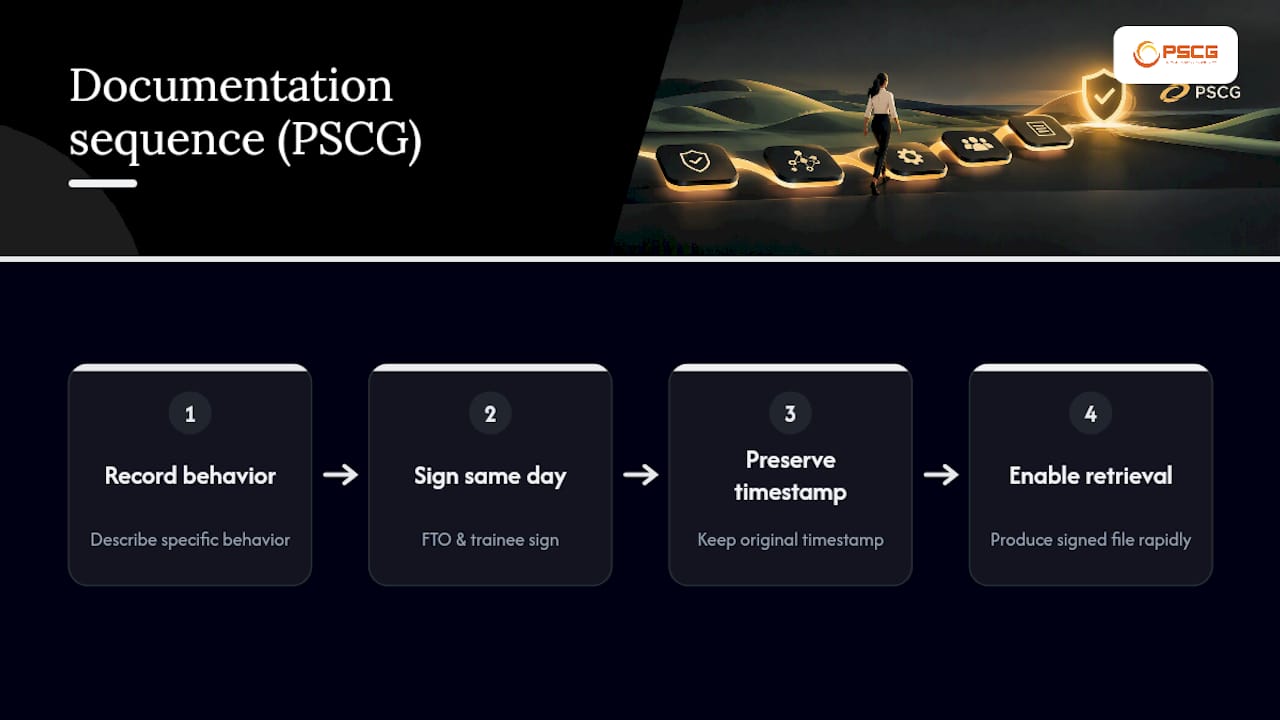
Storage matters as much as content. Departments that can produce a complete, signed training file within hours of a records request are in a fundamentally stronger legal position than departments still hunting through filing cabinets. This is one area where Thepscgroup’s operational risk reduction work overlaps directly with FTO program design, since the same documentation discipline that protects a department in an EMS incident protects it in a use-of-force claim.
Do You Need POST Approval, and What Does It Actually Check?
State POST commissions and their equivalents don’t grade every detail of your curriculum. Review packets, including California’s, focus heavily on two things: whether your SEGs and DOR forms meet the standardized format, and how well your program covers community relations and professional demeanor. The POST Field Training Program review packet makes clear that Section 6, covering professional conduct and community interaction, gets specific subcommittee attention rather than a rubber stamp.
That focus tells you something practical: approval reviewers care less about how many hours your program runs and more about whether your evaluation instruments are standardized and whether your curriculum actually teaches the interpersonal judgment that generates the most citizen complaints and lawsuits. A program with a thin legal module and a weak professional-demeanor component will struggle in review even if its patrol procedures section is excellent.
Not every state runs FTO programs through a formal POST-style approval process, and requirements vary by jurisdiction. Where your state doesn’t mandate a specific standard, the POST framework still functions as a strong de facto benchmark, since its SEG structure and DOR format have been stress-tested across a large number of agencies and legal challenges. Building toward that standard even without a mandate puts your department in a stronger position if a training-related claim ever reaches a courtroom, since you can point to alignment with a recognized model rather than an internally invented one.
How Should FTO Programs Handle Trainee Stress and Wellness?
Field training is one of the highest-stress periods in an officer’s early career, and a program that ignores that reality tends to lose good candidates to burnout rather than performance failure. Trainees are being evaluated daily, often by someone who also controls their schedule and reputation among peers, which creates a pressure environment unlike almost any other phase of the job.
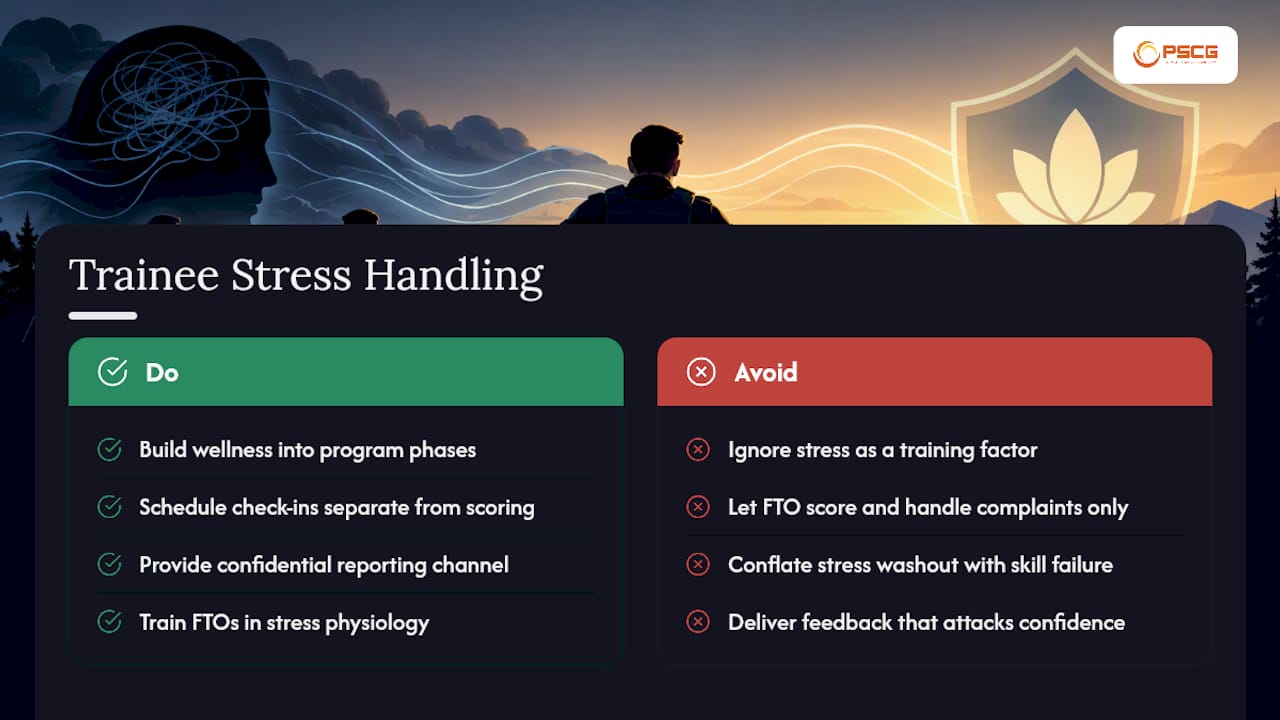
Building wellness into the program structure isn’t a separate initiative bolted onto training. It shows up in how phases are paced, how feedback is delivered, and how FTOs are trained to recognize the difference between a trainee who’s struggling with a skill and one who’s struggling with the stress of being constantly watched and scored. FTOs who understand basic stress physiology tend to give more accurate evaluations, because they can distinguish a trainee having a bad day from a trainee who genuinely lacks a competency.
Practical steps include building in scheduled check-ins separate from performance scoring, giving trainees a channel to raise concerns about their FTO relationship without it affecting their evaluation, and training FTOs to deliver corrective feedback in a way that addresses behavior without attacking confidence. Departments that pair field training with peer support resources, and that make clear those resources are confidential and separate from the FTO’s scoring authority, see better trainee retention through the program’s most difficult middle phases. A trainee who washes out from stress rather than skill deficiency represents a real loss, both in recruiting cost and in the message it sends to the next cohort about what the program is actually testing.
What Role Does Technology Play in Modern Field Training?
Paper DOR forms still work, but electronic systems have become the practical standard for agencies serious about defensible documentation. A digital DOR platform timestamps entries automatically, flags missing documented-situation narratives before a shift ends, and makes it far easier to aggregate scores across a cohort to spot trends a supervisor might miss reading individual forms one at a time.
Recorded scenario simulation is the other significant shift. Being able to record a scenario once and have three different FTOs score it independently is what makes inter-rater reliability testing practical rather than theoretical. Without recording, you’re relying on live side-by-side observation, which is harder to schedule and easier to skip when shift staffing gets tight.
Body-worn camera footage has also become a quiet but important tool in field training review, since it lets an FTP SAC or coordinator review a disputed evaluation against actual video rather than relying entirely on the written narrative and two conflicting memories of what happened. That doesn’t replace the DOR, but it does give appeals processes a factual anchor they didn’t have a decade ago.
None of this technology fixes a bad SEG or a poorly trained FTO on its own. A digital system built on vague evaluation criteria just produces vague documentation faster. The real value shows up when the technology sits on top of a well-designed program structure, capturing and organizing data that a well-trained FTO was already generating through careful observation.
Why Does Diversity and Inclusion Matter Inside the FTO Program?
The FTO relationship is one of the most influential in an officer’s career, and it’s also one where bias, conscious or not, can quietly shape who advances smoothly and who struggles. A trainee evaluated by an FTO who shares little cultural or communication style overlap with them can face subtle friction that has nothing to do with actual competency, and standardized SEGs exist partly to guard against exactly that kind of drift.
Bias mitigation training for FTOs isn’t a separate compliance exercise bolted onto the instructor curriculum. It belongs alongside the same DOR-writing and evaluation-scoring instruction every FTO receives, because the goal is the same: score the observed behavior, not an impression shaped by unrelated factors. Agencies that actively recruit FTOs from a range of backgrounds also tend to build trainee cohorts that see more of themselves reflected in the training staff, which research on mentorship consistently links to stronger early-career retention.
Community relations and professional demeanor already receive dedicated attention in POST review packets, and that same lens should extend to how the program treats trainees themselves. A field training officer program that produces officers skilled at treating the public equitably but trains those officers through an evaluation process riddled with inconsistent, biased scoring is teaching a contradiction. Inter-rater reliability checks, discussed earlier as a liability tool, double as a bias check when reviewers specifically look for scoring gaps that correlate with a trainee’s background rather than their actual performance on the recorded scenario.
Why Standardized FTO Programs Matter Beyond the Training Unit
A field training officer program is where a department’s stated values either become real habits or stay slogans on a wall. The agencies that treat their SEGs and DOR data as living documents, not paperwork, consistently produce officers who handle ambiguity better on their own. Standardization isn’t bureaucracy for its own sake. It’s how a department proves, to a court and to its own community, that competence was actually taught and actually measured.
If your program could use an outside audit or a rebuilt training design, reach out to Thepscgroup.
— Mike
How PSCG Helps Agencies Strengthen Field Training
Thepscgroup is the direct implementation partner for agencies that have identified a gap in this article and want it fixed rather than just diagnosed. Where a generic training vendor sells a fixed curriculum, Thepscgroup builds training design, documentation systems, and audit processes around your department’s actual call volume, staffing model, and legal exposure, drawing on field experience across EMS and public safety operations.
Services that map directly onto the gaps covered here include Professional Education Services for building or updating FTO instructor certification, Operational Risk Reduction for documentation overhaul and liability exposure review, and organizational assessment work that ties FTO outcomes back into a department’s broader operational structure. Every engagement starts with a review of where your current DOR, SEG, and instructor certification practices stand against recognized standards.
If your FTO program hasn’t had an outside review in the last few years, that’s the practical next step. Visit Thepscgroup to request a program review or a tailored training design consultation.
Sources
- FTO (Field Training Officer) Training Guide — NCJRS
- EMS Field Training and Evaluation Program (EMS-FTEP) — NEMSMA
- FEMA — Continuous improvement
FAQ
What Does a Field Training Officer Do?
A field training officer supervises and evaluates a new officer’s transition from academy graduate to independent patrol, scoring daily performance using DOR forms and SEG-defined behavior categories. The FTO also writes documented-situation narratives for any extreme rating and mentors the trainee through progressively more independent phases.
How Long Is Officer Field Training?
Most programs run at least ten weeks total, structured across an orientation period and two to three evaluated phases, based on timelines documented in the NCJRS FTO Training Guide. Exact length varies by agency size, call volume, and whether a trainee needs a remedial extension.
How Hard Is the FTO Program?
The FTO program is demanding for both the trainee, who’s evaluated daily while learning to handle real calls independently, and the FTO, who has to score honestly while teaching. Programs with clear SEGs and a supportive, well-trained FTO tend to feel structured and fair rather than punishing, while programs with vague evaluation criteria create unnecessary stress on both sides.
Do Field Training Officers Get Paid Extra?
Many departments offer FTOs additional compensation, often as a stipend or a pay differential, though the amount and structure vary by agency and union contract and aren’t standardized nationally. Agencies without a specific pay differential should still budget for the additional instructor certification and evaluation training the role requires, since Thepscgroup’s instructor best-practices work shows well-prepared FTOs consistently produce more consistent SEG scoring than those given the role without formal preparation.