



Close the reimbursement gap by fixing four things at once: documentation discipline, rapid insurance verification, disciplined accounts receivable follow-up, and coordinated state advocacy. Every dollar an agency loses to weak ambulance balance billing practices starts as a preventable gap upstream, not a collections problem downstream. Consultants work with municipal leaders and private ambulance companies on this kind of provider-side reimbursement optimization, and the strategies below reflect what actually closes the gap.
TL;DR:
- Most revenue is lost within the first 48 hours after a call due to missed insurance discovery, documentation issues, or unresolved claims.
- The average reimbursement shortfall per transport is about $1,526, with Medicare alone underreimbursing relative to actual costs.
- Improving field documentation, mileage reconciliation, and pre-bill quality checks can recover a significant portion of lost revenue before claims are even submitted.
- Payer strategies should be tailored, especially for Medicare Advantage plans and commercial payers, to effectively dispute underpayments and negotiate better rates.
- Regular AR and collections procedures, including clear escalation timelines and patient-friendly payment options, are essential to minimizing aging claims and enhancing recovery.
Table of Contents
- What Is Ambulance Balance Billing From the Provider’s Side?
- Your 30- and 90-Day Checklist to Shore Up Claims and Collections
- What Does the Reimbursement Gap Actually Look Like?
- How Do You Protect Claim Value Before You Ever Bill?
- Which Payers Need Different Playbooks?
- How Should You Structure Accounts Receivable and Collections?
- What Policy and Funding Levers Can Close the Gap Faster?
- The PSCG Perspective on Closing the Revenue Leak
- Ready to Close Your Agency’s Reimbursement Gap?
- Sources
What Is Ambulance Balance Billing From the Provider’s Side?
For an EMS agency or private ambulance company, ambulance balance billing means the operational and financial discipline of pursuing every dollar a payer legitimately owes, while managing the residual balance that falls to the patient after insurance pays its share. That is a different job than a patient trying to understand a surprise bill. It is a revenue-cycle function, and it lives at the intersection of field documentation, coding accuracy, payer contracts, and collections policy.
Get this wrong and two things happen simultaneously: your agency underrecovers on claims it should have won, and patients end up facing balances that damage community trust and generate complaints to elected officials. Get it right, and you protect both your budget and your reputation. The rest of this playbook breaks down how.
Your 30- and 90-Day Checklist to Shore Up Claims and Collections
Most agencies lose revenue in the first 48 hours after a call, not in the collections department months later. Fixing that sequence pays off faster than almost anything else you can do this quarter.
- Run insurance discovery within 24 to 48 hours of transport, and re-run it for any account still unresolved after two weeks.
- Add pre-bill quality checks for level of service, medical necessity documentation, and mileage segmentation before a claim ever leaves the building.
- Set AR aging triggers at 45, 60, and 90 days, with a named owner responsible for action at each stage.
- Build patient-friendly payment options, including a written hardship policy, before balances go to collections.
- Identify your top five payers by volume and dollar value, and build payer-specific follow-up templates for each.
Pro Tip: Assign one staff member to own eligibility discovery as their primary job function, even part-time. Agencies that treat this as “whoever has time” consistently see it slip, and a missed discovery window is often the single costliest error in the entire billing cycle.
What Does the Reimbursement Gap Actually Look Like?
The numbers are stark, and they explain why so many agencies feel like they’re running faster just to stay in place. The GADCS/RAND analysis found a mean cost of $2,673 per ambulance transport against a mean reimbursement of $1,147, an average shortfall of roughly $1,526 on every single call.
The math that matters: A shortfall per transport means a mid-sized agency running thousands of transports a year is absorbing millions in unrecovered cost annually, before factoring in payer mix variance.
That $1,526 gap is a national average, and local numbers move around it depending on payer mix and provider type:
- Government-run services and private providers see different reimbursement patterns depending on their share of Medicare, Medicare Advantage, and commercial patients.
- Medicare alone underreimburses relative to actual transport cost, which is a structural issue no amount of billing discipline fully offsets.
- Roughly A significant portion of agencies cannot break out their own payer mix, which means a quarter of the industry is making budget decisions blind.
- Agencies piloting treatment-in-place billing for calls that don’t end in transport are seeing measurable revenue where commercial payers reimburse for it.
Translate the national gap into your own numbers by multiplying your annual transport volume by your local cost-per-transport figure, then comparing it against your actual average reimbursement. That local math, not the national average, is what belongs in your budget presentation to the finance committee.
How Do You Protect Claim Value Before You Ever Bill?
The strongest ambulance balance billing strategy is the one that never lets a weak claim leave the building. Every dollar you protect in the field is a dollar you don’t have to fight for later in an appeal.
Documentation and mileage. Standardize your ePCR fields so medical necessity and transport level are captured consistently, not left to individual crew judgment. Mileage has to follow Medicare’s HCPCS segments: A0425 for the first 7 miles, A0435 for miles 8 through 15, and A0436 for anything beyond 16 miles. Reconcile that mileage against odometer readings and CAD/GPS data before charge entry, because a mismatch there is one of the fastest ways to trigger a payer edit.
Pre-bill quality assurance. Build payer-specific edits into your workflow so a claim missing a required element gets caught before submission, not after a denial. The revenue-cycle guidance from RevGuard treats this upstream field-to-claim handoff as the single biggest lever in ambulance billing recovery, ahead of anything you do in collections.
| Control point | What to check | Typical failure mode |
|---|---|---|
| Field documentation | Medical necessity, level of service | Vague or missing clinical narrative |
| Mileage capture | HCPCS segment accuracy, GPS/odometer match | Unsegmented or estimated mileage |
| Pre-bill QA | Payer-specific edit rules | Claims submitted with known defects |
| Eligibility discovery | Coverage confirmed within 24–48 hours | Discovery skipped or delayed past the window |
Run eligibility and insurance discovery within that 24 to 48 hour window every time, and re-run it for any account still unresolved. Then train your crews and QA staff on the two or three documentation habits that drive the most denials at your agency specifically, rather than a generic checklist. Guidance on ambulance mileage billing rules walks through the segment-level detail agencies most often get wrong.
Pro Tip: Run a rolling audit of your ten largest denials each month. Nine times out of ten, the pattern points to one documentation habit or one payer’s edit rule, and fixing that single pattern recovers more revenue than a broad policy rewrite.
Which Payers Need Different Playbooks?
Not every payer behaves the same way, and treating them identically leaves money on the table. Medicare fee-for-service pays on a predictable but consistently low schedule. Medicare Advantage plans, whose enrollment keeps growing, often reimburse below traditional Medicare rates, which means tracking MA versus FFS claim volume separately has become a necessity, not a nice-to-have. Commercial payers vary widely, and that variance is exactly where negotiated contracts and facility agreements can move the needle.
Build your approach around these tactics:
- Pursue facility contracts or local fee schedule agreements where commercial payer volume justifies the negotiation effort.
- Watch for Medicare Advantage alternative payment model pilots, since some plans are experimenting with different reimbursement structures for ground ambulance.
- Document systematic underpayment patterns with dates, claim numbers, and dollar amounts before requesting a payer meeting, and escalate to formal appeal or independent dispute resolution when the payer relationship and applicable law allow it.
- Understand how your state’s balance-billing statute affects your leverage. Several states now require insurers to reimburse non-contracted agencies at locally established fees or multiples of Medicare, though ERISA preemption limits that requirement to non-self-funded plans.
Knowing which lever applies to which payer is what separates agencies that recover systematically from agencies that recover by accident.
How Should You Structure Accounts Receivable and Collections?
An aging claim is a claim losing value every day it sits untouched. Build a clear escalation timeline and staff it deliberately rather than hoping someone gets to it.
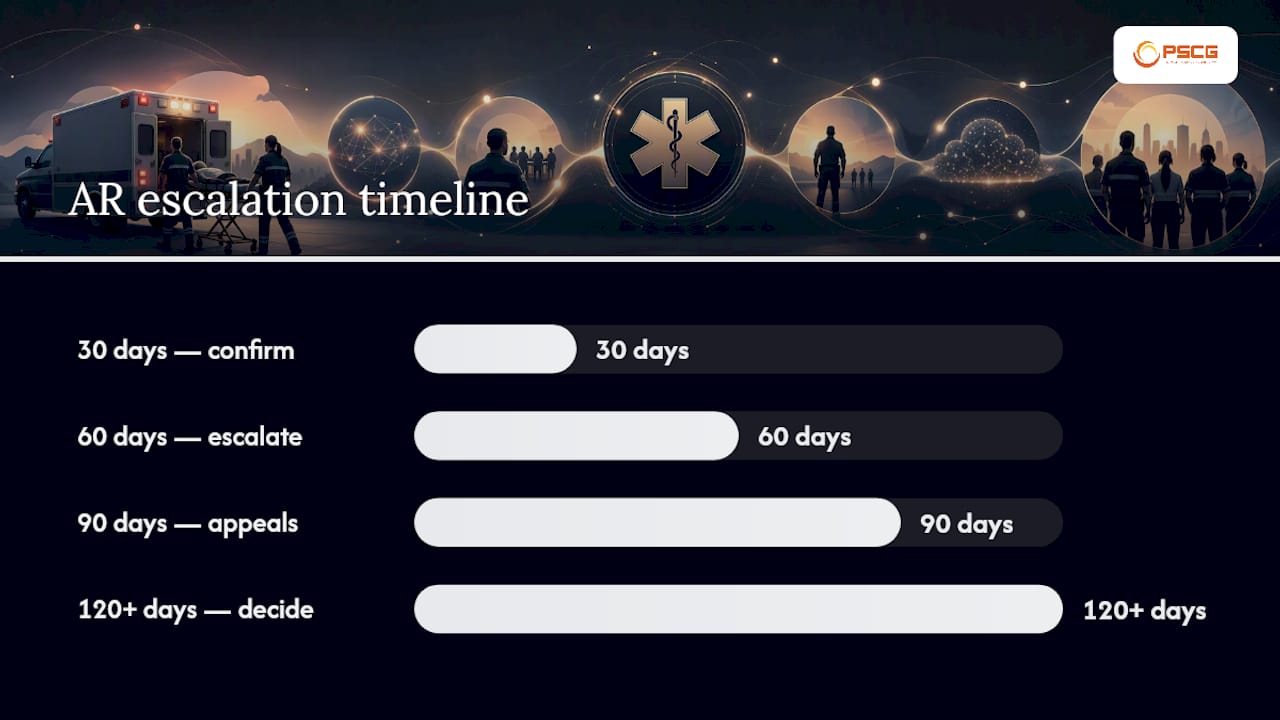
- At 30 days, confirm claim status and resolve any missing information.
- At 60 days, escalate unresolved claims to a named follow-up owner with a payer-specific script.
- At 90 days, initiate formal appeals or payer calls for anything still outstanding.
- Beyond 120 days, decide deliberately whether an account moves to a payment plan, hardship review, or a collections partner, rather than letting it drift there by default.
Track a handful of KPIs consistently: days in AR, with a target under 60; clean claim rate; denial rate; and cost to collect. The practitioner guidance on cashflow management consistently points to payer-specific reporting and real-time claims monitoring as the difference between agencies that shrink their AR and agencies that watch it grow.
On the patient side, plain-language billing statements, text and online payment options, flexible payment plans, and a written hardship policy protect community trust while still improving self-pay recovery. If you work with a third-party collections partner, choose one with EMS-specific experience and community-first practices. An outline on EMS collections improvement walks through how to structure that vendor relationship without damaging patient relationships.
Pro Tip: Review your hardship policy with your finance team once a year. Reimbursement rates shift, and a policy that made sense two budget cycles ago can quietly stop covering the patients it was designed for.
What Policy and Funding Levers Can Close the Gap Faster?
Operational fixes only go so far when the underlying reimbursement rate is structurally too low. States have taken varied approaches: some allow local fee schedule approval, some set payment at multiples of Medicare, some cap balance-billing exposure through arbitration. Each has real limits, particularly around ERISA-exempt self-funded plans that state law simply cannot reach.
- Build your case for a local fee schedule using your own per-transport cost data and payer mix, not just national averages.
- Explore short-term revenue options: facility contracts, mobile integrated health or treatment-in-place agreements, subscription-style community models, and available grant funding.
- Engage your state ambulance association and local legislators directly, and track the Advisory Committee on Ground Ambulance and Patient Billing’s recommendations as they move through state legislatures.
- Use municipal cost-analysis data, not anecdote, when you sit down with elected officials to make the budget case.
A municipal EMS cost analysis guide walks through the methodology behind building that case with numbers a finance committee will actually accept.
The PSCG Perspective on Closing the Revenue Leak
Most agencies already know they’re underreimbursed. What they underestimate is how much of that gap sits inside their own control, not the payer’s. We’ve seen agencies recover meaningful revenue simply by fixing mileage segmentation and pre-bill edits, before ever touching a payer contract.
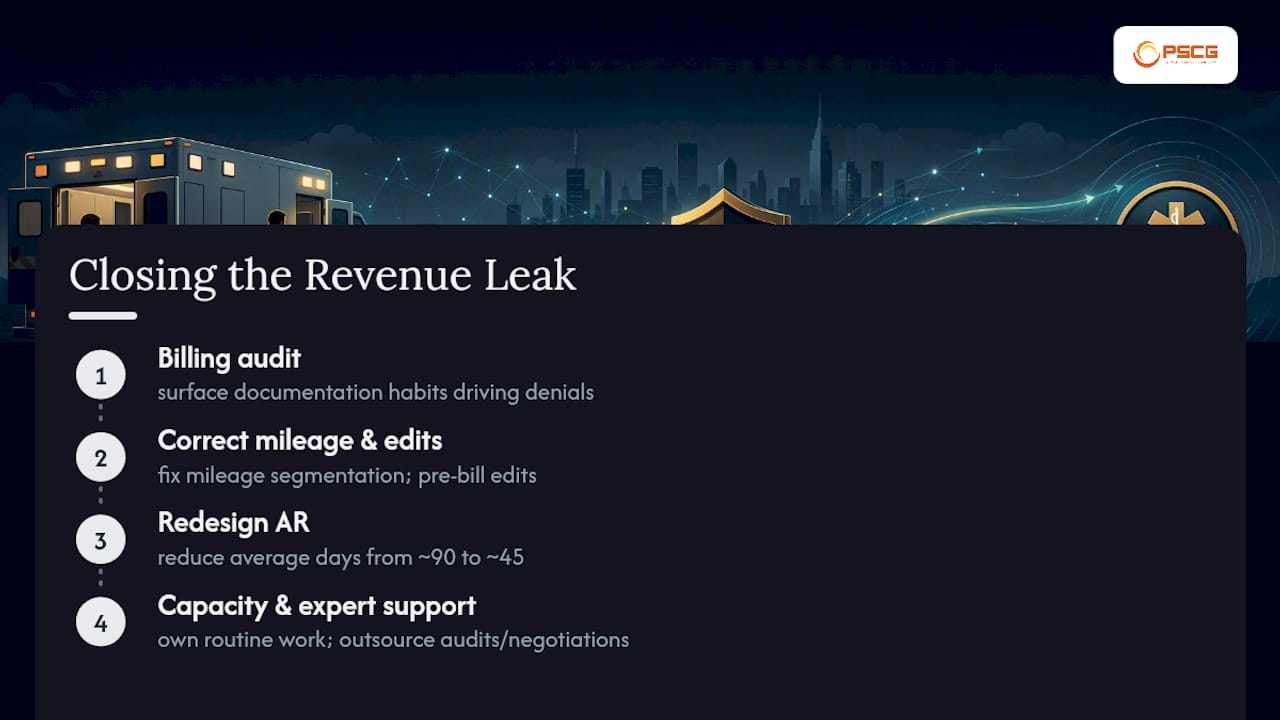
The pattern repeats: a billing audit surfaces two or three documentation habits driving most of the denials, a mileage-rule fix closes an entirely avoidable leak, and a redesigned AR process turns a 90-day average into something closer to 45. Work in Connecticut EMS billing and reimbursement reflects that same sequence.
A municipal leader should build internal capacity for the routine work, documentation, discovery, AR follow-up, but bring in outside expertise when the fix requires objectivity: a full billing audit, payer negotiation support, or a fee-schedule case built for elected officials who need the numbers, not the narrative.
— Mike
Ready to Close Your Agency’s Reimbursement Gap?
Municipal leaders and private ambulance companies turn to specialized partners when the gap between what a transport costs and what it recovers has gotten too wide to fix with another policy memo. Specialized reimbursement consulting work starts with actual cost-per-transport and payer-mix data, so recommendations are built for each budget, not a national average.

Our services most relevant to ambulance balance billing include billing audits, mileage-rule remediation, payer-negotiation support, and full AR process redesign, alongside broader municipal EMS strategy work for leaders planning further out. If your agency is carrying a reimbursement gap that keeps showing up in budget season, request a cost analysis or a quick billing audit through Thepscgroup and get a clear picture of where your revenue is actually leaking within weeks, not months.
Sources
- Quantifying the gap between expenses and revenue for EMS services
- Ambulance service billing: master guide