

Patient care always comes first, and you can still protect most evidence without slowing that care down. The two actions that matter most in the first minutes are limiting who enters the scene and leaving clothing and personal items as close to untouched as the patient’s treatment allows. Everything else, from bagging to documentation, follows from getting those two things right.
TL;DR:
- When removing clothing, cut around existing holes or tears, place each item in a separate paper bag, and never shake garments before packaging.
- Record arrival, contact, and movement times, identify everyone who entered, quote patient statements verbatim, and document each item’s location and transfer recipient.
- For chain of custody, assign every package a unique identifier, separate items, seal and initial each bag, and obtain a signed, timestamped handoff record.
- Document who requests invasive specimen collection and why; without a warrant or clear legal authority, delay it and contact medical control if care protocols conflict.
- For sexual assault cases, limit contact to care needs, advise against washing or changing when timing permits, and request a SANE or SART referral.
Table of Contents
- Scene Safety and Setting Your Priorities on Arrival
- Prehospital Steps to Protect Evidence During Patient Care
- Documentation and Chain of Custody Basics
- Working with Law Enforcement Within Legal and Ethical Limits
- Special Scenarios: Assault, Death, and Vehicle Crashes
- Building These Habits into Agency Policy and Training
- Why This Matters Beyond the Call
- How We Help Agencies Put This Into Practice
- FAQ
- Sources
Scene Safety and Setting Your Priorities on Arrival
Your first thirty seconds on scene set the tone for everything that follows. Scan for weapons, unstable structures, hostile bystanders, or signs the threat has not passed before you commit to patient contact. If the scene is not secure, stage and wait for law enforcement while following hospital security best practices to protect scene continuity during patient transport. No piece of evidence is worth a provider injury.
Once it is safe to proceed, keep your footprint small. The Crime Scene Investigation guide from the Department of Justice advises initial responders to treat a location as a potential crime scene until proven otherwise, which means limiting who walks through it matters as much for EMS as it does for police.
A few habits keep contamination risk low from the start:
- Send in only the personnel needed for patient care, not every available crew member.
- Use one path in and one path out, and have everyone use the same route.
- Note anyone or any vehicle leaving the area before you arrive, and mention it to law enforcement later.
- Avoid touching anything that is not the patient unless care requires it.
Pro Tip: Designate one provider to “think evidence” while the rest of the team focuses entirely on the patient. That person flags items to avoid and tracks what gets moved.
Prehospital Steps to Protect Evidence During Patient Care
Good preservation habits do not slow down good medicine. They run alongside it. The goal is to treat the patient fully while leaving a lighter footprint on the physical scene.
Follow this sequence as you work:
- Assess and treat without delay. Nothing here changes your clinical priorities.
- Avoid cutting through bullet holes, knife holes, or tears in clothing when you need to remove garments. Cut around them instead.
- Minimize washing or wiping the patient’s skin beyond what care requires.
- Photograph or verbally note the position of items you must move, including furniture, weapons, or personal belongings.
- Keep the patient’s clothing and linens with the patient whenever possible rather than leaving them behind.
State and sample EMS protocols reinforce these same habits. Kentucky’s statewide EMS protocols instruct crews to use a single entry and exit path, avoid cutting through existing holes in clothing, and bag removed clothing in paper rather than plastic.
A short checklist for bagging:
- Place each clothing item in its own paper bag, never plastic, since plastic traps moisture and accelerates degradation of biological material.
- Label each bag with the patient’s name, the item inside, the time, and your initials.
- Never shake out clothing before bagging it; loose trace evidence can fall away.
- Document every item you moved and why, right on the patient care report.
Documentation and Chain of Custody Basics
Your patient care report is often the only written record of what the scene looked like before anyone else arrived. Treat it that way.
Capture these fields whenever a call has potential evidentiary value:
- Time of arrival, time of patient contact, and time of any item movement.
- Names and roles of everyone who entered the scene with you.
- Verbatim patient statements in quotation marks, word for word, not paraphrased.
- A plain description of any item moved, where it was found, and where it ended up.
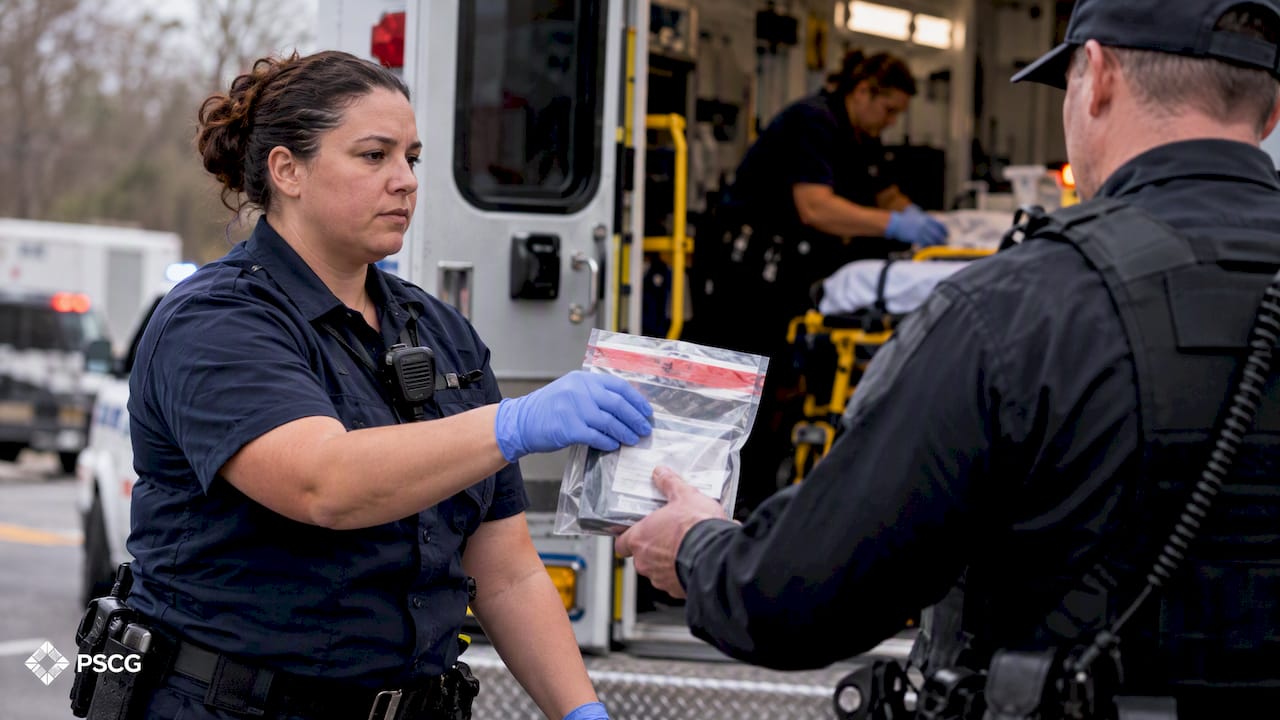
- The name and badge number of the law enforcement officer you hand items to.
A recent study of EMTs found that while most scored well on documentation, preservation knowledge lagged behind recognition and collection skills. That gap is exactly why training specifically on preservation, not just documentation closes real performance holes on scene.
Chain of custody starts the moment you touch an item. NIST’s OSAC standard for on-scene collection and preservation calls for unique identifiers on every package, separate containers for separate items, and a signed, timestamped record every time custody changes hands. Seal each bag, initial across the seal, and get a signature from the officer who receives it. Our EMS documentation standards guide walks through PCR templates that build these fields in rather than leaving them to memory.
Working with Law Enforcement Within Legal and Ethical Limits
Patient care obligations do not disappear because an officer asks for something. ACEP guidance makes clear that clinicians balance law enforcement requests against patient rights, consent, and in some cases a warrant requirement before intrusive evidence collection can proceed, as outlined in guidance on law enforcement information gathering in the emergency department.
In practice, that means:
- Comply with reasonable requests to preserve items or scene access when doing so does not interfere with care.
- Decline or delay requests that require invasive specimen collection without a warrant, and document the request.
- Contact medical control when an officer’s request conflicts with treatment protocols.
- Note any court order, warrant, or specific legal basis an officer cites, by name, in your report.
When in doubt, write down exactly what was asked, by whom, and what you did. That record protects your patient and your agency.
Special Scenarios: Assault, Death, and Vehicle Crashes
A few call types call for specific adjustments beyond standard trauma care.
Sexual assault patients: Limit physical contact with the patient to what care requires. Advise against showering, changing clothes, eating, or drinking when transport timing allows that conversation. Bag each clothing item separately in paper, and request a SANE or SART referral at the receiving facility, consistent with the SAFET-I framework for prehospital sexual assault care.
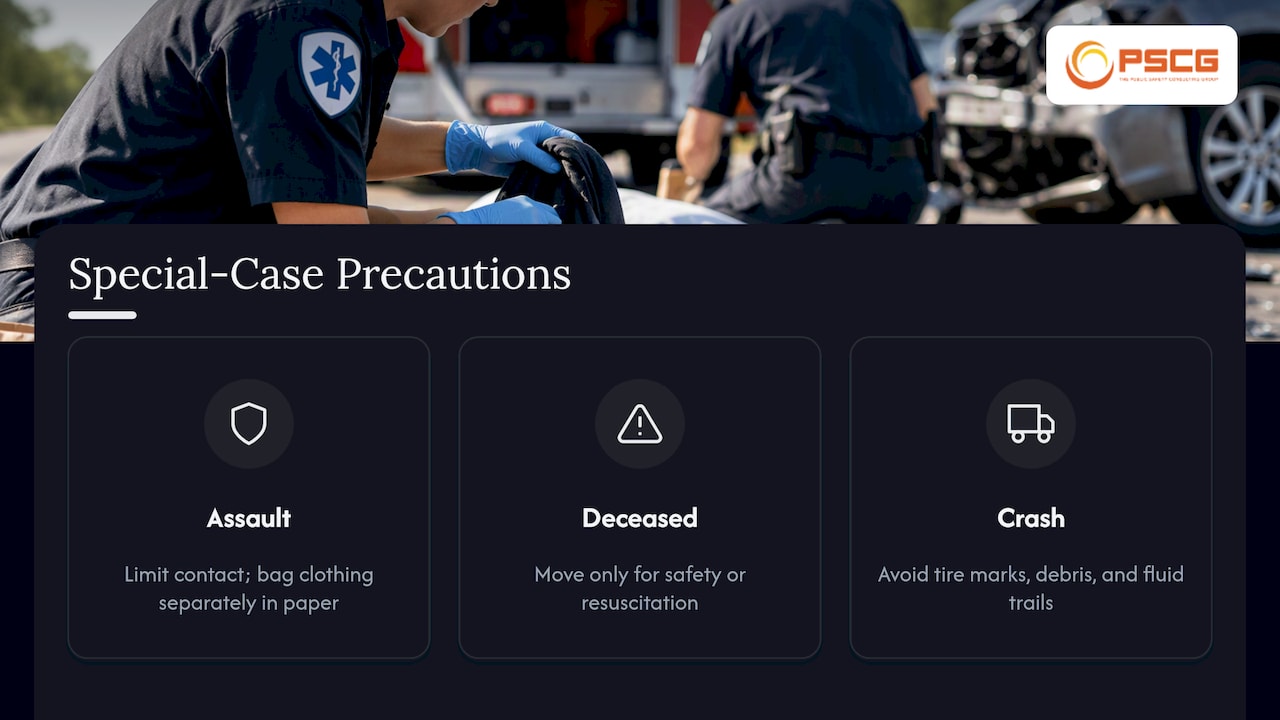
Deceased patients: Move the body only when necessary for safety or when protocol requires resuscitation attempts, and document the reason for any movement. Coordinate directly with the medical examiner and law enforcement before anyone leaves the scene.
Vehicle and crash scenes: Position your unit to avoid driving over tire marks, debris fields, or fluid trails. Treat broken glass and skid marks as evidence until law enforcement says otherwise.
Pro Tip: In any special-case scenario, slow down just enough to ask “what am I about to touch or move,” even mid-treatment.
Building These Habits into Agency Policy and Training
Field performance depends on what your SOP says, not just what one provider remembers. Add evidence-preservation checkboxes directly into your PCR template so documentation becomes automatic rather than optional.
Training priorities worth budgeting for:
- Scenario-based drills that pair patient care with evidence awareness, not two separate classes.
- Bagging kits stocked in every unit, paper bags included, not improvised at the scene.
- Clear elimination-sample plans so provider DNA at a scene does not confuse later analysis.
- Defined triggers for calling in CSI or forensic teams rather than leaving that judgment to the moment.
Periodic audits and a written memorandum of understanding with local law enforcement and SANE/SART teams keep these practices current as personnel turn over.
Why This Matters Beyond the Call
Every provider I have talked with over the years has a story about a scene where the right instinct kicked in, or didn’t. The gap is rarely knowledge. It is habit, built through repetition long before the radio tones drop. Leadership that invests in simple, repeatable SOPs gives crews permission to slow down for the ten seconds that protect a case months later, without ever asking them to choose between a patient and a prosecution.
— Mike
How We Help Agencies Put This Into Practice
We help agencies turn guidance like this into SOPs that actually survive shift change, not just policy binders that gather dust. These services include:

- Operational risk reduction audits that identify gaps in evidence-handling and documentation practices before they become liability.
- Professional education services built around scenario drills, not lecture slides.
- Expert witness support related to evidence-handling decisions from calls that end up in litigation.
If your agency is ready to build these habits into policy, visit Thepscgroup or explore our operational risk reduction services to start a conversation.
This article is general information, not a substitute for advice from a qualified lawyer. Consult a qualified legal professional about your own circumstances before acting on anything here.
FAQ
What is the top priority for EMS at a potential crime scene?
Patient care always comes first. Preserve evidence only when doing so does not delay lifesaving treatment, a principle reflected throughout DOJ crime scene guidance.
How should EMS remove clothing without destroying evidence?
Cut around bullet holes, knife holes, or tears rather than through them, and place each item in a separate paper bag. State EMS protocols consistently specify paper over plastic to prevent moisture damage to biological material.
Can law enforcement require EMS to collect specimens from a patient?
Generally no, not without a warrant or clear legal authority, since invasive collection raises consent and Fourth Amendment concerns addressed in ACEP-related guidance on law enforcement requests. Document any such request and contact medical control.
What should EMS document for chain of custody?
Record the time, the item, who found it, who it was handed to, and get a signature from the receiving officer. The NIST/OSAC on-scene preservation standard calls for unique identifiers and separate packaging for every item.
How can agencies improve evidence-handling consistency across shifts?
Build evidence-preservation prompts directly into PCR templates and run regular scenario drills rather than one-time training. We offer professional education services designed around exactly this kind of recurring, scenario-based training.
Sources
- Crime Scene Investigation: A Guide for Law Enforcement
- Law enforcement information gathering in the emergency department: Legal and ethical background and practical approaches
- Kentucky EMS State Protocols (Crime Scene / Preservation of Evidence section)