



Communications center accreditation is the formal, third-party verification that a 911 or public-safety dispatch operation meets recognized national standards for governance, training, and performance. For most directors and chiefs weighing whether to pursue CALEA, APCO, or IAED credentials, the answer is yes: accreditation is a high-return investment that strengthens public trust, tightens operations, and gives your agency a defensible record when budgets or liability questions arise. The rest of this guide lays out the standards, the timeline, and a practical roadmap, with Thepscgroup as a resource along the way.
TL;DR:
- Accreditation readiness depends on having current policies mapped to standards, verified training records, and documented QA processes before starting.
- The four-year CALEA cycle includes annual remote assessments and a quadrennial on-site review, requiring thorough preparation and organization.
- Standardization of policies poses a major challenge, with incomplete directives often delaying remote review assessments.
- External support from Thepscgroup can streamline documentation, policy mapping, and site-visit rehearsals, saving time and effort.
- Eligibility for CALEA is limited to government entities and private agencies evaluated case by case, impacting project planning and scope.
Table of Contents
- What Does Communications Center Accreditation Cover?
- Why Accreditation Matters for Service Quality and Trust
- How Long Does the Accreditation Cycle Take?
- What Are the Steps to Prepare for Accreditation?
- What Should Leaders Confirm Before Authorizing the Project?
- Common Hurdles That Delay Accreditation
- How Thepscgroup Approaches Accreditation Readiness
- Get Help Preparing for Accreditation
- Sources
- FAQ
What Does Communications Center Accreditation Cover?
Three organizations anchors this work, and each serves a different purpose. CALEA’s Public Safety Communications Accreditation Program is the broadest, verifying compliance across organizational structure, supervision, human resources, training, operations, and critical incidents. APCO’s training program certification focuses narrowly on telecommunicator training standards, typically running on a three-year certification cycle. IAED’s Accredited Center of Excellence (ACE) credential zeroes in on dispatch quality assurance, using independent case review to confirm consistent, high-quality call handling.
Eligibility for CALEA accreditation is not universal. Participation is limited to legally constituted governmental entities, component departments, and certain private agencies, with the Commission making case-by-case eligibility determinations. That distinction matters when you’re budgeting a project: a standalone regional dispatch authority may face a different eligibility review than a police department’s in-house communications division.
- CALEA: Whole-center governance, seven standards areas, four-year cycle
- APCO: Training program certification, three-year cycle
- IAED/ACE: Dispatch call quality and independent case review
Why Accreditation Matters for Service Quality and Trust
Accreditation forces a center to write down what it does and then prove it does that consistently. That single discipline, repeatable, documented procedure, changes how a communications center performs under pressure. Standards verification touches training, operations, and critical incidents, which means the same review that checks your call handling also checks whether your staff has the credentials to handle it.
The public benefit runs parallel to the operational one. Accreditation gives elected officials, county commissioners, and residents an outside, credible answer to “how do we know this center is any good?” That’s not a small thing when budget season arrives and a communications center is competing for the same dollars as roads and schools.
- Repeatable procedures reduce variance between shifts and personnel
- External verification builds transparency with governing bodies
- Training and QA requirements strengthen interoperability with partner agencies
Pro Tip: Accreditation reviewers care less about polished policy language and more about whether your actual practice matches the written directive. Audit your own compliance before anyone else does.
How Long Does the Accreditation Cycle Take?
CALEA’s Public Safety Communications Accreditation runs on a four-year cycle, with annual remote web-based assessments and a site-based assessment every four years. That cadence gives leaders a predictable calendar to plan around, rather than a single high-stakes exam.
The milestones generally run in this order:
- Eligibility review by the Commission, confirming your agency qualifies to apply
- Self-assessment against every applicable standard, department by department
- Remote file review, where assessors examine policy and evidence documentation
- Site-based assessment, an on-location verification that occurs quadrennially
- Commission credentialing, the formal accreditation decision
Standards themselves are not static. A Standards Review and Interpretation Committee revises them periodically, and requirements account for agency size and function, so a ten-person dispatch center and a regional consolidated authority are held to appropriately scaled expectations. Build that into your planning: what applied to your peer agency’s last cycle may not apply to yours.
What Are the Steps to Prepare for Accreditation?
The roadmap below reflects how most successful agencies actually move through preparation, not the idealized version.
- Run a readiness assessment and name an Accreditation Manager. One person needs ownership of the project calendar, or it drifts.
- Map every standard to a current written directive. This is where agencies lose the most time. Producing uniform, standard-specific policy language is typically the slowest phase of the entire project, and many leaders underestimate the staffing hours it consumes.
- Organize evidence for remote file review. A sample compliance review at one agency covered 102 individual standards in a single remote assessment, and missing or incomplete directives were the most common finding.
- Rehearse site-visit activities with staff so the on-location assessment reflects daily practice rather than a scripted performance.
- Stage the workload. Break the project into quarterly milestones so day-to-day dispatch operations never suffer for the sake of the accreditation timeline.
- Plan for maintenance. Once accredited, annual compliance reviews and evidence updates become a standing item on your operations calendar, not a one-time push.
Pro Tip: Treat policy mapping like a staffing model, not a writing assignment. Assign standards to specific supervisors with deadlines, the same way you’d assign shift coverage.
Thepscgroup’s guide on public safety accreditation steps and best practices walks through this sequence in more operational detail.
What Should Leaders Confirm Before Authorizing the Project?
Before a chief or director commits budget and staff hours to an accreditation push, a short readiness check in a leadership meeting can save months of rework.
- Written directives exist and are mapped to every applicable standard
- Training and certification records are current, including APCO and IAED credentials where relevant
- QA documentation, call recording retention, and CAD data exportability are all verified
- An Accreditation Manager is named and has stakeholder buy-in from supervisors
- Internal staff hours and any consultant support needed are estimated up front
| Readiness Area | What “Ready” Looks Like |
|---|---|
| Written directives | Every standard has a matching, current policy |
| Training records | APCO/IAED certifications documented and traceable |
| QA and data systems | Call recordings retained; CAD data exportable on demand |
| Project ownership | Accreditation Manager named, empowered, and supported |
| Staffing estimate | Internal hours and consultant roles scoped before kickoff |
Agencies that can check every box tend to move through remote reviews faster. Thepscgroup’s guide on how to assess emergency communications centers effectively offers a deeper look at the assessment methodology behind this checklist.
Common Hurdles That Delay Accreditation
Policy standardization is the hurdle almost every agency underestimates. Writing directives that map cleanly to each standard, rather than paraphrasing an old general order, takes longer than anyone expects going in.
- Missing or incomplete directives are a frequent finding in remote file reviews
- Gaps in call recording retention or QA sampling often surface late, when they’re hardest to fix
- Staff bandwidth suffers if the whole project lands on one supervisor’s shoulders
- External consultants often speed the process by translating standards directly into required evidence formats, rather than leaving staff to interpret language alone
Pro Tip: Document small wins as you go, a completed standard, a cleared file review section. Momentum matters more in a four-year cycle than most leaders expect.
How Thepscgroup Approaches Accreditation Readiness
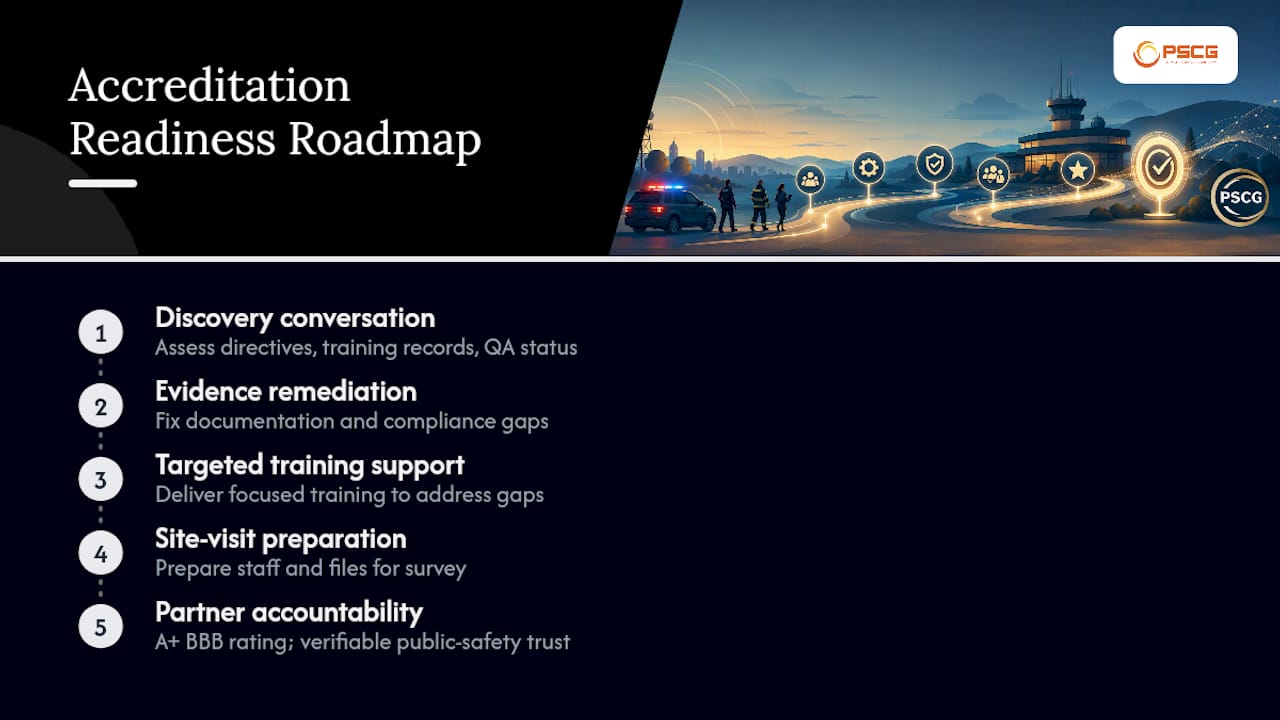
We’ve spent years working alongside communications centers and EMS systems on dispatch evaluation, quality assurance design, and operational risk reduction. Every engagement we run starts the same way: a candid discovery conversation about where your written directives, training records, and QA program actually stand today, not where the org chart says they should be.
From there, our engagements typically move through evidence remediation, targeted training support, and site-visit preparation. Thepscgroup holds an A+ rating with the Better Business Bureau, a signal we take seriously because public-safety leaders deserve a partner who can be checked.
— Mike
Get Help Preparing for Accreditation
Thepscgroup gives agencies a direct alternative to tackling accreditation prep alone with a stretched staff and a looming site visit. Where CALEA, APCO, and IAED set the standards, we help you translate those standards into the written directives, training records, and QA evidence a reviewer actually needs to see, without pulling your dispatch supervisors off the floor for months.
A typical engagement starts with a readiness assessment of your current policies, training files, and CAD/QA data, followed by hands-on documentation support and site-visit rehearsal. That mirrors the work we do across operational risk reduction and EMS quality assurance programs for agencies nationwide. If your center is weighing CALEA, APCO, or IAED accreditation and wants a practical second set of hands, visit Thepscgroup’s services page or reach out through our contact page at Thepscgroup to scope out what a readiness assessment would look like for your team.
Sources
- COMMUNICATIONS ACCREDITATION Winston-Salem (NC) Police Department — CALEA Communications Full Compliance Review
- Communications | CALEA® | The Commission on Accreditation for Law Enforcement Agencies, Inc.
- Accreditation – Emergency Communications – Onondaga County Department of Emergency Communications
FAQ
What Is Communications Center Accreditation?
It’s third-party verification that a public-safety communications center meets recognized standards for governance, training, and operations. CALEA is the broadest program, while APCO and IAED credential more specific functions like training and dispatch quality.
How Long Does CALEA Accreditation Take to Achieve?
There’s no fixed timeline before your first credentialing decision, but the ongoing cycle runs four years, with annual remote reviews and a site visit every four years. Most of the initial preparation time goes into mapping policies to standards, which varies by agency size and current documentation.
Who Is Eligible to Apply for CALEA Accreditation?
Eligibility is limited to legally constituted governmental entities, component departments, and certain private agencies reviewed case by case. The Commission makes the final eligibility determination before an agency can begin the formal process.
What’s the Difference Between CALEA and IAED/ACE Accreditation?
CALEA verifies an entire center’s governance, training, operations, and critical-incident handling across seven standards areas. IAED’s ACE credential focuses specifically on dispatch call quality through independent case review, making it a narrower, complementary credential rather than a substitute.
Can Thepscgroup Help My Agency Prepare for Accreditation?
Yes. Thepscgroup supports agencies through readiness assessments, documentation mapping, and site-visit preparation as part of its public safety consulting services. Visit Thepscgroup to discuss a project scoped to your center’s current standing.