



Lean speeds up flow by cutting waste. Six Sigma improves quality by reducing variation. That’s the whole distinction, and it’s the one most comparisons bury under jargon.
If your process is slow, clogged, or full of steps nobody can explain, start with Lean. If your process runs on schedule but produces inconsistent results or too many defects, start with Six Sigma. When you’re dealing with both a sluggish process and unpredictable output, combine them, an approach known as Lean Six Sigma, applying Lean first to simplify the work and Six Sigma second to control what remains.
- Lean = remove waste, speed up flow
- Six Sigma = reduce variation, cut defects
- Both problems present = simplify with Lean, then stabilize with Six Sigma
Key Takeaways
Choosing between Lean and Six Sigma comes down to diagnosing whether your core problem is slow flow or inconsistent quality, then matching the method, and the timeline, to that diagnosis.
| Point | Details |
|---|---|
| Lean fixes flow | Use value stream mapping, 5S, and kaizen events to cut waste and speed up slow processes in days or weeks. |
| Six Sigma fixes variation | Use DMAIC and statistical tools like control charts and Cpk to reduce defects over a three to six month project. |
| Sequence follows the problem | Start with Lean for visible bottlenecks, Six Sigma for hidden variation, and combine both when you face both. |
| Culture decides success | Programs stall without honest daily problem-solving and active, sustained leadership sponsorship. |
| Pilot before scaling | Test one process with clear baseline metrics before committing to a full training or certification investment. |
If your agency is weighing a Lean kaizen against a full Six Sigma initiative, or trying to figure out which one solves your actual bottleneck, The Public Safety Consulting Group works alongside municipal EMS leaders to design the right pilot for the right problem. Explore our EMS system design examples to see how this plays out in real public safety operations, or reach out through our contact page to talk through your first pilot.
Table of Contents
- What Is Lean, and What Problems Does It Solve?
- What Is Six Sigma, and How Does DMAIC Work?
- Lean vs Six Sigma: How Do They Compare Side by Side?
- Which Method Should You Use First?
- How Lean and Six Sigma Apply to EMS and Public Safety
- Getting Started: A 30 to 90 Day Pilot Roadmap
- Where Lean and Six Sigma Actually Came From
- Where Lean and Six Sigma Programs Go Wrong
- Why Culture and Leadership Decide Whether This Works
- Beyond Lean Six Sigma: Where Agile and TQM Fit In
- An Operator’s Take on the Lean vs Six Sigma Debate
- Sources
What Is Lean, and What Problems Does It Solve?
Lean grew out of the Toyota Production System, built around a simple premise: define value the way the customer defines it, then strip out everything that doesn’t contribute to it. The Lean Enterprise Institute frames Lean as a continuous improvement philosophy focused on eliminating non-value-added activity while improving flow. Practitioners often organize that waste into eight categories, things like waiting, overproduction, defects, and unused talent, and Lean’s job is to make waste visible so teams can address it.
Lean’s toolkit is deliberately hands-on:
- Value stream mapping (VSM) charts every step a product or patient moves through, exposing delays and handoffs that add no value.
- 5S (sort, set in order, shine, standardize, sustain) organizes workspaces so waste has nowhere to hide.
- Kaizen events bring a cross-functional team together for a few focused days to redesign a specific process.
- Kanban visualizes work-in-progress so teams stop starting more than they can finish.
Lean tracks lead time, cycle time, and work-in-progress (WIP) rather than defect counts, and most kaizen events deliver visible results within a short time.
A hospital emergency department that maps its intake-to-treatment value stream typically finds redundant paperwork and unnecessary handoffs; standardizing the intake sequence often cuts waiting time within a single kaizen week. Peer-reviewed reviews of Lean in healthcare confirm this pattern: shorter waits, more standardized care, and better patient and staff satisfaction, though the financial upside is harder to pin down in the literature.
Pro Tip: Run your first value stream map on paper with sticky notes before you touch any software. Teams see waste faster when they can physically move the steps around the room.
What Is Six Sigma, and How Does DMAIC Work?
Six Sigma is a structured, statistics-driven method for shrinking variation until output becomes reliably predictable. ASQ describes its target as near-perfection, often cited as 3.4 defects per million opportunities, a benchmark few processes hit but one that sets the direction of travel.
Every Six Sigma project follows DMAIC:
- Define the problem and the customer requirement it violates.
- Measure current performance with real data, not assumptions.
- Analyze the data to find root causes of variation.
- Improve the process and test the fix.
- Control the gains with monitoring so the process doesn’t drift back.
The statistical tools carry real weight here. Control charts flag when a process drifts out of statistical control. Design of experiments (DOE) isolates which variables actually drive an outcome. Capability indices like Cpk quantify how consistently a process meets specification.
Six Sigma also runs on a certification ladder, Green Belts handle smaller projects part-time, Black Belts lead complex, full-time improvement work, and Master Black Belts coach and train across an organization, per ASQ’s belt structure. That hierarchy determines who’s qualified to lead what.
A DMAIC project typically runs over several months and needs dedicated data collection, a trained project lead, and management sponsorship, a heavier lift than a kaizen, but suited to problems a five-day event can’t solve.
Lean vs Six Sigma: How Do They Compare Side by Side?
Here’s where the two methods diverge in practice, not just theory.
| Factor | Lean | Six Sigma |
|---|---|---|
| Primary goal | Eliminate waste, speed flow | Reduce variation, cut defects |
| Best problem type | Bottlenecks, excess motion, delays | Inconsistent quality, unclear root cause |
| Common tools | VSM, 5S, kanban, kaizen | DMAIC, control charts, DOE, Cpk |
| Key metrics | Lead time, cycle time, WIP | DPMO, sigma level, Cpk |
| Team model | Cross-functional kaizen team, short burst | Belt-led project team, sustained effort |
| Typical timeline | Days to a few weeks | Three to six months |
Lean simplifies the path work takes through your organization. Six Sigma controls how reliably that path produces the result you promised. Run them together and you get a process that’s both fast and predictable, which is the whole point of Lean Six Sigma.
The overlap matters more than the differences suggest. Purdue’s Lean Six Sigma program explainer notes that Lean Six Sigma simply merges Lean’s efficiency focus with Six Sigma’s statistical discipline, rather than treating them as competitors. If waste is visible, walk the floor and you’ll spot it, Lean is usually the faster fix. If the problem is hidden in the data (why does one shift’s output vary from another’s when nothing looks different?), you need Six Sigma’s analytical horsepower to find the cause.
Which Method Should You Use First?
Match your situation to the approach instead of picking a methodology by reputation.
- Slow flow, long queues, excess WIP → start with Lean. A kaizen event or VSM exercise will surface fixes fast.
- High defect rates, inconsistent output, unclear root cause → start with Six Sigma. You need data to find what’s actually driving the variation.
- Both slow flow and inconsistent quality → run Lean first to strip out waste and simplify the process, then apply DMAIC to control what’s left. SupplyChainToday’s comparison backs this sequencing, and it’s the pattern most practitioners settle on.
- Root cause is unknown and stakes are high (regulatory, safety, patient outcomes) → go straight to Six Sigma; guessing at a fix wastes the runway a five-day kaizen depends on.
Before you commit resources, run through a readiness checklist:
- Measurement systems: can you reliably capture the data you’d need for DMAIC, or is your data collection itself the problem?
- Leadership sponsorship: does a Lean kaizen have a manager ready to greenlight changes on the spot, and does a Six Sigma project have executive backing for a multi-month commitment?
- Training and certification: do you have Green or Black Belt capacity in-house, or will you need outside help?
- ROI horizon: Lean pilots often show results in days; Six Sigma projects need months before you see the payoff.
A Lean kaizen typically costs little beyond staff time for a focused week. A Six Sigma DMAIC project, particularly one led by an outside Black Belt, requires a real budget line and a multi-month calendar commitment.
How Lean and Six Sigma Apply to EMS and Public Safety
The clearest example we’ve seen of this two-step logic in action isn’t in manufacturing. It’s in an EMS system trying to fix its unit turnaround times.
Picture a municipal EMS agency where crews routinely lose 20 minutes at hospital handover. A three-day kaizen maps the handover process, cuts redundant paperwork, and standardizes where equipment gets exchanged. Turnaround time often drops immediately, the kind of quick win Lean is built for.

But say documentation quality still varies wildly between crews after that fix, some incident reports are thorough, others are missing required fields entirely. That’s not a flow problem anymore; it’s a variation problem, and it calls for a DMAIC project: measure current documentation error rates, analyze which fields get skipped most often and why, then build a control step (a structured template, a supervisor spot-check) that holds the gain.
This is the kind of dual-method work we do at The Public Safety Consulting Group, pairing Lean process redesign with Six Sigma-style measurement to fix both the speed problem and the consistency problem in the same system.
Pro Tip: If your agency doesn’t have in-house Black Belt capacity, bring in outside support for the DMAIC phase only. Save your internal team’s energy for kaizen events, where local knowledge of the workflow matters more than statistical training.
- Run the kaizen internally with frontline staff who know the bottleneck firsthand.
- Bring in outside expertise for the DMAIC phase if your team lacks statistical training.
- Call a consultant when the variation problem touches compliance, billing, or reimbursement, areas where a wrong root-cause guess gets expensive.
Getting Started: A 30 to 90 Day Pilot Roadmap
Pick one process, not five. Trying to fix everything at once is how improvement programs stall before they start.
- Select a pilot process and set baseline metrics. Choose something visible and measurable, turnaround time, error rate, wait time, so before-and-after comparisons are credible.
- Match the method to the problem using the decision matrix above. Don’t default to Six Sigma because it sounds more rigorous if the real issue is a clogged workflow.
- Assign a sponsor and a project lead, then schedule your cadence: a kaizen is typically a single focused week; a DMAIC project needs recurring check-ins over three to six months.
- Decide whether to train internally or hire external belts. Training builds long-term capacity; hiring a consultant gets faster results on your first complex project.
- Define your quick win and your scale-up criteria before you start, so success is obvious and the case for expanding the program writes itself.
Where Lean and Six Sigma Actually Came From
Lean traces back to Toyota’s manufacturing floor in postwar Japan, where engineers built a system around eliminating waste and pulling production based on actual customer demand rather than forecasts. The philosophy spread slowly through American manufacturing in the 1980s and 1990s before researchers coined the term “Lean” to describe it for a Western audience.
Six Sigma has a more corporate origin story. Motorola developed it in the 1980s to cut manufacturing defects using rigorous statistical control, then General Electric popularized it in the 1990s under Jack Welch, turning it into a company-wide discipline with belts, certifications, and a defined project structure. That corporate backing is part of why Six Sigma still carries a more formal, credentialed feel than Lean does.
The two methods ran on separate tracks for years, Lean in operations and manufacturing floors, Six Sigma in quality departments, until practitioners in the early 2000s started noticing the obvious: a process could be fast and still produce inconsistent results, or consistent and still be painfully slow. Combining them into Lean Six Sigma wasn’t an academic exercise. It was a practical response to watching one-dimensional fixes fail to solve two-dimensional problems.
Both methods have since moved well beyond manufacturing. Healthcare, government services, and public safety agencies now run kaizen events and DMAIC projects using the same core logic Toyota and Motorola built decades ago, just applied to patient flow, incident reports, and dispatch timing instead of assembly lines.
Where Lean and Six Sigma Programs Go Wrong
Most Lean and Six Sigma programs don’t fail because the methodology is flawed. They fail because of predictable, avoidable execution mistakes.
The most common one: treating a kaizen event as a one-time fix instead of the start of a habit. Teams celebrate the quick win, then drift back to old habits within a few months because nobody built a mechanism to sustain the change. Lean’s “sustain” step in 5S exists precisely because gains erode without ongoing attention.
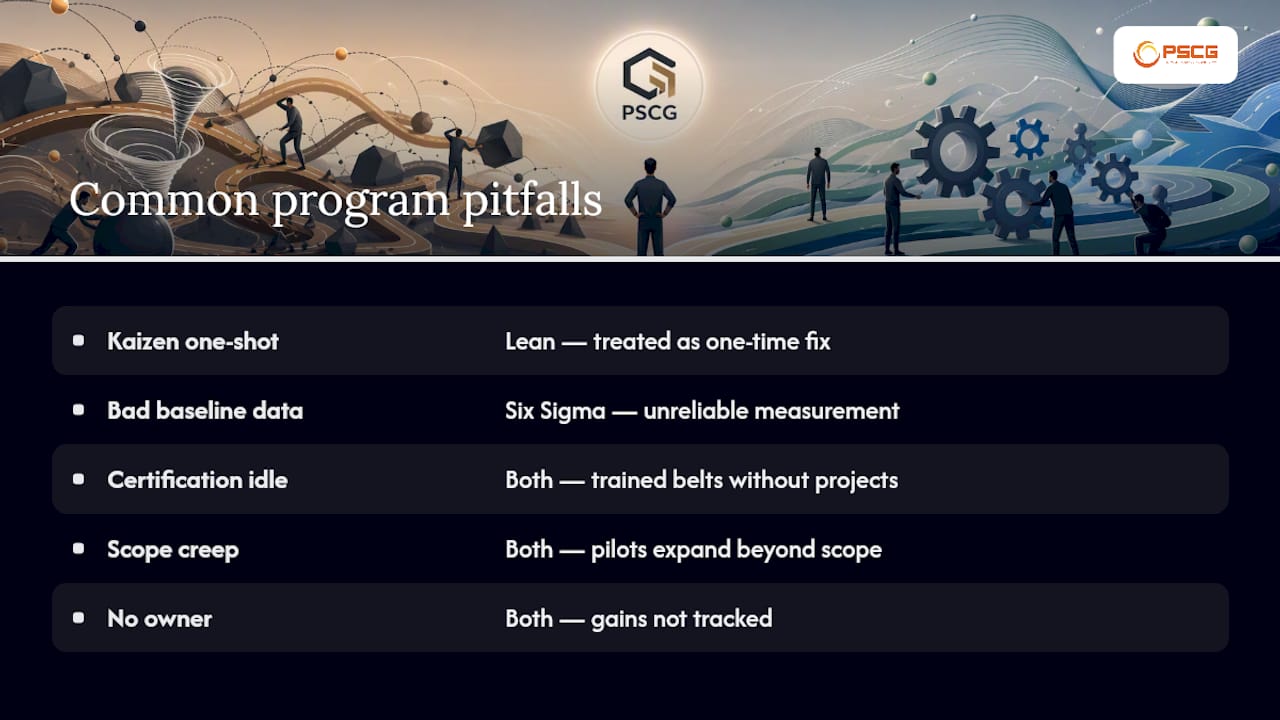
Six Sigma programs run into a different trap: launching a DMAIC project without reliable baseline data. If your measurement system itself is inconsistent, statistical analysis built on top of it produces false confidence rather than real insight. Teams sometimes spend weeks analyzing noise because nobody checked whether the data collection process was trustworthy first.
Certification without application is another recurring pitfall. An organization trains a batch of Green Belts, then hands them no real projects, and the skill atrophies. Belts need active project pipelines, not just classroom hours, to stay useful.
Scope creep kills momentum on both sides. A kaizen meant to fix one handoff spirals into redesigning an entire department; a DMAIC project meant to solve one defect type expands into auditing the whole production line. Tight scope is what makes 30 to 90 day pilots work.
Finally, both methods stall without a visible owner. Someone has to track whether the gains held three months later, or the improvement quietly reverses.
Why Culture and Leadership Decide Whether This Works
Tools don’t fix processes. People using tools consistently, over time, fix processes, and that depends entirely on leadership.
Lean succeeds fastest in organizations that already practice visual management and daily problem-solving, where frontline staff are used to flagging issues without fear of blame. A kaizen event dropped into a culture where employees hide problems from supervisors will surface polished answers instead of honest ones, and the fix will be built on bad information.
Six Sigma demands something different but equally cultural: comfort with data and patience for a multi-month process. Leaders who expect DMAIC to produce instant results before Measure is even complete will pull funding before Analyze uncovers anything useful. That’s a leadership failure, not a methodology failure.
In both cases, sponsorship has to be active, not symbolic. A manager who greenlights a kaizen but never checks whether the new process actually stuck is functionally the same as a manager who never approved it. Leaders who show up to the kaizen report-out, who ask about DMAIC control-phase metrics three months after go-live, are the ones whose programs compound over time instead of fading.
Frontline ownership matters just as much as leadership sponsorship. The people doing the work every day usually know exactly where the waste and variation live; a program that treats them as implementers of someone else’s plan, rather than co-designers, tends to produce compliance instead of genuine improvement.
Beyond Lean Six Sigma: Where Agile and TQM Fit In
Lean Six Sigma doesn’t have to stand alone, and treating it as a closed system undersells what it can do paired with other frameworks.
Agile, originally built for software teams, shares Lean’s bias toward short cycles and rapid feedback. Organizations running both often use Agile’s sprint structure to organize the pace of improvement work while Lean and Six Sigma supply the tools for diagnosing what to fix. A kaizen event can function almost like a sprint: time boxed, focused, ending in a demo of what changed.
Total Quality Management (TQM), the broader philosophy that predates both Lean and Six Sigma, emphasizes organization-wide commitment to quality and customer focus. Where Six Sigma gives you the statistical tools to hit a quality target, TQM provides the cultural scaffolding, employee involvement, continuous training, quality as everyone’s job, that makes those tools stick long-term.
Some organizations also layer in change management frameworks to handle the human side of process redesign, since even a perfectly designed DMAIC control plan fails if the people executing it weren’t brought along during the Improve phase.
None of these replace Lean or Six Sigma. They extend the runway. An agency running Lean Six Sigma pilots inside an Agile cadence, backed by TQM’s cultural commitment to quality, gets a improvement engine that doesn’t stall out after the first few wins, it becomes how the organization operates by default.
An Operator’s Take on the Lean vs Six Sigma Debate
Most comparisons of Lean and Six Sigma treat this like an academic argument about which philosophy is superior. It isn’t. It’s a diagnostic question: what’s actually broken?
The conventional advice, “do Lean first, then Six Sigma”, is directionally right but oversold as a universal rule. If your root cause is genuinely unknown and the stakes are high (patient safety, compliance exposure), skipping straight to DMAIC-style measurement can save you from months of kaizen activity aimed at the wrong target. Sequence follows the problem, not a formula.
What gets underestimated is how much culture determines outcome before either methodology gets applied. A kaizen in a blame-driven organization produces theater, not results. A DMAIC project without leadership patience gets defunded before Measure finishes. The tools matter less than whether the organization is honest with itself about where the waste and variation actually live.
Start smaller than you think you need to. One process, one pilot, one clear metric. That’s what separates programs that compound from ones that fizzle after the first kaizen.
— Mike
Sources
- Lean methodology: contributions to improving work processes in health and nursing — PMC
- Six Sigma — ASQ
- What is lean? — The Lean Enterprise Institute
- Six Sigma vs. Lean: The Ultimate Battle for Process Improvement — SupplyChainToday