



If you searched for the best public safety risk management software, here’s the direct answer: what your agency actually needs is a specialized public-safety risk management consulting team, not a shrink-wrapped software license. The tools matter less than the people applying them. Thepscgroup works this way with municipal leaders and EMS agencies every day, and the first move is simple: ask any respondent for named personnel, a defined scope, and references from comparable EMS or municipal projects before you sign anything.
Standards should anchor that conversation from the start. A credible partner will talk fluently about NFPA 1250 and 1500, CALEA accreditation pathways, and IADLEST training benchmarks, because those frameworks are what turn a risk assessment into something defensible in front of a city council or a courtroom.
Before you shortlist anyone, require:
- The specific names and résumés of staff who will do the work, not just sales-team credentials
- Sample deliverables from a completed engagement of similar scope
- At least two references from agencies with comparable size or risk profile
TL;DR:
- Always require detailed resumes and references from agencies with similar risk profiles before signing a risk management consulting contract.
- Confirm the consultant’s experience with NFPA standards, CALEA accreditation, and IADLEST or POST-certified training to ensure credible expertise.
- Insist on phased pricing and clear scope definitions, including audit, implementation, and retainer options, with specific success metrics.
- Call references directly, verify staff assignments, and review sample deliverables to prevent staffing substitutions and low-quality proposals.
- Focus on hiring staff who actively work with standards and have proven results, rather than generic or unsubstantiated consulting credentials.
Table of Contents
- What to Look For When Choosing a Public-Safety Risk Management Consultant
- Core Services Public-Safety Risk Management Consultants Provide
- RFP and Procurement Checklist for Public-Safety Risk Consulting
- How to Spot Red Flags Before You Sign
- How Thepscgroup Approaches Public-Safety Risk Engagements
- How Thepscgroup Can Help With Your Risk Management Project
- Key Takeaways
- Sources
What to Look For When Choosing a Public-Safety Risk Management Consultant
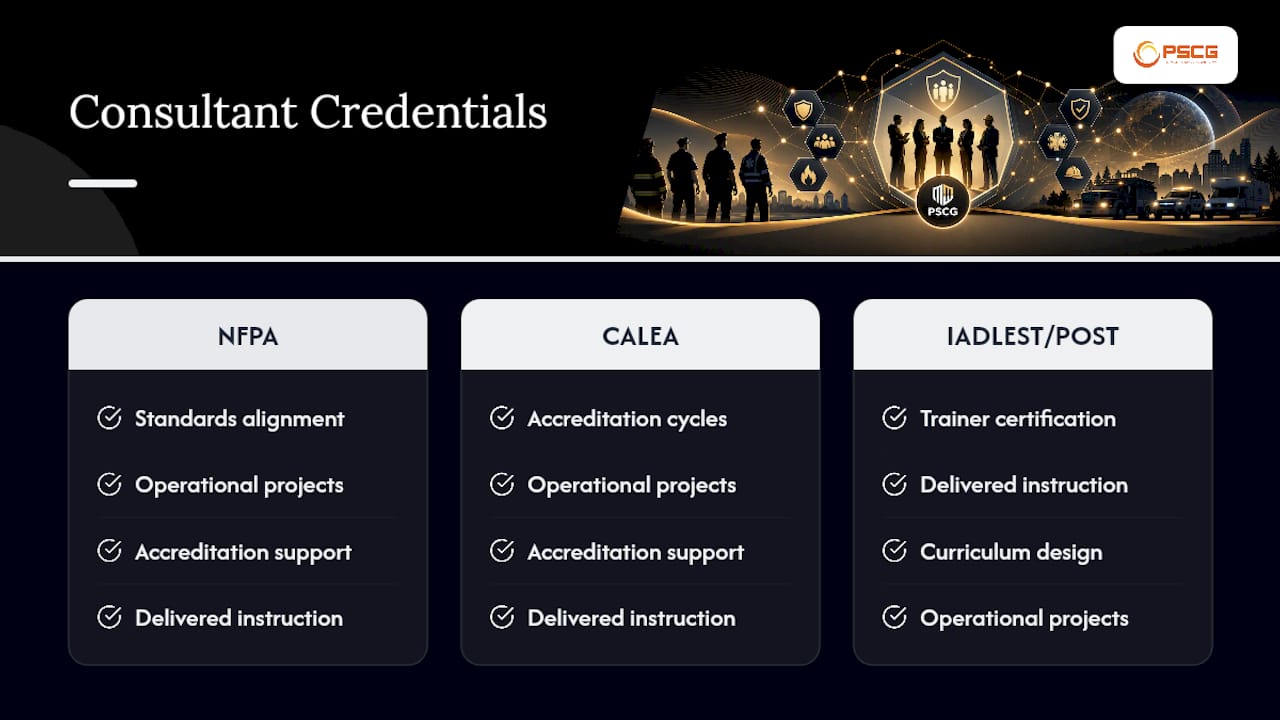
Credentials come first, but the right kind matters more than the volume of logos on a slide deck. Look for direct experience aligning work with NFPA standards, CALEA accreditation cycles, and IADLEST or POST-certified trainers who have actually delivered instruction, not just designed curriculum.
Domain experience should be provable, not asserted. A consultant worth hiring can point to specific EMS system redesigns, completed operational risk audits, accreditation support projects, or expert witness engagements, and can describe what changed as a result.
Staffing transparency separates serious firms from opportunistic ones. Insist on a contractual guarantee that the named staff in the proposal are the staff who show up to do the work, with a defined substitution process if circumstances change. This single requirement prevents most procurement disasters before they start.
Pricing structure tells you a lot, too. Reputable consulting engagements are generally shaped as audits, defined projects, retainers, or hourly expert witness work, and a vendor who cannot explain which shape applies to your project, and why, has not thought through your scope carefully.
Finally, ask about culture, not just compliance. Organizational culture is widely recognized as the strongest predictor of whether risk management actually works, which means the best consultants coach supervisors and build shared ownership of risk rather than handing over a binder and leaving.

Pro Tip: Ask a prospective consultant to describe how they coach a resistant shift supervisor through a policy change. Their answer will tell you more about their real capability than any credential on their website.
Core Services Public-Safety Risk Management Consultants Provide
Understanding what a consulting engagement actually delivers helps you separate real proposals from vague promises.
- Operational risk audits and gap analysis. A structured review that identifies exposure points and ranks them by probability and severity, following the core identify, evaluate, and control framework used in fire and EMS risk management.
- Policy and SOP development. Written procedures aligned with NFPA and POST standards, built to hold up under audit or litigation.
- Training programs for supervisors and line staff. Adult-learning-based instruction, not lecture-only compliance sessions.
- Incident review boards and sentinel event reviews. Facilitated root-cause analysis that produces a defensible, prioritized corrective action plan rather than a blame exercise.
- Accreditation and compliance support. Preparation work for CALEA review or training-record validation.
- EMS reimbursement optimization. Financial analysis that connects operational risk reduction to budget realities.
- Expert witness and litigation support. Testimony and case analysis grounded in standards, not opinion.
Thepscgroup’s own operational risk reduction work in EMS follows this same arc, moving from audit to implementation rather than stopping at a written report.
RFP and Procurement Checklist for Public-Safety Risk Consulting
A tight RFP protects your agency from vague proposals and wasted budget cycles. Build yours around these steps:
- Define scope and success criteria in measurable terms. “Reduced operational risk” needs a number or benchmark attached, not a vague aspiration.
- Require named personnel and sample work products in every proposal.
- Request references from agencies of comparable size and risk profile, and actually call them.
- Ask for phased pricing: audit fee, implementation phases, and retainer options, each with a schedule.
- Publish evaluation weights up front, since clear scoring criteria for technical approach, experience, schedule, and cost prevent subjective selection.
Your contract language matters as much as the scope. Include:
- Deliverable acceptance criteria tied to the success metrics you defined
- A no-substitution clause or a required approval process for staff changes
- Confidentiality and records-access terms appropriate for public-safety data
Agencies that expect a vendor to produce detailed hazard documentation may also want to review how job hazard analysis workflows structure risk-identification and control records, since that format often informs what a strong audit deliverable looks like.
How to Spot Red Flags Before You Sign
Weak proposals share a signature. Watch for these warning signs:
- Generic templates recycled from other industries with public safety terminology swapped in
- Refusal to name the staff who will actually perform the work
- Evasive or bundled pricing that hides what you are paying for
- No case studies from real public-safety clients, only general “consulting experience”
Verify every claim before you commit. Call the references, ask to speak directly with the named project lead, and request a sample deliverable from a comparable engagement. Procurement guidance consistently warns against accepting proposals that skip these steps, because bait-and-switch staffing is one of the most common ways agencies get burned.
Cheapest is rarely safest here. Low bids often mean fewer site visits, junior staff doing senior-level work, and shallow analysis dressed up in confident language.
Pro Tip: If a proposal cannot answer “who specifically will be in the room with our command staff,” treat that as a disqualifying answer, not a detail to work out later.
How Thepscgroup Approaches Public-Safety Risk Engagements
Thepscgroup builds engagements around a clear arc: audit, prioritized plan, training and implementation, then evaluation. That structure informs resources like our Public Safety Risk Reduction guide and our Types of Operational Risks framework. One municipal EMS client used this model to move from reactive incident response to a documented risk register, cutting repeat exposure categories within a single budget cycle.
— Mike
How Thepscgroup Can Help With Your Risk Management Project
Thepscgroup is the direct alternative to a generic software vendor for agencies that need real hands-on expertise, not a login and a dashboard. If your priority is an operational risk audit, our operational risk reduction work maps straight to that need. If you’re redesigning how EMS is delivered across a jurisdiction, our EMS system design consulting team handles that scope from assessment through implementation. Agencies facing litigation exposure can review our attorneys and EMS operations resource for expert witness and legal support options.
Whatever the entry point, the next step is the same: request a defined scope, ask for CVs of the staff who would actually work your project, and get a phased price with a realistic timeline. Visit Thepscgroup to start that conversation, or reach out directly through our contact page to schedule an initial audit consultation.
Key Takeaways
The most reliable path to lower operational risk is hiring named, credentialed consulting staff who work against NFPA, CALEA, and IADLEST standards rather than buying generic software.
| Point | Details |
|---|---|
| Demand named staff | Require CVs and a no-substitution clause before signing any consulting contract. |
| Check standards alignment | Confirm experience with NFPA 1250/1500, CALEA accreditation, and IADLEST/POST training. |
| Structure pricing in phases | Expect audit, project, and retainer pricing shapes with a clear schedule for each. |
| Verify, don’t assume | Call references directly and speak with the named project lead before awarding. |
| Thepscgroup fits this model | Thepscgroup runs audit-to-implementation engagements in EMS system design, operational risk reduction, and expert witness support. |
Sources
- Risk Management: A Key Component in Public Safety – Police Chief Magazine
- Risk Management Practices in the Fire Service – USFA/FEMA
- How to choose a good consultant | P25 Best Practice