



A municipal EMS subsidy is the local tax support a town or city puts into its ambulance service to cover the gap between what billing brings in and what it costs to be ready, around the clock, for a call that may or may not come. For most governmental EMS systems, that gap is real and permanent. Billing cannot close it by itself, and no federal program is built to close it for you. The question for municipal leaders is not whether to subsidize, but how much, on what basis, and how to explain it to taxpayers.
We work with municipal leaders, EMS agencies, fire departments and emergency managers on exactly this question at The Public Safety Consulting Group (PSCG), thepscgroup.net. What follows is a practical guide: why the gap exists, what federal money does and does not do, how to size a subsidy, and how to defend it.
TL;DR
- A subsidy pays for readiness, meaning the crews, ambulances and dispatch capacity that must exist 24/7 whether or not a patient is transported.
- Medicare pays for transports to a covered destination. Assessment and treatment in place are typically not covered, and that leaves unfunded cost.
- Federal money for EMS is fragmented and mostly aimed at capital or rural improvements, not general operating support.
- A defensible subsidy starts with a full cost picture, including shared municipal costs that rarely reach the EMS budget, and a clear statement of the service level the community expects.
Table of Contents
- Why billing alone does not cover the cost of EMS
- What a municipal EMS subsidy actually pays for
- What the evidence says about local tax support and cost
- Federal and state help: useful, but not a subsidy substitute
- How to size a subsidy you can defend
- Making the case to council and residents
- Common mistakes we see
- Our perspective
- How PSCG can help
- FAQ
- Sources
Why billing alone does not cover the cost of EMS
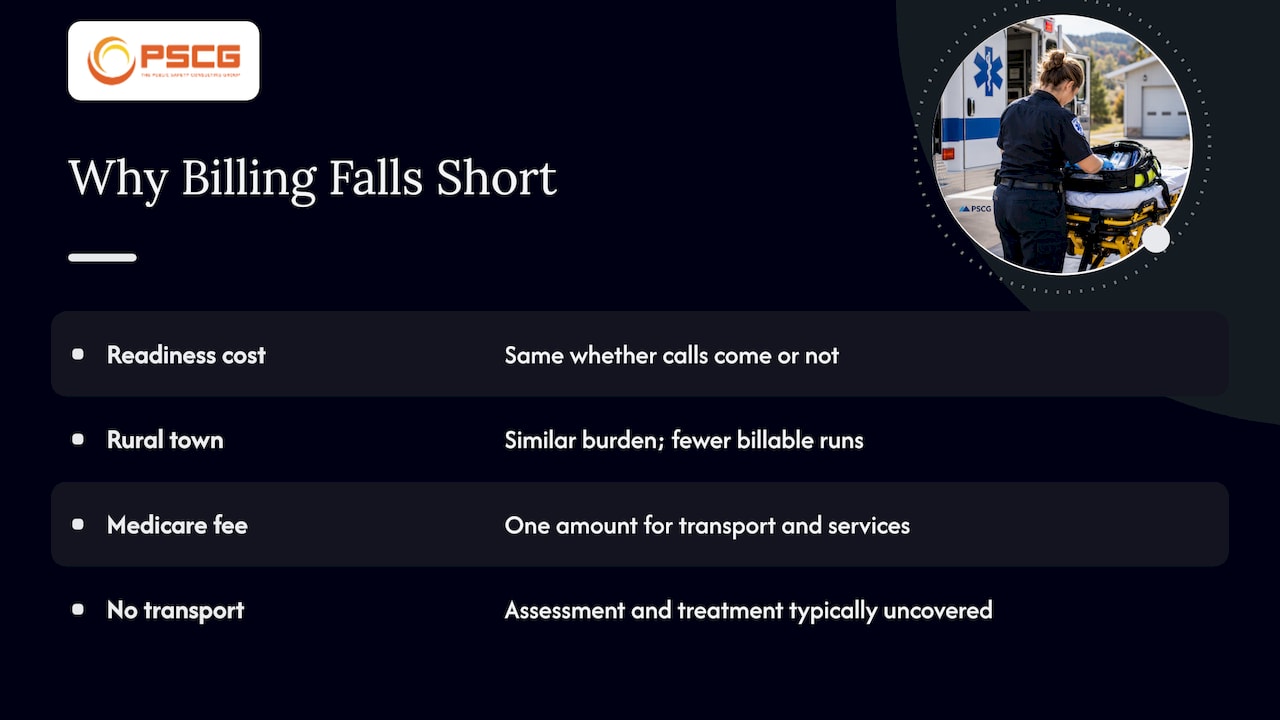
An ambulance service sells something unusual: availability. The crew that sits at the station at 3 a.m. costs the same whether the phone rings ten times or not at all. Analysts call these fixed costs, and they do not shrink when call volume dips. A rural town with a few hundred calls a year carries nearly the same readiness burden as a busier neighbor, spread across far fewer billable runs.
The revenue side has its own limits. Medicare’s ambulance fee schedule pays a single amount covering the transport and associated services, and responses that end without a transport, including assessment and treatment in place, are typically not covered. In 2026, the same MedPAC document lists a ground ambulance conversion factor of $284.56 and a Part B deductible of $283.00. Those figures are national payment mechanics. They say nothing about what your crew and your ambulance cost in your town.
Many leaders assume that better billing will eventually make EMS pay for itself. Better billing helps, often a great deal. But when a service is built to respond quickly to everyone, including patients who are not transported, who have no insurance, or who live far from the station, billing is only one leg of the funding stool. The national EMS advisory council has pointed out that EMS lacks the legal status of an essential service that governments must provide, which is part of why funding varies so widely from one community to the next.
What a municipal EMS subsidy actually pays for
In practice, a subsidy is a line in the town or city budget, or a dedicated tax levy, that supports the EMS operation. It usually covers some mix of the following:
- Staffing for 24/7 readiness. Paramedics and EMTs on duty at all hours, including the overnight and low-volume periods when billing revenue is thinnest.
- Unbilled and under-reimbursed care. Non-transports, patients covered by programs that pay below cost, and patients who cannot pay.
- Capital replacement. Ambulances, monitors, stretchers and radios on a planned cycle rather than an emergency one.
- Dispatch and communications. Call-taking, medical dispatch and the coordination that gets the right unit moving.
- Training and quality assurance. The oversight that keeps clinical performance and documentation strong.
A concrete local example: the Town of Coventry, Connecticut, published a proposed FY2026-2027 budget that includes an ambulance subsidy of $213,711 to maintain 24/7 municipal staffing. That is the kind of transparent, line-item presentation that lets residents see what they are paying for and what they get in return. It is a single town’s proposal, not a national benchmark, but it shows the model working in the open.
What the evidence says about local tax support and cost
Municipal leaders sometimes worry that more tax support simply means more spending. The research is more nuanced. A Government Accountability Office study of ambulance providers found that among providers without shared costs, those drawing the largest share of revenue from local tax support (81%) had estimated average costs 61% higher than those with no local tax support. The GAO’s reading is that this reflects, in part, an income effect: when a community funds EMS more generously, it can afford more sophisticated vehicles, more highly trained staff, and higher service standards.
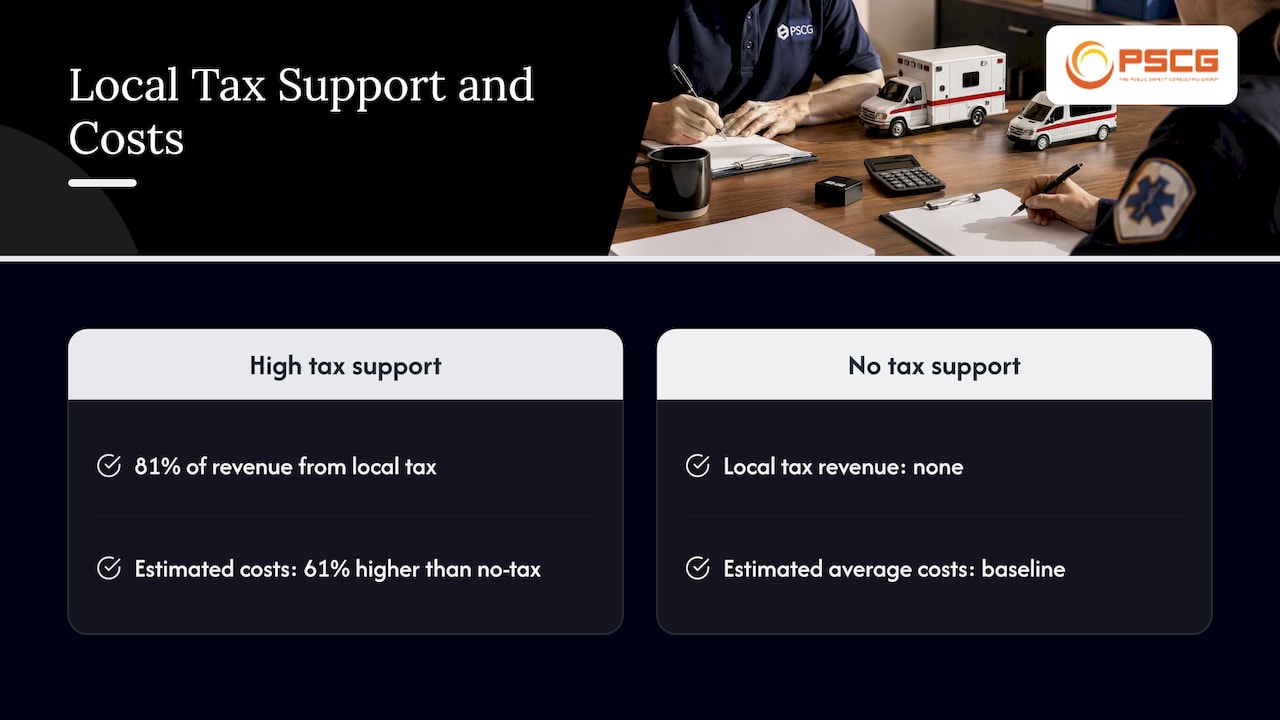
That finding cuts both ways, and both readings deserve respect. A higher-cost system may be buying something residents value, such as faster response and advanced-level care. It may also have room to tighten deployment. Which is true for your service is a question to answer with data, not assumption.
Costs also vary enormously. In an earlier GAO review, the median cost per transport was $429, ranging from $224 to $2,204, for 2010 data. Those numbers are old and should not be used as a current benchmark, but the spread is the lesson: no two systems look alike, and comparing your cost per transport to a neighbor’s without understanding the differences can mislead.
Private and public models each have strengths
Private, volume-driven providers are often efficient in dense markets, and they have built strong billing and logistics disciplines. Governmental providers often carry obligations that those models do not, such as serving every corner of a jurisdiction, staffing for surge and disaster, and integrating with fire, police and emergency management. Experts have cautioned in a comment letter to MedPAC that payment analyses which leave governmental providers out of their trimmed datasets risk skewing conclusions toward lower-cost private business models. Both models have a place. The point for a town is to understand which obligations it is asking its EMS service to carry, and to fund them honestly.
Federal and state help: useful, but not a subsidy substitute
Residents often ask whether the federal government covers this. Mostly, it does not, at least not as general operating support. Federal funding for EMS is spread across programs with specific purposes:
| Source | What it generally supports | What it does not do |
|---|---|---|
| Medicare ambulance fee schedule | Payment for covered transports | Pay for non-transport responses or readiness |
| USDA Rural Development | Capital such as equipment and vehicles in rural communities, for example a $37,300 investment in ambulance equipment for a Kentucky service in 2025 | Cover payroll or ongoing operations |
| HRSA Flex Program | Rural improvement work, funded through states | Serve as a general municipal subsidy |
| State programs | Varies widely by state | Follow a common national model |
The federal Medicare program has also recognized the cost of rural service through a temporary add-on payment, including a 22.6% increase in the base rate for transports originating in the most sparsely populated rural areas. Check the current CMS schedule for the status of such add-ons before building them into a budget, because temporary provisions can change.
Our practical advice: pursue every eligible grant, and treat each one as a capital or project tool. We keep a guide to grants for municipal and EMS leaders for this purpose. Then build the operating budget on stable local support plus well-run billing.
How to size a subsidy you can defend
A subsidy that holds up to council scrutiny is built from the ground up. Here is the sequence we use with municipal clients.
- Define the service level. What response time, staffing level and clinical capability does the community expect? Write it down. A subsidy is only meaningful against a stated standard.
- Capture the full cost. Include the costs that live elsewhere in the municipal budget: facilities, utilities, fuel, fleet maintenance, shared benefits and administrative support. CMS has noted in its ground ambulance data collection FAQ that organizations report cost and revenue information through the GADCS, and agencies that leave shared costs out end up with an incomplete picture and potentially misleading benchmarks.
- Model the revenue realistically. Use collection rates by payer, not gross charges. Separate transports from non-transports. Our piece on ambulance service cost analysis walks through the cost side in more detail.
- Identify the gap. The difference between full cost at the agreed service level and realistic net revenue is the readiness gap. That figure, not last year’s appropriation plus a percentage, is your subsidy need.
- Test the deployment. Before asking taxpayers for more, make sure units are positioned and scheduled to match demand. Peak-load staffing and system status management can change the cost of a given service level considerably. See our overview of EMS deployment models for municipalities.
- Report back. Publish response times, call volume, collection performance and the subsidy per resident each year.
A worked illustration
The numbers below are hypothetical and for explanation only. They are not drawn from any real town.
| Line | Annual amount |
|---|---|
| Full cost of 24/7 service at agreed standard (including shared municipal costs) | $2,400,000 |
| Net collected revenue from billing | $1,650,000 |
| Grants applied to capital | $100,000 |
| Readiness gap to be met by local support | $650,000 |
In this illustration, the subsidy is not a failure of billing. It is the visible price of keeping a crew ready. If the town then improves collections by a few percentage points, the subsidy shrinks. If the council raises the response standard, it grows. Either way, the conversation is grounded in a shared set of facts.
Making the case to council and residents
The most successful systems align what the community expects with the money available, instead of leaning on one funding stream. A 2002 GAO report on ambulance services and funding is a useful historical reference on how systems rely on a blend of sources. Here is how we suggest leaders frame the discussion:
- Start with the promise. When a resident dials 911, what do we promise, and how fast? Everyone understands that.
- Show the fixed-cost reality. Explain that the ambulance must be ready before the emergency, the way a fire engine is.
- Show what you have already done. Billing improvements, grant awards, and deployment changes tell council you have pulled the levers within your control.
- Offer options, not ultimatums. Present two or three service levels with their price tags, and let elected officials choose.
- Commit to reporting. A subsidy that comes with annual performance reporting earns trust.
If a state or county funding change is part of your strategy, our resources on the public safety legislative process and legislative advocacy strategies can help your team prepare.
Common mistakes we see
Leaving shared costs off the books. When fuel, facilities and benefits sit in other departments, EMS looks cheaper than it is, and the eventual correction lands as a shock.
Treating subsidy as a sign of failure. A well-run governmental service with a clear standard and a visible subsidy is often a sound arrangement. The warning sign is a subsidy nobody can explain.
Counting on billing to do everything. Billing improvements are worth pursuing, and our reimbursement consulting overview explains where they pay off. They have limits, as the Medicare transport-based model shows.
Comparing to the wrong peers. A town with long distances, low density and mutual-aid obligations is not comparable to a compact urban system. Choose peers by similar conditions, not by geography alone.
Waiting for a crisis. Sizing the subsidy during a staffing emergency or a failed fleet means rushed decisions. Plan on a multi-year horizon.
Our perspective
After more than 32 years of work in EMS and public safety, here is what we keep coming back to. A subsidy is not a handout to the ambulance service. It is the community paying, openly, for something it already counts on: that when the worst day of someone’s life arrives, help is on the way.
The communities that handle this best do three things. They are honest about cost, including the parts that hide in other departments. They are specific about the service level they want. And they do the operational homework first, so that every dollar of local support is buying readiness rather than slack. We work alongside municipal teams on each of those steps, from cost analysis to deployment design to the conversation with council.
We would also say this plainly: there is no single right answer. Private providers, fire-based systems, third-service models and hybrids all serve communities well when they are matched to local conditions and funded for what they are asked to do. Our job is to help leaders see their own system clearly and make a decision they can stand behind.
— Mike
How PSCG can help
If your town is facing a budget cycle, a contract renewal, or a question from council about what EMS really costs, we can help. Our work includes financial improvement analysis, system design, deployment planning and billing and collections review, as well as municipal EMS strategy and reimbursement optimization built around your community’s own numbers. We work with you from identifying the issue through putting the plan into action. Reach us at thepscgroup.net.
FAQ
What is a municipal EMS subsidy?
It is local tax money, appropriated by a town or city, that supports its ambulance service beyond what billing collects. It generally funds the readiness cost of keeping crews and vehicles available around the clock. It may appear as a general fund line, a dedicated levy or a contract payment.
Does the federal government subsidize municipal EMS?
Not with a general operating subsidy. Federal support is mostly through the Medicare payment for covered transports and through targeted programs, such as USDA rural capital investments and the HRSA Flex Program. These help with equipment and rural improvements, not ongoing payroll.
Why doesn’t Medicare payment cover the full cost of an ambulance response?
Medicare’s ambulance benefit is built around transport, so responses that do not end in a transport are typically not covered, as MedPAC explains. Fixed readiness costs also stay the same regardless of call volume. That leaves a gap that local support commonly fills.
How do we know if our subsidy is too high or too low?
Compare it against a full cost accounting at your stated service level, including shared municipal costs, and against realistic net revenue. If the subsidy cannot be tied to a defined standard and a documented gap, it is worth reviewing. A deployment and billing review often reveals where savings or revenue are available before a tax increase is considered.
Is EMS required by law to be provided by a municipality?
Generally no. NEMSAC notes that EMS does not hold essential-service status at the federal level, so obligations and funding models vary by state and locality. Your state statutes and local charter are the place to look for your own requirements.
Sources
- MedPAC, Ambulance Services Payment System
- NEMSAC, EMS System Funding and Reimbursement advisory
- Town of Coventry, FY2026-2027 proposed budget presentation
- GAO-07-383, Ambulance Providers: Costs and Expected Medicare Margins Vary Greatly
- GAO-13-6, Ambulance Providers: Costs and Medicare Margins Varied Widely
- Comment letter to MedPAC on GADCS
- USDA Rural Development, investment in ambulance equipment
- HRSA Flex Program funding opportunity
- CMS, Ambulance Fee Schedule Public Use Files
- CMS, Medicare Ground Ambulance Data Collection System FAQ
- GAO-02-28, ambulance services report