


TL;DR:
- Winning grants require eligibility alignment, disciplined application, and strong post-award capacity.
- Agencies must verify eligibility, active registrations, and project fit before applying for funding.
Grants are competitive, time-bound funding awards that can underwrite EMS system improvements, workforce expansion, and capital equipment purchases — but winning one requires eligibility-first alignment, disciplined application structure, and genuine post-award administrative capacity. Before your agency drafts a single sentence of narrative, three actions matter most: confirm your eligibility against the Notice of Funding Opportunity (NOFO), verify that your SAM.gov registration is active and your Grants.gov account is ready, and run a quick project-fit triage against the funder’s stated priorities. Eligibility-first alignment is the single behavior that separates funded proposals from well-written rejections.
At a glance — opportunity and risk:
- Opportunity: Capital for equipment, staffing, system redesign, training, and pilot programs
- Opportunity: Federal, state, and foundation sources fund municipal EMS and public-safety projects directly
- Risk: Most programs require a cost match (often 10–25%), which must be documented before award
- Risk: Post-award reporting, procurement compliance, and audit readiness demand dedicated internal capacity
Your three immediate actions:
- Pull the NOFO and confirm your agency type appears in the eligible applicants list
- Log into SAM.gov and verify your Unique Entity Identifier (UEI) registration is active — first-time registrations typically take 10–15 business days
- Score the project fit: does your measurable objective map directly to the funder’s review criteria?
Table of Contents
- Which federal, state, and private grants fund public-safety and EMS projects?
- How to find and triage opportunities so you only pursue good fits
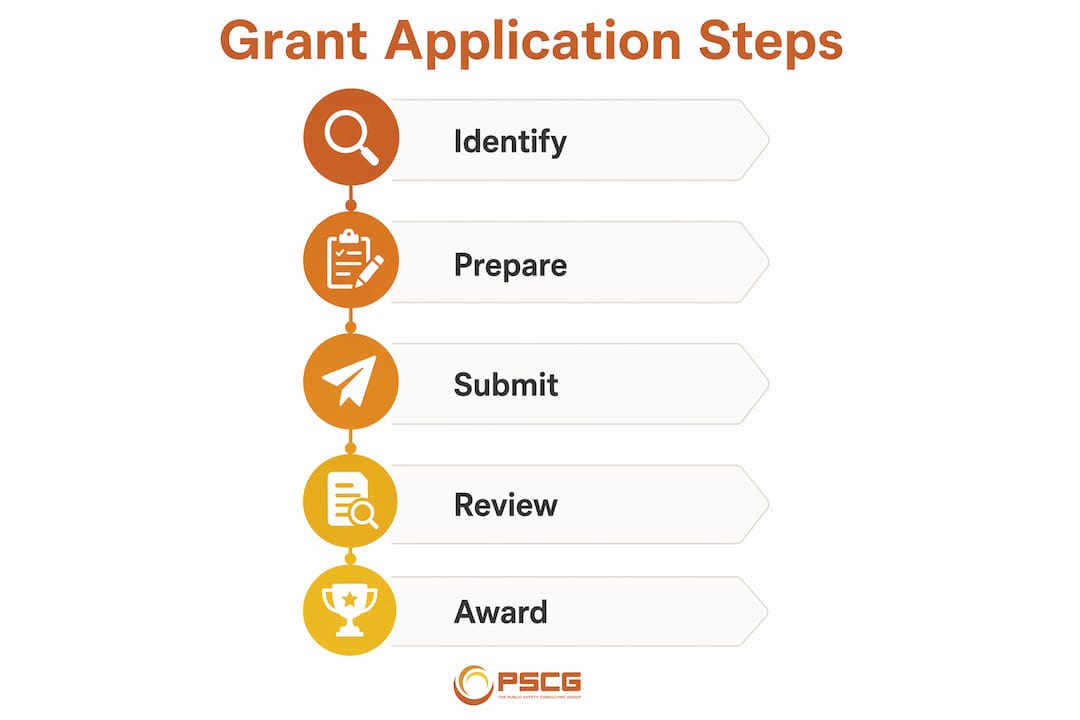
- Step-by-step: preparing a successful grant application
- Post-award administrative capacity you must have to keep a grant
- When it makes sense to hire a grants consultant
- Common misconceptions and pitfalls that waste time or doom proposals
- Key Takeaways
- Why structured grant strategy matters for public safety
- Thepscgroup can support your grant strategy and readiness
- Authoritative sources and further reading
Which federal, state, and private grants fund public-safety and EMS projects?
Approximately 95% of federal grant dollars go to organizations — state and local governments, nonprofits, and universities — not individuals. That makes municipal EMS agencies and fire departments natural candidates for the programs below.
| Program | Administering Agency | Typical Funding Focus | Eligible Applicants |
|---|---|---|---|
| Assistance to Firefighters Grant (AFG) | FEMA | Equipment, training, wellness | Fire/EMS departments |
| SAFER | FEMA | Firefighter/EMS staffing | Local governments, fire depts |
| EMS-related programs | HRSA | Rural EMS, workforce, training | Local govts, nonprofits |
| Byrne Discretionary Grants | DOJ/OJP | Criminal justice, public safety | Designated local entities |
| CDC funding streams | CDC | Injury prevention, opioid response | State/local health agencies |
| SBIR/STTR Phase I & II | NSF | Technology R&D, EMS tech pilots | Small businesses with govt partners |
| SCALE Program | SBA | Supply chain, logistics enablement | Public/private/nonprofit entities |
FEMA’s AFG and SAFER programs are the most direct entry points for most EMS agencies. HRSA funds rural EMS workforce and training initiatives. The DOJ’s Byrne program, which allocated $62,378,550 across 84 anticipated awards in FY 2026, supports criminal justice and public-safety projects in designated communities. When your project includes a technology development component, NSF SBIR/STTR Phase I and II awards open a separate pathway.
For a categorized breakdown of public-safety grant types and eligibility requirements, the PSCG 2026 funding guide is a practical starting point.
Where to search:
- Grants.gov — the single federal portal for all discretionary grant NOFOs and submissions
- State EMS offices — publish state-specific funding competitions and formula grants
- Foundation grant portals and community foundations — fund training, pilot programs, and community health initiatives
How to find and triage opportunities so you only pursue good fits
Most agencies lose time chasing grants they were never eligible to win. A structured screening process fixes that. Before committing staff hours to a proposal, run every NOFO through this checklist:
- Eligible applicant type: Does your agency’s legal entity type appear explicitly in the NOFO?
- Cost match: Can you document and sustain the required match from non-federal sources?
- Allowable costs: Do your project costs fall within the program’s approved cost categories?
- Project period: Can your agency execute and report within the award timeline?
- Evaluation criteria: Do your measurable objectives align 1:1 with the NOFO’s review criteria?
- Reporting burden: Do you have staff capacity to meet quarterly or annual reporting requirements?
Track opportunities in a simple spreadsheet with columns for program name, deadline, eligible applicant type, match requirement, estimated administrative burden, and a 1–5 fit score. Opportunities scoring below 3 should be dropped without further investment.
Pro Tip: Prioritize NOFOs whose review criteria map directly to performance baselines your agency already tracks — response time benchmarks, call volume data, or training completion rates. Funders reward specificity, and you already have the evidence.

The EMS public policy guide from Thepscgroup offers additional framing for positioning projects to funders at the state and federal level.
Step-by-step: preparing a successful grant application
The NOFO is the governing document for every competition. Ignoring its review criteria is the fastest path to disqualification. Structure your proposal to mirror the NOFO’s evaluation sections exactly.
Proposal template outline:
- Project summary — two to three sentences stating the problem, your solution, and the expected measurable outcome
- Needs statement — local data (call volume, response times, unmet demand) that establishes urgency
- Goals and measurable objectives — SMART objectives tied directly to the funder’s priorities
- Methods and workplan — timeline, responsible parties, and milestones
- Evaluation plan — how you will measure and report outcomes
- Sustainability — how the program continues after the grant period ends
Budget line items to include:
| Category | Examples | Notes |
|---|---|---|
| Personnel | Project coordinator, data analyst | Include FTE percentage and fringe |
| Equipment | Monitors, vehicles, PPE | Attach vendor quotes |
| Supplies | Training materials, consumables | Itemize by unit cost |
| Indirect costs | Admin overhead | Use your negotiated rate or de minimis 10% |
| Match | In-kind or cash contributions | Document source and valuation method |
Submission checklist:
- SAM.gov registration active (renew annually; allow 10–15 business days for first-time registration)
- Grants.gov Workspace account established and application package downloaded
- All required attachments complete (budget narrative, letters of support, proof of match)
- Authorized organizational official identified and available to sign
- Application submitted at least 48–72 hours before the official deadline to allow time for system validation
Pro Tip: Use your agency’s own performance data as the backbone of your needs statement. A proposal citing your specific response time gap or training deficit is far more compelling than one built on national averages.
For real-world examples of how grant-funded EMS system redesigns are scoped and delivered, see Thepscgroup’s EMS system design case examples.
Post-award administrative capacity you must have to keep a grant
Winning a grant is the beginning of the compliance obligation, not the end of it. Many agencies lose funding not because they failed to deliver programs, but because they failed to document them correctly.
Administrative checklist:
- Maintain active SAM.gov registration throughout the award period
- Accept the award formally and review all special conditions before drawing funds
- Track expenditures by budget category against the approved budget in real time
- Follow federal procurement rules (2 CFR Part 200) for all purchases above micro-purchase thresholds
- Manage any subrecipients with written agreements and monitoring plans
- Submit performance and financial reports on schedule — typically quarterly or semi-annually
- Maintain audit-ready documentation: invoices, timesheets, procurement records, and match documentation
Common failure modes:
- Expired SAM.gov registration blocking payment draws
- Expenses charged to the grant that are not in the approved budget or are unsupported by documentation
- Procurement conducted without competitive bidding when required
- Performance reports submitted late or missing required data elements
- Match contributions not documented with a clear valuation methodology
Federal awards under the Uniform Guidance (2 CFR Part 200) are subject to single audit requirements when an organization expends $750,000 or more in federal funds in a fiscal year. Build that threshold into your capacity planning from day one.
When it makes sense to hire a grants consultant
Internal capacity is the honest starting point for this decision. If your agency lacks staff with NOFO-alignment experience, has never submitted a federal application, or is facing a complex multi-agency proposal with a tight deadline, outside expertise closes that gap faster than training alone.
Decision triggers for engaging a consultant:
- No internal SAM.gov or Grants.gov experience
- First-time federal application with a competitive NOFO
- Multi-agency or regional proposal requiring coordinated narratives
- Large-scale system redesign project where the grant funds a significant operational change
- Post-award compliance setup for a newly awarded program
What to require in an RFP or scope of work:
| Scope tier | Deliverables | Typical timeline |
|---|---|---|
| Advisory | NOFO review, eligibility memo, proposal outline | 1–2 weeks |
| Full proposal development | Narrative, budget, attachments, submission | 4–8 weeks |
| Post-award compliance setup | Reporting templates, procurement checklist, audit prep | Ongoing |
Red flags to screen for:
- Guarantees of award (no ethical consultant can promise this)
- Upfront fees for SAM.gov registration or Grants.gov account setup (both are free)
- No verifiable references from public-safety or municipal clients
- Scope limited to opportunity hunting with no proposal writing or compliance support
Pro Tip: Ask every consultant candidate to walk you through a NOFO they have worked with recently — specifically how they mapped the review criteria to the proposal narrative. That answer tells you more than a portfolio page.
Consultants add the most value when they close specific capability gaps: NOFO alignment, proposal writing, and post-award compliance setup. Agencies that build internal capacity alongside consultant support tend to perform better in subsequent funding cycles.
Common misconceptions and pitfalls that waste time or doom proposals
“Federal grants are for startups and nonprofits, not municipal agencies.” In reality, local governments are among the most common and competitive applicants for federal public-safety funding. The eligibility question is not about your agency type in the abstract — it is about whether your specific legal entity appears in the NOFO’s eligible applicants section.
Myth vs. fact:
- Myth: You can apply for any federal grant through Grants.gov. Fact: Each NOFO specifies eligible applicant types; applying outside your eligibility category results in automatic disqualification.
- Myth: Match requirements are negotiable after award. Fact: Match commitments are binding and must be documented before the award period closes.
- Myth: A strong narrative can overcome a weak budget. Fact: Reviewers score budget sections independently; an unsupported or inflated budget undermines an otherwise competitive proposal.
Quick fixes that rescue promising applications:
- Confirm your entity type against the NOFO’s eligible applicants list before writing a word
- Pull local data — call volume, response times, training gaps — and cite it in the needs statement
- Allocate a named staff member to own post-award reporting before you submit
- Set a submission target of 48–72 hours before the deadline, not the night before
Key Takeaways
Grants are strategic investments in EMS system capacity, and the agencies that win them consistently treat eligibility screening, administrative readiness, and post-award compliance as non-negotiable prerequisites — not afterthoughts.
| Point | Details |
|---|---|
| Eligibility comes first | Confirm your entity type in the NOFO before committing any staff time to a proposal. |
| SAM.gov readiness is critical | First-time registrations take 10–15 business days; let an expired registration lapse and you cannot draw funds. |
| Submit 48–72 hours early | Grants.gov validates packages and may return errors; early submission gives you time to correct them. |
| Post-award capacity determines outcomes | Budget tracking, procurement compliance, and timely reporting are what keep a grant from becoming a liability. |
| Thepscgroup supports the full cycle | PSCG provides grant strategy, proposal development, and post-award compliance support for municipal EMS agencies. |
Why structured grant strategy matters for public safety
The agencies I see struggle most with grant funding are not the ones that lack good ideas. They are the ones that treat grant applications as one-time events rather than as part of a deliberate funding strategy. A proposal written in isolation, without a clear line back to the agency’s operational performance data and system design priorities, rarely survives competitive review.
At Thepscgroup, we work alongside municipal leaders and EMS agencies to connect grant opportunities to the operational improvements that actually move outcomes — response time benchmarks, workforce sustainability, system redesign. Our 2026 funding guide and case examples reflect what we have seen work across a range of program types, from FEMA AFG to state EMS office competitions. The EMS public policy resources we publish are designed to help agencies build the kind of documented, data-supported case that funders want to see before they commit dollars.
Grant strategy is not separate from EMS system strategy. The agencies that treat them as the same discipline — and build the administrative infrastructure to sustain awards — are the ones that convert one-time grants into durable improvements.
Thepscgroup can support your grant strategy and readiness
Thepscgroup’s municipal EMS strategy services are built for exactly the situation many agency leaders face: a real funding opportunity, limited internal grant-writing capacity, and a short runway to submission. We provide end-to-end support — from NOFO eligibility review and proposal development through post-award compliance setup and performance reporting frameworks. Whether you are pursuing your first federal application or managing a multi-agency regional proposal, we work alongside your team to close the capability gap without replacing your internal leadership.
To discuss a funding readiness assessment or get support on an active NOFO, visit us at thepscgroup.net or review our EMS system design consulting services to see how grant-funded projects translate into measurable operational improvements.
Authoritative sources and further reading
Use the NOFO as your primary reference for every competition — it contains the eligibility criteria, review criteria, budget requirements, and submission deadlines that govern the award. Verify eligibility and deadlines directly from official agency pages, not secondary summaries.
- Grants.gov — federal NOFO search, Workspace application submission, and applicant training resources
- SAM.gov — UEI registration, annual renewal, and entity validation required for all federal awards
- How to Develop and Write a Grant Proposal, Congress.gov — Library of Congress guidance on eligibility-first proposal preparation
- SBA Grants and Funding Programs — federal grant program guidance and alignment with strategic priorities
- SBA SCALE Program Announcement — example of a current federal competition with Grants.gov submission requirements
- NSF SBIR/STTR Solicitation — technology R&D funding pathway relevant to EMS innovation projects
- DOJ/OJP Byrne Discretionary Grants NOFO — FY 2026 public-safety grant program with eligibility and submission details
- PSCG 2026 Public Safety Funding Guide — categorized grant types, eligibility guidance, and EMS-specific program notes
- PSCG Services — full scope of consulting services including grant strategy, proposal development, and post-award support