



TL;DR:
- FirstWatch offers real-time surveillance for overdose detection and situational awareness for EMS agencies. Selecting the right platform depends on agency size, data needs, and successful pilot outcomes. Thepscgroup guides agencies through evaluation, pilot design, and cost management to ensure operational effectiveness.
FirstWatch is a real-time public-safety surveillance and operational analytics platform built specifically for EMS and public safety agencies. If your agency needs near-real-time overdose cluster detection, syndromic event alerts, or situational awareness tied directly to CAD, ePCR, 911, and hospital feeds, FirstWatch belongs on your evaluation shortlist. The three factors that most often determine fit are CAD integration depth, HIPAA compliance posture, and whether your agency has a structured pilot process. Thepscgroup works alongside EMS system planners at each of those decision points.
Choosing the right analytics platform is less about feature checklists and more about matching system scale to your agency’s call volume, data maturity, and operational workflows. The strongest procurement signal comes from documented pilot outcomes rather than vendor marketing decks.
Table of Contents
- How does FirstWatch compare to ImageTrend, ESO, RapidDeploy, and ZOLL?
- Thepscgroup can guide your platform selection and pilot design
- Key Takeaways
How does FirstWatch compare to ImageTrend, ESO, RapidDeploy, and ZOLL?
| Platform | Best For | Primary Data Sources | Time to Deploy / Pilot | Pricing Model | Training & Support | Analytics Features | HIPAA / Security |
|---|---|---|---|---|---|---|---|
| FirstWatch | Near-real-time overdose/surge detection, syndromic surveillance, operational alerts | CAD, ePCR, 911, hospital feeds | 30–90 day pilot typical | Subscription, enterprise | Onboarding, ongoing support | Real-time alerts, dashboards, custom queries | HIPAA BAA available |
| ImageTrend | Integrated ePCR, QA, and data reporting alongside analytics | ePCR, CAD, RMS | 30–90 days | Subscription, per-module | Training library, support tiers | QA workflows, reporting dashboards | HIPAA compliant |
| ESO | Larger agencies needing integrated ePCR, rostering, and analytics | ePCR, CAD, fire RMS | 30–90 days | Enterprise subscription | Dedicated onboarding, support SLAs | Operational dashboards, clinical analytics | HIPAA compliant |
| RapidDeploy | Modern 911 integration and mapping-first situational awareness | 911/CAD, dispatch feeds | 30–90 days | Subscription, cloud-native | Implementation support, training | Mapping, real-time dispatch intelligence | HIPAA / FedRAMP aligned |
| ZOLL | Hardware/software bundling with clinical device integration | ePCR, device data, CAD | 30–90 days | Enterprise, per-unit | Vendor-led training, field support | Clinical analytics, device-linked dashboards | HIPAA compliant |
Vendor profiles
FirstWatch is purpose-built for public-safety surveillance. Its alerting engine ingests CAD, ePCR, 911, and hospital data to surface overdose clusters, infectious disease signals, and demand surges in near-real time. Agencies that have struggled to detect opioid events before they overwhelm unit availability find this specificity valuable.

ImageTrend brings a deep ePCR feature set and mature QA workflows. It suits agencies that want analytics embedded in their records management environment rather than a standalone surveillance layer.
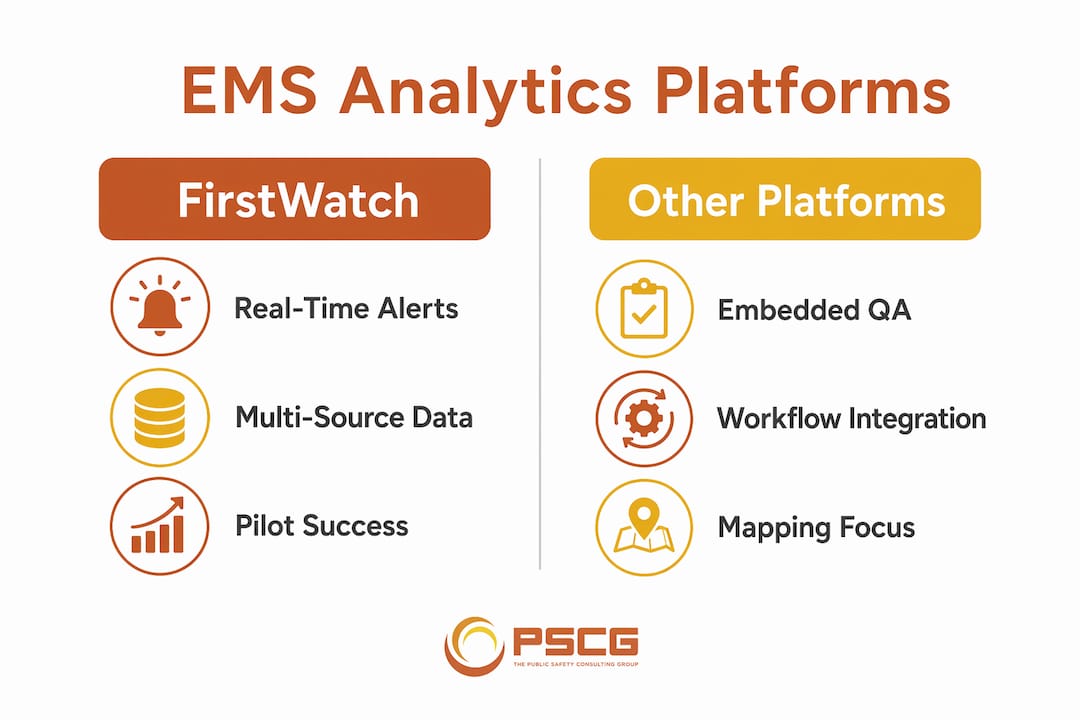
ESO is an enterprise operations platform. Its strength is workflow integration across ePCR, rostering, and analytics, which makes it a natural fit for larger systems that want a single vendor relationship spanning clinical and operational data.
RapidDeploy leads with mapping and 911-centric situational intelligence. Its cloud-native architecture means faster deployment cycles, and it is a strong choice when dispatch data is the primary signal source.
ZOLL brings tight integration between clinical devices and patient care records. For systems that already run ZOLL defibrillators or monitors, the data continuity from device to dashboard is a genuine operational advantage.
How to build your pilot shortlist
Experienced implementers consistently prioritize usability and support SLAs over feature density when narrowing to a pilot candidate. Use this checklist to get to one or two vendors:
- Confirm the vendor supports your specific CAD system and ePCR platform with a live reference implementation.
- Define your primary use case: syndromic surveillance, operational awareness, or clinical QA. Let that drive the shortlist, not the broadest feature set.
- Request a sample deployment timeline and a data governance plan before the demo.
- Verify HIPAA Business Associate Agreements are available and review the vendor’s security posture documentation.
- Ask for two or three agency references at comparable call volume and data maturity.
Procurement checklist for your RFP
During vendor evaluation, request the following in writing:
- Integration references for your specific CAD and ePCR systems
- A phased deployment timeline with defined milestones
- Data governance plan and HIPAA BAA
- Training plan and estimated hours per role
- Support SLAs, escalation paths, and after-hours coverage
- Case studies with measurable pilot outcomes such as detection latency reduction or alert validation rates
Total cost of ownership
Licensing is rarely the full cost. Budget for integration middleware if your CAD or ePCR requires a custom connector, implementation services during the data-mapping sprint, and ongoing maintenance fees. Some vendors charge per-event or per-data-ingestion fees that are not visible in the base subscription. A short, instrumented pilot of 30–90 days with predefined success metrics will surface these costs before contract execution.
Common adoption challenges
Alert fatigue is the most frequently cited operational friction. When alerting thresholds are not calibrated to local CAD variance, dispatchers and supervisors begin ignoring notifications within weeks. Local CAD data mapping overhead is the second most common delay driver, particularly in agencies with legacy or highly customized dispatch systems. Training and staff turnover compound both issues. Build a sustainment plan that includes refresher training cycles and a designated data steward role before go-live.
Thepscgroup can guide your platform selection and pilot design
Selecting a surveillance analytics platform is a procurement decision with multi-year operational consequences. Thepscgroup brings independent, experienced guidance to every phase: vendor evaluation, pilot scoping, integration planning, data governance and HIPAA review, training plan development, and ROI measurement against predefined metrics.
We work alongside your team to define success before a vendor is selected, not after. That means establishing detection latency benchmarks, alert validation targets, and integration acceptance criteria that hold vendors accountable throughout the pilot. Our EMS system design consulting work gives us direct experience with the CAD environments, ePCR platforms, and medical oversight structures that shape how well any analytics platform performs in practice.
Pro Tip: Run a 30–90 day instrumented pilot with predefined success metrics, including reduction in overdose detection time and percent of alerts validated by medical oversight, and include a data-mapping sprint in week one to surface integration costs before they become contract surprises.
To schedule a scoping conversation or review EMS system design examples from comparable agencies, contact Thepscgroup at thepscgroup.net.
Key Takeaways
FirstWatch is the strongest fit for agencies prioritizing near-real-time syndromic surveillance tied to CAD, ePCR, and hospital feeds, but pilot design and integration planning determine whether any platform delivers time-to-value.
| Point | Details |
|---|---|
| Match platform to use case | Choose FirstWatch for syndromic/overdose surveillance; ImageTrend or ESO for ePCR-centered analytics; RapidDeploy for 911/dispatch intelligence. |
| Pilot before you commit | A 30–90 day instrumented pilot with defined success metrics surfaces integration costs and alert-fatigue risks before contract execution. |
| TCO exceeds licensing | Budget for integration middleware, data-mapping services, and potential per-event fees beyond the base subscription. |
| Prioritize support SLAs | Accessible after-sales support and clear upgrade paths reduce long-term operational risk across all five platforms. |
| Thepscgroup as advisor | Thepscgroup provides independent vendor evaluation, pilot design, and HIPAA review for EMS agencies selecting analytics platforms. |