


AI in public safety is not a future concept. It is operational infrastructure that, when deployed correctly, reduces decision latency, unifies situational awareness across agencies, and keeps human judgment in command of every critical call. For EMS and public safety leaders, the question in 2026 is not whether to adopt artificial intelligence in emergency response, but how to do it responsibly and effectively.
What AI in public safety means for EMS strategy
AI in public safety refers to technology that integrates data across dispatch, field units, logistics, and partner agencies to give human commanders a faster, more accurate operational picture. The OECD classifies public safety agencies as high-risk AI end users, meaning the stakes of getting adoption wrong are higher here than in almost any other sector. The technology supports human judgment; it does not replace it.
Key concepts every EMS leader needs to understand:
- Decision latency reduction: AI surfaces relevant data to commanders before the next radio call arrives.
- Unified situational awareness: Dispatch, field resources, logistics, and mutual-aid partners work from one current picture rather than several lagging ones.
- Human-in-command design: Recommended actions are presented to a human decision-maker for approval. Execution follows human authorization, not algorithmic output.
- Machine learning for public safety: Predictive models, natural language processing, and computer vision each address distinct operational tasks, from flood forecasting to call transcription.
- Ethical obligation: Because citizens place the highest levels of trust in police and emergency services, AI adoption must be transparent, validated, and protective of individual rights.
How AI is already improving EMS and emergency response operations
The coordination gain AI delivers is clearest where emergency response depends on connecting multiple agencies under time pressure. EMS, fire, and emergency management rarely fail because a single unit lacks capability. They lose time at the boundaries, where dispatch, field resources, and logistics operate from separate views of the same event.
The MAESTRO system demonstrates what closing that gap looks like at scale. Across 100 typhoon scenarios, MAESTRO matched expert alert levels in 98% of cases and reduced decision latency by over 85%. In a 72-hour replay of Typhoon Lekima, earlier warnings enabled the relocation of a large number of residents with significantly increased lead time for evacuation.
Core AI application categories in EMS and public safety:
- Automated call transcription: Reduces telecommunicator cognitive load and creates accurate incident records in real time.
- Evidence summarization: Cuts hours of review to minutes, freeing personnel for field work.
- Early warning platforms: Cross-agency coordination systems like MAESTRO convert hazard forecasts into coordinated government response.
- Predictive resource allocation: Machine learning models identify where demand will concentrate before calls arrive.
- Real-time situational awareness: Satellite imagery, sensor data, and social media feeds processed simultaneously to map affected areas.
The UK’s PoliceAI initiative, backed by substantial government investment over several years, will free the equivalent of 3,000 officers to return to active policing by automating evidence triaging, transcription, and summarization. That scale of operational return illustrates what well-targeted AI investment can produce.
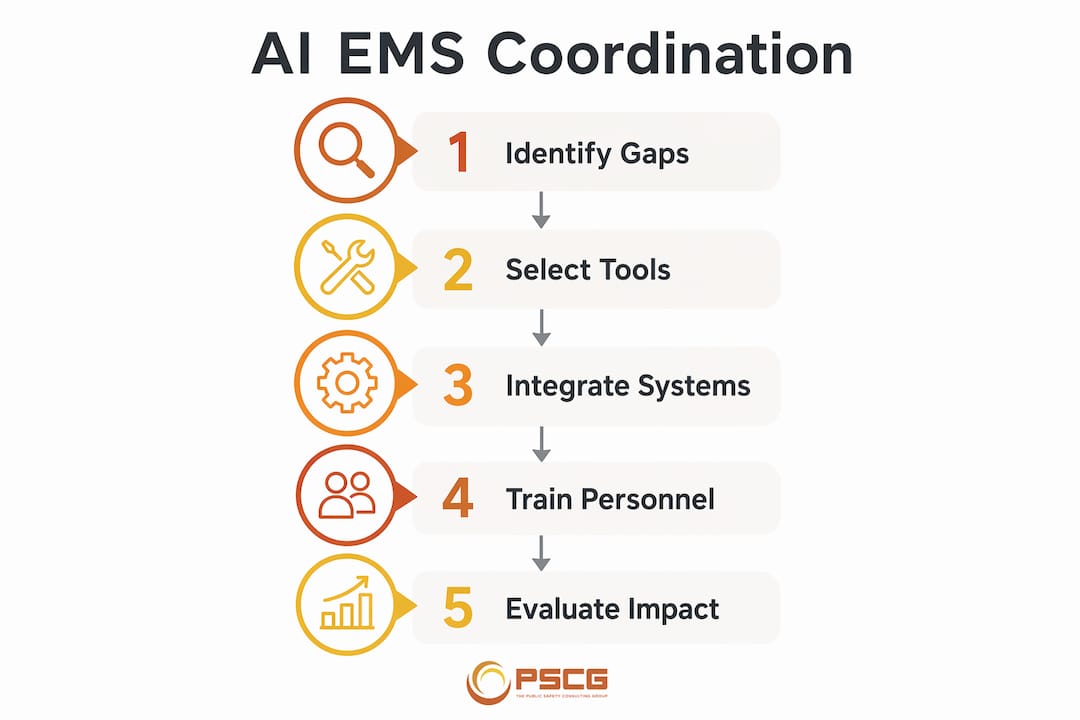
Pro Tip: Before selecting any AI platform, map your agency’s coordination gaps first. The highest-value AI deployments address the specific boundaries where your dispatch, field units, and logistics lose time, not the most visible technology on the market.
Why trust and transparency are non-negotiable in public safety AI
The OECD’s framework for high-risk AI end users requires that public safety agencies validate tools rigorously, maintain meaningful human control, and protect individual rights throughout deployment. This is not a compliance checkbox. Public trust in emergency services depends on it.

The “Black Box” problem is real and specific. Data quality is more critical than algorithmic sophistication. An AI system trained on biased or incomplete data will produce biased outputs, regardless of how advanced the underlying model is. Agencies that adopt tools without understanding their data sources take on legal and operational risk they may not see until it surfaces in a courtroom or a community complaint.
Ethical practices that belong in every AI deployment:
- Bias auditing: Independent testing of AI models for accuracy and demographic fairness before deployment.
- Transparent tool registries: Public documentation of which AI tools are in use and for what purpose.
- Human dignity safeguards: No AI system should make a final determination affecting an individual’s liberty or safety without human review.
- Data governance protocols: Clear policies on how training data is sourced, maintained, and updated.
How public safety leaders can implement AI solutions effectively
Effective AI adoption in EMS and public safety starts with organizational readiness, not technology selection. The biggest barrier to AI adoption is not the algorithm. It is disconnected data silos, proprietary systems across agencies, and the organizational friction that prevents a unified operational picture from forming.
A phased, human-centered approach works best:
- Start with a proof of concept: Let your agency serve as an active user in a joint research or pilot project. This surfaces real operational constraints before full deployment.
- Prioritize integration over replacement: AI coordination layers can sit above existing dispatch, records, and resource management systems without requiring a full infrastructure overhaul. System integration done right preserves institutional knowledge while adding real-time coordination.
- Build workforce proficiency early: Simulation-based training reduces resistance and builds the operational confidence personnel need to trust AI-assisted recommendations.
- Size the budget to operational gains: Quantify the specific response time, coordination, or administrative efficiency improvements you expect, then size the investment accordingly.
- Maintain human-in-command architecture: Every AI-recommended action should require human approval before execution. Accountability must remain with the person, not the platform.
Pro Tip: The agencies that get the most from AI are the ones that involve frontline personnel in the selection and testing process. Dispatcher and paramedic input on workflow design catches usability problems that no vendor demo will reveal.
What US regulatory and legal frameworks say about AI in public safety
The regulatory environment for AI technology in law enforcement and EMS in the United States is active and evolving. The Office of Justice Programs has published guidance frameworks for evaluating AI applications in law enforcement, emphasizing data quality, technology maturity, and ethical constraints as the three filters every agency should apply before deployment.
At the federal level, FEMA is actively exploring AI applications for disaster response and resource coordination. State legislatures across the country are advancing bills that govern facial recognition, predictive policing tools, and automated decision systems used by public agencies. EMS leaders should work with legal counsel to assess state-specific requirements before procurement, particularly around data retention, algorithmic transparency, and civil rights compliance. The legislative process for public safety AI is moving faster than most agency procurement cycles.
Data privacy and security in AI-enabled EMS systems
AI deployment in EMS creates specific data privacy obligations that differ from general healthcare or law enforcement contexts. Patient care data, dispatch records, and location information processed by AI systems may fall under HIPAA, state privacy statutes, and federal data security requirements simultaneously.
Agencies must establish clear data ownership policies before signing vendor contracts, particularly with providers whose business models depend on maintaining proprietary control over the data their platforms generate. Encryption standards, access controls, and breach notification protocols need to be defined contractually, not assumed. The privacy risks of AI-enabled surveillance, including predictive tools that aggregate location and behavioral data, require ongoing legal review as capabilities expand. Operational risk reduction in EMS starts with knowing exactly what data your AI systems collect, where it goes, and who controls it.
Key Takeaways
AI in public safety delivers the greatest operational value when it connects agencies in real time, keeps humans in command of every decision, and is built on high-quality, audited data.
| Point | Details |
|---|---|
| Coordination is the core gain | AI reduces response time losses at agency boundaries, not within individual units. |
| MAESTRO cut decision latency by over 85% | Cross-agency AI coordination enabled significantly increased lead time for evacuation in a live typhoon scenario. |
| Data quality beats algorithm complexity | Biased or incomplete training data produces unreliable outputs regardless of model sophistication. |
| Human-in-command is the standard | Every AI-recommended action requires human approval; accountability stays with the decision-maker. |
| Regulatory compliance is active now | US federal and state frameworks for AI in public safety are advancing faster than most procurement cycles. |
Where Thepscgroup stands on AI and public safety strategy in 2026
The conversation about AI in public safety too often gets framed as a technology decision. It is not. It is an operational strategy decision, and the technology is just one variable. What I see consistently is that agencies that struggle with AI adoption are not struggling because they chose the wrong platform. They are struggling because they did not first define what coordination problem they were trying to solve, who owns the decision at each step, and how their workforce would be prepared to work alongside the new system.
Thepscgroup’s approach is grounded in EMS system design and municipal EMS strategy that puts operational outcomes ahead of technology adoption for its own sake. We work alongside your team to assess performance gaps, map coordination failures, and build the strategic framework that makes any technology investment defensible and measurable. That includes reimbursement optimization, legislative advocacy, and leadership development, because sustainable AI adoption requires financial viability and organizational buy-in at every level.
The agencies that will lead in 2026 are the ones that treat AI as a coordination tool within a human-commanded system, not as a substitute for operational strategy. That distinction shapes everything from procurement to workforce training to community trust.
Thepscgroup | thepscgroup.net | Connecticut-based EMS and public safety consulting