



Most U.S. EMS agencies that transmit electronic transactions are HIPAA-covered entities, and that status carries real legal weight. If your service bills electronically, checks patient eligibility, or receives remittance from a payer, you are almost certainly subject to the Privacy, Security, and Breach Notification Rules. HIPAA compliance for EMS is not an abstract regulatory concern; it is a day-to-day operational requirement that touches every ePCR, radio transmission, and mobile device your crews carry.
Three actions belong on your desk this week:
- Lock down devices and ePCRs. Confirm multi-factor authentication, encryption, and remote wipe capability on every laptop, tablet, and phone that touches patient data.
- Confirm your business associate agreements. Every cloud, ePCR, and billing vendor handling patient health information needs a signed BAA with documented safeguards.
- Start or verify your risk analysis. PSCG’s operational audits have found a significant compliance gap across EMS systems, and it usually starts with a missing or stale risk assessment.
Each of these gets a full walkthrough below, along with the policies, training cadence, and vendor checks that turn a passing grade into a durable compliance program.
Key Takeaways
HIPAA compliance for EMS depends on encrypted devices, signed BAAs, current risk analyses, and documented training working together as one program, not as separate boxes to check.
| Point | Details |
|---|---|
| Covered entity status | Most EMS agencies billing electronically must follow HIPAA’s Privacy, Security, and Breach Notification Rules. |
| Minimum Necessary limits access, not care | Treatment disclosures stay unrestricted; payment and operations sharing gets limited internally. |
| MFA and encryption come first | These two controls block the majority of account takeover and device loss incidents. |
| Right of access has a hard deadline | Records requests need a response within 30 days or penalties can follow, as seen in the AMR settlement. |
| PSCG audits find fixable gaps | PSCG’s operational audits found a 68% compliance gap, concentrated in training and device security fixes. |
Table of Contents
- HIPAA Basics for EMS: Covered Entities, PHI, and TPO
- Minimum Necessary in Practice: Field Rules and Examples
- Security Rule Essentials: Encryption, Devices, and Ambulance Controls
- Policies, Training, Risk Analysis, and Business Associate Agreements
- Breach Response, Notification Timelines, and OCR Investigations
- Right of Access: Handling Records Requests Without Enforcement Risk
- Real EMS Cases of Noncompliance and What Followed
- A Prioritized Checklist to Close the Compliance Gap
- Primary Sources and Further Reading
- What the Research Actually Tells Us About EMS and HIPAA
- Get a HIPAA Readiness Audit Built for EMS Operations
- Frequently Asked Questions About HIPAA Compliance for EMS
- Sources
HIPAA Basics for EMS: Covered Entities, PHI, and TPO
If your agency submits electronic claims, verifies insurance eligibility, or receives electronic remittance advice, you meet HIPAA’s definition of a covered entity. Most EMS agencies that transmit electronic transactions fall into this category whether they realize it or not, which means the Privacy, Security, and Breach Notification Rules all apply.
Protected health information in EMS shows up in more places than most crews expect:
- The narrative section of an ePCR
- Photos taken at a scene for documentation
- GPS coordinates tied to a specific patient encounter
- Radio transmissions that name or otherwise identify a patient
HIPAA’s treatment, payment, and operations framework, often shortened to TPO, governs when you can share this information without separate authorization. Treatment disclosures, handing a report to the receiving hospital, briefing an incoming crew, are essentially unrestricted because patient care cannot wait on paperwork. Payment and operations disclosures, like sharing records with your billing vendor or during a quality improvement review, are where the Minimum Necessary standard kicks in and limits how much gets shared and who sees it.
Minimum Necessary in Practice: Field Rules and Examples
Minimum Necessary trips up more crews than any other HIPAA concept, mostly because they misapply it during actual patient care. The standard limits internal exposure for payment and operations activities, but it does not restrict what you tell the emergency department about a patient’s condition. Treatment comes first, always.
Here is how that plays out on shift:
- Radio reports should stay concise and clinically focused, not because HIPAA demands brevity, but because good radio discipline naturally limits unnecessary detail.
- QA reviews should pull only the fields relevant to the metric being studied, not the full chart, when a full chart is not required.
- Training materials built from real calls need de-identification, stripped names, addresses, and any detail that could reveal identity.
Pro Tip: Build a one-page Minimum Necessary reference card for your rigs. Supervisors conducting QA reviews should ask “does this field answer my question?” before opening any additional record.
Security Rule Essentials: Encryption, Devices, and Ambulance Controls
The Security Rule’s technical safeguards are where most agencies either build real protection or leave dangerous gaps. Encryption in transit and at rest is not optional for any device carrying ePCR data. Pair that with unique user IDs, multi-factor authentication, automatic logoff after inactivity, and audit logs that track who accessed what and when.
MFA alone blocks roughly 99.9% of automated account takeover attempts according to industry reporting from Microsoft and Google, which makes it one of the cheapest, highest-return controls an agency can deploy. Most tablets and ePCR platforms already support it; the barrier is usually policy, not technology.
Device lifecycle management matters just as much as the initial setup:
- Patch operating systems and ePCR software on a defined schedule, not an ad hoc one.
- Enable remote wipe on every mobile device before it leaves the station.
- Secure charging and storage on the ambulance itself, not just at the base.
- Use locked cabinets or chained mounts for tablets left in vehicles overnight.
When vetting a new ePCR or billing vendor, ask for SOC 2 or HIPAA attestation documentation, evidence of audit logging, clarity on data residency, and a written breach notification process. A vendor that cannot answer these questions in writing is a liability you are choosing to accept.
Policies, Training, Risk Analysis, and Business Associate Agreements
A defensible compliance program rests on three pillars: documented risk analysis, structured training, and airtight vendor agreements.
Risk analysis should cover every system that touches PHI, from ePCR tablets to billing software to radio infrastructure. Conduct it annually at minimum, and immediately after any major technology change. Document findings, remediation timelines, and who owns each fix.
Training needs to happen at hire, at role change, and annually thereafter, with scenario-based drills that reflect actual field situations rather than generic slideshows. Retain signed attestations and training rosters. If OCR ever asks, you need to produce them in minutes, not weeks.
Business associate agreements are required with any vendor that creates, receives, maintains, or transmits PHI on your behalf, including ePCR platforms, billing clearinghouses, and cloud storage providers. When reviewing a BAA:
- Confirm it names permitted uses and disclosures explicitly.
- Verify it requires the vendor to report breaches within a defined window.
- Check that it obligates the vendor to implement appropriate safeguards, not just promise them.
- Ask whether the agreement gets reviewed and re-signed on a recurring schedule.
Breach Response, Notification Timelines, and OCR Investigations
The moment you suspect a breach, the clock starts. Evaluate quickly: who received the PHI, was it actually acquired or just briefly exposed, and can you mitigate through remote wipe or account lockout before it spreads further.

Notification obligations scale with breach size. Individual notice is required in nearly every case. Breaches affecting 500 or more people in a single jurisdiction require notification to HHS OCR and, in many cases, local media, generally within 60 days of discovery.
Documentation determines how an investigation unfolds. OCR frequently reviews an agency’s entire compliance history once a breach is reported, not just the incident itself, which means a single lost device can surface years of gaps in training records or risk assessments.
A reported breach can trigger wide OCR scrutiny of policies and historical compliance. Proactive documentation and corrective action materially reduce that exposure before an investigator ever asks for it.
Vulnerabilities specific to EMS, device loss, social media disclosures, and vendor breaches, are exactly the patterns OCR investigates most often in this sector.
Right of Access: Handling Records Requests Without Enforcement Risk
OCR expects a response to a patient records request within 30 days, no exceptions for staffing shortages or holiday schedules. Delays and improper fees have produced real penalties in EMS specifically.
A workable request process looks like this:
- Intake: Log the request the moment it arrives, with a timestamp.
- Identity verification: Confirm the requester’s identity using a consistent, documented method.
- Retrieval: Pull the specific record, not the full patient history unless requested.
- Formatting: Deliver in the format the patient asks for, electronic when possible.
- Logging: Record the completion date to prove you met the deadline.
OCR imposed a $115,200 civil monetary penalty on an EMS company for failing to provide timely access, a penalty that traced back to a process that had no single owner and no tracking mechanism.
Pro Tip: Assign one person as the records request owner, even in a small agency. A shared responsibility becomes no responsibility once the 30-day clock starts running.
Real EMS Cases of Noncompliance and What Followed
A Georgia ambulance service lost an unencrypted laptop containing patient data and ended up paying a $65,000 settlement along with a multi-year corrective action plan. The investigation found no encryption policy and no recent risk analysis, gaps that likely existed long before the laptop went missing.
The AMR right-of-access case mentioned earlier stemmed from a records request that sat unanswered well past 30 days, with no documented process to catch the delay before it became a federal case.
Root causes across these cases repeat: absent risk analysis, missing or outdated training records, and BAAs that were either unsigned or never enforced.
Remediation that worked: mandatory encryption on all portable devices, quarterly BAA audits, and a records request tracker with automated deadline alerts.
Agencies that treat a single incident as an isolated event miss the point. OCR investigates the whole program once it starts looking, and the program is usually where the real exposure lives.
A Prioritized Checklist to Close the Compliance Gap
PSCG’s operational audits found a 68% compliance gap across EMS systems reviewed, concentrated in device security, training documentation, and vendor management. The highest-impact fixes, in order: encrypt all devices, enable MFA, sign or update every BAA, complete a current risk analysis, formalize training attestations, secure ambulance device storage, build a records-request tracker, and designate named privacy and security officers.
A phased approach makes this achievable on a real budget:
- 30 days: Encryption, MFA, and BAA inventory review.
- 90 days: Completed risk analysis and updated training records.
- 6 to 12 months: Full policy rewrite, vendor audit cycle, and incident response plan testing.
Pro Tip: Assign an owner and a deadline to each phase before you start. A checklist without accountability rarely survives past the first busy shift.
Agencies that need direct support can reach PSCG’s team for a structured audit built around these same priorities.
Primary Sources and Further Reading
- HIPAA Compliance for Paramedics: A Practical Field Guide
- HIPAA Training for Emergency Medical Services
- Ambulance Services Face Health Privacy Challenges
- What Is EMS Compliance? A 2026 Guide for EMS Leaders
What the Research Actually Tells Us About EMS and HIPAA
The conventional advice on HIPAA compliance treats it like a paperwork exercise: sign the forms, run the annual training, file it away. The cases that actually reach OCR tell a different story. Every settlement referenced here traces back to a gap that existed long before the incident, an unencrypted laptop, an unanswered records request, a BAA nobody enforced.
What gets underestimated is how much a single breach report widens the lens. OCR does not just look at the laptop. It looks at your training records, your risk analysis, your whole program, going back years. That should change how agencies prioritize. Documentation is not defense after the fact; it is the thing that determines whether a bad day becomes a six-figure settlement or a contained incident.
What deserves more attention than it gets: Minimum Necessary confusion. Crews sometimes hesitate to share clinically relevant information out of a misplaced fear of violating HIPAA, when the rule was never meant to slow down patient care. Fix that misunderstanding first. It costs nothing and it protects both your patients and your crews.
Get a HIPAA Readiness Audit Built for EMS Operations
Reading through every safeguard, deadline, and documentation requirement above is one thing. Building a program that actually holds up under an OCR review is another, and it is exactly what Thepscgroup does for EMS agencies across Connecticut and beyond. Where a generic compliance vendor sells a template, Thepscgroup builds a phased corrective action plan around your actual call volume, your actual vendor stack, and your actual budget cycle.

We also support agencies through risk analyses, policy rewrites, and training program design as part of broader EMS system design consulting.
If your agency is ready for a structured audit, reach out through Thepscgroup’s main site to schedule a readiness consultation this month.
Frequently Asked Questions About HIPAA Compliance for EMS
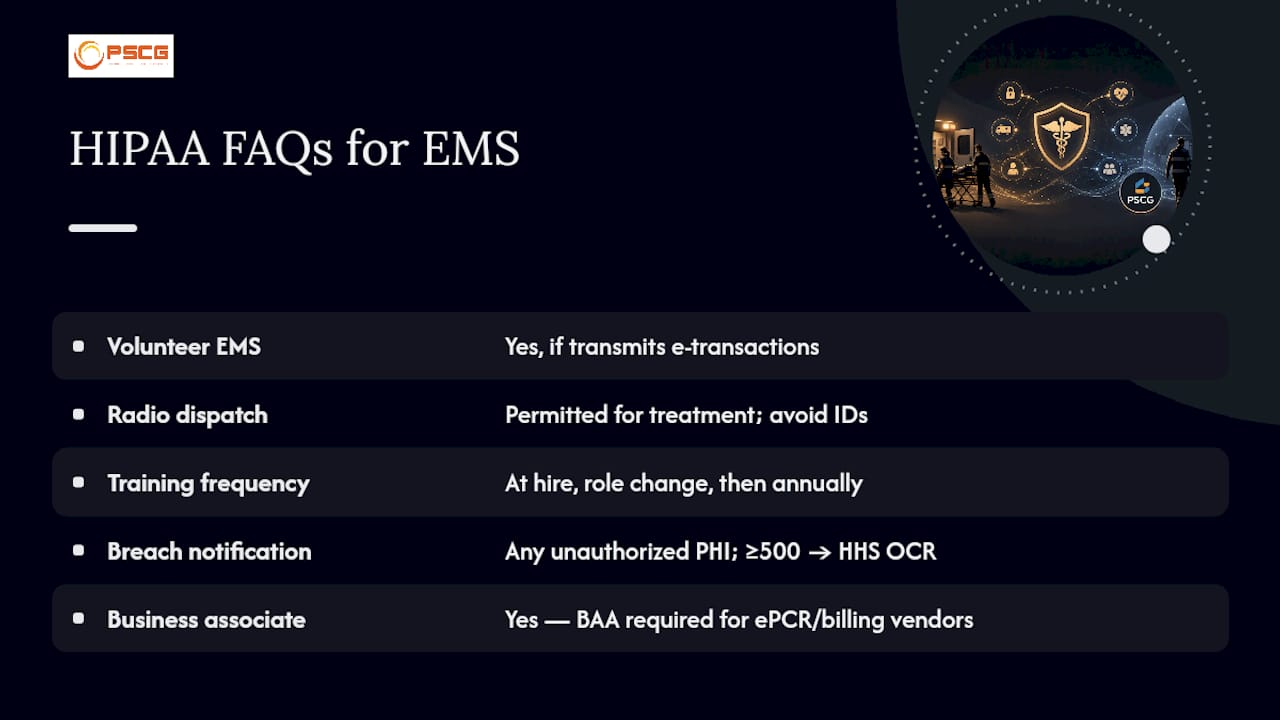
Does HIPAA apply to volunteer EMS agencies?
Yes, if the agency transmits electronic transactions like billing or eligibility checks, volunteer status does not exempt it from HIPAA regulations for EMS.
Can dispatch share patient information over open radio channels?
Radio transmissions for treatment purposes are generally permitted, but agencies should minimize identifying details when a patient’s name or address is not clinically necessary for the responding crew.
How often does HIPAA training need to happen for paramedics?
Training for paramedics should occur at hire, after any role change, and at least annually thereafter, with signed attestations kept on file for audit purposes.
What triggers a HIPAA breach notification for EMS agencies?
Any unauthorized acquisition or disclosure of unsecured PHI triggers individual notice, and breaches affecting 500 or more people in one jurisdiction require HHS OCR and possible media notification within 60 days.
Do EMS agencies need a business associate agreement with their ePCR vendor?
Yes, any vendor that creates, stores, or transmits PHI on an agency’s behalf, including ePCR and billing platforms, requires a signed BAA outlining safeguards and breach reporting obligations.
This article is general information, not a substitute for advice from a qualified doctor. Consult a qualified healthcare professional about your own circumstances before acting on anything here.
Sources
- HIPAA training for emergency medical services
- HHS settles HIPAA right of access case with EMS company
- Ambulance services face health privacy challenges – The HIPAA E-Tool