



Performance gap closure is the practice of closing the distance between a defended metric today and a dated target, and it starts with naming one metric and assigning one owner. This isn’t abstract theory. It’s a discipline that PSCG has applied across EMS systems and municipal agencies, where a stalled response time or a billing shortfall has real consequences for the people a department serves.
TL;DR:
- Closing a performance gap requires accurately identifying its type, such as process, skill, definition, or strategy, to apply the correct intervention.
- Most gaps stem from unclear ownership, broken measurement, or resource constraints, which can be diagnosed with a simple five-why analysis.
- A clear, one-page closing plan should assign a single owner, one action, and a check-in date, avoiding diffuse accountability that hampers follow-through.
- Verified closure depends on setting a realistic target, running a pilot, and confirming sustained improvement over time using control charts or baseline re-measurements.
- External support from consultants can accelerate closure when gaps involve system design, staffing, or compliance issues beyond internal control.
Table of Contents
- What counts as a performance gap, and why the type matters
- Why closing performance gaps matters to outcomes and resource use
- Common causes of performance gaps and a rapid diagnostic approach
- A gap-analysis and closure checklist you can run this week
- Interventions that actually close each type of gap
- Choosing metrics and dashboards that stay honest
- Ownership and governance: the accountability test
- Verifying closure without declaring victory too soon
- PSCG practitioner notes: applying the method in the field
- The blind spot most managers miss
- How PSCG helps leaders close performance gaps
- Sources
- FAQ
What counts as a performance gap, and why the type matters
A performance gap is the measurable space between what a team is producing now and what leadership expects. Not every gap looks the same, and treating them as identical is how well-meaning managers waste a quarter chasing the wrong fix.
Four types show up again and again:
- Performance gap: the metric is accurate, but results are below target, often a skill, process, or resource issue.
- Tracking gap: the real result may be fine, but the data collecting it is broken or delayed.
- Definition gap: teams disagree on what the metric even means, so comparisons are meaningless.
- Strategy gap: the team is hitting its targets, but the targets no longer serve the organization’s goals.
A dispatch center missing its call-processing benchmark has a performance gap. A department reporting response times from three different software systems has a tracking gap. Naming the type first keeps the fix proportional to the problem.
Why closing performance gaps matters to outcomes and resource use
Every uncorrected gap carries a cost, whether it shows up as missed transports, overtime spending, or slower emergency response. Organizations that build performance management systems with goal cascading, real-time feedback, and KPI alignment show stronger strategic coherence and better cross-functional coordination than those relying on occasional check-ins.
A well-run gap-analysis process clarifies whether a shortfall is an execution problem or a strategy problem, according to Harvard Business School Online, and that distinction determines whether the fix is operational or a full strategy review. A modest improvement in a high-volume metric, such as call-to-dispatch time across thousands of monthly calls, tends to produce outsized value compared with the effort required to close it. Small, well-targeted corrections often beat sweeping overhauls.
Common causes of performance gaps and a rapid diagnostic approach
Before assigning a fix, find the actual cause. Six sources account for most gaps we see in public safety operations:
- Unclear ownership: nobody is accountable for the specific number.
- Broken measurement: the data lags, is manually compiled, or contradicts itself across systems.
- Skill shortfalls: staff lack training on a new protocol or tool.
- Process friction: the workflow itself creates delay or error.
- Misaligned incentives: people are rewarded for something other than the target behavior.
- Resource constraints: staffing, equipment, or budget limits the ceiling on performance.
Run a single round of 5 Whys on the gap before building a plan: ask why the metric missed, then why that happened, and continue until you reach something an owner can actually change. If every “why” points back to a target that no longer matches organizational priorities, you’re looking at a strategy gap, not an execution gap, and no amount of training will close it.
A gap-analysis and closure checklist you can run this week
A workable closing plan does not need a committee or a quarter-long study. It needs five honest inputs and one meeting.
- Step 1: Anchor the current state. Name the metric, the date it was measured, and the source system. “Average patient contact time was 8.4 minutes as of last Tuesday, per the CAD system” is defensible. “Response times are slow” is not.
- Step 2: Set the target. Include a deadline and the assumptions behind it. If the target assumes added staffing, say so.
- Step 3: Classify the gap. Use the four types above, then run one 5 Whys pass to find the root cause.
- Step 4: Build the closing plan. One owner, one primary action, one check-in date. Resist the urge to assign three owners or five actions. Diffuse accountability is how gaps linger for years.
- Step 5: Decide if a strategy review is needed. If the root cause traces back to a target set without current operational data, pause the closing plan and revisit the strategy first.
Pro Tip: Write the closing plan on one page. If it needs a second page, you have more than one gap.
This structure mirrors the gap-analysis template many consulting practices use, where current state, future state, gap type, root cause, and a named owner form the backbone of every entry, and where teams assigning a clear owner tend to see stronger follow-through than those leaving accountability unassigned.
Interventions that actually close each type of gap
Match the fix to the cause, not to whatever solution is already familiar to the team.
- Skill gaps call for targeted training, not a generic refresher course.
- Process gaps call for workflow redesign, often starting with the single slowest handoff.
- Motivation gaps call for incentives or recognition tied to the specific behavior you want more of.
- Resource gaps call for staffing or equipment changes, verified against a realistic budget.
Pay-for-performance deserves a caution here. Pay-for-performance is positively related to job performance, with a stronger effect on task performance than on broader contextual behavior, but that benefit depends heavily on how fair employees perceive the process to be. Programs built without attention to distributive and procedural justice risk creating pressure that undercuts the very performance they intend to reward.
Before rolling out any fix organization-wide, run a small pilot: one shift, one station, or one unit, with a defined measurement window and a pre-agreed threshold for success. If the pilot doesn’t move the metric, the root cause diagnosis was likely wrong.
Choosing metrics and dashboards that stay honest
A metric that nobody trusts is worse than no metric at all. Pick one defended metric per gap, always with a date and a named source system, and make sure the whole team is measuring the same thing the same way.
Leading indicators, like unit availability or training completion rates, tend to move before lagging indicators, like response time or patient outcomes, catch up. Tracking both gives a manager early warning instead of a quarterly surprise.
- Show the last-update timestamp on every dashboard, so nobody acts on stale numbers.
- Set an escalation trigger, a defined point at which a stalled metric automatically goes to a supervisor.
- Review cadence should match the metric’s volatility, weekly for operational numbers, monthly for financial ones.
Our guide to EMS performance metrics walks through how public safety leaders choose and defend the numbers that actually predict outcomes.
Ownership and governance: the accountability test
Assigning an owner means nothing if that person doesn’t control the inputs that move the number. Before finalizing any closing plan, apply this test:
- Can the owner change the process, staffing, or tool involved without a lengthy approval chain? If not, the real owner is whoever controls that chain.
- Does the owner have visibility into the metric on a cadence that lets them act? A monthly report is too slow for a weekly problem.
- Is there an escalation path if the owner hits a barrier outside their control?
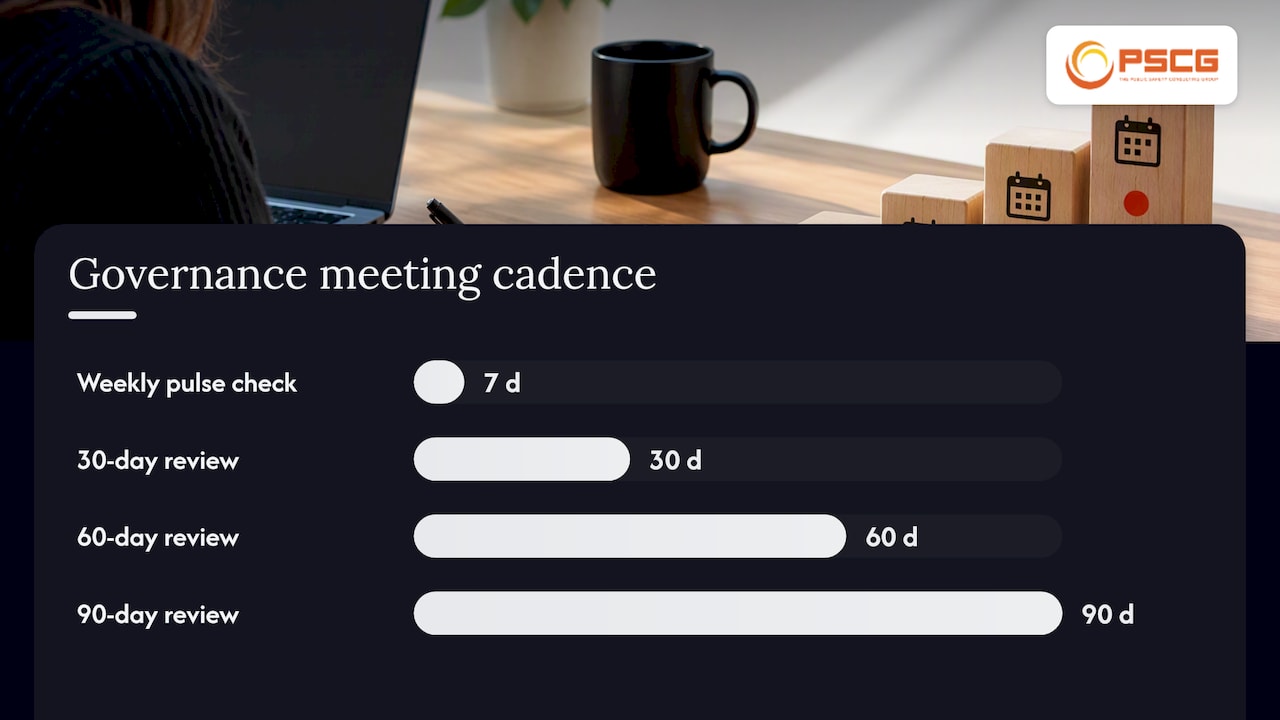
A 30/60/90-day rhythm, backed by a brief weekly pulse check, keeps momentum without turning into another standing meeting nobody reads the notes from. The most common governance trap is assigning ownership to a committee. Committees diffuse responsibility exactly when a gap needs one clear decision-maker.
Pro Tip: If two people are “co-owners” of a metric, you have zero owners.
Verifying closure without declaring victory too soon
Closure means the metric has hit its target and held there long enough to trust the result, not a single good week. Define the success threshold at the same time you set the original target, using the same metric and the same source system.
- Run a short pilot period after the intervention, long enough to smooth out normal variation.
- Use control charts or simple before-and-after comparisons to confirm the shift is real, not noise.
- Spot-check the underlying data source to rule out a tracking gap masquerading as a fixed performance gap.
- Re-baseline the target if conditions changed during the closing period, staffing levels, call volume, or protocol updates.
- If the gap reopens shortly after closure, treat it as a signal to run a full strategy review rather than another quick fix.
PSCG practitioner notes: applying the method in the field
PSCG’s EMS Quality Improvement Consulting work has surfaced this pattern repeatedly: EMS Operational Audits have revealed a 68% compliance gap in audited systems, a finding that points to widespread room for operational improvement across staffing, documentation, and response protocols.
Mapped to the four-step template, that finding becomes actionable:
- Current state: audit result showing 68% compliance against the applicable standard.
- Target: full compliance by a set date, with assumptions about training capacity noted up front.
- Gap type: usually a process or skill gap, occasionally a definition gap when compliance criteria are interpreted inconsistently across shifts.
- Closing plan: Our 7 Step OSHA Checklist gives agencies a structured sequence for closing compliance and operational gaps, with a named owner for each step.
When an internal team lacks the bandwidth or independence to run this diagnostic honestly, that’s the point to bring in outside support.
The blind spot most managers miss
The single biggest failure isn’t a bad metric. It’s a metric with no owner and no update date, quietly going stale while everyone assumes someone else is watching it. Build a weekly metric pulse into your calendar and treat PSCG’s resources as a starting checklist, not a last resort.
— Mike
How PSCG helps leaders close performance gaps
Closing a performance gap internally works well when the cause is clear and the fix sits inside your team’s control. When the gap touches system design, staffing models, or compliance across multiple units, an outside diagnostic often moves faster than an internal committee ever will.
Relevant consulting services include:
- High Performance EMS (HPEMS) System Design, for agencies rebuilding deployment from the ground up.
- Operational Risk Reduction, for compliance and safety gaps like the ones surfaced in EMS audits.
- Municipal EMS Strategy and Reimbursement Optimization, for financial performance gaps tied to billing and collections.
If your team has already run the four-step method above and the gap persists, or if the root cause points to system design rather than a single process, visit Thepscgroup to talk through where your operation stands and what a closure plan would look like with outside support.
Sources
- A cognitive evaluation and equity-based perspective of pay for performance on job performance: A meta-analysis and path model
- How Gap Analysis Can Drive Strategic Change in Your Organization
FAQ
What does “gap closure” mean?
Gap closure means bringing a measured result up to a defined target and confirming the change holds over time, not just for a single reporting period. It requires a defended current-state metric, a dated target, and a named owner responsible for the actions that move the number.
What does performance gap mean?
A performance gap is the difference between what a team, process, or metric is currently achieving and what it’s expected to achieve. Gaps can stem from execution problems, broken measurement, unclear definitions, or an outdated strategy, and the correct fix depends on which type you’re facing.
What are the 5 C’s of performance management?
Definitions of frameworks like this vary across organizations and consulting practices, so there’s no single universally agreed version. Most managers get better results focusing on a clear metric, a dated target, a defined gap type, a documented root cause, and one accountable owner, the practical structure covered throughout this guide.
Can you give me an example of a performance gap?
A dispatch center targeting a 90-second call-processing time but averaging 2 minutes has a performance gap tied to process or staffing. A fire department reporting inconsistent response times because three stations use different timestamp systems has a tracking gap, not a true performance shortfall.