



EMS–hospital partnerships reduce time-to-treatment and improve patient outcomes by aligning prearrival care with emergency department workflows. When EMS and hospitals operate as a coordinated system rather than separate silos, the clinical and operational gains are measurable and significant. Nearly 70% of inpatient admissions arrive via EMS, which means the quality of that handoff directly shapes the patient’s trajectory from the moment care begins. EMS data also supplies near real-time information on emergency types and social determinants of health used by public health and emergency management, making EMS a public-health asset that extends well beyond transport.
The core reasons why EMS partnerships deliver value:
- Faster time-to-treatment through prearrival notification and coordinated triage
- Smoother patient handoffs with shared protocols and standardized documentation
- Better ED throughput by reducing diversion hours and door-to-provider times
- Data-driven quality improvement through shared outcome reporting and feedback loops
- Stronger mutual aid coverage, especially across rural or multi-jurisdictional service areas
- Interoperability gains when ePCR, EHR, and CAD systems exchange data in real time
Pro Tip: If you are just starting to build a partnership program, prearrival notification is the single highest-impact, lowest-cost place to begin. It requires no new technology in most systems and delivers measurable ED prep time within weeks.
Table of Contents
- How EMS–hospital partnerships improve patient care and clinical outcomes
- What are the most productive areas for EMS and hospital collaboration?
- Which technologies make EMS–hospital data exchange actually work?
- What operational KPIs should you track to measure partnership impact?
- How do you build and sustain an EMS–hospital partnership from the ground up?
- What barriers will you face, and how do you get past them?
- What does the research and public health data tell us about EMS partnerships?
- What timeline and budget should you plan for?
- Key Takeaways
- What the data and experience actually tell us about building these programs
- Useful sources and further reading
How EMS–hospital partnerships improve patient care and clinical outcomes
The clinical case for EMS collaboration is grounded in a straightforward mechanism: when hospitals receive structured prearrival information, they can mobilize the right resources before the patient arrives. That preparation compresses the time between arrival and definitive treatment, which matters most for time-sensitive conditions such as STEMI, stroke, and sepsis.

Operationally, the benefits extend beyond individual calls. ED preparedness improves when staff know what is coming. Triage accuracy increases when nurses and physicians receive prearrival vitals, interventions, and medication history rather than reconstructing the picture from scratch at the door. Fewer critical diagnoses are missed when the field assessment is documented in a structured ePCR and transmitted ahead of arrival.
Consider a community hospital that implemented a structured prearrival alert protocol with its primary EMS agency. By receiving standardized notifications for chest pain patients, the ED activated its cardiac catheterization team an average of 14 minutes earlier per call. That kind of compression in activation time is exactly what hospital-EMS collaboration research has consistently identified as a driver of improved survival in acute coronary events.
Key clinical and operational benefits include:
- Reduced door-to-provider and door-to-balloon times for cardiac and stroke patients
- Improved triage accuracy through structured prearrival documentation
- Fewer repeat assessments and duplicate data entry at the ED
- Better matching of patient destination to hospital capability
- Reduced ED diversion hours through coordinated capacity management
- Stronger continuity of care from field to floor
What are the most productive areas for EMS and hospital collaboration?
Knowing why to partner is only the starting point. The more practical question is where to focus first. Not every collaboration domain delivers equal value, and the right priority depends on your system’s scale, geography, and existing gaps.
The highest-yield collaboration areas, in rough order of implementation ease:
- Prearrival notification — structured alerts for high-acuity patients (STEMI, stroke, trauma, sepsis) that trigger ED preparation before arrival
- Shared clinical protocols — aligned treatment and destination protocols so field decisions match hospital capability
- Joint training and simulation — combined drills, crew resource management exercises, and case reviews that build operational synchrony
- Outcome feedback loops — hospitals sharing patient outcome data with EMS agencies so field crews learn what happened after the handoff
- Transfer coordination — standardized processes for interfacility transfers that reduce delays and documentation gaps
- Mutual aid agreements — formal arrangements for resource sharing across jurisdictional lines, particularly in rural or multi-agency regions
- Patient outcome data sharing — aggregate reporting that supports quality improvement at both the agency and hospital level
Consistent field partnerships build psychological safety and operational synchrony over time. That rhythm is difficult to build with rotating crews and no shared feedback mechanism. Planned joint staffing and liaison roles accelerate performance during critical incidents.
Pro Tip: Urban systems with high call volume should prioritize prearrival notification and shared STEMI/stroke protocols first. Rural systems often gain more from mutual aid agreements and shared training, where ambulance service partnerships enable agencies to share personnel and resources across districts that no single agency can cover alone.
A quick-start checklist for each domain:
- Prearrival notification: Identify the EMS agencies that transport the most patients to your ED. Draft a one-page notification template. Pilot it for STEMI and stroke within 30 days.
- Shared protocols: Convene a joint medical director meeting. Align destination criteria and treatment thresholds for your top five high-acuity diagnoses.
- Joint training: Schedule one combined simulation per quarter. Include debrief time with both EMS and ED staff present.
- Feedback loops: Commit to sharing 30-day outcome summaries with your primary EMS partners. Start with cardiac arrest and STEMI.
Which technologies make EMS–hospital data exchange actually work?
Technology does not create a partnership, but it determines whether the partnership can scale. The foundational data flow runs from the ePCR (electronic patient care report) generated in the field through to the hospital’s EHR or Health Information Exchange (HIE). When that flow works, ED staff receive prearrival vitals, interventions, and medication history before the patient crosses the threshold.

The standards that govern this exchange matter. NEMSIS (National EMS Information System) defines the data elements and format for EMS records, providing a common vocabulary across agencies. FHIR (Fast Healthcare Interoperability Resources) and HL7 standards govern the EHR side of the exchange. Agencies that adopt API-based, standards-aligned exchanges reduce documentation burden and improve prearrival information flow. The practical implication: when selecting ePCR or CAD vendors, require explicit NEMSIS compliance and FHIR API support before signing any contract.
Implementation priority by effort and impact:
- Low effort, high impact: Prearrival alert systems (text or app-based notifications to ED charge nurses) — deployable in weeks with existing ePCR platforms
- Medium effort, high impact: HIE integration that routes ePCR data to the hospital’s EHR at patient arrival — reduces duplicate entry and improves documentation accuracy
- Higher effort, high long-term value: Bidirectional EHR exchange that sends hospital outcome data back to the EMS agency — closes the feedback loop and supports QI
CAD (Computer-Aided Dispatch) integration adds another layer by enabling real-time unit tracking and resource coordination. Telemedicine capabilities, where a hospital physician can consult with a field crew on a complex patient, represent the leading edge of this integration and are increasingly practical with current mobile broadband infrastructure.
Pro Tip: When evaluating vendors, require open API documentation and ask specifically whether the platform supports NEMSIS 3.5 and FHIR R4. Proprietary data formats create long-term lock-in and make future integrations expensive. Secure data exchange is also worth examining early. For healthcare organizations managing sensitive communications, secure email and messaging standards are a foundational layer that partnerships often overlook until a compliance issue surfaces.
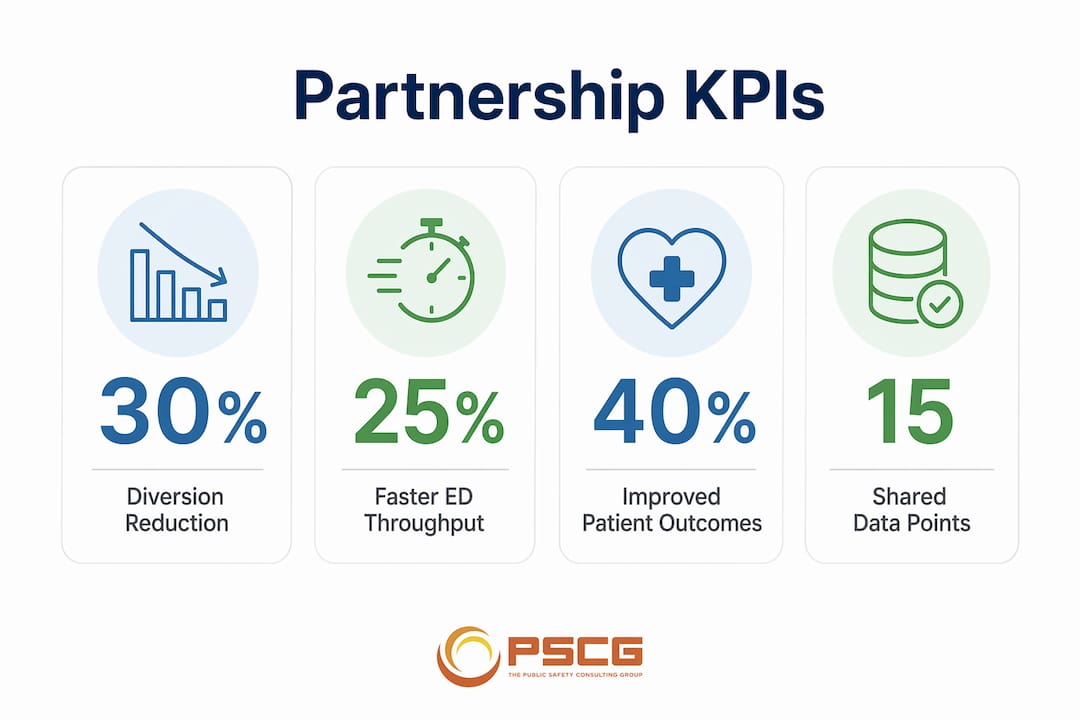
What operational KPIs should you track to measure partnership impact?
A partnership without measurement is a relationship without accountability. The KPIs below give administrators a concrete framework to establish baselines, set incremental targets, and attribute improvements to specific partnership activities.
| KPI | Baseline source | Target direction | Reporting cadence |
|---|---|---|---|
| EMS response time (dispatch to scene) | CAD data | Decrease | Monthly |
| Door-to-provider time | ED tracking system | Decrease | Monthly |
| EMS-to-ED handoff time | ePCR + ED timestamp | Decrease | Monthly |
| Inpatient admission rate via EMS | Hospital ADT data | Monitor/optimize | Quarterly |
| ED diversion hours | Hospital operations | Decrease | Monthly |
| ED length of stay (EMS arrivals) | EHR | Decrease | Quarterly |
| Cardiac arrest survival to discharge | Hospital QI data | Increase | Quarterly |
Establishing a baseline before any partnership activity begins is non-negotiable. Without it, you cannot attribute improvement to the collaboration rather than to seasonal variation or unrelated operational changes. Pull 12 months of historical data for each KPI before launching a pilot.
Key figure: Nearly 70% of inpatient admissions arrive via EMS. That single statistic reframes EMS from a transport vendor into a primary intake channel that deserves the same strategic attention as any other major referral source.
Attribution works best when you tie specific partnership activities to specific KPIs. Prearrival notification should move door-to-provider time. Joint training should move handoff time and reduce errors at the transition point. Outcome feedback loops should, over time, improve field triage accuracy and reduce inappropriate destination choices.
For municipal EMS systems, tracking these KPIs at the agency level alongside hospital-side metrics creates a shared performance picture that neither party can produce alone.
How do you build and sustain an EMS–hospital partnership from the ground up?
The roadmap below reflects the phases that consistently produce durable partnerships. Timelines are approximate and will vary based on organizational complexity and existing relationships.
Phase 1: Planning (months 1–3)
- Identify your primary EMS agency partners and designate an internal hospital EMS champion.
- Conduct a joint gap assessment: where do handoffs break down, where is data missing, where do protocols diverge?
- Draft a Memorandum of Understanding (MOU) covering scope, data-sharing clauses, patient privacy protections, operational expectations, and dispute resolution.
- Establish a joint Quality Improvement (QI) committee with representatives from both organizations.
Phase 2: Pilot (months 3–6)
- Launch a focused pilot: prearrival alerts for STEMI and stroke, combined with a 30-day outcome feedback report to the EMS agency.
- Assign a dedicated EMS liaison role on the hospital side and a hospital liaison on the EMS side.
- Collect baseline KPI data and set 90-day targets.
- Run one joint simulation exercise and debrief with both teams.
Phase 3: Scale (months 6–18)
- Expand prearrival notification to additional high-acuity categories (sepsis, trauma, OB emergencies).
- Integrate ePCR data with the hospital HIE or EHR.
- Formalize a joint training calendar with quarterly combined exercises.
- Present QI results to both organizations’ leadership to secure ongoing commitment.
Phase 4: Sustain
- Conduct annual MOU reviews and update data-sharing clauses as technology evolves.
- Maintain a regular meeting cadence: monthly operational check-ins, quarterly QI reviews, annual strategic planning.
- Use shared outcome data to identify the next performance gap and set new targets.
MOU checklist essentials:
- Defined scope of collaboration (transport, notification, data sharing, training)
- Data-sharing clauses with explicit HIPAA compliance language
- Patient privacy protections and breach notification procedures
- Operational expectations for each party (response times, notification windows)
- Credentialing and affiliation responsibilities for EMS clinicians
- Dispute resolution process
- Renewal and termination terms
Hospitals that share patient outcomes and enable prearrival, near-real-time data exchange with EMS agencies report higher trust and measurable clinical throughput gains. That trust is the foundation that makes every other element of the partnership work.
Pro Tip: The fastest path to a measurable win is a narrow pilot: one EMS agency, one condition (STEMI or stroke), prearrival alerts plus a 30-day outcome report. That combination typically produces visible throughput improvement within 3–6 months and gives both organizations a concrete result to present to leadership.
What barriers will you face, and how do you get past them?
Every EMS–hospital partnership encounters predictable friction points. Knowing them in advance means you can design around them rather than react to them.
Funding and sustainability. Partnership programs require staff time, technology investment, and ongoing coordination. The mitigation: frame the program in terms of ED throughput gains and diversion reduction, both of which have direct revenue implications for the hospital. Shared grant funding through HRSA, ASPR, or state EMS offices can offset startup costs. Public-private partnership structures offer additional funding models worth exploring.
Jurisdictional complexity. A single hospital may receive patients from a dozen EMS agencies across multiple counties. Coordinating protocols and data standards across that many jurisdictions is genuinely difficult. The practical approach: start with your highest-volume transport partner, build a replicable model, then expand. Ambulance service partnerships that formalize mutual aid across districts provide a governance template for multi-agency coordination.
Cultural mistrust. EMS crews sometimes feel that hospitals do not value their clinical assessments. Hospital staff sometimes underestimate field complexity. Both perceptions are understandable, and both erode collaboration.
Role shadowing, where ED nurses spend time on an ambulance and EMS crews observe ED workflows, is one of the most effective tools for breaking down this barrier. Simulation drills, crew resource management, and structured debriefs are repeatedly cited as foundational to building the teamwork that high-stakes calls demand.
Incompatible technology. Legacy ePCR systems that do not support FHIR or NEMSIS 3.5 create integration barriers that are expensive to work around. The mitigation: include technology compatibility as a criterion in your MOU and build a phased integration roadmap that starts with low-tech solutions (structured text alerts) while longer-term integrations are developed.
Privacy and legal concerns. HIPAA compliance in data-sharing arrangements requires explicit legal review. Do not assume that existing BAAs (Business Associate Agreements) cover new data flows. Address this in the MOU drafting phase with legal counsel from both organizations.
Pro Tip: Shared outcome reporting is the single most effective cultural bridge between EMS and hospital teams. When field crews see that their triage decisions led to a patient surviving a cardiac arrest, the relationship shifts from transactional to collaborative. Build that feedback loop early, even if it is just a monthly email summary.
What does the research and public health data tell us about EMS partnerships?
The public-health case for EMS collaboration extends beyond individual patient encounters. EMS data supplies near real-time information on emergency types and social determinants of health used by public health and emergency management agencies. That means EMS is not just a clinical resource; it is a surveillance and planning asset for the communities it serves.
Interdisciplinary collaboration, aligning EMS, public health, and emergency management, multiplies impact on population health problems that no single organization can solve alone. Syndromic surveillance, overdose tracking, and disaster response planning all depend on the kind of granular, geographically distributed data that EMS generates on every shift.
From Thepscgroup’s perspective, the organizations that make the most progress are those that treat EMS partnerships as a system-design question, not just a relationship question. That means defining data flows, governance structures, and performance metrics before the first joint training exercise. It means building EMS system design into the hospital’s strategic planning cycle, not treating it as an operational afterthought.
The research from PMC and published in Annals of Emergency Medicine consistently points to hospital-EMS collaboration as a driver of improved outcomes in time-sensitive conditions. The mechanism is not mysterious: better information, earlier preparation, and aligned protocols produce faster, more accurate care.
What timeline and budget should you plan for?
Setting realistic expectations upfront prevents the program from stalling when early results are slower than anticipated.
Typical timeline:
- Planning phase (1–3 months): Stakeholder alignment, gap assessment, MOU drafting, baseline data collection
- Pilot phase (3–6 months): Narrow pilot with one EMS partner and one condition, initial KPI measurement, first joint training exercise
- Scale phase (6–18 months): Expand to additional agencies and conditions, HIE/ePCR integration, formalized QI committee
- Sustain phase (ongoing): Annual MOU reviews, continuous QI, technology upgrades as standards evolve
High-level budget components:
- Integration engineering: ePCR-to-EHR or HIE connection, API development or vendor configuration
- Staff time: EMS liaison role (hospital side), hospital liaison role (EMS side), joint QI committee participation
- Training: Joint simulation exercises, crew resource management facilitation, debrief facilitation
- Technology licenses: ePCR platform upgrades, prearrival alert software, telemedicine infrastructure if applicable
- Legal and compliance: MOU drafting, HIPAA review, BAA updates
Ways to reduce upfront cost:
- Phased pilots that start with no-cost or low-cost interventions (structured text alerts, monthly outcome emails)
- Grant funding through HRSA Rural Health programs, ASPR Hospital Preparedness Program, or state EMS offices
- Shared procurement with partner EMS agencies for technology licenses
- Leveraging existing HIE infrastructure rather than building point-to-point integrations
Near-term ROI drivers include reduced diversion hours (which have direct revenue implications), faster ED throughput (which increases capacity), and improved patient destination matching (which reduces inappropriate transfers and associated costs). For leaders building an executive summary, include these line items: integration engineering, liaison staff time, training costs, legal review, and technology licenses. Frame the return against diversion reduction and throughput gains.
Key Takeaways
EMS–hospital partnerships deliver measurable improvements in patient outcomes and ED throughput when built on shared protocols, structured data exchange, and consistent governance.
| Point | Details |
|---|---|
| Start with prearrival alerts | Prearrival notification for STEMI and stroke is the fastest path to measurable ED throughput improvement. |
| Nearly 70% of admissions arrive via EMS | That share makes EMS a primary intake channel deserving strategic investment, not just operational coordination. |
| Use NEMSIS and FHIR standards | Standards-aligned data exchange reduces documentation burden and enables scalable interoperability across agencies. |
| Build governance before technology | An MOU, a joint QI committee, and defined liaison roles produce more durable results than technology alone. |
| Measure from day one | Establish baseline KPIs before the pilot launches so you can attribute improvements to specific partnership activities. |
Pro Tip: Present your partnership program to hospital leadership using the ED throughput and diversion reduction framing. Those metrics translate directly into financial terms that resonate with administrators and boards.
What the data and experience actually tell us about building these programs
There is a version of EMS partnership work that looks good on paper and produces almost nothing in practice. It usually involves a signed MOU, a kickoff meeting, and then six months of silence while both organizations return to their daily pressures. The programs that actually move the needle share a different pattern: a narrow, measurable pilot with a clear owner on each side, a feedback loop that closes within 30 days, and leadership at both organizations who treat the results as worth talking about.
The research is consistent on this point. True interoperability is as much organizational as it is technical. Agencies that combine standards-aligned APIs with cross-organizational governance realize the greatest downstream clinical and operational gains. Technology without governance produces data that nobody acts on. Governance without technology produces relationships that cannot scale.
What often gets underestimated is the cultural dimension. EMS crews who never hear what happened to their patients after the handoff tend to disengage from quality improvement processes. Hospitals that treat EMS as a transport vendor rather than a clinical partner miss the feedback that would improve their own triage and preparedness. The outcome feedback loop is not a nice addition to a mature program. It is the mechanism that keeps both sides invested.
Thepscgroup works alongside EMS agencies and hospital systems to design these programs with the governance, data infrastructure, and performance measurement frameworks that make them last. If you are ready to move from concept to implementation, the PSCG EMS system design consulting team can help you build a program that produces results your leadership will notice.
Visit us at thepscgroup.net to learn more or reach out directly to our team.
Useful sources and further reading
The sources below informed this article and provide deeper implementation guidance for leaders ready to move forward.
Hospital Collaboration with Emergency Medical Services in the Care of Critically Ill Patients — PMC/Annals of Emergency Medicine peer-reviewed research on the clinical outcomes associated with structured EMS–hospital collaboration. The foundational academic reference for this topic.
EMS Collaboration with Public Safety and Public Health — EMS.gov federal resource on the public-health value of EMS data and interdisciplinary collaboration. Essential reading for administrators integrating EMS into population health planning.
EMS: Your Hospital’s Next Strategic Priority — ESO white paper documenting the share of inpatient admissions arriving via EMS and the operational case for treating EMS as a strategic intake channel.
How to Achieve True EMS Interoperability: A Definitive Guide — Emergent’s technical and organizational guide to NEMSIS, FHIR, and API-based data exchange. Practical reference for technology selection and vendor evaluation.
Ambulance Service Partnerships — Missouri Ambulance Association guidance on mutual aid, shared training, and coordinated procurement for rural and multi-jurisdictional systems.
Lessons on Partnerships in EMS — JEMS practitioner-focused analysis of how consistent crew interactions and liaison roles build operational synchrony.
Teamwork in EMS: Strengthening Emergency Response — Practical overview of simulation drills, crew resource management, and structured debriefs as tools for building teamwork in EMS.
NREMT Glossary — National Registry of Emergency Medical Technicians definitions for affiliation, credentialing, and competency verification. Useful reference for MOU drafting.
Further reading from Thepscgroup: The PSCG resource library includes implementation guides on EMS system design, municipal EMS strategy, and effective public safety partnerships. For direct consultation, visit thepscgroup.net.