


TL;DR:
- Risk assessment in EMS involves a structured process of identifying and evaluating hazards that impact operations, patient safety, and responder well-being. Continuous monitoring and documented risk appetite are essential to manage occupational, clinical, and environmental risks effectively.
Risk assessment in EMS is the structured, evidence-based process of identifying potential hazards and evaluating their impact on emergency medical services operations, patient safety, and responder welfare. Every EMS agency, regardless of size, faces a layered set of occupational, clinical, and environmental risks that demand systematic evaluation rather than reactive response. Frameworks like ISO 31000 and NIST SP 800-30 provide the governance architecture, while organizations like Thepscgroup translate those standards into field-ready practice. Understanding why risk assessment in EMS is non-negotiable starts with recognizing that unmanaged hazards do not disappear. They shift, compound, and eventually surface as patient harm, responder injury, or organizational liability.
What types of risks do EMS teams face and how are they identified?
EMS teams operate in some of the most unpredictable work environments in public safety. Risk identification is the first and most critical step in any effective risk management program, and it requires looking beyond the obvious.
The hazard categories EMS professionals encounter fall into four primary groups:
- Physical hazards: Lifting injuries, vehicle collisions, and scene violence. 83.3% of EMS students recognize physical hazards as a workplace risk, making this the most widely acknowledged category.
- Chemical hazards: Exposure to bloodborne pathogens, hazardous materials, and airborne contaminants. Recognition rates among EMS students reach 81.3% for chemical risks, reflecting strong training emphasis in this area.
- Ergonomic hazards: Repetitive strain, awkward patient lifts, and confined-space transfers. Only 26.0% of EMS students identify ergonomic risks as a significant hazard. That gap represents a serious blind spot in workforce preparation.
- Patient aggression: 63.5% of EMS students report encountering aggressive patients at least once annually. Aggression is both a physical and psychological hazard that demands dedicated risk protocols.
Clinical risks add another dimension. Transient loss of consciousness (T-LOC) calls illustrate the complexity well. T-LOC accounts for up to 10% of emergency calls, yet non-conveyance rates range from 4% to 16%. That variability reflects how difficult it is to assess risk accurately under time pressure with incomplete patient history.
Environmental and operational risks round out the picture. Weather conditions, communication failures, and transport hazards all create dynamic threat environments. Thepscgroup’s work in EMS system design consistently shows that agencies underestimate how environmental factors compound clinical and occupational risks simultaneously.
Pro Tip: Ergonomic hazards cause more cumulative career-ending injuries in EMS than most acute incidents. Build ergonomic risk identification into every operational audit, not just annual safety reviews.
How does risk assessment improve safety and decision-making in EMS?
Systematic risk assessment does more than catalog hazards. It creates a decision-making architecture that supports both frontline responders and organizational leaders under pressure.

The core benefit is structured prioritization. When risks are evaluated against a defined risk appetite, EMS leaders can allocate resources where exposure is highest rather than where noise is loudest. For T-LOC patients, for example, a structured assessment framework helps clinicians weigh conveyance risk against the risk of leaving a patient at home without adequate follow-up.
Situational awareness, communication, and adaptive decision-making are the three pillars of effective risk management during emergency transport. Each one depends on pre-established risk evaluation criteria, not improvisation in the moment.
The table below contrasts two approaches to EMS risk management:
| Approach | Fixed Protocol Model | Adaptive Risk Management |
|---|---|---|
| Decision basis | Standardized checklist | Clinical judgment plus protocol |
| Risk handling | Attempts to eliminate risk | Identifies, evaluates, and treats risk |
| Flexibility | Low | High |
| Outcome focus | Compliance | Patient and responder safety |
| Update cycle | Annual review | Continuous, triggered by incidents or KRI breaches |
Regulators now expect a defensible risk story rather than a completed checklist. That shift means EMS agencies must document not just what risks exist, but how leadership evaluated them, what thresholds were set, and what actions were taken. Thepscgroup’s EMS liability consulting practice is built around exactly this kind of documented, board-approved risk governance.
Pro Tip: Define your agency’s risk appetite in writing before an incident forces the conversation. A board-approved risk threshold document protects leadership and gives frontline providers clear decision-making authority.
What frameworks and best practices guide risk assessment in EMS?
Recognized frameworks give EMS agencies a repeatable, defensible structure for managing risk. Three stand out as most applicable to emergency services contexts.
ISO 31000 provides a principles-based risk management framework applicable across industries. Its core value for EMS is the emphasis on integrating risk management into organizational governance rather than treating it as a standalone compliance exercise.
NIST SP 800-30 offers a more technical risk assessment methodology originally developed for information systems but widely adapted for operational risk in public safety. Its structured approach to threat identification and impact analysis translates directly to EMS operational audits.
COSO ERM (Committee of Sponsoring Organizations Enterprise Risk Management) addresses organizational risk appetite and board-level governance. EMS agencies that adopt COSO principles align their risk programs with the expectations of municipal governments and regulatory bodies.
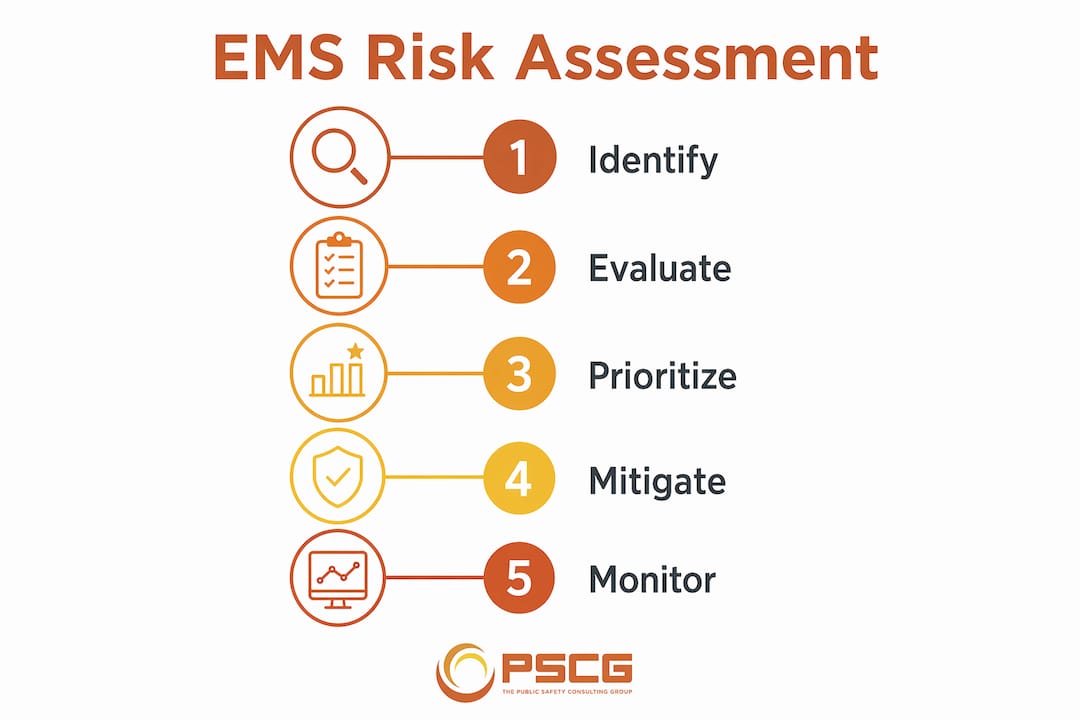
The five-step risk assessment process that underpins all three frameworks works as follows:
- Identify all potential hazards across occupational, clinical, environmental, and operational categories.
- Analyze the likelihood and potential impact of each identified risk.
- Evaluate risks against the organization’s defined risk appetite and prioritize accordingly.
- Treat risks through elimination, mitigation, transfer, or acceptance, with documented rationale for each decision.
- Monitor continuously, updating the risk register after incidents, near-misses, or key risk indicator (KRI) breaches.
Continuous monitoring is non-negotiable. Static annual checklists do not capture the dynamic hazard environment EMS teams face daily. Effective programs update risk registers in real time and use KRI thresholds to trigger reassessment before a hazard becomes an incident.
Thepscgroup’s approach to operational risk reduction integrates all five steps into agency-specific frameworks, connecting risk assessment directly to training programs, leadership oversight, and system design decisions.
What challenges and pitfalls undermine risk assessment in EMS?
Even well-designed risk programs fail when common organizational and operational pitfalls go unaddressed. Knowing where programs break down is as important as knowing how to build them.
The most frequent failure points include:
- Hazard awareness gaps: The low recognition of ergonomic risks among EMS personnel is a documented problem. Agencies that do not actively train for ergonomic hazard identification will consistently underreport and undermitigate this category.
- Protocol rigidity: Restrictive protocols can delay interventions, displacing risk into transport or later decompensation stages rather than eliminating it. This is the risk displacement phenomenon, and it is a direct consequence of prioritizing compliance over clinical judgment.
- Operational pressure: Time constraints, incomplete patient information, and scene distractions all degrade the quality of real-time risk evaluation. Agencies that do not build structured decision support into their protocols leave providers to improvise under pressure.
- Inadequate leadership support: Risk programs without visible managerial commitment stall. Frontline providers will not raise safety concerns in cultures where those concerns go unacknowledged or unaddressed.
- Outdated risk registers: A risk register last updated two years ago does not reflect current hazard exposure. Complacency with static documentation is one of the most common and most preventable failures in EMS risk management.
Overly restrictive protocols may shift risk rather than reduce it. That finding should prompt every EMS medical director and agency leader to audit their protocols for unintended consequences, not just intended protections. Thepscgroup’s EMS clinical protocols guide addresses exactly this balance between structure and clinical discretion.
Pro Tip: Create a standing agenda item in every leadership meeting for near-miss reporting. Normalizing safety conversations at the top of the organization changes the culture at the bottom.
How can EMS leaders implement a sustainable risk assessment program?
Building a risk assessment program that lasts requires more than policy documents. It requires deliberate integration into daily operations, training, and leadership behavior.
A practical implementation roadmap follows these steps:
- Define your risk appetite. Work with your board or municipal leadership to establish written thresholds for acceptable risk across patient care, responder safety, and operational continuity. This document becomes the foundation for every subsequent risk decision.
- Train at every level. Risk assessment is not a management-only function. Frontline providers, supervisors, medical directors, and board members each play a role. Thepscgroup’s EMS instructor best practices resource outlines how to build hazard recognition into ongoing education programs.
- Establish monitoring protocols. Assign ownership of key risk indicators to specific roles. Define what triggers a risk register update and who is responsible for initiating it.
- Conduct regular operational audits. Audits surface gaps between documented protocols and actual field practice. They also generate the incident data that feeds continuous risk monitoring.
- Embed risk assessment in system design. Integrated approaches reduce variability, improve safety culture, and promote proactive hazard mitigation. Risk assessment should inform unit deployment, staffing models, and response time benchmarks, not just safety policies.
Stakeholder engagement is the factor most often underestimated. Frontline responders see hazards that leadership does not. Medical directors understand clinical risk in ways that administrators may not. Boards carry governance accountability that requires documented risk justification. Effective programs bring all three groups into the risk assessment process, not just the compliance review.
Key Takeaways
Effective risk assessment in EMS requires continuous monitoring, documented risk appetite, and clinical judgment working alongside structured protocols to protect patients, responders, and agency operations.
| Point | Details |
|---|---|
| Hazard awareness gaps exist | Only 26% of EMS personnel recognize ergonomic risks, creating a significant blind spot in workforce safety. |
| Protocol rigidity creates new risk | Overly restrictive protocols can displace risk rather than eliminate it, delaying critical patient care. |
| Continuous monitoring is required | Static annual reviews are insufficient; risk registers must update after incidents and KRI breaches. |
| Documented risk appetite is non-negotiable | Boards and regulators expect a defensible, written risk story, not just completed checklists. |
| Integration drives results | Embedding risk assessment into training, audits, and system design reduces variability and improves safety culture. |
The protocol trap: What 15 years in EMS consulting taught me about risk
The most dangerous assumption in EMS risk management is that a well-written protocol eliminates risk. It does not. Protocols redistribute risk. They move it from one point in the care continuum to another, and if you are not watching carefully, you will not notice where it landed until a patient deteriorates in the back of a unit or a provider burns out after years of ergonomic strain that nobody tracked.
What I have seen consistently across agencies is that the organizations with the strongest safety cultures are not the ones with the thickest protocol binders. They are the ones where a paramedic can walk into a supervisor’s office and say, “This protocol is creating a problem,” and be taken seriously. That kind of culture does not happen by accident. It is built through deliberate leadership choices, documented risk appetite, and a genuine commitment to continuous learning over compliance theater.
The shift toward data-driven risk monitoring is real and it is accelerating. Agencies that invest now in KRI frameworks and incident-driven risk register updates will be significantly better positioned as regulatory expectations tighten. The ones that treat risk assessment as an annual checkbox exercise will find themselves on the wrong side of a liability conversation they were not prepared for.
My advice to EMS leaders is direct: stop waiting for an incident to force the conversation about risk appetite. Have it now, document it, and build your protocols around it. That is the difference between a defensible organization and a vulnerable one.
— Mike
How Thepscgroup supports EMS risk programs
Thepscgroup works alongside EMS agencies and municipal leaders to build risk assessment programs that hold up under operational pressure and regulatory scrutiny. Our work spans EMS system design and municipal EMS strategy, connecting risk assessment directly to the structural decisions that determine how your agency performs.

Whether your agency needs a full operational risk audit, a documented risk appetite framework, or guidance on balancing clinical protocols with provider discretion, we bring the expertise to move from assessment to action. Visit us at thepscgroup.net to connect with our team and learn how we can support your agency’s safety and performance goals.
FAQ
What is risk assessment in EMS?
Risk assessment in EMS is the structured process of identifying, analyzing, and evaluating hazards that affect patient safety, responder welfare, and agency operations. It uses frameworks like ISO 31000 and NIST SP 800-30 to produce documented, defensible risk management decisions.
Why is risk evaluation vital for EMS organizations?
Risk evaluation gives EMS leaders the information they need to allocate resources, set clinical protocols, and meet regulatory expectations. Without it, agencies react to incidents rather than preventing them.
What is risk mitigation in EMS?
Risk mitigation in EMS refers to the actions taken to reduce the likelihood or impact of identified hazards, including protocol adjustments, training programs, staffing changes, and equipment upgrades. Effective mitigation balances structured guidelines with clinical judgment to avoid displacing risk rather than eliminating it.
How often should EMS agencies update their risk assessments?
Risk assessments should update continuously, triggered by incidents, near-misses, or key risk indicator breaches. Annual-only reviews are insufficient for the dynamic hazard environment EMS teams face.
What role does clinical judgment play in EMS risk management?
Clinical judgment fills the gaps that protocols cannot anticipate, particularly in complex cases like T-LOC patients where non-conveyance rates vary from 4% to 16%. Effective risk management supports provider discretion within a documented framework rather than replacing it with rigid checklists.