



TL;DR:
- Response time analysis measures the time from a service request to response, crucial for effective emergency services.
- Percentile metrics like P95 and P99 reveal the true range of response performance, highlighting areas needing improvement.
Response time analysis is defined as the diagnostic process of measuring elapsed time from an initial request to a completed system or service response, and it is the foundation of effective emergency service delivery. In public safety, this process goes beyond technical measurement. It connects directly to whether a cardiac arrest patient receives care in time, whether a dispatcher routes the closest unit, or whether a communications system fails under peak load. Understanding response time metrics explained through percentile standards like P95 and P99, rather than simple averages, gives public safety leaders a far more accurate picture of where their systems succeed and where they fall short. Thepscgroup works with agencies across Connecticut and beyond to apply this analysis where it matters most.
What is response time analysis and why does it matter?
Response time analysis is the structured process of measuring, decomposing, and interpreting the time between a service request and its completed response. The industry standard definition covers the full cycle: from the moment a call enters a dispatch system, through processing and unit assignment, to the moment a crew arrives on scene. Optimal system response falls between 0.1 and 1 second for digital systems, with delays above 5 seconds triggering user abandonment. In emergency communications, the equivalent thresholds carry life-or-death weight.
The importance of response time analysis extends beyond compliance reporting. It gives agency leaders a repeatable method for identifying where time is lost, whether in dispatch queuing, unit positioning, or system processing. Without this analysis, operational decisions rest on incomplete data. With it, leaders can target specific failure points and measure whether interventions actually work.
Public safety agencies increasingly rely on interval-based analysis, a technique that breaks total response time into discrete segments and tracks each one over time. The National Fire Protection Association and the National EMS Information System both use interval-based frameworks to establish response time benchmarks for emergency services. These frameworks give agencies a consistent baseline against which to measure performance.
What are the key metrics in response time analysis?
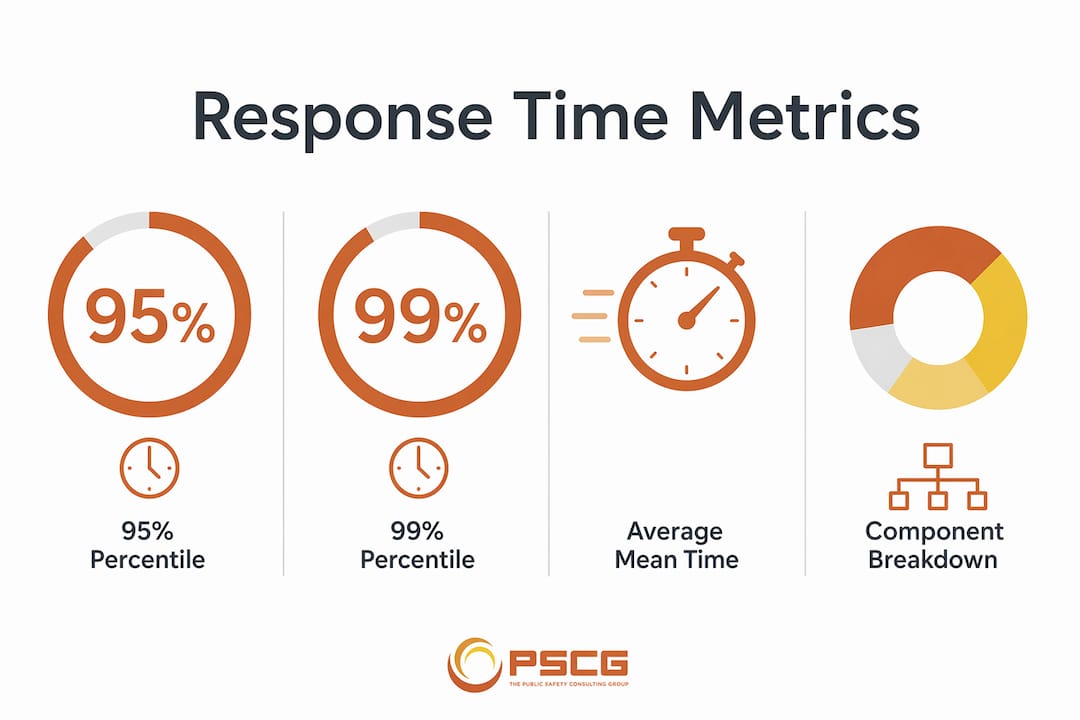
Response time metrics fall into two broad categories: central tendency measures and percentile measures. Each tells a different story about system performance.
- Average (mean) response time calculates the sum of all response times divided by the number of events. It is easy to compute but easy to misread. A single unusually fast response can pull the average down and hide a pattern of slow ones.
- Median (P50) identifies the midpoint of all recorded response times. Half of responses fall below this value, half above. It is more resistant to outliers than the mean.
- P95 means 95% of responses completed within that time threshold. The slowest 5% fall above it. This metric captures what practitioners call the “bad but common” experience.
- P99 isolates the slowest 1% of responses. In a high-volume dispatch center, that 1% can represent hundreds of calls per month.
- Peak response time records the single worst observed response. It is useful for stress testing but not for routine performance management.
Percentile-based metrics like P95 and P99 more accurately reflect the experience of the users most affected by slow performance. For public safety, those users are patients and communities waiting for help.
Pro Tip: Never report only average response times to elected officials or oversight boards. Present P95 alongside the mean to show the full range of community experience. A mean of 6 minutes with a P95 of 11 minutes tells a very different story than the average alone.
How is response time analysis conducted?
Total response time does not arrive as a single undivided number. It decomposes into components that each require separate measurement and interpretation.

| Component | Description | Example in EMS Context |
|---|---|---|
| Network transit time | Time for data to travel between endpoints | Call data moving from PSAP to CAD system |
| Server-side processing | Time the application spends computing a response | CAD unit recommendation algorithm runtime |
| Database query time | Time to retrieve or write records | Patient history lookup during dispatch |
| Third-party dependency wait | Delays from external APIs or services | Hospital diversion status feed latency |
| Client rendering time | Time for the end interface to display results | Dispatcher screen update after unit assignment |
Baseline comparison is the most reliable diagnostic approach. You establish a normal performance range during typical operating conditions, then compare current measurements against that range. Deviations signal where to investigate. Interval-based analysis extends this by tracking each component across defined time windows, such as shift changes or peak call volume periods, to detect patterns that a single snapshot would miss.
The W3C’s Server Timing headers standard provides a structured way to annotate each request with timing data from the server side. This makes root-cause diagnostics transparent across layered applications, which is exactly what modern emergency communications systems are. When a CAD system slows down, Server Timing data tells you whether the bottleneck is in the network, the database, or an external feed.
Separating API latency (time to first byte) from full response time (time to last byte) is also critical. Measuring only latency can hide severe delays in payload delivery. In a public safety communications system, a dispatcher may receive an initial acknowledgment from the CAD server quickly, while the full unit recommendation takes several additional seconds to arrive. That gap matters.
Why is response time analysis essential for public safety and emergency services?
Faster response times produce measurably better patient outcomes. Research consistently shows that each minute of delay in cardiac arrest response reduces survival probability. The same principle applies across emergency service types: structure fires grow exponentially in the first minutes, and trauma patients deteriorate with delay. Analyzing EMS response times with precision gives leaders the data they need to make the case for resource changes.
Response time analysis also prevents system failures before they occur. Proactive interval-based monitoring identifies slow queries, missing database indexes, and network congestion under load conditions before those issues cascade into outages. In a 911 communications center, an outage is not an inconvenience. It is a public safety emergency in itself.
The operational benefits of regular response time review include:
- Resource positioning: Data on where and when response times spike guides unit deployment decisions and System Status Management protocols.
- Accountability: Documented performance trends give supervisors objective grounds for addressing process failures.
- Budget justification: Agencies can demonstrate to municipal leaders exactly where additional staffing or infrastructure investment reduces response times.
- Accreditation support: Organizations pursuing CAAS or NAEMSP accreditation use response time data as core evidence of operational standards compliance.
- Community trust: Transparent reporting of response time trends builds public confidence in emergency services.
Continuous monitoring, rather than periodic audits, is the standard that leading agencies now apply. A quarterly review catches trends. A real-time dashboard catches the problem before the next call is affected.
How to apply response time analysis in public safety operations
Applying response time analysis in a public safety setting follows a clear sequence. Each step builds on the last, and skipping steps produces unreliable results.
Establish your baseline. Pull at least 90 days of historical response time data segmented by interval: call receipt, dispatch, turnout, travel, and on-scene arrival. Calculate mean, P50, P95, and P99 for each interval. This baseline becomes your reference point for all future comparisons.
Set percentile thresholds. Define acceptable performance ranges for each interval using P95 as your primary benchmark. Align these thresholds with NFPA 1710 or 1720 standards, or with your agency’s contractual obligations to the municipality.
Implement confirmation logic for alerts. Effective alert systems require 2–3 consecutive observations across multiple monitoring points before triggering a notification. This reduces false positives caused by transient network variability and keeps your team focused on real degradations.
Combine client-side and server-side monitoring. Client-side data (RUM) captures what the dispatcher or field provider actually experiences, including network delays outside your server’s control. Server-side data (APM) isolates what your infrastructure contributes. Both views together give you the complete picture.
Schedule regular performance reviews. Monthly reviews at the supervisory level and quarterly reviews with agency leadership create a rhythm of accountability. Use these sessions to compare current P95 values against baseline, identify emerging trends, and assign ownership for corrective action.
Document and act on findings. Analysis without action is just reporting. Each review should produce a short list of specific changes, whether repositioning a unit, upgrading a network segment, or adjusting a CAD workflow, with assigned owners and target completion dates.
Pro Tip: When presenting response time findings to municipal officials, pair each metric with a geographic map showing where slow responses cluster. Numbers alone rarely move budget decisions. A map showing that one district consistently sees P95 times 40% above the agency average is far harder to ignore.
Key Takeaways
Effective response time analysis requires percentile-based metrics, component-level decomposition, and proactive monitoring to produce the operational improvements that public safety agencies need.
| Point | Details |
|---|---|
| Use percentile metrics | P95 and P99 reveal the true range of response performance that averages conceal. |
| Decompose total response time | Break time into network, server, database, and dependency components to find the real bottleneck. |
| Apply interval-based analysis | Track each response time segment across shifts and call volumes to detect patterns early. |
| Combine RUM and APM data | Client-side and server-side measurements together give a complete performance picture. |
| Build confirmation logic into alerts | Require 2–3 consecutive observations before triggering alerts to reduce false positives. |
Response time data is a leadership tool, not just a technical metric
I have spent years working alongside public safety leaders who treat response time data as something their IT department manages. That framing is a mistake, and it costs agencies real operational ground.
Response time analysis is one of the most direct lines between data and community outcomes that a public safety leader has. When you understand where your system loses time, you can make specific, defensible decisions about unit positioning, staffing levels, and infrastructure investment. When you do not, you are managing by instinct in a field where instinct is not enough.
The most common pitfall I see is agencies that report mean response times to their governing boards and stop there. The mean looks acceptable. The P95 tells a different story. Communities in the outer districts, or calls that come in during shift change, are experiencing response times that the average never reveals. That gap between the mean and the P95 is where accountability lives.
The second pitfall is treating response time analysis as a retrospective exercise. The agencies that perform best use it as a forward-looking tool. They set baselines, monitor continuously, and act on early signals before a slow trend becomes a public failure. Municipal EMS best practices in 2026 reflect this shift toward proactive performance management.
My strong view is that every public safety leader should be able to read a percentile distribution chart and explain what it means to a city council member. That skill is not technical. It is leadership.
— Mike
How Thepscgroup supports response time performance improvement
Public safety agencies that want to move from data collection to real operational improvement need more than software. They need structured analysis, clear benchmarks, and a plan that connects findings to decisions.

Thepscgroup specializes in EMS system design and municipal EMS strategy, working directly with agency leaders to build the analytical frameworks that drive faster, more reliable response. From establishing performance baselines to presenting findings to municipal stakeholders, we work alongside your team at every stage. Our EMS system design consulting gives leaders the tools to turn response time data into concrete system improvements. Reach us at thepscgroup.net to discuss what a structured response time review looks like for your agency.
FAQ
What is response time analysis in public safety?
Response time analysis is the process of measuring and breaking down the elapsed time between an emergency request and a completed service response. It identifies where delays occur across dispatch, travel, and on-scene intervals.
Why are P95 and P99 metrics better than averages?
Average response time masks outliers by blending fast and slow responses into a single number. P95 and P99 show the actual experience of the slowest-served callers, which is where operational failures concentrate.
What components make up total response time?
Total response time decomposes into network transit, server-side processing, database query time, third-party dependency delays, and client rendering time. Each component requires separate measurement to identify the true source of delay.
How do you reduce false positives in response time alerts?
Effective alert systems require 2–3 consecutive observations across multiple monitoring points before triggering a notification. This filters out transient network variability and focuses attention on genuine performance degradations.
How often should public safety agencies review response time data?
Supervisors should review response time metrics monthly, and agency leadership should conduct formal performance reviews quarterly. Continuous real-time monitoring between reviews catches emerging issues before they affect service delivery.