



Fixing upstream documentation and running a risk-segmented, automated collections workflow is the fastest way to lift EMS net collections. The three levers that matter most are data quality at the point of care, claim automation that catches errors before submission, and a denial triage process with clear ownership. Agencies that tackle these in sequence, rather than buying software first, see the biggest gains (Thepscgroup).
TL;DR:
- Most EMS revenue losses stem from documentation gaps and disconnected workflows starting in the field, not from billing system issues.
- Implementing upstream data quality, intake validation, and risk-segmented collections significantly improves collections before investing in new software.
- Addressing common documentation errors like missing signatures or insurance data reduces denials more effectively than automation alone.
- Building real-time validation, integrated systems, and structured denial workflows can lead to measurable gains within a few billing cycles.
- Leaders must prioritize incremental process improvements, KPI tracking, and staff training to sustain collection gains over time.
Table of Contents
- What Is the Fastest Path to EMS Collections Improvement?
- Why Clean Documentation Prevents Most Denials Before They Start
- What Should EMS Agencies Automate First?
- How Should Agencies Handle Denials and Appeals?
- Which KPIs Actually Predict Collections Health?
- What PSCG Sees When Agencies Fix Collections
- How Do Medicare and Medicaid Rules Shape EMS Billing?
- Why Ongoing Billing Training Pays for Itself
- What Patient Communication Actually Improves Payment Rates?
- Why Insurance Verification Before Transport Saves Time Later
- How Flexible Payment Plans Increase Patient Collections
- How Should EMS Billing Connect With Hospital Systems?
- What Leadership Should Prioritize to Sustain Collections Gains
- Ready to Improve Your Agency’s Collections Performance?
- Sources
What Is the Fastest Path to EMS Collections Improvement?
Most agencies chase collections improvement backward. They shop for a new billing platform before they’ve asked why claims are failing in the first place. The data tells a different story: the largest share of EMS revenue loss traces back to documentation gaps and disconnected workflows that begin in the field, not in the billing office, according to ImageTrend’s analysis of EMS billing recovery.
That means the highest-leverage work for most agencies is upstream. Clean up the master data. Enforce intake validation before a claim ever gets coded. Segment your accounts receivable by risk so your team spends human time where it counts and lets automation handle the routine follow-ups. Denial management comes next, not first, because a tight intake process prevents most denials from ever occurring.
Here’s a seven-step sequence that works for agencies of nearly any size, from a single-station volunteer service to a regional third-service provider running a dozen ambulances.
- Run a master-data completeness check. Pull your open accounts receivable and find the 20 percent of accounts driving 80 percent of your outstanding balance. Fix those first.
- Enforce intake validation at dispatch. Require key patient care report fields (insurance information, signature capture, service level documentation) before a call ever routes to billing.
- Build a coding and clinical review workflow for high-acuity transports and modifier-heavy claims, where errors are most expensive.
- Move to near-real-time claim submission with automated technical retries for rejected claims, rather than batch processing once a week.
- Deploy risk-segmented collections. Low-risk, low-value accounts get self-service payment options. High-value or complicated accounts get a human on the phone.
- Create a denial triage system with a service-level agreement and a named owner for every category of denial.
- Build a lean KPI dashboard tracking Days Sales Outstanding (DSO), Collection Effectiveness Index (CEI), recovery rate, and days-to-first-contact, with daily alerts for accounts falling behind.
Pro Tip: Don’t automate a broken process. If your master data is inconsistent, automation just helps you fail faster. Fix the data first, then layer in the technology.
Why Clean Documentation Prevents Most Denials Before They Start
The most common failure modes in EMS billing are unglamorous: a missing insurance policy number, an unsigned patient authorization, a service level that doesn’t match the clinical narrative. These small gaps in the patient care report cause outsized damage down the line, since documentation issues account for the largest share of denials your billing team will ever see, per ImageTrend’s field-to-billing research.
A simple audit method works well here. Pull your top 50 unpaid transports from the last 90 days and classify each one by root cause: missing insurer information, absent signature, mismatched service level, or incomplete clinical narrative. Patterns emerge fast.
From there, pilot targeted fixes:
- Make key fields mandatory in your ePCR before a report can close.
- Build visibility rules so crews only see the fields relevant to the call type, reducing clutter.
- Add repeat-patient lookups that auto-populate known insurance information.
- Use mobile prompts that flag missing data before the crew leaves the scene, not after.
Pro Tip: Ask your crews which two or three fields cause the most rework complaints. Fixing those first buys you goodwill for the rest of the rollout. PSCG’s work on EMS quality improvement consulting often starts exactly here, because clinical documentation and billing documentation are the same document.
What Should EMS Agencies Automate First?
Automation in EMS billing works best in three layers, and confusing them is where most agencies waste money. The first layer is technical retries: quiet, automated fixes for claims rejected due to formatting or transmission errors, recovered without anyone noticing. The second is workflow orchestration, which routes accounts to the right person or process based on risk and value. The third is patient-facing self-service, where low-risk balances get resolved through an online portal instead of a phone call.
Modern collections rely on this kind of orchestration, blending automated retries, workflow logic, and self-service payments, rather than blanket dunning letters sent to every account regardless of circumstance, according to Zuora’s research on automated accounts receivable. Automation and AI tools in EMS billing also reduce manual data entry and reconciliation work, which matters most for agencies trying to grow collections without adding headcount, per EMS1’s coverage of billing automation.
Before you scale any of it, check these boxes:
- Map your ePCR fields directly to your billing system so nothing requires manual re-entry.
- Build real-time validation rules that catch errors at the point of documentation.
- Stand up a patient payment portal with bank reconciliation built in, not bolted on.
- Pilot automation on your lowest-risk account segment first, and measure the recovery lift before rolling it out agency-wide.
Master-data completeness is the gating factor here. Agencies that skip that step and automate anyway tend to automate their mistakes, just faster.
How Should Agencies Handle Denials and Appeals?
A denial isn’t a dead end. It’s a data point, and how fast you act on it determines whether it becomes revenue or a write-off. The most effective denial workflows sort incoming denials into four buckets, then route each one to a specific owner with a deadline attached.
- Quick fixes. Typos, wrong dates of service, mismatched patient identifiers. These should be corrected and resubmitted within 48 hours.
- Documentation corrections. Missing signatures or incomplete clinical narratives. Route back to the field supervisor for completion.
- Payer disputes. Coding disagreements or medical necessity questions that require a formal appeal letter.
- Clinical necessity appeals. The most complex category, usually requiring a clinician’s input and a tighter service-level agreement, often five to seven business days.
Assign a specific role to each bucket. One person owns initial research, another drafts appeals, and a supervisor handles escalation when a payer pushes back a second time.
Pro Tip: Pause automated dunning on any disputed account while it’s under appeal. Sending a patient a payment reminder while you’re actively fighting their insurer for coverage damages trust and invites complaints that slow everything down.
Which KPIs Actually Predict Collections Health?
You can’t fix what you don’t measure, and EMS billing has a compact set of numbers that tell you almost everything you need to know. A data-first framework that tracks these daily materially reduces DSO and improves how efficiently your collectors spend their time, per Symbolic Data’s research on accounts receivable improvement.
- DSO (Days Sales Outstanding): how long it takes, on average, to collect after a transport.
- CEI (Collection Effectiveness Index): what percentage of collectible revenue you actually recover.
- Recovery rate: how much of your denied or aged AR eventually converts to payment.
- Aging buckets: the distribution of AR across 0 to 30, 31 to 60, 61 to 90, and 90-plus days.
- Days-to-first-contact: how quickly a new account gets a first collections touch.
| Metric | What it tracks | Reporting cadence |
|---|---|---|
| DSO | Average days to collect | Weekly |
| CEI | Percent of collectible revenue recovered | Monthly |
| Recovery rate | Denied/aged AR converted to payment | Monthly |
| Days-to-first-contact | Speed of initial outreach on new accounts | Daily |
Collectors need daily visibility into aging and days-to-first-contact. Leadership needs the monthly trend on CEI and recovery rate to judge whether the whole system is actually improving.
What PSCG Sees When Agencies Fix Collections
Agencies that follow this sequence, master-data cleanup, then intake rules, then a targeted automation pilot, then a denial playbook, then a KPI dashboard, tend to see measurable gains within two to three billing cycles. One municipal client reduced a persistent documentation-driven denial pattern simply by adding mandatory field validation at the ePCR level. A private ambulance provider cut days-to-first-contact nearly in half after segmenting accounts by risk instead of working them in date order.
- Documentation fixes typically pay off before any technology investment does.
- Automation pilots work best on predictable, low-risk account segments first.
- KPI dashboards only matter if someone acts on the daily alerts they generate.
Learn more about how PSCG approaches EMS quality improvement or visit the PSCG homepage to see the full range of services.
How Do Medicare and Medicaid Rules Shape EMS Billing?
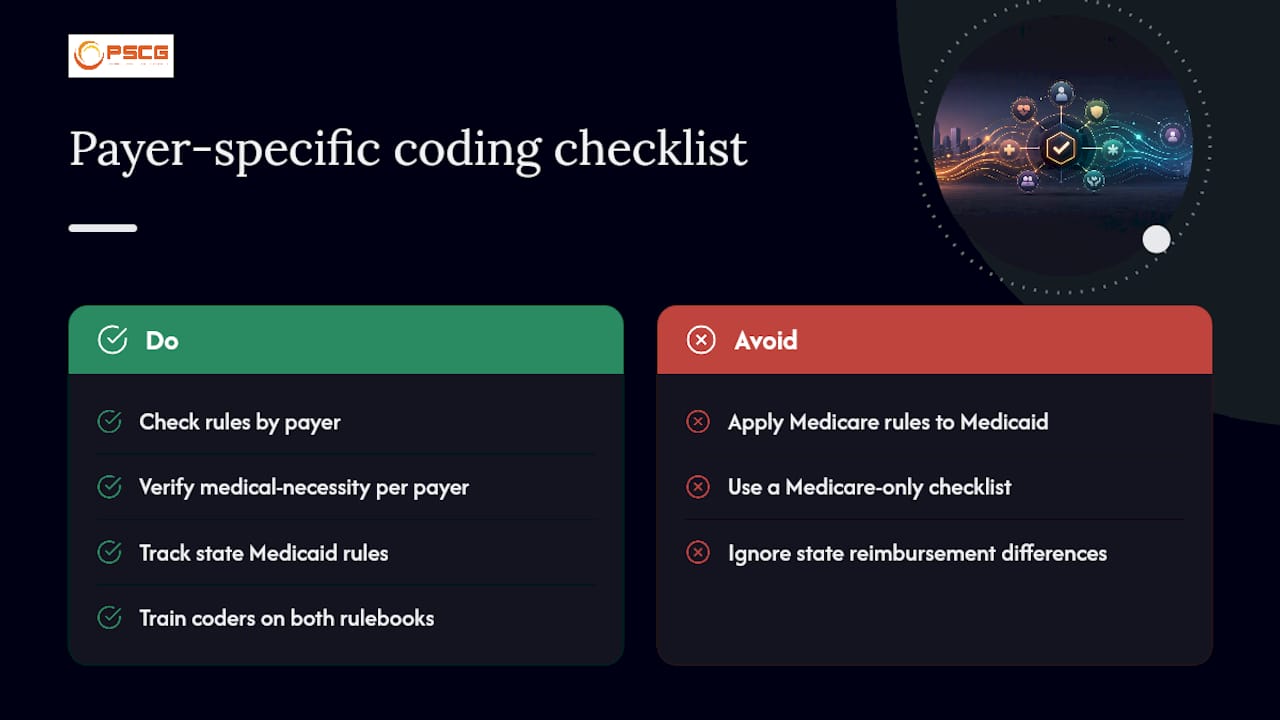
Federal and state rules aren’t optional context for EMS billing. They’re the frame every claim has to fit inside, and getting that frame wrong is one of the fastest ways to see a clean-looking claim get denied anyway. Medicare and Medicaid set specific coverage criteria for ambulance transport, including medical necessity documentation, mileage reporting, and origin-destination requirements that vary by transport level, according to HHS’s overview of Medicare and Medicaid programs.
Medicaid adds another layer, since coverage rules and reimbursement rates are set at the state level, meaning an agency operating across county or state lines has to track more than one rulebook. This is where agencies most often trip up: applying a Medicare medical necessity standard to a Medicaid claim, or vice versa, without realizing the definitions don’t always line up.
The AMA also publishes coding and documentation guidance tied to compliant billing practices, including HIPAA-related administrative standards that affect how patient information moves between your agency, the hospital, and the payer, per the AMA’s coding and billing resources.
The practical takeaway: build your coding review checklist around the payer, not just the transport. A checklist tuned only for Medicare will let Medicaid-specific errors slip through, and vice versa. Agencies that serve both populations, which is most of them, need coders who know both rulebooks cold.
Why Ongoing Billing Training Pays for Itself
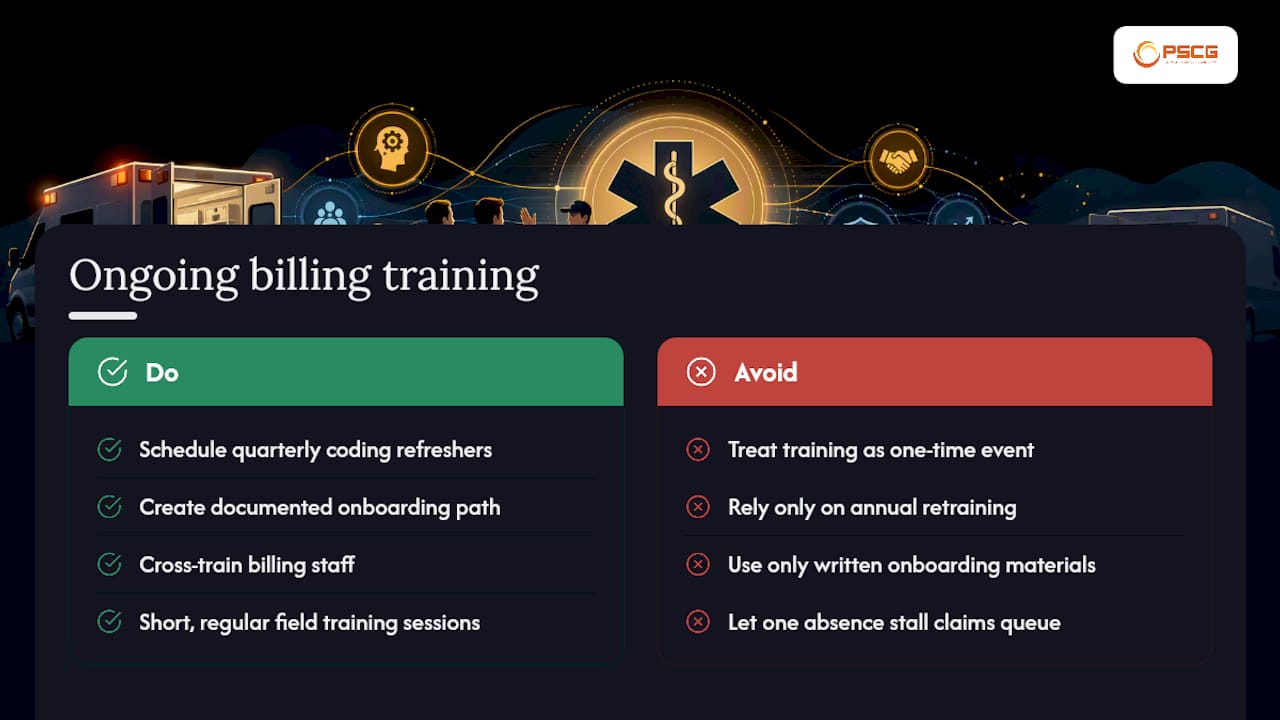
Billing rules change more often than most crews realize, and a coder trained two years ago is working from an outdated map. Regulatory shifts, payer policy updates, and staffing turnover all push in the same direction: without continuing education, billing accuracy quietly erodes.
The agencies that hold their collection gains, rather than seeing them slip back within a year, tend to build training into the calendar rather than treating it as a one-time event. That usually looks like quarterly refreshers on coding updates, a documented onboarding path for new billing staff, and cross-training so a single absence doesn’t stall the whole claims queue.
Field crews need training too, not just the billing office. A transport-level coding error often originates from how a crew member documented the call, not from a mistake the biller made afterward. Regular, short training sessions for field staff on what documentation actually supports a claim close that gap far faster than annual retraining sessions do.
Pro Tip: Pair a new biller with a veteran for their first thirty days of live claims, not just onboarding materials. Watching how an experienced coder handles an ambiguous transport catches more errors than any manual.
PSCG’s leadership development work often folds billing literacy into broader training programs, since the skill sets overlap more than agencies expect. A crew that documents well is, in effect, already doing quality billing work in the field.
What Patient Communication Actually Improves Payment Rates?
Patients don’t ignore ambulance bills because they’re careless. They ignore them because the bill arrives confusing, unexpected, or long after the transport, when the memory of the event has faded and the urgency to pay has faded with it.
Clear, early communication changes that. A short letter or text sent within a week of transport, explaining what the patient can expect and how to ask questions, sets a tone of transparency that a bill arriving unannounced two months later simply can’t match. Offering multiple channels, mail, text, and a payment portal, meets patients where they already are rather than forcing everyone through the slowest option.
Plain language matters more than most billing offices realize. A statement full of procedure codes and payer jargon reads as a threat to someone who doesn’t understand it. A statement that explains, in a sentence or two, what happened and what’s owed gets paid faster and generates fewer confused phone calls.
Tools that support secure, two-way messaging give patients a way to ask questions before a balance goes to collections, which is often when relationships with the agency sour permanently. Healthcare-focused messaging platforms increasingly build these capabilities directly into patient communication workflows, as described in Demivolt’s coverage of healthcare workflow integrations.
Why Insurance Verification Before Transport Saves Time Later
The best time to catch an eligibility problem is before the transport, not three weeks after the claim gets denied. Real-time eligibility checks, run at dispatch or shortly after, flag coverage gaps, out-of-network issues, or lapsed policies while there’s still time to correct the record or set patient expectations.
Agencies without this step often discover coverage problems only when a claim bounces back, at which point the information needed to fix it, an updated policy number, a guarantor’s contact information, is much harder to track down. Building eligibility verification into the intake workflow, rather than treating it as a billing-office task performed after the fact, closes that gap.
This doesn’t need to slow down an emergency response. Verification can run in parallel with dispatch and transport, using automated eligibility lookups that check payer databases in seconds rather than requiring a phone call. The goal is having accurate coverage information on file by the time the claim is coded, not before the ambulance rolls.
How Flexible Payment Plans Increase Patient Collections
A patient who owes $1,200 and sees no path to paying it will often pay nothing. A patient offered a $100-a-month plan will usually pay something, and something beats a write-off every time.
Flexible payment plans work because they match the reality of how most households manage unexpected medical expenses. Offering tiered options, a short-term interest-free plan for smaller balances, longer terms for larger ones, gives patients a realistic path forward instead of an all-or-nothing demand.
Self-service portals make this easier to scale. A patient who can set up their own payment plan online, without a phone call, is more likely to actually do it. Reserve live collector time for higher-balance accounts or situations that need a human conversation, and let automation handle the routine plan setups. A well-designed accounts receivable playbook treats payment flexibility as a collections tool, not a concession, and the data backs that framing up.
How Should EMS Billing Connect With Hospital Systems?
EMS billing rarely happens in isolation. A transport almost always connects to a hospital encounter, and when those two billing systems don’t talk to each other, both sides lose time chasing information the other one already has.
Integration between EMS billing platforms and hospital or third-party billing systems reduces duplicate data entry and shortens the time it takes to confirm insurance details, since the hospital often verifies coverage independently during registration. Sharing that information, where data-sharing agreements and patient privacy protections allow it, means your billing team isn’t starting from zero on every transport tied to an emergency department visit.
This kind of integration also helps close the loop on coordination-of-benefits questions, where a payer needs to know whether Medicare, Medicaid, or a private insurer is primary. Hospitals frequently resolve that question faster than a standalone EMS billing office can, simply because they’re touching the patient’s full episode of care. Secure messaging standards built for clinical environments, the kind described in secure messaging guidance for clinics, offer a useful model for how EMS agencies should be exchanging this information: fast, but protected.
Agencies that build these connections tend to see fewer stalled claims sitting in limbo waiting on information someone else already has.
What Leadership Should Prioritize to Sustain Collections Gains
Leaders who treat collections improvement as a one-time project usually watch the gains erode within a year. Sustaining them means budgeting pilots in phases, not all at once, and setting collector KPIs that reward accuracy and follow-through rather than just call volume. Protect crew time during rollout. Adding five new documentation fields overnight invites pushback and shortcuts.
Roll out changes incrementally. A phased approach measured against your KPI dashboard shows real return on any automation investment without burning out a billing staff that’s often already stretched thin. Track the numbers, but talk to your team too.
We’d encourage any agency leader considering this work to have a PSCG logo] assessment conversation before committing budget. Reach out through [Thepscgroup’s contact page to talk through where your agency stands today.
— Mike
Ready to Improve Your Agency’s Collections Performance?
Everything in this checklist, master-data cleanup, intake validation, automation, denial triage, KPI tracking, works best when it’s sequenced correctly for your agency’s specific payer mix and call volume. That sequencing is where most in-house efforts stall, not because the ideas are wrong, but because nobody has the bandwidth to run the diagnostic work alongside daily operations.
Thepscgroup built its reimbursement optimization practice around exactly this gap. Our consultants have worked directly with municipal and private EMS agencies across Connecticut and beyond to fix upstream documentation, redesign intake workflows, and stand up the KPI dashboards this article describes, without asking your billing office to pause operations while it happens. Learn more about the role reimbursement consultants play in EMS success and how a focused engagement can shorten your path to measurable results.
If your agency is ready to find out where its own collections process is leaking revenue, request a consultation through Thepscgroup’s homepage and we’ll walk through what a diagnostic assessment would look like for your specific operation.
Sources
- Medicare and Medicaid (HHS)
- EMS Billing and Revenue Recovery Without Overloading Crews (ImageTrend)
- How to Improve Collection of Accounts Receivable Using a Data-First Framework (Symbolic Data)