



Many public safety officials believe all 911 data delivers immediate operational intelligence. The reality challenges this assumption: approximately 70% of 911 data is retrospective rather than real-time, fundamentally changing how agencies can leverage it for emergency response optimization. Understanding the distinction between real-time and retrospective data, along with practical analytic frameworks, empowers officials to transform raw call records into strategic insights that measurably improve response times, resource allocation, and community outcomes.
Table of Contents
- Introduction To 911 Data And Its Importance
- Types And Sources Of 911 Data
- Common Misconceptions About 911 Data
- Analytical Frameworks And Methods For 911 Data
- Impact Of 911 Data On Emergency Response Strategies
- Challenges And Limitations Of 911 Data
- Practical Steps For Public Safety Officials Using 911 Data
- Conclusion And Future Directions
Key takeaways
| Point | Details |
|---|---|
| Data categories | 911 data includes structured fields like call type and timestamps, plus unstructured audio and transcripts. |
| Retrospective focus | 70% of 911 data is retrospective, limiting immediate operational use but enabling strategic analysis. |
| Response time gains | Predictive analytics using 911 data reduce EMS response times by up to 12% in documented deployments. |
| Integration value | Connecting 911 data with EMS and hospital systems enhances outcome tracking by 40%. |
| Quality challenges | Data quality issues affect up to 20% of call records, requiring regular audits and validation. |
Introduction to 911 data and its importance
911 data encompasses the complete information ecosystem generated when citizens request emergency assistance. This includes precise time stamps marking call initiation and dispatch, location coordinates from caller devices or verbal descriptions, call type classifications, caller demographics, and response outcome documentation. Public Safety Answering Points (PSAPs) serve as the primary collection hubs where telecommunicators capture this information during emergency interactions.
This data functions as both a real-time operational tool and a retrospective performance archive. While dispatchers use immediate call details to deploy resources, analysts mine historical patterns to understand emergency demand cycles, identify service gaps, and forecast future needs. The dual nature of 911 data makes it invaluable for both tactical response coordination and strategic system design.
Public safety officials who grasp the full scope of 911 data can make evidence-based decisions about staffing models, station placement, and protocol refinement. Each call record contributes to a growing knowledge base that reveals community health trends, crime patterns, and infrastructure vulnerabilities. Leveraging this EMS operations impact requires understanding what data exists, where it originates, and how to extract actionable intelligence from millions of records.
The operational pulse provided by 911 data extends beyond emergency services. Public health departments track disease outbreaks through call pattern anomalies. Urban planners identify high-risk intersections from motor vehicle incident clustering. Fire departments optimize apparatus placement using historical demand mapping. When properly analyzed, 911 data transforms from administrative records into a strategic asset driving measurable community safety improvements.
Types and sources of 911 data
Structured 911 data consists of standardized fields that enable quantitative analysis and system-wide comparisons. These fields include:
- Call type classifications using standardized codes
- Priority levels assigned by telecommunicators
- Dispatch timestamps marking resource assignment
- Unit response and arrival times
- Disposition codes documenting call outcomes
- Location data with address and coordinate precision
Unstructured data captures the qualitative richness of emergency interactions through recorded audio files, transcribed conversations, and free-text notes entered by telecommunicators. This content provides context that structured fields cannot convey, such as caller emotional state, background environmental sounds suggesting incident severity, and detailed descriptions of complex situations that resist simple categorization.
Integrating 911 data with EMS dispatch and hospital data creates a closed-loop system improving outcome tracking by 40%. When PSAPs share call records with EMS agencies, and those agencies connect patient care reports to hospital admission data, officials gain complete visibility from initial call through final patient disposition. This data interoperability enables sophisticated outcome analysis, revealing which protocols produce optimal results and where system gaps allow preventable adverse events.
EMS dispatch systems contribute vehicle location tracking, unit availability status, and resource utilization metrics. Hospital emergency departments provide patient outcomes, including diagnoses, treatments, and mortality data. When these three data streams converge, agencies can answer critical questions: Did rapid response improve survivability? Which call types most frequently require hospital admission? Where do transport delays compromise patient outcomes?

Understanding these diverse sources helps officials improve data quality at collection points and expand analytic scope through strategic partnerships. Each data type offers unique insights, but their integration multiplies value exponentially.
Common misconceptions about 911 data
The belief that all 911 data provides real-time operational intelligence represents the most pervasive misconception among public safety leaders. Approximately 70% of 911 data is retrospective rather than real-time, limiting its immediate operational use. While dispatchers access current call details instantly, the comprehensive data needed for strategic analysis only becomes available after incident completion, quality review, and database integration.
Another common error involves interpreting increased call volume as evidence of declining public safety. Rising 911 call counts often reflect heightened community awareness, expanded mobile phone access, or improved public education about when to seek emergency assistance. Without demographic context and call type segmentation, raw volume statistics mislead rather than inform. A jurisdiction experiencing population growth naturally generates more calls without any change in per-capita emergency rates.
Data quality assumptions create the third major misconception. Officials frequently presume that electronic capture ensures accuracy, but reality proves more complex. Incomplete caller information, inconsistent coding practices, and human error during high-stress interactions reduce reliable analysis by up to 20% in many systems. Believing data is pristine when quality issues persist leads to flawed conclusions and misallocated resources.
These misconceptions skew resource planning, creating over-deployment in some areas and dangerous gaps in others. Policy decisions based on misunderstood data patterns waste taxpayer dollars while failing to address genuine community needs. Recognizing these ems myths represents the first step toward data-driven excellence.
Pro Tip: Segment 911 data by call type, time, and location before drawing conclusions. Aggregate statistics hide critical patterns that targeted analysis reveals, preventing costly strategic errors.
Analytical frameworks and methods for 911 data
Transforming raw 911 data into actionable intelligence requires structured analytical frameworks combining statistical rigor with operational expertise. The most effective approaches follow four sequential stages:
- Data collection with validation protocols ensuring accuracy and completeness
- Pattern analysis using statistical methods to identify trends and anomalies
- Predictive modeling that forecasts future demand based on historical patterns
- Operational application translating insights into resource deployment changes
Predictive analytics leverages machine learning algorithms to forecast call volume by hour, day, and location. These models analyze years of historical data, identifying seasonal patterns, day-of-week effects, and special event impacts. Predictive deployment helped NYC Fire Department achieve a 12% reduction in emergency response times over two years by positioning units where and when demand would peak.
Risk mapping represents another powerful technique, visualizing call concentration through heat maps that reveal geographic demand clusters. Officials use these maps to evaluate station placement, identify underserved areas, and justify resource allocation decisions to governing bodies. Temporal analysis adds time dimensions, showing how risk zones shift between day and night or weekday versus weekend.
Dynamic resource allocation adapts staffing and unit positioning based on emerging demand trends. Rather than maintaining static deployment patterns, systems adjust in near real-time as call patterns evolve. This requires robust data pipelines feeding current information to decision support tools that recommend optimal unit placement.
| Analytical Method | Accuracy Range | Best Use Case | Data Requirements |
|---|---|---|---|
| Time series forecasting | 75-85% | Predicting daily call volume | 2+ years historical data |
| Geographic clustering | 80-90% | Station placement decisions | Location-tagged call records |
| Machine learning classification | 70-80% | Call type prediction | Structured call fields |
| Regression analysis | 65-75% | Response time modeling | Complete temporal data |
These system assessment steps require investment in analytical talent and technology infrastructure. However, even small agencies can begin with basic statistical analysis using spreadsheet tools before graduating to sophisticated platforms. The key is establishing data quality as foundational, since flawed inputs guarantee unreliable outputs regardless of analytical sophistication.
System status management benefits enormously from these frameworks, enabling agencies to match resource availability with predicted demand rather than reacting after overwhelming call surges.
Pro Tip: Start with simple descriptive statistics before attempting complex predictive models. Understanding basic patterns in your data builds organizational literacy and identifies quality issues that would undermine advanced analytics.
Impact of 911 data on emergency response strategies
Data-driven emergency response strategies produce measurable improvements across multiple performance dimensions. NYC Fire Department cut average fire emergency response times by 12% within two years using predictive deployment informed by 911 call pattern analysis. This dramatic gain translated directly into lives saved and property damage reduced, demonstrating the tangible value of sophisticated data utilization.
Beyond response time optimization, 911 data analysis reveals emerging public health and safety trends before they reach crisis levels. Clusters of overdose calls signal drug epidemic hotspots requiring intervention. Repeated falls at specific addresses identify vulnerable populations needing social services. Motor vehicle crashes concentrated at particular intersections justify traffic engineering improvements.
Resource optimization metrics show how data-driven approaches reduce operational costs while improving service quality. By positioning ambulances based on predicted demand rather than arbitrary geographic coverage zones, agencies reduce fuel consumption, vehicle wear, and overtime expenses. Units spend less time traveling and more time available for emergencies.
Data-Driven Impact: Agencies integrating 911 data with EMS and hospital systems report outcome tracking improvements of 40%, enabling evidence-based protocol refinement that directly enhances patient survival rates.
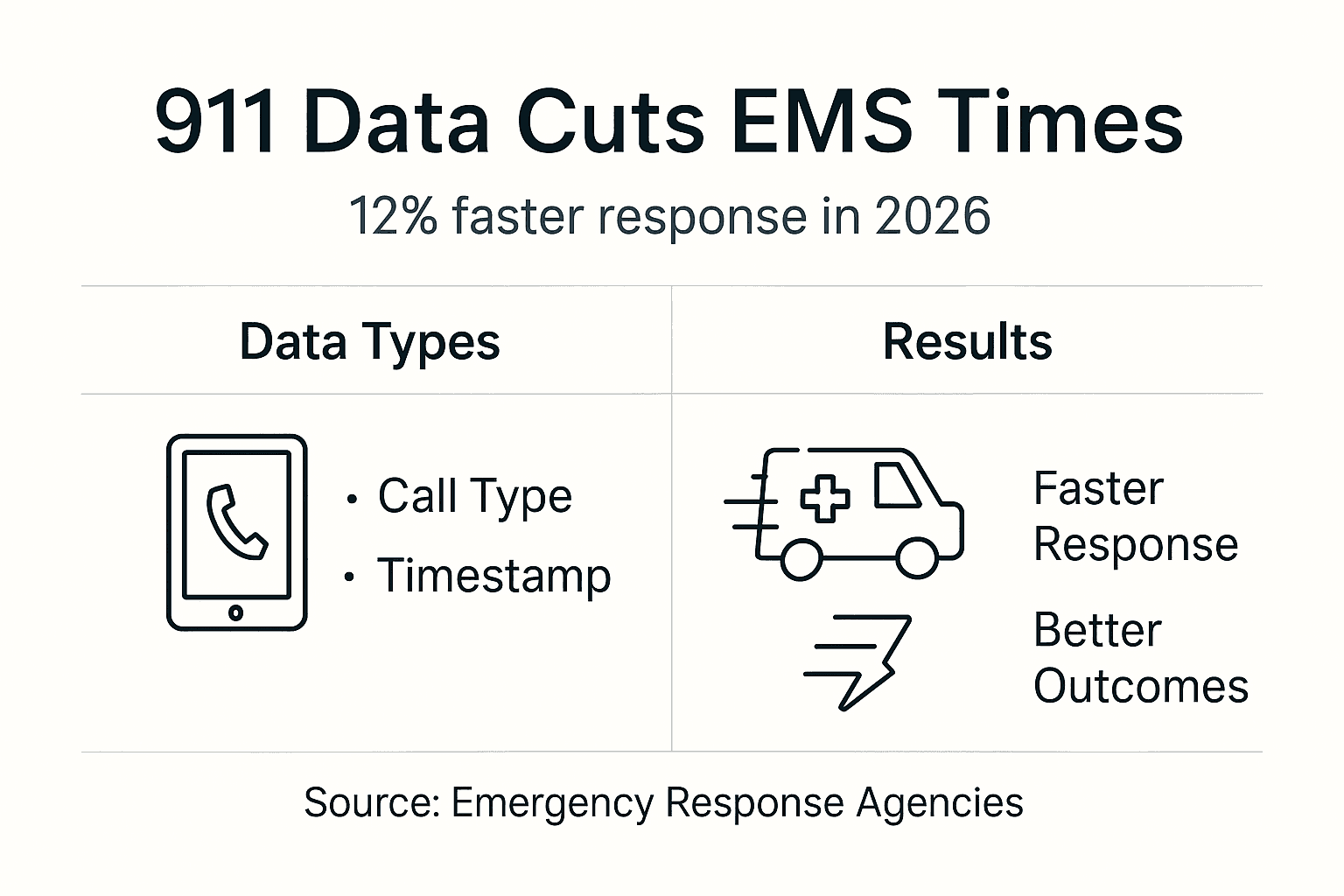
Quantitative performance tracking creates accountability loops that drive continuous improvement. When agencies establish baseline metrics, implement data-informed changes, and measure results, they build organizational cultures focused on measurable outcomes rather than anecdotal impressions. Dashboard visualizations make performance transparent to line staff, fostering engagement and innovation.
Case studies from progressive agencies demonstrate that ems customer service examples improve when data reveals customer experience pain points. Analyzing complaints alongside 911 records identifies systemic problems that targeted training or policy changes can resolve.
Challenges and limitations of 911 data
Despite its immense potential, 911 data faces significant quality and standardization challenges that constrain analytical utility. Incomplete caller information represents the most common problem, occurring when panicked callers disconnect before providing full details or when telecommunicators prioritize rapid dispatch over comprehensive data capture. Missing location data, unclear incident descriptions, and absent callback numbers create gaps that analysts cannot fill through inference.
Inconsistent coding practices between PSAPs and even among telecommunicators within single centers undermine cross-jurisdictional comparisons. One center might classify a breathing difficulty call as a cardiac event while another codes it respiratory, making aggregate analysis unreliable. Without standardized taxonomy and rigorous quality assurance, agencies cannot confidently compare performance or identify best practices.
Data privacy and security concerns legitimately constrain information sharing between agencies. Protected health information regulations, criminal justice data restrictions, and institutional liability fears create silos that prevent the integration necessary for comprehensive analysis. Balancing transparency with privacy protection requires sophisticated governance frameworks that many jurisdictions lack.
Operational barriers compound technical challenges. Legacy computer-aided dispatch systems often lack export functionality, trapping valuable data in proprietary formats. Limited analytical expertise within public safety agencies means sophisticated tools sit unused. Training gaps leave telecommunicators unaware that data quality directly impacts strategic decision-making.
- Incomplete or inconsistent caller information impacts 15-20% of records
- Non-standardized coding reduces cross-agency comparability
- Privacy regulations limit beneficial data sharing
- Legacy systems prevent efficient data extraction
- Staff training gaps reduce data quality at capture
Regular data audits identify systematic quality issues requiring process improvements. Incremental standardization through regional collaborations helps align coding practices without requiring expensive wholesale system replacements. These gradual smart growth in EMS approaches prove more sustainable than ambitious projects that exceed organizational capacity.
Pro Tip: Conduct quarterly data quality audits sampling 100 random call records. Track error rates over time to measure improvement and identify persistent problems requiring targeted intervention.
Practical steps for public safety officials using 911 data
Implementing effective 911 data utilization begins with building interoperable systems that connect PSAPs, EMS agencies, and hospitals through shared technical standards and governance agreements. Officials should prioritize data exchange agreements that specify what information flows between organizations, how privacy protections apply, and who bears responsibility for data quality. These interoperability solutions require legal, technical, and operational coordination but unlock the analytical power of integrated datasets.
Analytical capacity building represents the second critical step. Small agencies can partner with regional councils or universities to access expertise they cannot afford internally. Larger departments should invest in hiring data analysts with public safety domain knowledge or training existing staff in modern analytical methods. Online courses, professional conferences, and peer mentoring accelerate skill development.
- Establish data governance committees with representation from all stakeholder agencies
- Implement automated data validation checks catching errors at entry points
- Create user-friendly dashboards displaying key performance indicators for operational leaders
- Schedule regular training refreshers for telecommunicators on data quality importance
- Develop feedback loops showing staff how their data entry affects system improvements
- Pilot predictive analytics projects in limited geographic areas before system-wide deployment
Data validation protocols prevent garbage-in-garbage-out scenarios by catching errors before they contaminate analytical databases. Automated checks flag impossible values like negative response times, missing required fields, and geographic coordinates placing calls in oceans. Real-time validation alerts telecommunicators to errors during call processing when correction is easiest.
Dashboard development makes data accessible to non-technical leaders who need insights without becoming analysts themselves. Effective dashboards present 5-7 key metrics with trend visualizations, geographic maps, and automated alerts when performance deviates from targets. These tools democratize data access, fostering evidence-based culture throughout organizations.
Continuous improvement mindsets treat every analytical insight as a hypothesis requiring testing through operational changes and outcome measurement. Rather than assuming data reveals absolute truth, sophisticated agencies implement controlled experiments when feasible, comparing performance in areas receiving interventions against control zones. This system assessment steps rigor separates genuine improvements from random variation.
Pro Tip: Start small with one high-impact use case like predicting peak demand hours. Demonstrate value through quick wins that build organizational support for expanded data initiatives.
Conclusion and future directions
911 data represents a critical strategic asset that forward-thinking public safety agencies are leveraging to achieve measurable improvements in emergency response effectiveness. The evidence is clear: agencies applying rigorous analytical frameworks to their call data reduce response times, optimize resource allocation, and identify emerging community risks before they escalate. Success requires acknowledging data limitations while systematically addressing quality challenges through improved processes and staff training.
Emerging technologies promise to expand 911 data capabilities dramatically over the next decade. Artificial intelligence will enable real-time call classification, suggesting optimal unit dispatch before telecommunicators complete initial assessments. Machine learning algorithms will identify subtle patterns in millions of call records that human analysts would miss. Real-time data streams from connected vehicles, smart buildings, and wearable devices will supplement traditional 911 calls with automatic incident detection.
Sustained improvement depends on continued focus on data quality and interoperability as foundational requirements. Without accurate, standardized, and integrated data, even the most sophisticated analytical tools produce unreliable results. Public safety agencies should prioritize investments in data infrastructure and analytical talent over flashy technologies that promise magic solutions. The unglamorous work of data governance, quality assurance, and staff training delivers more value than expensive vendor platforms implemented without proper foundation.
“The agencies that will lead public safety innovation in 2026 and beyond are those treating data as a core operational asset, not an administrative byproduct. Every call record contains insights waiting to be discovered by organizations willing to invest in the people and processes that transform raw data into wisdom.”
Future-proofing emergency medical services through innovative data use positions agencies to meet evolving community needs with evidence-based strategies. Officials who begin building analytical capability today will find their organizations prepared for tomorrow’s challenges.
Optimize your EMS response with expert 911 data solutions
Transforming 911 data from administrative records into strategic intelligence requires specialized expertise that most public safety agencies lack internally. The Public Safety Consulting Group brings decades of experience helping EMS systems and fire departments implement data-driven response optimization.
Our consulting services include comprehensive system status management assessments that identify opportunities for improved resource utilization through predictive analytics. We conduct detailed public safety system assessments evaluating your current data collection, analysis capabilities, and integration readiness. Our team develops customized analytical frameworks matching your organizational capacity and community needs, ensuring sustainable improvements rather than short-lived projects. Whether you need help establishing data governance structures, training analytical staff, or implementing performance dashboards, PSCG provides practical solutions that deliver measurable results.
FAQ
How is 911 data typically collected and stored?
Data collection occurs at PSAPs where telecommunicators capture structured fields like call type, location, and timestamps during emergency interactions. Systems automatically record audio conversations and track dispatch events. Centralized databases store this information with searchable metadata enabling retrospective analysis.
Can 911 data be used in real-time decision making?
Approximately 30% of 911 data supports real-time dispatch decisions through immediate caller information access. The remaining 70% becomes available only after call completion and quality review, serving strategic planning rather than tactical operations. Real-time applications focus on resource deployment while retrospective analysis informs long-term system design.
What challenges affect 911 data quality?
Incomplete caller information, inconsistent coding between telecommunicators, and human error during high-stress situations reduce data reliability. Privacy restrictions and legacy system limitations compound these problems. Regular audits identifying systematic errors and standardized coding procedures gradually improve quality over time.
How can public safety agencies integrate 911 data with EMS and hospital systems?
Implementing data system interoperability requires technical standards enabling information exchange and governance agreements specifying privacy protections. Agencies must establish data sharing agreements, adopt common taxonomies, and invest in middleware connecting disparate systems. This integration enables complete patient journey tracking from initial call through hospital disposition, revealing outcome patterns that inform protocol improvements.
Recommended
- Public Safety Trend Analysis 2026 For EMS Leaders
- Public Safety Risk Reduction 2026: Cut Crime 20% Fast
- EMS Needs Smart Growth, Not Expensive Gadgets and Procedures | The Public Safety Consulting Group
- C-MED Dispatch Centers: A Dying Technology or a Sleeping Giant Ready to Evolve? | The Public Safety Consulting Group