



Leading a Connecticut EMS system means balancing rising demands with limited resources while public expectations remain high. Without clear assessment objectives and robust data, it is tough to drive real improvements or justify operational changes. By focusing on community-driven priorities and using validated data sources, you can set measurable goals, identify true gaps, and move from reactive problem-solving to strategic performance enhancement that resonates across your entire municipality.
Table of Contents
- Step 1: Define Assessment Objectives And Priorities
- Step 2: Gather And Analyze EMS System Data
- Step 3: Identify Gaps And Improvement Areas
- Step 4: Implement Targeted Operational Enhancements
- Step 5: Validate And Monitor Performance Outcomes
Quick Summary
| Essential Insight | Clarification |
|---|---|
| 1. Define clear objectives | Establish specific, measurable assessment goals to focus efforts and align priorities with stakeholder expectations. |
| 2. Systematic data collection is crucial | Gather comprehensive data across various metrics to transform raw data into actionable insights for evaluation. |
| 3. Identify and prioritize gaps | Assess discrepancies against benchmarks to pinpoint critical areas needing improvement, ensuring targeted strategies are developed. |
| 4. Implementation requires ownership | Assign clear responsibilities for operational changes to ensure accountability and adherence to newly established protocols. |
| 5. Monitor and validate performance continuously | Regularly evaluate outcomes against established metrics to maintain accountability and adjust strategies when necessary. |
Step 1: Define assessment objectives and priorities
Before you dive into evaluating your EMS system, you need clarity on what you’re actually trying to accomplish. Without defined objectives and priorities, your assessment becomes unfocused and resource-intensive. This step sets the foundation for everything that follows.
Start by identifying what’s driving your need for assessment. Are you concerned about response time performance? Are budget constraints forcing difficult decisions? Does your community face specific safety challenges that demand attention? Understanding the real trigger helps you focus on what matters most.
Next, engage your leadership team and key stakeholders to align on priority areas. This isn’t a solo exercise. Your fire chief, EMS director, municipal budget officer, and community representatives bring different perspectives. Community-driven conversations ensure your objectives reflect both operational realities and public expectations.
Define 3-5 specific, measurable assessment objectives. Instead of “improve system efficiency,” aim for concrete targets like:
- Reduce average response time to cardiac emergencies by 15% within 12 months
- Identify resource gaps in stations serving populations over 10,000 residents
- Assess compliance with state EMS protocols and staffing requirements
- Evaluate financial sustainability of current operational model
- Determine capacity needs for next 5-year period
Each objective should connect directly to your EMS system’s challenges or opportunities. Vague goals produce vague results.
Once objectives are set, rank them by impact and feasibility. Not every priority can be addressed simultaneously in a municipal budget. Ask yourself which assessments will provide the most actionable insights for improving patient outcomes and operational sustainability. This prioritization prevents scope creep and keeps your team focused.
Document these objectives in writing and share them with your assessment team. Everyone needs to understand what success looks like before the work begins. This clarity prevents misalignment later when recommendations are being developed.
Clear, measurable assessment objectives keep your team focused and ensure the evaluation addresses your most pressing operational challenges.
Pro tip: Build in a 30-day window before starting the formal assessment to gather preliminary stakeholder input through brief interviews or surveys, ensuring your final objectives truly reflect the concerns of your department, municipal leadership, and community.
Step 2: Gather and analyze EMS system data
You’re now ready to collect the information that will drive your assessment conclusions. Raw data becomes actionable intelligence only when gathered systematically and analyzed thoughtfully. This step transforms operational records into strategic insights.
Start by identifying what data sources exist within your current systems. Your CAD (Computer Aided Dispatch) system, electronic patient care records, station logs, and financial records all hold valuable information. Many Connecticut municipalities already track response times, call volumes, and unit locations but haven’t synthesized this data into a cohesive picture.
Gather data across multiple dimensions. Don’t limit yourself to response times alone. Collect information on call types, geographic distribution, staffing levels, equipment utilization, and patient outcomes. Systematic data collection ensures you capture both clinical and operational metrics that matter.

Here’s a summary of key differences between common data sources used in EMS assessments:
| Data Source | Primary Use | Typical Insights |
|---|---|---|
| CAD System | Track dispatch and response data | Response times, call locations |
| Electronic Patient Care Reports | Clinical care documentation | Patient outcomes, protocol use |
| Station Logs | Daily operations logbook | Staffing, unit activity |
| Financial Records | Monitor costs and revenue | Budget, cost per call, funding |
Consider these key data categories:
- Response times by call priority, geography, and time of day
- Call volume trends across 12-24 month periods
- Unit deployment and availability patterns
- Staffing composition and hours worked
- Patient outcome indicators where available
- Financial performance including costs per call and revenue recovery
Once collected, validate your data for accuracy. Incomplete records, data entry errors, or inconsistent categorizations can skew your analysis. Spot-check samples and reconcile discrepancies before moving forward.
Analyze patterns using both basic and advanced techniques. Calculate averages and percentiles for response times. Look for geographic hot spots or time-of-day variations. Advanced statistical models can reveal how factors like weather, location, and call urgency interact to affect performance. Your assessment team may include analysts who can build predictive models for future planning.
Create visual summaries of your findings. Maps showing response time by zone, charts tracking call volume by month, and dashboards highlighting key metrics help stakeholders grasp patterns quickly. Numbers alone rarely tell the story as effectively as well-designed visuals.
Validated, comprehensive data analysis reveals the operational patterns driving your EMS system’s performance and identifies where improvement opportunities exist.
Pro tip: Export your data into a standardized format like CSV or Excel early in the process, establish clear naming conventions for variables, and create a data dictionary documenting what each field means—this prevents confusion later and allows multiple team members to work with the same information accurately.
Step 3: Identify gaps and improvement areas
With your data analyzed, you can now see where your EMS system falls short of optimal performance. Gaps appear as discrepancies between current state and evidence-based benchmarks, and identifying them precisely is what transforms data into strategy. This step separates systems that improve from those that stagnate.
Start by comparing your findings against established benchmarks. National response time standards, state protocol requirements, and best practice guidelines give you objective measurement points. A 12-minute average response time to cardiac emergencies might meet minimum standards but lag behind high-performing systems achieving 8 minutes. The difference represents your gap.
Look for variability across your service area. Geographic disparities reveal resource distribution problems. If your urban core achieves 6-minute response times while rural zones average 18 minutes, you’ve identified a critical access gap. Similarly, protocol adherence varies by station and provider, indicating training or supervision shortcomings.
National studies show significant gaps in EMS performance quality across agencies of different sizes and types. Your assessment should examine both operational consistency and clinical protocol adherence, not just speed metrics.
Consider gaps across multiple dimensions:
- Clinical protocol compliance and clinical decision accuracy
- Response time performance by call priority and geography
- Staffing adequacy relative to call demand patterns
- Equipment and technology availability and utilization
- Training currency and competency validation
- Data sharing and interoperability systems
- Financial sustainability of current operational model
Prioritize gaps by impact on patient outcomes and operational viability. A 30-second response time improvement matters less than addressing protocol adherence or staffing shortages. Ask your team which gaps directly affect the safety and care quality your community receives.
Document gaps with specificity. Instead of “poor response times,” note “response times exceed 12 minutes in Zone 3 for 34% of calls.” Specific gaps lead to measurable improvement targets and actionable recommendations.
This table highlights how different gap types can impact EMS performance improvement:
| Gap Type | Typical Consequence | Example of Improvement Focus |
|---|---|---|
| Response Time | Delayed patient care | Zone-based deployment |
| Protocol Compliance | Variations in care quality | Targeted staff retraining |
| Staffing Adequacy | Burnout, missed calls | Adjust schedules, hiring |
| Equipment Availability | Resource shortages | Inventory management update |
Precise gap identification grounded in data and evidence creates the foundation for targeted, realistic improvement recommendations your organization can actually implement.
Pro tip: When presenting gaps to stakeholders, pair each gap with the specific data point supporting it and include context showing how your system compares to similar-sized Connecticut municipalities—this builds credibility and helps leaders understand the magnitude of improvement opportunities.
Step 4: Implement targeted operational enhancements
You’ve identified what needs to change. Now comes the work of actually making those changes stick in your operations. Implementation separates consultants from leaders who drive real improvement. This step turns recommendations into daily practice.
Start with your highest-impact gaps. If response times in Zone 3 are unacceptable, tackle that first. If protocol adherence is inconsistent, prioritize training and supervision improvements. Quick wins build momentum and demonstrate to staff that assessment recommendations have teeth.
Break each enhancement into specific, measurable actions. Instead of “improve resource allocation,” commit to “relocate one ambulance to Station 5 by March 15 and track response time reduction monthly.” Clarity on what, when, and how prevents vague intentions from becoming no action.
Optimization approaches like ambulance allocation strategies use geographic information systems and queuing models to balance efficiency with service equity. You don’t need advanced analytics to start, but understanding how location, demand patterns, and unit availability interact helps guide decisions.
Structure your implementation timeline realistically:
- Month 1-2: Quick wins and pilot programs in one zone or station
- Month 3-4: Measure results and adjust based on early data
- Month 5-12: Expand successful changes across your system
- Ongoing: Monitor performance against new targets
Assign clear ownership for each enhancement. Your EMS director owns protocol implementation. Your operations chief owns station deployment changes. Your training officer owns competency validation. Ambiguous responsibility means nothing happens.
Communicate changes to front-line staff before implementation. Ambulance personnel, dispatchers, and station crews need to understand why changes are happening and what you expect from them. Buy-in from those doing the work determines success more than consultant expertise.
Build in regular checkpoint reviews at 30, 60, and 90 days. Are changes being followed? Are they producing desired results? Are unintended consequences emerging? Early feedback allows course correction before problems compound.
Successful implementation requires clear ownership, realistic timelines, front-line communication, and willingness to adjust tactics based on real-world performance data.
Pro tip: Establish a performance dashboard that tracks your key metrics weekly and share results with your team every two weeks—transparency about progress (or lack thereof) maintains accountability and demonstrates whether enhancements are actually working as intended.
Step 5: Validate and monitor performance outcomes
Implementation is only half the battle. Without rigorous validation and ongoing monitoring, improvements fade and old patterns resurface. This step ensures your enhancements deliver measurable results and maintains accountability over time.
Validation begins immediately after implementation starts. You need to confirm that changes are actually happening as planned. Are staff following new protocols? Is the relocated ambulance in the right location? Are dispatch procedures actually changed? Don’t assume compliance. Observe and measure.
Compare current performance against your baseline metrics from Step 2. Response times should improve in targeted zones. Protocol adherence rates should increase. Patient safety indicators should trend positively. If they don’t, something in your implementation needs adjustment.
A structured performance measurement framework tracks structure, process, and outcome domains to validate EMS operational effectiveness comprehensively. You don’t need complex systems to start. Simple spreadsheets tracking response times, call volumes, and protocol compliance work fine initially.
Establish clear key performance indicators for each enhancement:
- Response time achievement rates by zone and priority level
- Protocol adherence percentages by station and provider type
- Patient safety outcome measures like medication errors or missed diagnoses
- Staff retention and competency validation completion rates
- Financial metrics including cost per call and revenue recovery
- Equipment availability and utilization rates
Monitor these indicators weekly or monthly depending on the metric. Response times fluctuate daily, so monthly trending reveals patterns. Protocol compliance should be assessed monthly during quality assurance reviews. Patient outcomes require quarterly analysis due to lower event frequencies.
Share results transparently with your team. If enhancements are working, celebrate the improvement and acknowledge the effort. If metrics aren’t moving, investigate why. Maybe staff need additional training. Maybe the enhancement didn’t address the root cause. Transparency builds trust and enables rapid problem-solving.
Schedule formal review meetings quarterly. Examine trends, discuss barriers, and make course corrections. After six months, conduct a comprehensive assessment comparing current state against your original baseline. Document what worked, what didn’t, and what you’ll do differently next cycle.
Continuous monitoring prevents backsliding, demonstrates accountability, and provides early warning when enhancements need adjustment or additional support.
Pro tip: Create a simple one-page dashboard showing your five to seven most critical metrics, update it monthly, and email it to your leadership team and station chiefs—this keeps performance visible and makes it harder for improvement efforts to slip off the radar.
Unlock Your EMS System’s Full Potential with Expert Guidance
Struggling with unclear assessment objectives or difficulty translating data into actionable EMS improvements can stall your system’s progress and impact patient outcomes. The challenges of defining measurable goals, validating performance data, pinpointing operational gaps, and implementing lasting changes demand specialized knowledge and hands-on support. At The Public Safety Consulting Group, we understand these pain points and offer tailored solutions that align perfectly with your priorities like response time optimization, protocol compliance, and sustainable resource management.
Take control of your EMS assessment journey today by partnering with a Connecticut-based leader in public safety strategy. Whether you need help designing robust EMS systems, navigating reimbursement complexities, or driving effective operational enhancements, our experienced consultants stand ready to deliver proven results. Visit The Public Safety Consulting Group to learn how our comprehensive approach can transform your assessment findings into real-world success. Don’t wait to make improvements that save lives and safeguard your community.
Discover how we can help you set focused objectives, analyze your EMS data with precision, and implement targeted changes by exploring our services at https://www.thepscgroup.net/. Take the first step toward a stronger, smarter EMS system now.
Frequently Asked Questions
What are the key steps in assessing an EMS system for optimal results?
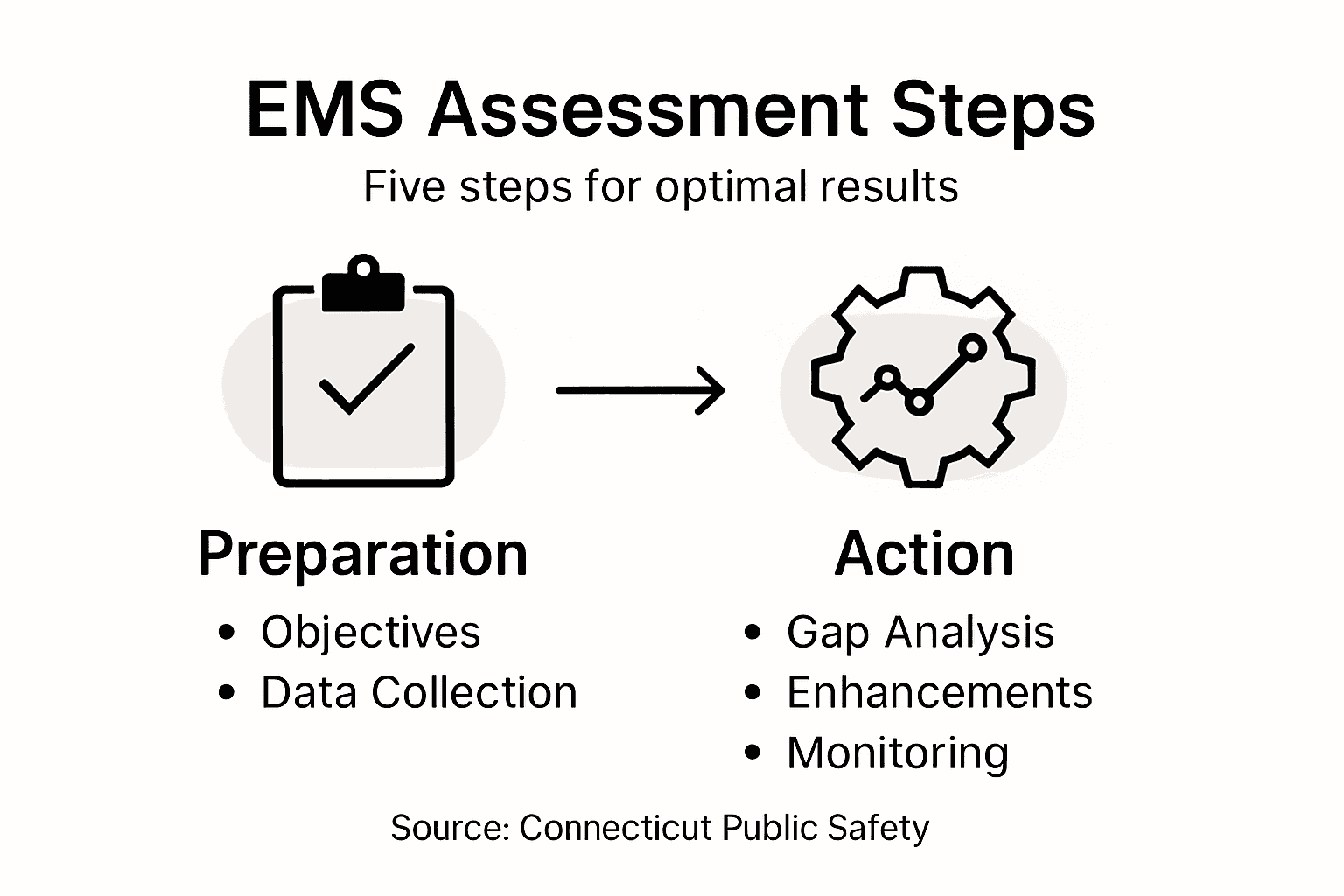
Start by defining assessment objectives and priorities, followed by gathering and analyzing data. Then, identify gaps and areas for improvement, implement targeted operational enhancements, and validate and monitor performance outcomes. This structured approach ensures a comprehensive evaluation of your EMS system.
How can I ensure my assessment objectives align with community needs?
Engage your leadership team and key stakeholders to discuss and align on priority areas. Document and rank 3-5 specific assessment objectives that directly address the challenges or opportunities within your EMS system, ensuring they reflect both operational realities and community expectations.
What types of data should I collect for an EMS system assessment?
Gather data from various sources, including response times, call volumes, staffing levels, and patient outcomes. Aim for comprehensive coverage by collecting information across multiple dimensions to provide a holistic view of your EMS system’s performance.
How do I identify and prioritize gaps in EMS performance?
Compare your collected data against established benchmarks and look for discrepancies between current performance and best practices. Prioritize gaps based on their impact on patient outcomes and operational viability to focus on the most critical areas needing improvement.
What steps should I take to implement operational enhancements in my EMS system?
Start with your highest-impact gaps and break down each enhancement into specific, measurable actions. Assign clear ownership for each task and establish a timeline for implementation to ensure accountability and track progress effectively.
How often should I monitor performance outcomes after implementing changes?
Monitor key performance indicators regularly, ideally on a weekly or monthly basis depending on the metric. Schedule formal review meetings quarterly to assess trends and make necessary adjustments, ensuring that improvements remain effective over time.