


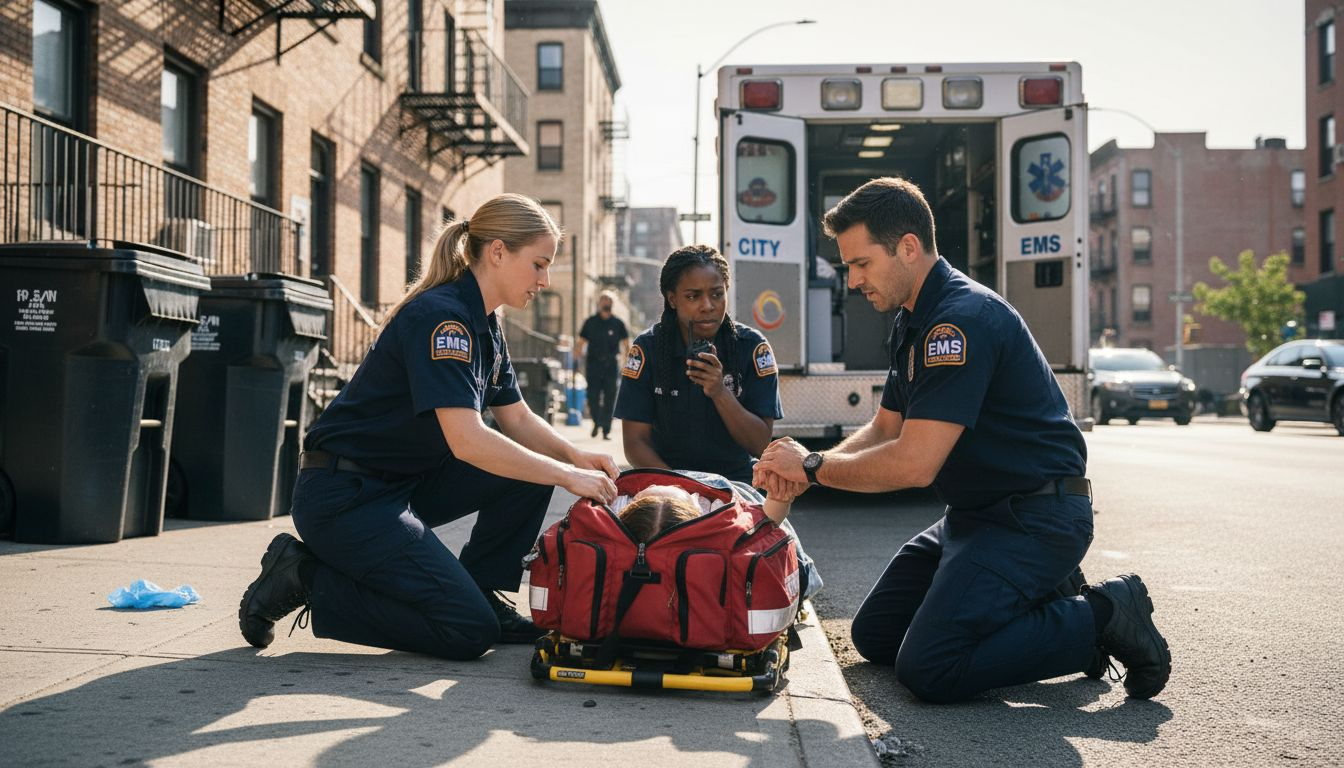
What makes one public safety approach stronger than another during a crisis in Connecticut? For EMS directors, a clear understanding of public safety in emergency response directly shapes how your team allocates resources and collaborates with agencies from Hartford to Stamford. NIMS defines public safety as coordinated action among government, nongovernmental, and private partners to prevent, mitigate, and recover from incidents. Knowing this definition helps you build resilient systems and improve outcomes for your community.
Table of Contents
- Defining Public Safety In Emergency Response
- Core Components And EMS’s Role Explained
- Key Legal Standards And Regulatory Bodies
- Interagency Collaboration And System Integration
- Liabilities, Mistakes, And Compliance Risks
Key Takeaways
| Point | Details |
|---|---|
| Definition of Public Safety | Public safety in emergency response involves collaboration across agencies to protect people, property, and the environment. It’s essential for EMS directors to understand this for effective system structure and resource allocation. |
| Core Components for EMS | EMS plays a vital role in prevention, mitigation, response coordination, and recovery. Mastery of these components enhances community safety and ensures a high standard of care. |
| Legal Standards and Compliance | EMS operations are governed by federal, state, and local regulations. Staying informed about these layers is essential for operational compliance and risk management. |
| Interagency Collaboration | Effective emergency response relies on strong collaboration with other agencies. Establishing formal relationships and trust before emergencies can improve response times and outcomes. |
Defining Public Safety in Emergency Response
Public safety in emergency response extends far beyond traditional law enforcement or fire suppression. For EMS directors in Connecticut, understanding this definition directly shapes how you structure systems, allocate resources, and coordinate with regional partners.
At its core, public safety in emergency response means protecting people, property, and the environment through coordinated action across multiple agencies and sectors. The National Incident Management System (NIMS) defines this as a unified approach where government entities, nongovernmental organizations, and private sector partners collaborate to prevent, protect, mitigate, respond to, and recover from incidents.
For your EMS operations, this definition carries three practical implications:
- Coordination responsibility: You’re not working in isolation—you’re part of a larger system that includes fire departments, hospitals, law enforcement, and mutual aid partners.
- Shared vocabulary: Everyone involved must understand the same terminology and processes to function effectively during crises.
- Resource management: Public safety requires strategic deployment of personnel and equipment based on community needs and regional capacity.
Your definition of public safety should reflect your specific community context. A rural Connecticut town has different safety priorities than an urban center. Your system’s capacity, population density, and available resources all factor into what public safety means operationally.
Public safety in emergency response isn’t a single agency’s responsibility—it’s a shared mission requiring alignment across all responder disciplines and community partners.
Effective emergency response also demands proper emergency preparedness and hazard awareness among your personnel. Workers need training in recognizing hazards, understanding protocols, and maintaining safety standards during high-stress incidents. This worker-focused perspective complements the broader systems view of public safety.
When you clearly define public safety for your EMS organization, you establish expectations for performance, communication, and partnership. Ambiguous definitions lead to operational confusion and missed coordination opportunities.
Consider also how your definition aligns with mutual aid agreements and regional strategies. Mutual aid isn’t a system failure—it’s evidence that your public safety approach recognizes community interdependence.
Pro tip: Document your organization’s specific definition of public safety and share it with all stakeholders—hospital administrators, fire chiefs, law enforcement, and municipal leadership—to ensure everyone operates from the same foundation.
Core Components and EMS’s Role Explained
Public safety in emergency response rests on several interconnected core components. For EMS directors, understanding each one clarifies your organization’s responsibilities and integration points within the broader safety ecosystem.
The first component is prevention and preparedness. Your EMS system must anticipate potential emergencies, plan responses, and train personnel accordingly. This isn’t reactive—it’s proactive planning that reduces risk before incidents occur.
The second component is mitigation. Once an emergency begins, your role includes minimizing harm through rapid response, appropriate triage, and resource allocation. Mitigation directly saves lives during the critical first minutes.
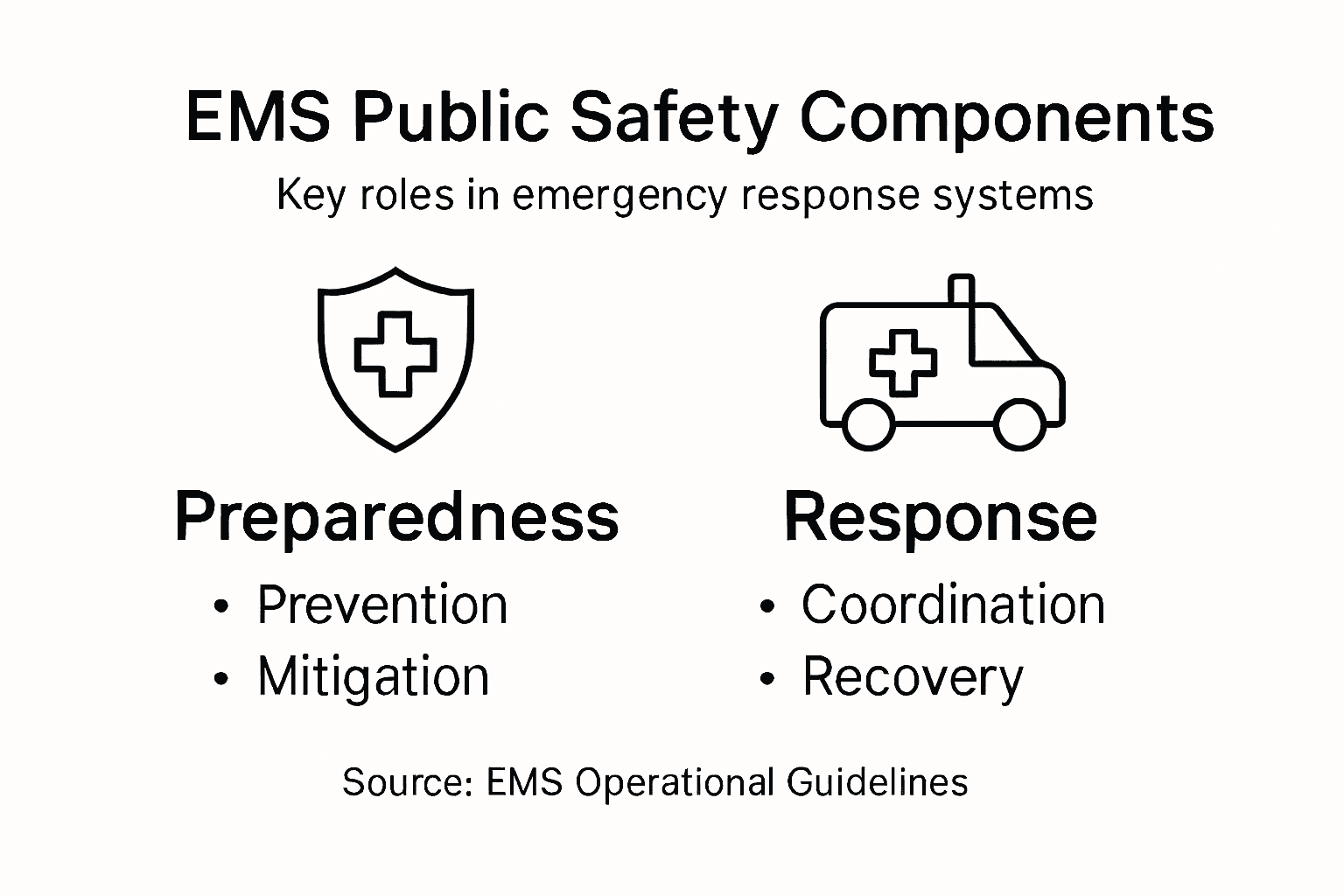
The third component is response coordination. EMS doesn’t operate alone. You work within a command structure that includes fire, law enforcement, public health, and hospital partners. Unified command structures ensure clear authority and coordination during complex incidents.
The fourth component is recovery and continuity. After the immediate emergency passes, your system supports long-term patient care, collects outcome data, and helps communities return to normal operations.
Here’s a quick breakdown of the four core components of public safety and how EMS contributes to each:
| Component | EMS Contribution | Operational Impact |
|---|---|---|
| Prevention & Preparedness | Risk assessment, training | Reduces incident likelihood |
| Mitigation | Rapid response, triage | Minimizes harm during events |
| Response Coordination | Collaboration with agencies | Improves resource deployment |
| Recovery & Continuity | Post-incident care, data review | Restores normal operations |
Your EMS role encompasses all four components:
- Clinical expertise: Delivering appropriate care to patients in crisis situations.
- System leadership: Coordinating with agencies and managing resources strategically.
- Public health integration: Participating in preparedness planning and protective measures that address broader community health threats.
- Operational accountability: Ensuring personnel follow protocols and maintain performance standards.
EMS isn’t just emergency response—it’s a critical public health function that bridges clinical care, community safety, and system coordination.
Many Connecticut EMS directors underestimate their public health role. You’re not just treating patients; you’re part of a system designed to reduce population-level mortality and morbidity. During pandemics, natural disasters, or mass casualty events, your decisions affect entire communities.
Your accountability for performance excellence directly supports these core components. When your team maintains high standards, prevention works, mitigation succeeds, coordination flows smoothly, and recovery happens faster.
Pro tip: Map your current EMS operations against all four components—prevention, mitigation, response, and recovery—to identify gaps where your system could strengthen public safety outcomes.
Key Legal Standards and Regulatory Bodies
Your EMS operations exist within a multi-layered legal framework. Understanding which bodies set standards and what compliance looks like prevents operational missteps and protects your organization.
At the federal level, the National Highway Traffic Safety Administration (NHTSA) establishes core education and scope of practice standards for EMS. These standards provide the foundation that states build upon. NHTSA doesn’t regulate you directly—your state does—but NHTSA’s guidelines shape what your state requires.
Connecticut’s Department of Public Health oversees your state-level EMS licensing and regulations. This is your primary regulatory relationship. The state office ensures compliance with standards, manages paramedic and EMT certifications, and enforces scope of practice rules.
At the municipal level, your local government or hospital authority typically holds EMS licensing authority. This creates a three-tier structure:
- Federal standards: Set baseline education and competency expectations.
- State regulations: Translate federal standards into state-specific rules and oversee licensing.
- Local requirements: Adapt regulations to community context and provide direct oversight.
The National Conference of State Legislatures maintains an EMS legislation database tracking how states approach EMS administration, funding, regulatory systems, and workforce issues. This database shows how Connecticut’s approach compares to neighboring states and identifies emerging legislative trends.
Key regulatory areas you must monitor include personnel licensing, scope of practice changes, equipment standards, and data reporting requirements. Each carries compliance obligations.
Regulatory bodies set minimum standards, but your organization should aspire to exceed them—compliance is a floor, not a ceiling.
Connecticut EMS directors often focus on operational compliance while missing legislative changes at the state level. Stay connected with your state EMS office and professional associations to anticipate regulatory shifts before they become mandatory.
Your organization should also understand local ordinances governing EMS response, mutual aid agreements, and billing practices. These vary by municipality and directly affect your operational authority.
Pro tip: Assign one team member to monitor state legislative updates and regulatory changes quarterly, then brief leadership on compliance implications before requirements become effective.
Interagency Collaboration and System Integration
Public safety exists at the intersection of many agencies. Your EMS system cannot function in isolation—it must integrate seamlessly with fire, law enforcement, public health, hospitals, and emergency management. This integration determines response speed and outcome quality.

Effective collaboration starts with understanding differing agency cultures and priorities. Fire departments prioritize scene safety differently than hospitals prioritize patient flow. Police focus on crime scene integrity while EMS focuses on patient transport. These differences create friction unless you deliberately build bridges.
Establish formal working relationships across agencies before emergencies occur. This means regular meetings, shared training exercises, and documented protocols that everyone understands.
The second essential element is trust-building through communication. Interagency communication networks require pre-established relationships and information-sharing systems that function before, during, and after incidents. You cannot build trust during an active emergency—you must invest in it beforehand.
Integration also requires addressing real operational barriers:
- Siloed budgets: Agencies operate under different funding streams, limiting resource sharing.
- Differing expectations: Each agency measures success differently; align metrics.
- Communication gaps: Different radio systems, terminology, and dispatch protocols create confusion.
- Competing priorities: Scene safety conflicts with rapid transport; establish clear decision rules.
Effective collaboration requires establishing formal working groups and information-sharing processes that integrate systems across federal, state, and local levels. This means technology integration (shared dispatch, common data platforms) and procedural integration (mutual aid agreements, unified command structures).
For Connecticut EMS directors, system integration means your personnel can function seamlessly with local fire chiefs, police captains, hospital administrators, and public health officials. Each party understands its role and respects others’ expertise.
Agencies that collaborate before emergencies respond faster during them—preparation prevents chaos.
Mutual aid agreements exemplify integration done right. When your system reaches capacity, established agreements with neighboring services allow rapid resource transfer without negotiation delays.
Pro tip: Schedule quarterly joint training exercises with fire, police, and hospital partners to test interagency communication and identify integration gaps before real emergencies expose them.
Liabilities, Mistakes, and Compliance Risks
EMS operations carry inherent liability exposure. Every patient contact, transport decision, and clinical intervention creates potential legal risk. Understanding where mistakes happen and how to prevent them protects your organization and your personnel.
Common liability sources in EMS include transport denial decisions, use of lights and sirens, determinations of medical futility, and termination of resuscitation efforts. Ethical challenges in EMS require clear protocols addressing these high-risk decisions. Without documented guidelines, your personnel face both ethical confusion and legal exposure.
Documentation is your strongest liability defense. Every patient encounter requires clear, objective charting that reflects your clinical reasoning and justifies your treatment decisions. Vague or incomplete documentation creates liability during legal review.
Scope of practice violations represent another major risk area. Your personnel must operate within their license level and your system’s protocols. When a paramedic performs interventions outside their scope, your organization shares liability.
Key compliance risks to address:
- Inadequate training: Personnel performing procedures without proper certification.
- Outdated protocols: Guidelines that don’t reflect current evidence or state regulations.
- Poor documentation: Records that don’t support clinical decisions or lack required elements.
- Deviation from policy: Personnel creating their own procedures instead of following established protocols.
- Failure to report: Not escalating quality issues or adverse events through proper channels.
Accreditation through recognized bodies provides a pathway to reduced liability. CAAS accreditation establishes quality and safety standards that reduce legal exposure through rigorous self-assessment and external review. Organizations meeting accreditation standards demonstrate commitment to quality and compliance, which protects you during litigation.
Liability prevention starts with clear policies, consistent training, and meticulous documentation—not with hoping nothing goes wrong.
Connecticut EMS directors should also implement quality assurance programs that identify errors before they become liabilities. Regular case review, peer feedback, and outcome tracking reveal patterns that need correction.
The following table highlights common EMS compliance risks and practical prevention strategies:
| Compliance Risk | Example Scenario | Prevention Strategy |
|---|---|---|
| Inadequate training | Performing new procedures | Regular certification updates |
| Outdated protocols | Using obsolete guidelines | Annual protocol reviews |
| Poor documentation | Incomplete patient charts | Mandatory quality audits |
| Policy deviation | Improvised interventions | Strict adherence monitoring |
| Failure to report | Unreported adverse events | Clear escalation procedures |
Pro tip: Conduct quarterly liability audits reviewing a sample of patient charts, checking for protocol compliance, scope of practice adherence, and documentation quality—identify and correct patterns before they create legal exposure.
Strengthen Your EMS Impact with Expert Public Safety Solutions
The article highlights the critical challenges EMS directors face in defining public safety within complex emergency response ecosystems. Coordination responsibility, resource management, compliance risks, and interagency collaboration are demanding priorities that require comprehensive and tailored support. Your EMS system’s performance and public safety outcomes depend on clear strategies and proactive leadership that bridge prevention, response, and recovery.
Unlock your EMS organization’s full potential by partnering with The Public Safety Consulting Group (PSCG). We specialize in EMS system design and operational risk reduction that align perfectly with your goals around unified command, liability prevention, and regulatory compliance. Act now to gain a competitive edge and ensure your public safety definition translates into measurable improvements. Visit The Public Safety Consulting Group for expert guidance and actionable solutions tailored specifically for Connecticut EMS leaders.
Explore how our expertise in municipal EMS strategy and leadership development can transform your emergency response effectiveness today.
Frequently Asked Questions
What is the definition of public safety in emergency response?
Public safety in emergency response is about protecting people, property, and the environment through coordinated action among various agencies and sectors, ensuring a unified approach to prevent, respond to, and recover from incidents.
How does coordination impact EMS operations?
Coordination is crucial for EMS operations as it involves collaboration with fire departments, hospitals, law enforcement, and mutual aid partners, enabling a unified response to emergencies and efficient resource management.
What are the four core components of public safety that EMS contributes to?
The four core components are prevention and preparedness, mitigation, response coordination, and recovery and continuity. EMS plays a role in each by anticipating emergencies, minimizing harm, coordinating responses, and supporting long-term patient care.
What legal standards should EMS directors be aware of?
EMS directors must understand federal standards set by the National Highway Traffic Safety Administration, state regulations from the Department of Public Health, and local requirements governing EMS operations, including personnel licensing and scope of practice.
Recommended
- The Impact of Climate Change on EMS: Preparing for More Extreme Weather Events | The Public Safety Consulting Group
- Practical examples of customer service principles in EMS | The Public Safety Consulting Group
- Public Safety Terminology: Improving EMS Communication
- EMS Needs Smart Growth, Not Expensive Gadgets and Procedures | The Public Safety Consulting Group
- What Is Emergency Accommodation Like for Events? | Jigsaw Conferences
- Why Signage Impacts Event Safety for Planners –
- Hazardous Waste Risks: What UK Businesses Must Know in 2025 – Venture Waste