


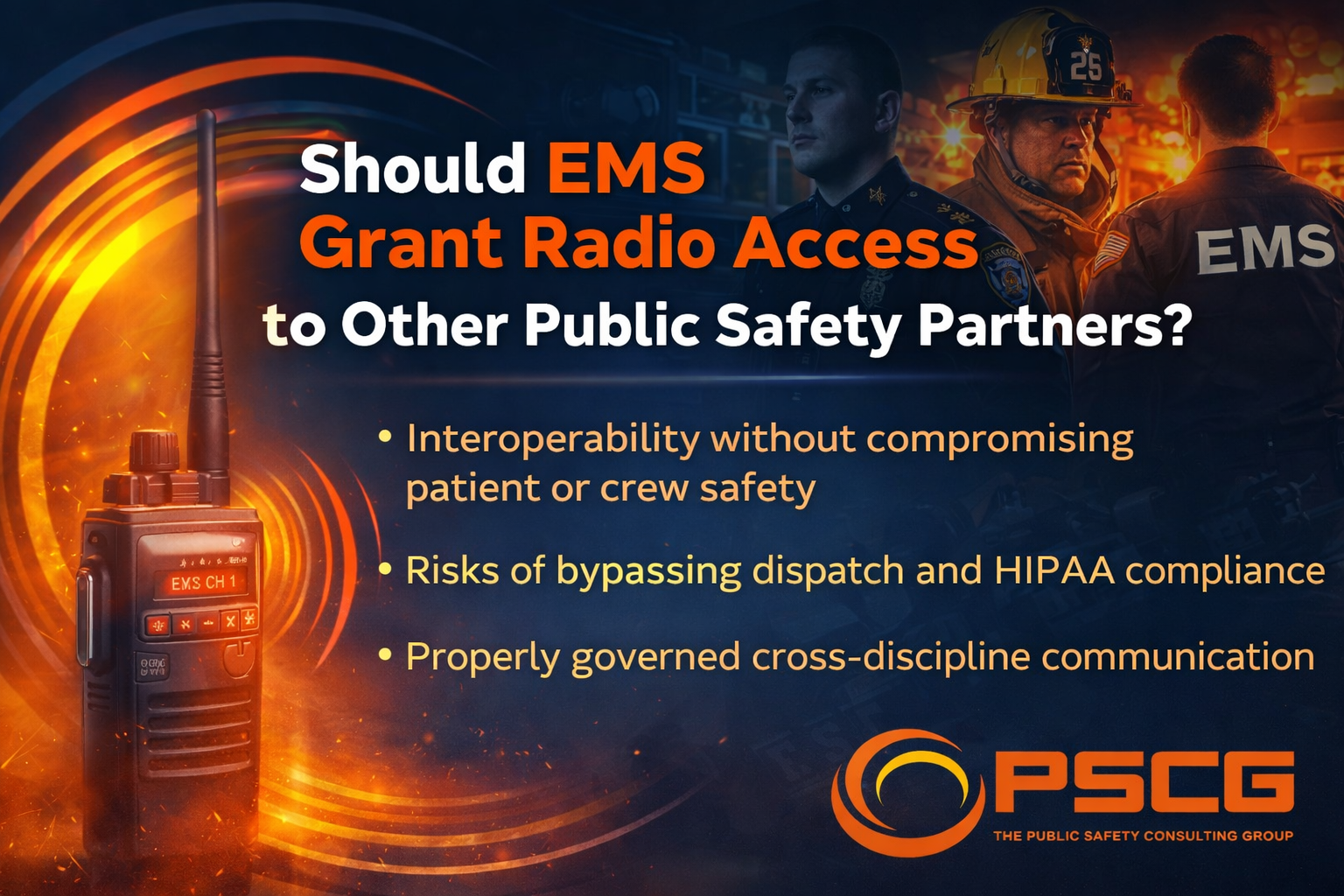
Interoperability Without Surrender
Should a Third-Service EMS Be Required to Grant Radio Access to Other Public Safety Partners?
Executive Summary: EMS Interoperability vs. Radio System Control
Interoperability is essential in modern public safety. But interoperability does not require a third-service EMS agency to surrender operational control of its radio system.
Federal doctrine, NFPA standards, FCC regulations, and HIPAA privacy law all support the same principle:
Interoperability must be structured, governed, and role-defined.
It is not synonymous with unrestricted cross-agency transmission privileges.
When outside agencies communicate directly with EMS units without governance, dispatch integration, or medical communications competency, the result can increase risk to:
Crew safety
Patient safety
Patient privacy
Incident command integrity
Organizational liability
A disciplined interoperability model strengthens public safety. An unmanaged access model weakens it.
What Does “Interoperable” Mean in EMS and Public Safety Communications?
When municipalities debate EMS radio access, the underlying question is often misunderstood.
There are two very different issues:
Can agencies communicate effectively during joint incidents?
Should outside agencies have routine access to EMS operational channels?
The first is essential.
The second requires caution.
Public safety radio systems are safety-critical infrastructure. They are not symbolic gestures of collaboration. They exist to move accurate, time-sensitive information in high-stress environments where confusion carries consequences.
NIMS and ICS: National Standards for EMS Interoperability
Under the Federal Emergency Management Agency, the National Incident Management System (NIMS) defines interoperability as the ability of agencies to communicate across jurisdictions using compatible systems and defined protocols.
Similarly, the Incident Command System (ICS) requires structured communications planning through formal Incident Communications Plans.
Neither NIMS nor ICS requires:
Open access to another agency’s radio system
Removal of discipline-specific control
Informal cross-agency transmissions
They require:
Planned interoperability
Defined authority
Managed communications channels
Role clarity
Interoperability is about capability—not possession.
SAFECOM and EMS Communications Governance
The Cybersecurity and Infrastructure Security Agency (CISA), through its SAFECOM Interoperability Continuum, identifies five pillars of public safety communications maturity:
Governance
SOPs
Technology
Training & Exercises
Usage
Technology alone does not equal interoperability.
If EMS radio access is granted without:
Authorization protocols
Training requirements
Defined activation triggers
Audit controls
then communications maturity declines.
Access without governance creates congestion and safety risk.
FCC Regulations and Public Safety Radio Authorization
Public safety radio systems operate under regulations established by the Federal Communications Commission (FCC), specifically Part 90 of the Code of Federal Regulations.
These systems are:
Licensed
Authorized
Regulated
Interoperability is typically achieved through:
Designated interoperability talkgroups
National or statewide mutual aid channels
ECC-managed console patches
Incident-based gateway systems
There is no FCC requirement that a third-service EMS agency must provide unrestricted operational channel access to other disciplines.
Radio systems are regulated infrastructure—not informal property.
CAAS Accreditation and EMS Operational Integrity
The Commission on Accreditation of Ambulance Services (CAAS) framework emphasizes reliability, quality assurance, and operational control within EMS systems.
Accredited EMS agencies demonstrate interoperability through:
Defined communications policies
Mutual aid agreements
Training documentation
Governance structures
Accreditation supports disciplined systems—not unmanaged access.
NFPA Standards: EMS Communications as a Safety Function
The National Fire Protection Association reinforces that communications are embedded within incident safety and command structure.
NFPA 1561 and Incident Command Communications
NFPA 1561 establishes requirements for organized incident management, including disciplined communications aligned with defined authority.
NFPA 1561 supports:
Structured command
Defined communications protocols
Accountability systems
It does not support unrestricted cross-discipline radio access.
NFPA 1225 and Emergency Communications Centers
NFPA 1225 governs emergency communications systems and centers.
NFPA recognizes dispatch as a professional public safety function—not an optional intermediary.
Bypassing ECC contradicts the communications discipline envisioned by NFPA.
HIPAA and EMS Radio Communications Compliance
EMS agencies operate under the Health Insurance Portability and Accountability Act (HIPAA).
EMS radio transmissions may include:
Patient condition
Medication administration
Behavioral health indicators
Demographic information
Hospital activation details
HIPAA permits necessary disclosures for treatment and public safety purposes. It does not permit uncontrolled broadcast of protected health information.
Unrestricted radio access increases risk of:
Incidental disclosure
Recording by non-clinical personnel
Erosion of minimum necessary standards
Proper interoperability includes:
EMS-controlled clinical channels
Encryption where appropriate
Dedicated operational interoperability talkgroups
SOP-driven information sharing thresholds
Patient privacy is not optional. It is a legal obligation.
The Risk of Bypassing ECC in EMS Operations
Some agencies argue that direct radio communication with EMS units increases efficiency.
In practice, bypassing the Emergency Communications Center introduces risk.
Dispatch performs essential safety functions:
Unit location tracking
Status monitoring
Emergency alert processing
Resource coordination
Incident documentation
When outside agencies communicate directly with EMS units without ECC awareness:
Situational awareness fragments
Conflicting instructions can occur
Documentation gaps emerge
Liability exposure increases
ICS depends on a common operating picture.
Dispatch is central to that picture.
Removing ECC from communications pathways degrades safety.
Institutional Experience: Medical Communications Is a Specialty
EMS radio operations are clinically structured workflows, including:
Hospital pre-notification formats
Medical control consultation
STEMI, stroke, and trauma activation triggers
Compliance-based status milestones
HIPAA-sensitive phrasing
A first responder agency—even highly professional—may not have institutional experience in medical communications.
Without that experience, cross-discipline radio access can introduce:
Terminology confusion
Parallel clinical direction
Disruption of paramedic workflow
Delayed hospital activation
Increased patient safety risk
Medical communications competency matters.
Interoperability requires expertise—not just access.
Best Practices for EMS Radio Interoperability
A defensible third-service EMS interoperability model includes:
Retain
EMS control of primary operational channels
Encrypted clinical communications
Provide
Dedicated interoperability talkgroups
ECC-managed console patches
Defined activation criteria
Require
Authorization matrix for external access
Training prior to transmission privileges
Explicit prohibition on non-credentialed clinical direction
Logging and audit review
Misuse enforcement procedures
Interoperability should be engineered—not improvised.
Policy Standard: When Is a Third-Service EMS Truly Interoperable?
A third-service EMS agency is interoperable when it can demonstrate:
ICS-compliant communications planning
Access to designated interoperability channels
ECC-integrated oversight
HIPAA-compliant clinical channel protection
NFPA-aligned communications discipline
Authorized and trained external access controls
Interoperability does not require:
Unrestricted partner transmission privileges
Removal of dispatch oversight
Access to encrypted clinical talkgroups
Interoperability is coordinated capability—not surrendered control.
Frequently Asked Questions About EMS Radio Interoperability
Does NIMS require open EMS radio access?
No. It requires structured interoperability.
Can fire and police communicate with EMS during incidents?
Yes—through designated interoperability channels governed by policy.
Is encryption anti-interoperability?
No. Encryption protects patient information while interoperability occurs on managed shared resources.
Does protecting EMS channels harm teamwork?
No. It strengthens clarity, safety, and accountability.
References
Federal Emergency Management Agency — National Incident Management System
Cybersecurity and Infrastructure Security Agency — SAFECOM Interoperability Continuum