



A properly designed municipal ambulance subscription program can lower resident out-of-pocket exposure while supporting EMS cash flow, but only when it is built as gap coverage layered on top of insurance, not a substitute for it. The program is viable when your legal counsel has cleared it against federal anti-kickback rules and state insurance law, your pricing is actuarially sound, and your billing team bills primary payers first every time.
TL;DR:
- The program must be effectively layered as gap coverage on top of insurance, not as a substitute, and should be legally approved for anti-kickback and insurance compliance.
- Accurate actuarial pricing based on historical data is essential to avoid creating an inducement, and prices must align with state-specific reimbursement rules and potential legal restrictions.
- Billing must always be filed with the primary payer first, and documentation should clearly disclose the subscription’s role as a residual coverage, not a free ride.
- Clear, straightforward enrollment and renewal processes, with verification of eligibility and transparent communication, help prevent legal or audit issues.
- Successful promotion relies on trusted channels like EMS staff and local community outreach, maintaining credibility without overselling benefits or obscuring program boundaries.
Table of Contents
- What Is an Ambulance Subscription Program, and What Models Work?
- What Legal Requirements Apply to Ambulance Subscription Programs?
- How Do Subscriptions Interact With Insurance Billing?
- How Should Enrollment and Renewal Actually Run?
- What Does a Launch Checklist Look Like?
- How Do Subscriptions Compare to Traditional Ambulance Billing?
- What Impact Do These Programs Have on Patients?
- How Should Residents Enroll or Opt Out?
- What Role Should Ambulance Providers Play in Promotion?
- What Are the Downsides for Consumers?
- PSCG’s Perspective on Subscription Programs
- How Thepscgroup Helps You Build This Right
- Sources
What Is an Ambulance Subscription Program, and What Models Work?
An ambulance subscription program, sometimes called an EMS membership program or emergency medical service membership, is a municipal or agency-run plan that waives the patient’s remaining balance after insurance has paid its share. It is not insurance in the traditional sense, and the distinction matters enormously for how you structure and market it.
Three U.S. municipal examples show how much room there is to tailor a program to local needs. Bedford, Texas runs a household-based ambulance subscription program that charges $60 per year and covers the balance left after insurance pays, while excluding Medicaid recipients since Medicaid already prohibits balance billing. Sierra Madre, California takes a tiered approach, with its Paramedic Subscription Program offering a standard plan and a modest-income tier verified against HUD income thresholds, both billing insurance first before applying secondary coverage. The McCandless Franklin Park Ambulance Authority runs a similar model in Pennsylvania, where subscription revenue directly supports operations that would otherwise depend more heavily on local tax dollars.
Across these programs, annual fees typically fall within a moderate range, often with:
- Household or family tiers priced higher than individual coverage
- Modest-income discount tiers requiring documented proof of eligibility
- Business tiers covering employees injured or ill while on duty
- Medicaid exclusions, since those patients already carry protection from balance billing
- Non-prorated annual cycles that start and end on a fixed calendar date
Enrollment usually runs through a municipal website, a utility-bill insert, or a walk-in counter at the fire department or city hall. None of that is complicated. What is complicated is what comes next.
What Legal Requirements Apply to Ambulance Subscription Programs?
Before your council votes on anything, your legal team needs to clear four distinct regulatory gates. Skipping any one of them is how a well-intentioned community benefit turns into a federal or state enforcement problem.
- Federal anti-kickback exposure. The Anti-Kickback Statute can apply if waiving a Medicare or Medicaid beneficiary’s cost-sharing looks like an inducement to choose your service. OIG Advisory Opinion 03-11 found a similar program permissible because it was structured like actuarially sound supplemental insurance, not a sham discount. That opinion is the closest thing the field has to a federal blueprint.
- State insurance law classification. Some state insurance departments consider subscription plans to be the business of insurance, which triggers licensure. New York’s Department of Financial Services has issued guidance treating certain ambulance membership plans exactly this way, and other states have taken similar positions informally. This is a check your own state counsel has to run before launch, not something you can assume from a neighboring jurisdiction’s experience.
- State administrative rules. Texas addresses subscription programs directly in Health and Safety Code Section 773.011, which authorizes them but requires surety bonds and compliance with executive commissioner rulemaking. New Hampshire’s reimbursement guidance layers on Medicare-multiplier requirements that can shift the revenue math behind your pricing.
- Procurement and budget certification. An Ohio Attorney General opinion on township ambulance contracting found that billing revenue must be properly reflected in budget certification under state statutes governing township finance. Your finance office and procurement counsel need to be at the table early, not brought in after the ordinance passes.
Pro Tip: Route your draft program design through state insurance counsel and a healthcare fraud-and-abuse attorney simultaneously, not sequentially. Sequential review routinely adds months to a launch timeline that a coordinated review avoids.
How Do Subscriptions Interact With Insurance Billing?
The operational rule is simple to state and easy to violate: bill the primary payer first, every single time, and apply the subscription only to what remains as the patient’s responsibility. A subscription that gets applied before insurance is billed, or that discourages a subscriber from submitting insurance information, starts to look like concealment of a billable claim rather than legitimate gap coverage.
Good documentation protects the program and the patient. That means:
- Claim comments and cover letters that clearly disclose the subscription’s existence to the payer
- A subscriber-signed authorization allowing release of insurance information to the billing vendor
- A billing system flag that distinguishes “subscriber balance waived” from “written off as uncollectible” for audit purposes
- Retained records tying every waived balance back to a specific, dated subscription enrollment
Pricing has to be built the same way an actuary would build it, not the way a marketing brochure would. Statistic Callout: Bedford prices its household plan at $60 per year, a figure that only works because it is calibrated against the agency’s own historical patient-responsibility write-off volume, not picked because it sounds affordable. A fee set too low relative to actual waived balances starts to resemble an inducement rather than a premium for supplemental coverage, which is precisely the line OIG Advisory Opinion 03-11 asked programs to respect.
State-level reimbursement rules complicate this math further. Where states peg commercial payments to Medicare-based multipliers or require filed local rate schedules, your expected collections shift, and your subscription pricing has to be revisited whenever those rules change. A billing partner familiar with mileage billing rules and denial patterns can help you spot where state-specific quirks are eroding revenue before they show up as a budget surprise.
How Should Enrollment and Renewal Actually Run?
Getting the paperwork right matters just as much as getting the pricing right, since a program with sloppy enrollment records is the first thing an auditor or a plaintiff’s attorney will target.
- Offer multiple enrollment channels. Online forms, a walk-in counter, and a utility-bill insert campaign each reach different segments of the household base, and Sierra Madre’s program leans on documentation requirements at every one of these entry points.
- Verify eligibility at the door. Proof of residency for standard tiers and income documentation against a published threshold, such as HUD limits, for discounted tiers keeps the program defensible if it is ever challenged.
- Integrate subscriber status into dispatch and billing. CAD needs to flag a subscriber the moment a call comes in, and that flag has to travel cleanly to the billing vendor, because a program that only lives in a spreadsheet is an audit finding waiting to happen.
- Set clear renewal and proration rules. Most municipal programs run non-retroactive, fixed-calendar-year cycles with no proration for late signups, which keeps the accounting simple and the expectations unambiguous.
- Disclose plainly. Every piece of subscriber-facing material should state, in plain language, that insurance is billed first and the subscription covers what is left, which heads off any later claim of concealment.
Pro Tip: Write your enrollment confirmation letter so a subscriber could read it aloud to a skeptical neighbor and have it make sense. If the language needs a lawyer to translate, rewrite it.
What Does a Launch Checklist Look Like?
Moving from concept to a live program means clearing four categories of work roughly in parallel, not one after another.
- Legal: state insurance counsel review, an Anti-Kickback Statute analysis, a determination on whether your state treats the program as licensed insurance, and a check on any surety bond requirement.
- Financial: actuarial pricing built from historical write-off data, a reserve or bonding plan sized to worst-case drawdown, and confirmation that revenue flows correctly through municipal budget certification.
- Procurement and ordinance: council or board approval, and contract language that clearly defines the billing vendor’s role and data-sharing obligations.
- Operations: enrollment systems, a CAD-to-billing status flag, staff training, and public-facing communications that explain the program without overpromising.
| Milestone Category | Primary Owner | Key Risk If Skipped |
|---|---|---|
| Legal review (AKS, state insurance law) | City/agency counsel | Federal fraud exposure, forced program shutdown |
| Actuarial pricing and reserves | Finance director / actuary | Underfunded liabilities, insolvency of the fund |
| Council/board approval and ordinance | Municipal leadership | Program lacks legal authority to operate |
| Enrollment and CAD/billing integration | EMS operations and billing vendor | Misapplied waivers, audit findings |
A program that clears every row on that table is a program built to survive its first serious audit, which is the only realistic test that matters.
How Do Subscriptions Compare to Traditional Ambulance Billing?
Traditional fee-for-service billing sends every patient a bill for the full balance after insurance, with collections, payment plans, or write-offs handled case by case. That model is simpler to administer and requires no actuarial modeling, no state insurance review, and no subscriber enrollment infrastructure. It also means every uninsured or underinsured resident absorbs the full financial shock of an ambulance transport, often at a moment when they are least able to plan for it.
A subscription program adds real administrative weight: pricing models, legal review, enrollment systems, and CAD integration all have to exist before a single subscriber benefits. What it buys in return is predictability. Residents who enroll know their maximum exposure in advance, and the agency gains a modest, recurring, non-tax revenue stream that traditional billing does not offer. Traditional billing keeps cash flow tied entirely to claim-by-claim collections; a subscription base smooths that curve somewhat, even though it will never replace the bulk of agency revenue.
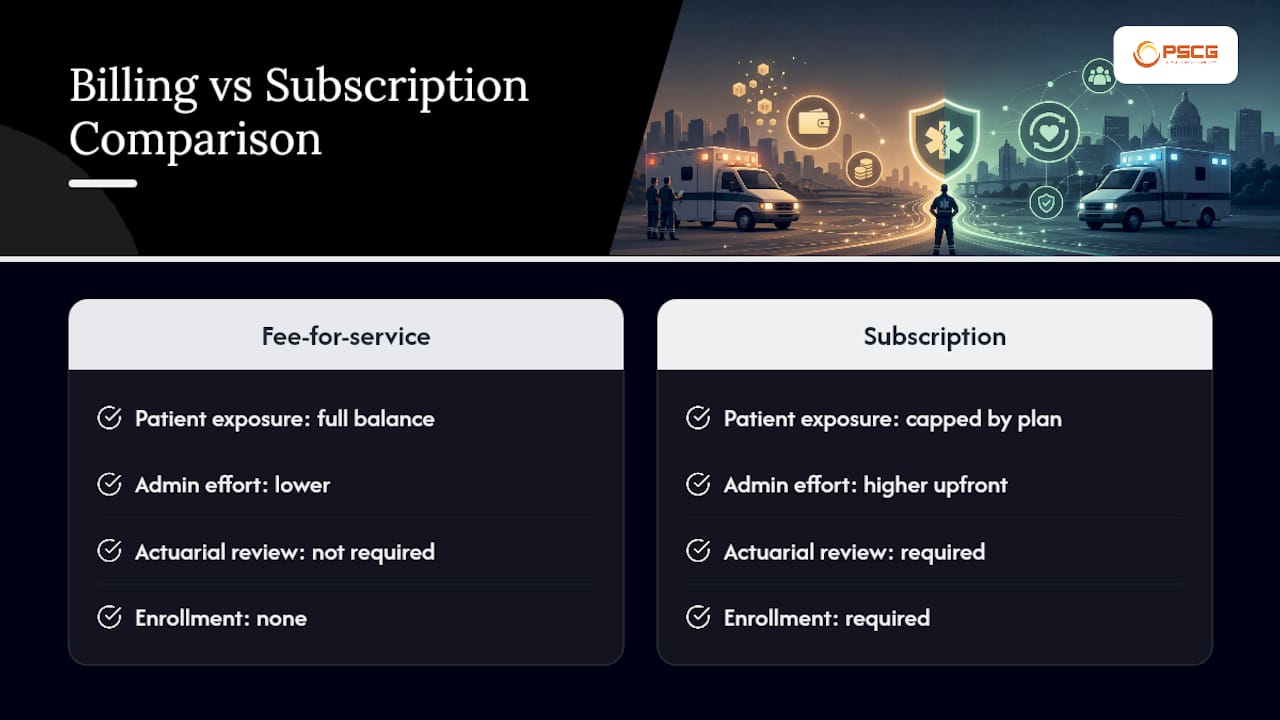
Neither model is inherently superior. Traditional billing is lower-effort and easier to explain to a council unfamiliar with actuarial concepts. Subscription programs ask more of the agency up front but give residents something traditional billing cannot: certainty before the ambulance ever gets called. Most municipalities that run subscription programs keep traditional billing running underneath it, since insurance is always billed first regardless of subscriber status. The subscription is a layer, not a replacement, and framing it that way to your council avoids the common mistake of overselling what the program can do.
What Impact Do These Programs Have on Patients?
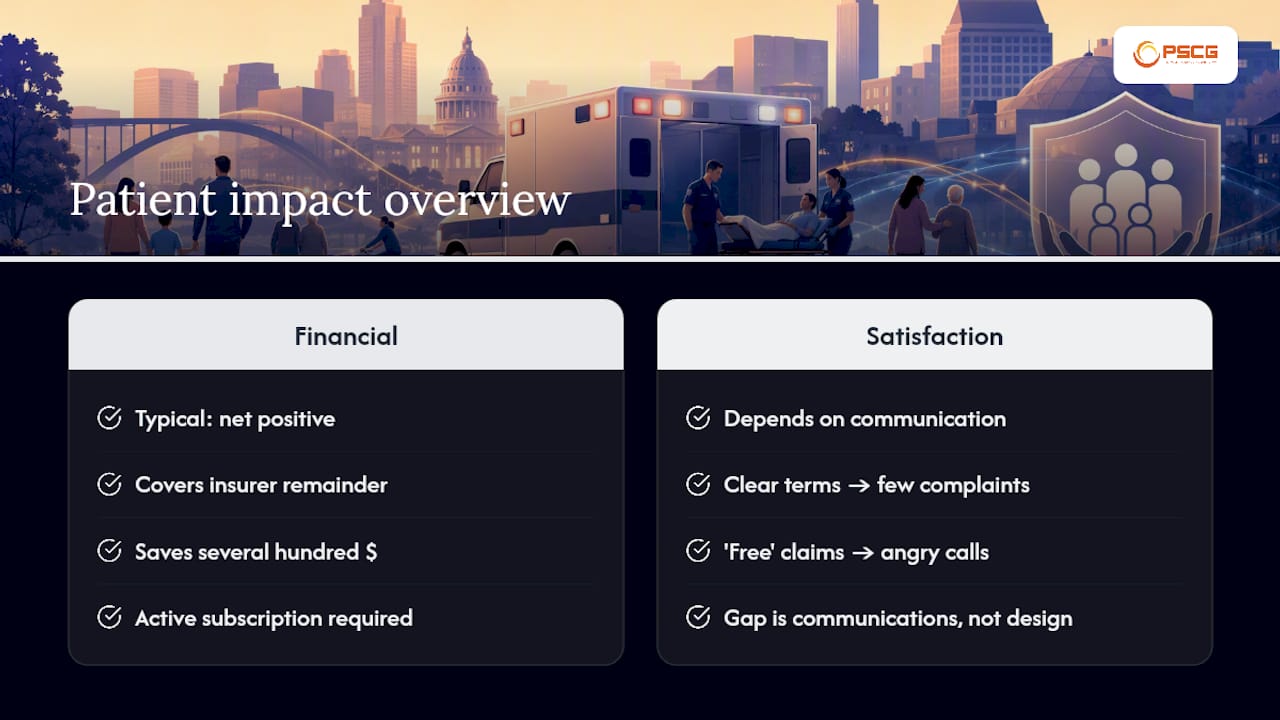
For a resident who has paid a modest annual fee and then faces a real emergency, the financial relief can be substantial. A household that might otherwise owe several hundred dollars in patient-responsibility balance after insurance instead owes nothing, provided the transport was medically necessary and the subscription was active and non-lapsed at the time of the call.
The satisfaction impact tends to track directly with how clearly the program was explained at enrollment. Residents who understood upfront that insurance gets billed first and the subscription only covers the remainder rarely feel misled when that is exactly what happens. Residents who signed up believing the subscription meant “free ambulance rides, full stop” are the ones who call city hall angry when a bill still arrives for a service the subscription did not cover, such as a transport ruled not medically necessary by the payer.
That gap between expectation and reality is almost entirely a communications problem, not a design flaw. Programs that use plain, specific language in their marketing materials, avoiding words like “free” or “unlimited,” see far fewer complaints than programs that lean on vague reassurance. The financial outcome for most subscribers is genuinely positive. The satisfaction outcome depends on whether your public information materials set expectations honestly before the emergency happens, not after.
How Should Residents Enroll or Opt Out?
For a resident deciding whether to join, the process should be short and the terms should be clear before money changes hands. Most municipal programs, including Bedford’s and Sierra Madre’s, publish a straightforward application that asks for household information, proof of residency, and, for discounted tiers, income documentation.
A resident enrolling should confirm four things before signing: the annual fee and whether it covers a household or an individual, what the plan does not cover (transports ruled not medically necessary, or care from a different agency), whether Medicaid enrollment disqualifies them, and when the coverage year starts and ends. Because most programs run non-prorated fixed-calendar cycles, enrolling partway through the year still typically requires the full annual fee, which residents should know going in rather than discovering later.
Opting out is usually just a matter of letting the subscription lapse at renewal, since most programs do not auto-renew with an automatic charge the way a commercial subscription service might. A resident who wants to cancel mid-year should still confirm in writing that no future charges will be applied and that the lapse date is documented, since that record matters if a billing dispute ever surfaces. Agencies that publish this process clearly, rather than burying it in fine print, tend to field fewer complaint calls and build more long-term trust in the program overall.
What Role Should Ambulance Providers Play in Promotion?
Your EMS agency is the most credible messenger for this program, and that credibility is worth protecting carefully. A provider promoting a subscription plan should lean on the same plain language recommended for enrollment materials: what the fee covers, what it does not, and how it interacts with insurance.
Effective promotion channels tend to be the ones already trusted by residents: a mailer that arrives with the utility bill, a table at a community health fair staffed by an EMT who can answer real questions, or a short segment at a town hall where the fire chief explains the program directly. What works less well is promotion that oversells the benefit, because an agency’s credibility is the one asset a subscription program cannot function without.
Providers also have a quieter but important role: flagging subscriber status internally so field crews and billing staff both know a patient is enrolled, without ever letting that status influence a clinical transport decision. The subscription exists on the back end of the billing process, not the front end of patient care, and providers who keep that separation clean protect both the program’s legal standing and the agency’s clinical integrity.
What Are the Downsides for Consumers?
No subscription program covers everything, and residents deserve a straight answer about where the limits are. Coverage typically applies only to transports the payer deems medically necessary, which means a subscriber can still receive a bill if insurance denies the claim on medical-necessity grounds, something the subscription cannot override.
Medicaid recipients are commonly excluded outright, since Medicaid rules already bar providers from balance billing those patients, which means the subscription fee would buy nothing for that household. Non-prorated annual terms mean a resident who signs up in month eleven pays the same as one who signed up in month one, and a resident who lets coverage lapse for even a short gap may find themselves fully exposed if an emergency happens during that window. Coverage also typically applies only to the issuing agency’s own transports, so a resident transported by a neighboring jurisdiction’s ambulance during travel gets no benefit from a subscription tied to their home agency.
None of these limitations make the model a bad one. They make it a supplemental tool with real boundaries, and residents who understand those boundaries before they need the coverage are the residents who stay satisfied after they use it.
PSCG’s Perspective on Subscription Programs
We see subscription programs succeed when leaders treat them as community support and gap coverage, rather than a substitute for sustainable EMS funding. The recurring failures we encounter are predictable: skipping state insurance review, pricing fees below what waived balances actually cost, and weak documentation that leaves payers confused about what was disclosed. When your team needs financial modeling, payer strategy, or legal coordination to get this right, that is exactly the work we do alongside municipal leaders every day.
— Mike
How Thepscgroup Helps You Build This Right
Thepscgroup is the partner municipal leaders turn to when a subscription program needs to survive legal scrutiny and actually balance its own books, not just sound good in a council meeting. We build the actuarial pricing, coordinate the legal review across federal and state law, and design the billing workflow integration that keeps your program compliant from day one.

Our municipal EMS strategy work covers exactly this kind of program design, from pricing models through payer disclosure language, and our EMS system design consulting services help you fold a subscription plan into a broader funding strategy rather than launching it in isolation. A partner like RevRing can also support the claim-scrubbing and payer verification workflows that keep a subscription program’s billing clean once it launches. If your agency is weighing whether this model fits your community, reach out through Thepscgroup and let’s map out a program review together.
Sources
- Ambulance Subscription Program — City of Bedford, TX
- Paramedic Subscription Program — City of Sierra Madre
- What is the legality of an EMS subscription program? — EMS1 (Page, Wolfberg & Wirth)
- How are ambulance ‘membership’ or ‘subscription’ plans treated under the New York Insurance Law? — NY DFS