


Public safety agencies using integrated systems report a 25% reduction in operational errors due to improved data consistency and accessibility. Yet many leaders still underestimate how achievable and transformative system integration can be for their operations. This article explains how pursuing integration elevates efficiency, collaboration, and emergency response outcomes across your agency.
Table of Contents
- Understanding System Integration In Public Safety
- Operational Benefits Of System Integration
- Enhancing Interagency Collaboration And Situational Awareness
- Common Misconceptions About System Integration
- Standards And Frameworks For Integration In Public Safety
- Quantifying The Impact: Case Studies And Data
- Implementing System Integration: Practical Considerations
- Conclusion: Transforming Public Safety Through Integration
- Enhance Your Public Safety Systems With Expert Consulting
- Frequently Asked Questions
Key takeaways
| Point | Details |
|---|---|
| System integration reduces errors and improves efficiency | Integrated systems cut operational errors by up to 25% and reduce emergency response times by 10 to 15%. |
| Better collaboration and situational awareness | Multi-agency coordination efficiency improves by around 40% through shared data platforms and real-time information. |
| Phased approaches lower costs and complexity | Stepwise integration reduces upfront costs by approximately 30% and enables legacy system compatibility through middleware. |
| Standards compliance supports funding eligibility | Adherence to national interoperability frameworks like NIEM is often required for federal grant funding. |
| Real case studies demonstrate measurable impact | Agencies report 30% reductions in dispatch errors and 15% improvements in EMS response accuracy post integration. |
Understanding system integration in public safety
System integration in public safety means unifying disparate technologies like computer-aided dispatch (CAD), emergency medical services (EMS) management, video surveillance, sensor networks, and records systems into a coherent operational framework. Instead of isolated tools that force responders to toggle between platforms, integration creates seamless workflows where data flows automatically across systems. This public safety operations definition emphasizes coordination and real-time information sharing.
Key systems involved in integration typically include:
- Computer-aided dispatch (CAD) platforms managing 911 calls and unit assignments
- Radio communication systems connecting field units and dispatch centers
- Records management systems (RMS) storing incident reports and historical data
- Video surveillance feeds from traffic cameras and body-worn devices
- Geographic information systems (GIS) providing spatial context for incidents
- Sensor networks monitoring environmental or infrastructure conditions
Fragmented workflows create gaps where critical information gets lost or delayed. Integration addresses these gaps by enabling automated data exchange, reducing manual entry errors, and providing unified dashboards for decision makers. Early clarity on your integration purpose helps guide technology selection and stakeholder alignment. When you understand which systems need to communicate and why, you can prioritize projects that deliver the fastest operational gains.
Operational benefits of system integration
Integration transforms how public safety agencies respond to emergencies by streamlining workflows and eliminating data silos. Agencies implementing integrated command centers have seen emergency response times drop by 10 to 15% because dispatchers access real-time unit locations, availability status, and incident history without switching systems. This speed advantage directly impacts survival rates in cardiac arrests and trauma cases.
Centralized data access reduces operational errors by approximately 25% because responders work from a single source of truth rather than reconciling conflicting information across platforms. When CAD, records management, and field reporting systems share data automatically, you eliminate transcription mistakes and version control problems. Resource allocation improves by around 20% when unified management systems provide visibility into equipment availability, personnel certifications, and vehicle maintenance schedules.
Key operational improvements include:
- Faster incident notifications through automated alerts across multiple platforms
- Reduced manual data entry saving dispatchers an average of 15 minutes per shift
- Better decision making supported by consolidated incident histories and analytics
- Improved system status management through real-time unit tracking and availability updates
Pro Tip: Consult with EMS experts early in your integration planning to identify which system connections will deliver the fastest operational gains for your specific agency size and call volume. Prioritizing high-impact integrations first builds momentum and demonstrates value to stakeholders who may be skeptical about the investment. Consider how field providers can engage in legislative advocacy to support funding for these critical improvements.
Enhancing interagency collaboration and situational awareness
System integration breaks down information barriers between police, fire, EMS, emergency management, and supporting agencies. When these entities share a common operating picture through integrated data platforms, they coordinate responses more effectively during multi-agency incidents. Consolidated video feeds, dispatch logs, and sensor data give all responders the same situational awareness regardless of which agency employs them.

Multi-agency coordination efficiency can improve by approximately 40% when integration eliminates the need for phone calls, radio relays, and manual information sharing during active incidents. Real-time data sharing enables incident commanders to see which units from any agency are closest to an emergency, what specialized equipment is available, and how traffic conditions might affect response routes. This visibility transforms how agencies manage large-scale events like natural disasters or mass casualty incidents.
Collaborative benefits extend beyond emergency response:
- Joint training exercises become more realistic when agencies practice with integrated systems
- After-action reviews improve when all participants access the same incident timeline and data
- Mutual aid agreements work more smoothly with standardized data formats and communication protocols
- Resource sharing decisions benefit from unified inventory and availability tracking
Effective collaboration requires both technical interoperability and agreed-upon protocols for data access and information sharing. Technology enables collaboration, but leadership must establish the policies and relationships that make integration work across organizational boundaries. Agencies that invest in both technical connectivity and interagency agreements see the greatest improvements in coordination and outcomes.
Common misconceptions about system integration
Many public safety leaders avoid pursuing integration because they believe it requires massive upfront investments and complete technology replacements. This misconception prevents agencies from realizing significant operational improvements. Phased integration approaches actually reduce upfront costs by approximately 30% compared to big-bang implementations because you spread expenses over multiple budget cycles and validate each phase before proceeding.
Another persistent myth holds that legacy systems cannot integrate with modern platforms, forcing expensive replacements. Middleware solutions have increased legacy system compatibility success rates by around 50% by translating data formats and protocols between old and new technologies. You can often extend the useful life of existing investments while gradually introducing newer capabilities.
Common myths that hinder integration efforts:
- Myth: Integration projects always run over budget and behind schedule. Reality: Phased approaches with clear milestones and vendor accountability reduce overrun risks significantly.
- Myth: Small agencies cannot afford integration. Reality: Cloud-based solutions and shared services models make integration accessible for agencies of all sizes.
- Myth: Integration alone solves collaboration problems. Reality: Technology enables collaboration, but leadership engagement and training drive actual behavioral change.
- Myth: Integrated systems create security vulnerabilities. Reality: Proper authentication, encryption, and access controls often improve security compared to disconnected systems.
Pro Tip: Engage vendors with proven experience in phased public safety integration projects to manage costs and technical risks effectively. Ask for references from agencies similar to yours in size and complexity. Review detailed project plans that show how they will handle legacy system compatibility, data migration, and user training without disrupting your daily operations.
Standards and frameworks for integration in public safety
National interoperability standards provide the technical foundation for successful system integration. The National Information Exchange Model (NIEM) establishes common data formats and definitions that enable different public safety systems to share information seamlessly. NIEM adoption promotes consistency across vendors and jurisdictions, reducing custom integration work and long-term maintenance costs.
The National Emergency Communications Plan sets interoperability goals that guide integration efforts nationwide. Federal grants often require adherence to recognized frameworks like NIEM, the National Incident Management System (NIMS), and regional interoperability standards. Compliance with these standards not only improves your integration success but also positions your agency for funding opportunities.
Key standards and their purposes:
| Standard | Purpose | Impact on Integration |
|---|---|---|
| NIEM | Common data exchange vocabulary | Reduces custom translation between systems |
| NIMS | Incident management framework | Aligns operational procedures with technical capabilities |
| P25 | Radio interoperability | Enables voice communication across agencies |
| CAP | Common alerting protocol | Standardizes emergency notifications across platforms |
Integration projects should include systematic assessment steps to evaluate current system compliance with relevant standards. This assessment identifies gaps that could complicate integration or limit interoperability with regional partners. Early alignment with standards prevents costly rework and ensures your integration delivers both operational benefits and strategic positioning for future grant funding.
Quantifying the impact: case studies and data
Real-world implementation data demonstrates the measurable value of system integration for public safety agencies. A mid-sized city reduced dispatch errors by 30% within 12 months after integrating their CAD, radio, and records management systems. The integration eliminated duplicate data entry and provided dispatchers with instant access to caller history, reducing time spent verifying addresses and gathering background information.
EMS response accuracy improved by 15% when integration connected ambulance vehicle tracking, hospital bed availability, and patient care reporting systems. Paramedics received better pre-arrival information and hospitals prepared more effectively for incoming patients. Communication system failures dropped by 10% because integrated platforms provided automatic failover and backup routing when primary channels experienced problems.
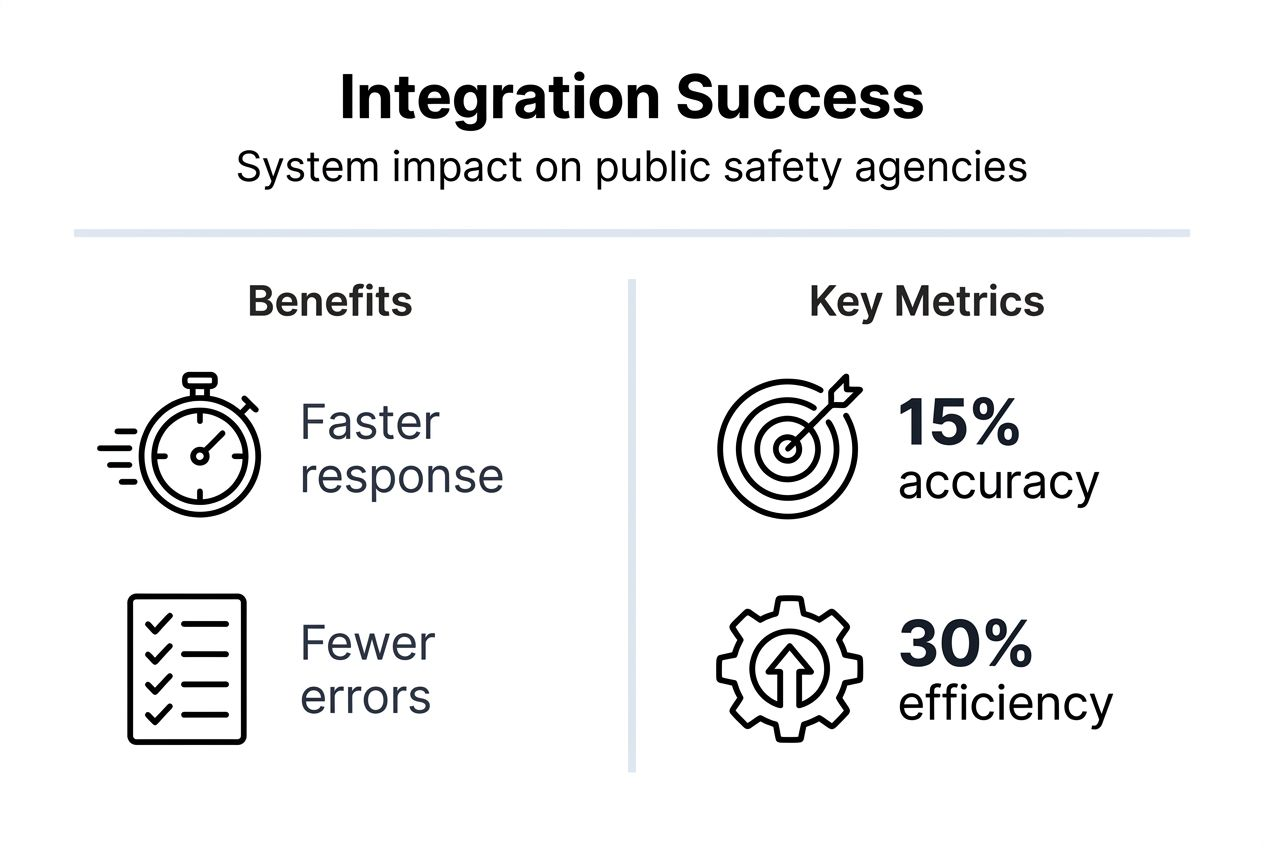
Performance metrics before and after integration:
| Metric | Before Integration | After Integration | Improvement |
|---|---|---|---|
| Dispatch error rate | 8.5% | 5.9% | 30% reduction |
| Average response time | 7.2 minutes | 6.3 minutes | 12.5% improvement |
| Multi-agency incidents coordinated | 45 per month | 63 per month | 40% increase |
| Communication system uptime | 96.5% | 98.8% | 2.3 percentage points |
“The integrated CAD and RMS implementation transformed our operations. Dispatchers now spend less time searching for information and more time supporting responders in the field. Our error rates dropped significantly within the first year.” – Emergency Communications Director, Mid-Sized Metropolitan Agency
These quantified results build the business case for integration investments. When you can demonstrate similar improvements to elected officials and budget authorities, you secure the resources needed for comprehensive integration projects that deliver lasting operational benefits.
Implementing system integration: practical considerations
Successful integration requires strategic planning that balances technical requirements with organizational readiness. Phased approaches reduce risk by validating each integration component before expanding scope. This stepwise method cuts upfront costs and allows your team to learn and adapt as the project progresses.
Leadership engagement drives data-driven decisions throughout the integration lifecycle. When executives actively participate in planning, they ensure alignment between technical capabilities and operational priorities. This involvement also builds credibility for the project and increases user adoption rates among staff who might otherwise resist workflow changes.
Key implementation steps for successful integration:
- Conduct thorough system assessments identifying current capabilities, gaps, and interoperability requirements
- Define clear success metrics tied to operational outcomes like response times, error rates, and coordination efficiency
- Engage stakeholders from all affected agencies and departments to build consensus on priorities and protocols
- Select vendors with proven public safety integration experience and strong references from similar agencies
- Establish governance structures that assign decision authority and accountability for integration milestones
- Develop comprehensive training programs that prepare staff for new workflows and system capabilities
- Implement phased rollouts with pilot testing, feedback collection, and iterative improvements
- Monitor performance metrics continuously and adjust configurations to optimize outcomes
Compliance with interoperability standards remains critical throughout implementation. Federal funding often requires documented adherence to frameworks like NIEM and NIMS. Verify that vendors understand these requirements and have experience meeting them in previous projects.
Pro Tip: Early stakeholder alignment and transparent milestone tracking significantly improve integration success likelihood. Create a project steering committee with representatives from all affected agencies and schedule regular progress reviews. When stakeholders see consistent progress and have opportunities to provide input, they become champions for the integration rather than obstacles. Strong leadership engagement throughout the project maintains momentum and resolves conflicts before they derail implementation.
Conclusion: transforming public safety through integration
System integration represents a strategic investment that transforms public safety operations by reducing errors, accelerating response times, and enabling better collaboration across agencies. The evidence from implemented projects shows substantial improvements in dispatch accuracy, resource allocation, and multi-agency coordination. These operational gains translate directly into better outcomes for the communities you serve.
Compliance with national interoperability standards positions your agency for federal funding opportunities while ensuring long-term compatibility with regional partners. Phased implementation approaches make integration achievable even for agencies with limited budgets and legacy technology constraints. The key is starting with clear goals, engaging stakeholders early, and selecting partners with proven public safety integration expertise.
Public safety leaders who initiate integration planning now will position their agencies to meet growing demands for coordinated emergency response and data-driven decision making. The operational and collaborative benefits documented in this article demonstrate why system integration deserves priority consideration in your strategic planning and capital improvement processes.
Enhance your public safety systems with expert consulting
The operational improvements described in this article become achievable when you partner with experienced consultants who understand both technology and public safety workflows. The Public Safety Consulting Group brings deep expertise in system status management and interoperability to help agencies design and implement integration projects that deliver measurable results.

Our team guides you through assessment, planning, vendor selection, and implementation phases while ensuring compliance with federal standards and funding requirements. We help you prioritize integration projects that align with your operational goals and budget constraints. Whether you need strategic planning support or hands-on project management, our consultants accelerate your path to integration success.
Frequently asked questions
What are the primary challenges public safety agencies face without system integration?
Fragmented communication systems and data silos prevent responders from accessing critical information during emergencies. Dispatchers must manually relay information between disconnected platforms, increasing error rates and delaying response times. Coordination across agencies becomes difficult when each entity operates isolated systems with incompatible data formats. These gaps result in duplicated efforts, missed information, and suboptimal resource deployment during both routine calls and major incidents.
How can legacy public safety systems be integrated without complete replacement?
Middleware solutions create connectivity between legacy systems and modern platforms by translating data formats and communication protocols. These integration layers enable gradual technology modernization without disrupting daily operations or requiring massive upfront investments. Phased implementation allows you to validate each connection before proceeding, reducing technical and financial risks. Many agencies successfully extend legacy system life by 5 to 10 years through strategic middleware deployment.
What federal standards and funding opportunities support system integration efforts?
The National Information Exchange Model (NIEM) provides common data exchange standards that many federal grants require for eligibility. The National Emergency Communications Plan establishes interoperability goals that guide integration priorities nationwide. Grants from the Department of Homeland Security, FEMA, and other federal agencies often prioritize projects demonstrating compliance with these frameworks. State and regional programs may offer additional funding tied to interoperability improvements and multi-agency collaboration capabilities.
What role does leadership play in successful system integration?
Leadership engagement ensures that integration projects align with operational priorities and receive necessary resources throughout implementation. Executives who actively participate in planning build stakeholder buy-in and resolve organizational conflicts that could derail technical progress. Data-driven decision making by leaders helps optimize system configurations and workflow changes based on performance metrics. Strong leadership also drives the cultural change required for staff to adopt new technologies and collaborative practices that integration enables.
Recommended
- Interoperability Without Surrender | The Public Safety Consulting Group
- The crucial connection: Field providers and legislative engagement | The Public Safety Consulting Group
- Public Safety System Assessment Steps for Optimal EMS Results
- 911 dispatcher has spotty record | The Public Safety Consulting Group