



EMS systems using structured QI programs reduced clinical errors by up to 30% over 12 months. For Connecticut EMS leaders, quality improvement is no longer optional. It’s a strategic necessity that drives better patient outcomes, operational efficiency, and regulatory compliance. This guide walks you through the definitions, methodologies, compliance requirements, and actionable steps to build effective QI programs tailored to Connecticut’s EMS environment.
Table of Contents
- Introduction To Quality Improvement In EMS
- Core Principles And Methodologies Of EMS Quality Improvement
- Regulatory And Compliance Requirements For EMS Quality Improvement In Connecticut
- Common Misconceptions About EMS Quality Improvement
- Real-World EMS Quality Improvement Case Studies And Outcomes
- Step-By-Step Implementation Strategies For EMS Quality Improvement Programs
- Challenges And Best Practices In EMS Quality Improvement
- Conclusion: Embedding Quality Improvement Into EMS Culture
- Enhance Your EMS Quality Improvement Journey With PSCG Solutions
Key Takeaways
| Point | Details |
|---|---|
| QI reduces clinical errors | Structured programs cut errors by 30% within one year through data-driven cycles. |
| Connecticut mandates compliance | State regulations require quarterly QI reviews and thorough documentation. |
| PDSA cycles drive improvement | Plan-Do-Study-Act methodology enables iterative, manageable testing and refinement. |
| Challenges are manageable | Data integrity, staff engagement, and resources can be addressed with phased approaches. |
| Small wins build momentum | Incremental improvements create sustainable change without overwhelming teams. |
Introduction to Quality Improvement in EMS
Quality improvement in EMS is a continuous, data-driven process designed to enhance patient care and operational performance. It moves beyond simply meeting compliance checklists to creating measurable service excellence. Operational risk reduction in EMS becomes achievable when QI aligns your team toward consistent assessment and adjustment.
The purpose extends to clinical outcomes, response efficiency, and staff development. You’re not just checking boxes. You’re building a system that learns from every call, every patient interaction, and every operational challenge. This iterative cycle transforms reactive firefighting into proactive excellence.
QI aligns EMS teams by establishing clear metrics and shared goals. When everyone understands the target, you create accountability and purpose. System status management in EMS improves as teams track performance against benchmarks. Here are core EMS QI concepts:
- Continuous measurement of clinical and operational metrics
- Regular data review cycles to identify improvement opportunities
- Team collaboration to test and implement changes
- Transparent communication of results to maintain engagement
- Alignment with public safety leadership tips for EMS leaders
- Integration with smart growth strategies for EMS
Successful QI transforms organizational culture. Your staff becomes invested in outcomes when they see their input driving real change. This cultural shift is what separates agencies that comply from those that excel.
Core Principles and Methodologies of EMS Quality Improvement
The Plan-Do-Study-Act cycle is the foundation of effective EMS quality improvement. PDSA provides a structured yet flexible framework for testing changes before full implementation. You identify a problem, plan a small test, execute it, analyze results, and decide whether to adopt, adapt, or abandon the change.
Typical QI cycle duration ranges from 3 to 6 months per iteration with baseline assessments and metric selection. This timeline allows meaningful data collection without dragging out improvement efforts. Short cycles keep momentum high and teams engaged.
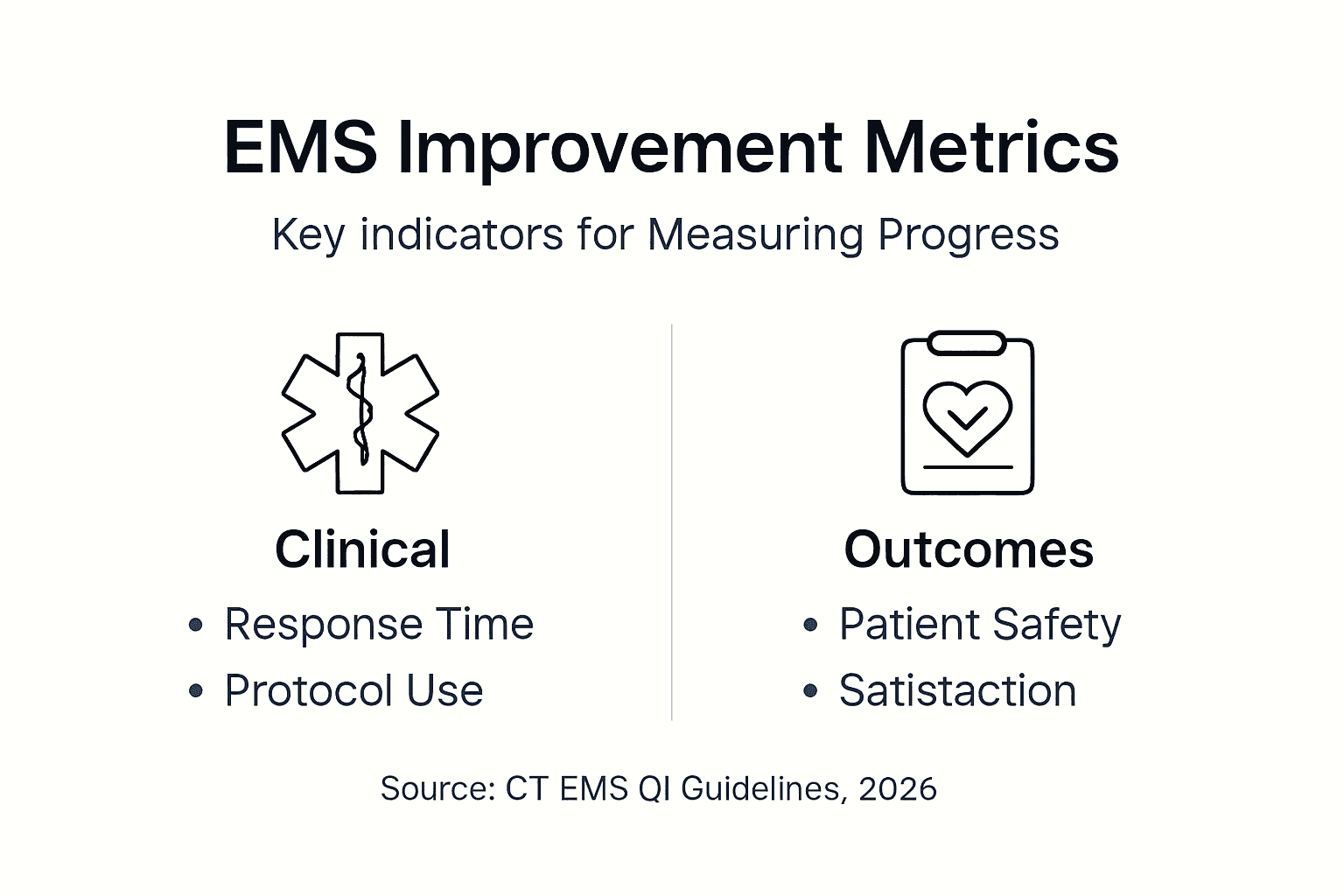
Key performance indicators in EMS include response times, clinical protocol adherence, patient outcome metrics, and customer satisfaction scores. These KPIs must be specific, measurable, and directly tied to service quality. Generic metrics won’t drive the targeted improvements your agency needs.
Here’s how three QI methodologies compare for EMS applications:
| Methodology | Best For | Implementation Complexity | EMS Fit |
|---|---|---|---|
| PDSA | Rapid testing and iteration | Low | Excellent for all agency sizes |
| Six Sigma | Large-scale process optimization | High | Better for large systems with data resources |
| Lean | Workflow efficiency and waste reduction | Medium | Good for operational improvements |
Pro Tip: Start small with PDSA cycles focusing on high-impact metrics to gain early wins and build organizational confidence in the QI process.
Implementing PDSA cycles requires systematic execution. Follow these steps:
- Identify a specific problem or improvement opportunity through data analysis
- Set a clear, measurable goal for the improvement initiative
- Design a small-scale test with defined parameters and timeline
- Collect baseline data before implementing any changes
- Execute the test while carefully monitoring results
- Analyze outcomes against your goal and baseline
- Decide whether to adopt, modify, or abandon the change
- Scale successful changes across the organization
This structured approach connects directly to EMS strategic planning process and best practices for EMS instructors. Quality improvement becomes embedded in how your agency operates. Regular public safety system assessment steps support continuous refinement.
Regulatory and Compliance Requirements for EMS Quality Improvement in Connecticut
Connecticut mandates specific quality improvement activities for licensed EMS agencies. You must conduct regular QI reviews and maintain comprehensive documentation of all improvement activities. These aren’t suggestions. They’re legal requirements that protect both your agency and the patients you serve.
Quarterly reporting ensures consistent oversight and accountability. Your QI committee must meet regularly to review incidents, analyze trends, and document corrective actions. Audit preparation becomes straightforward when you maintain thorough, organized records throughout the year.
Clear record-keeping serves dual purposes. It satisfies regulatory requirements while providing the data foundation for genuine improvement. When auditors arrive, you’ll demonstrate not just compliance but a culture of excellence. Essential Connecticut EMS QI regulatory requirements include:
- Designated QI coordinator or committee with defined responsibilities
- Quarterly review meetings with documented minutes and action items
- Incident reporting systems that capture clinical and operational issues
- Corrective action plans with timelines and accountability measures
- Annual summary reports submitted to state oversight agencies
- Staff training documentation showing QI education and participation
- Patient care review processes that protect confidentiality while enabling improvement
Compliance supports rather than hinders quality improvement. The documentation you create for regulatory purposes becomes the evidence base for identifying patterns and opportunities. Public safety leadership tips for EMS leaders emphasize this integration of compliance and improvement.
Your QI program must balance regulatory requirements with practical operations. Don’t create bureaucracy that bogs down your team. Design streamlined processes that capture essential data without overwhelming staff with paperwork.
Common Misconceptions About EMS Quality Improvement
Quality improvement is not just a compliance exercise. Many EMS leaders view QI as another regulatory burden, but this misses the strategic value. Real QI transforms how your agency operates, improves patient outcomes, and strengthens team cohesion. Compliance is a byproduct of genuine improvement, not the goal itself.
Successful QI programs don’t require massive budgets. Small and mid-sized agencies achieve significant results with existing resources when they focus strategically. You don’t need expensive consultants or sophisticated software to start. Begin with your current data, identify one high-impact opportunity, and test a change.
QI is continuous, not episodic. Some leaders treat quality improvement as a project with a start and end date. This approach fails because excellence requires ongoing attention. Build QI into your organizational rhythm through regular review cycles and persistent focus on measurement.
Key misconceptions to avoid:
- QI only matters for large urban EMS systems
- Effective programs require dedicated full-time staff
- You need perfect data before starting improvement efforts
- QI competes with operational priorities for attention
- Results must be dramatic to justify the effort
- Staff resistance makes QI impossible in established agencies
Pro Tip: Focus on continuous incremental improvements rather than large overhauls to build momentum and demonstrate value without disrupting operations.
Both small and mid-sized agencies achieve measurable improvements when they commit to the process. Your agency size doesn’t determine QI success. Leadership commitment, staff engagement, and systematic execution matter far more than budget or scale.
Real-World EMS Quality Improvement Case Studies and Outcomes
Cardiac arrest protocol improvements demonstrate QI’s life-saving impact. One Connecticut EMS system revised their resuscitation procedures based on outcome data analysis. They saw survival-to-discharge rates increase by 18% over two years through targeted protocol adjustments and focused training.
EMS systems using structured QI programs reduced clinical errors by up to 30% over 12 months. This isn’t theoretical. Agencies with disciplined QI approaches document fewer medication errors, improved documentation quality, and better protocol adherence. The data proves what common sense suggests: measuring and improving performance works.

Patient satisfaction rose through feedback-based service modifications. Several agencies implemented patient follow-up surveys and used the feedback to refine their approach. Small changes in communication style, transport procedures, and facility selection led to measurably higher satisfaction scores.
Key evidence-based QI outcomes include:
- Clinical error reduction of 30% within the first year of structured programs
- Response time improvements averaging 90 seconds through deployment optimization
- Protocol adherence rates increasing from 75% to 92% with targeted education
- Patient complaint reduction by 40% through communication training
- Staff retention improvements when teams see their input driving change
- Cost savings from reduced errors, better resource utilization, and improved reimbursement
The 30% clinical error reduction represents approximately 150-200 prevented errors annually for a typical mid-sized EMS agency. This translates directly to better patient outcomes and reduced liability exposure. The study on EMS QI reducing clinical errors provides detailed methodology and results.
These outcomes aren’t luck. They result from disciplined application of QI principles. Agencies that commit to continuous measurement, staff engagement, and iterative improvement see results. Your agency can achieve similar gains with the right approach.
Step-by-Step Implementation Strategies for EMS Quality Improvement Programs
Launching an effective QI program requires systematic planning and execution. Implementing QI in EMS includes baseline assessment, metric selection, data processes, education, PDSA testing, and ongoing evaluation. Follow this sequence to build a sustainable program:
- Conduct baseline assessment of current performance across clinical and operational metrics
- Select 2-3 high-impact metrics to focus initial improvement efforts
- Establish reliable data collection processes with clear responsibilities
- Educate all staff on QI principles, selected metrics, and their role in improvement
- Design and execute small-scale PDSA tests targeting identified opportunities
- Analyze results objectively and decide on scaling or modifying changes
- Implement successful changes system-wide with appropriate training and support
- Continue monitoring metrics to ensure sustained improvement and identify new opportunities
Important considerations for successful implementation:
- Secure visible leadership commitment before launching initiatives
- Engage frontline staff early to build buy-in and gather practical input
- Start with achievable goals that demonstrate value quickly
- Maintain data integrity through training and validation processes
- Communicate progress transparently to maintain momentum
- Celebrate wins to reinforce the value of QI participation
- Integrate QI with EMS strategic planning process
Pro Tip: Maintain transparent communication with staff to foster buy-in and smooth adoption, sharing both successes and setbacks to build trust in the process.
Typical PDSA cycle duration is 3-6 months, allowing manageable incremental progress without overwhelming your team. This timeline provides enough data for meaningful analysis while keeping momentum high. Shorter cycles risk insufficient data, while longer ones lose focus.
Connect your QI efforts to best practices for EMS instructors and public safety system assessment steps. Quality improvement touches every aspect of operations. Integration across functions strengthens the entire system.
Challenges and Best Practices in EMS Quality Improvement
Data integrity issues plague many EMS quality improvement efforts. 40% of EMS agencies struggle with data collection integrity, which hampers QI efforts and undermines confidence in results. Address this through standardized data entry protocols, regular validation checks, and staff training on documentation standards.
Staff engagement challenges require proactive leadership. Your team needs to understand how QI benefits them personally, not just the organization. When people see their input driving meaningful change, engagement follows. Without this connection, QI becomes another top-down mandate that generates resistance.
Resource constraints can be managed through phased, scalable initiatives. You don’t need to tackle everything simultaneously. Focus on high-impact opportunities that generate early wins. Success builds momentum and justifies additional resource allocation.
Best practices to overcome common challenges:
- Implement double-entry verification for critical data points
- Create feedback loops showing how staff input drives changes
- Start with existing data rather than waiting for perfect systems
- Assign clear ownership for each QI initiative with defined accountability
- Integrate QI activities into regular shift operations rather than adding separate tasks
- Recognize and reward staff contributions to improvement efforts
- Link QI to operational risk reduction in EMS to demonstrate value
- Address data collection challenges in EMS QI systematically
Leadership commitment must be visible and consistent. If QI becomes a priority only when convenient, your team will treat it the same way. Regular leadership participation in QI meetings, transparent communication about results, and willingness to act on findings demonstrate genuine commitment.
Balance standardization with flexibility. While consistent processes improve data quality, rigid systems that don’t account for operational realities create workarounds that undermine accuracy. Design processes that work in real-world conditions.
Conclusion: Embedding Quality Improvement into EMS Culture
Quality improvement delivers sustained clinical and operational improvements when embedded in organizational culture. The 30% reduction in clinical errors isn’t a one-time achievement. It’s the result of continuous attention to measurement, analysis, and refinement. Your agency builds this capability through persistent focus and disciplined execution.
Leadership commitment is vital to fostering continuous QI engagement and innovation. When leaders model curiosity about data, openness to feedback, and willingness to test new approaches, teams follow. This cultural shift from defensive to learning mindset separates high-performing agencies from average ones.
Continuous cycles of data-driven assessment and change are essential for evolving EMS needs. Patient populations change, regulations evolve, and medical science advances. Your QI program must adapt continuously to remain relevant. Building public safety leadership for EMS supports this adaptive capacity.
The journey from compliance-focused QI to genuine culture of excellence requires patience and persistence. You’ll face setbacks, data challenges, and resistance. Push through these obstacles with clear vision, transparent communication, and commitment to incremental progress. The result is an agency that learns, adapts, and delivers measurably better outcomes for every patient you serve.
Enhance Your EMS Quality Improvement Journey with PSCG Solutions
Building an effective quality improvement program is challenging. The Public Safety Consulting Group brings specialized expertise to help Connecticut EMS leaders implement sustainable QI strategies. Our EMS strategic planning process integrates quality improvement into your strategic vision.
We guide agencies through system status management that supports both operational efficiency and continuous improvement. Our consultants understand Connecticut’s regulatory environment and help you meet compliance requirements while driving measurable service improvements. Whether you’re launching a new QI program or refining existing efforts, PSCG provides the expertise to accelerate your progress. Discover how to embed continuous quality improvement and operational excellence through PSCG EMS services.
Frequently Asked Questions
What is quality improvement in EMS?
Quality improvement in EMS is a systematic, data-driven approach to enhancing patient care and operational performance. It involves continuous measurement of key metrics, analysis of results, testing of improvement strategies, and implementation of successful changes. The goal is creating sustainable excellence rather than one-time fixes.
How can EMS agencies in Connecticut ensure compliance with QI regulations?
Maintain quarterly QI reviews, thorough reports, and accurate documentation as per Connecticut mandates. Designate a QI coordinator, establish regular committee meetings, and create systems for incident reporting and corrective action tracking. Engage staff in continuous improvement efforts to support audit readiness and demonstrate genuine commitment beyond paperwork.
What are the biggest challenges in implementing EMS quality improvement?
Data integrity and collection issues, staff engagement, and resource constraints are primary challenges. 40% of EMS agencies struggle with data collection integrity which hampers QI efforts. Address these through systematic training, transparent communication about the value of QI, and phased implementation that generates early wins without overwhelming teams.
How quickly can EMS agencies expect to see results from quality improvement efforts?
Significant improvements, such as error reduction, may be observed within one year. Structured QI programs in EMS can reduce clinical errors by up to 30% within 12 months. PDSA cycles typically span 3-6 months, allowing iterative adjustment and steady progress. Early wins in focused areas often appear within the first cycle, building momentum for broader improvements.
Recommended
- Operational Risk Reduction in EMS – Improving Safety and Service
- Best Practices for EMS Instructors: Shaping the Future of Emergency Medical Services Education | The Public Safety Consulting Group
- EMS Needs Smart Growth, Not Expensive Gadgets and Procedures | The Public Safety Consulting Group
- EMS Strategic Planning Process for Successful Service Delivery