

Every EMS leader has felt the pressure when a single vulnerability threatens both crew safety and service reliability. In cities across the United States, balancing limited resources with rising emergencies demands more than quick fixes. By prioritizing operational risk reduction, you build a culture where transparency, accountability, and ongoing improvement work together to protect your teams and your community. This approach supports smarter decisions, adaptive systems, and real solutions that keep your EMS operations resilient no matter the challenge.
Table of Contents
- Operational Risk Reduction Defined for EMS
- Major Types of Operational Risks in EMS
- Core Strategies and Best Practices
- Regulations and Standards for Compliance
- Common Pitfalls and How to Avoid Them
Key Takeaways
| Point | Details |
|---|---|
| Operational Risk Reduction | It combines safety and service quality to identify and control hazards affecting EMS operations. |
| Core Elements | Transparency, accountability, and continuous improvement are essential for effective risk management. |
| Proactive Assessment | Conduct regular risk assessments to identify vulnerabilities that threaten crew safety and service delivery. |
| Collaborative Approach | Partnerships with hospitals and other agencies enhance coordination and communication, reducing operational risks. |
Operational Risk Reduction Defined for EMS
Operational risk reduction in EMS isn’t just about preventing accidents. It’s about building systems where safety and service quality work together seamlessly.
At its core, operational risk reduction involves identifying hazards that could disrupt your EMS operations and then controlling those hazards before they impact your team or community. Think of it as strategic planning that keeps your crews safe while maintaining response effectiveness.
Integrating risk control into service planning directly enhances your decision-making across all levels of your organization. This means moving beyond reactive responses to identifying vulnerabilities before they become crises.
What Operational Risk Actually Means for Your EMS System
Operational risks in EMS come from multiple sources. Your crews face hazards daily—vehicle accidents, exposure to bloodborne pathogens, musculoskeletal injuries, and mental health challenges from repeated trauma exposure.
But risks aren’t limited to field operations. Staffing shortages, aging equipment, communication breakdowns, training gaps, and financial constraints all create operational vulnerabilities that ripple across your entire system.
Recognizing these risks as a foundation allows you to target specific interventions. When you understand what can go wrong, you can implement controls that actually prevent it.
The Three Core Elements of Operational Risk Reduction
Transparency – Everyone from paramedics to administrators understands the risks present in your operations and the controls designed to manage them
Accountability – Clear responsibility for risk management is assigned to specific teams or individuals with authority to implement changes
Continuous Improvement – Your organization learns from near-misses, incidents, and data analysis to refine processes and strengthen safety culture
Why This Matters Right Now
Public safety leaders and risk management officers face mounting pressure. Response times matter. Patient outcomes matter. Crew safety matters. Regulatory compliance matters. Operational risk reduction is the framework that addresses all of these simultaneously.
When you reduce operational risks effectively, you’re not sacrificing efficiency for safety—you’re building a system where both strengthen each other.
This isn’t a program you implement once and forget. It’s an ongoing process of evaluation, adaptation, and refinement that keeps your organization resilient.
For more context on how operational risk fits within broader public safety goals, understanding public safety definitions and their impact on EMS operations provides valuable perspective on how risk management aligns with your community’s expectations.
Getting Started With Your Own Risk Reduction Program
The process begins with honest assessment. What vulnerabilities exist in your current operations? Which ones pose the greatest threat to crew safety, patient care, or service delivery?
Then you prioritize. You can’t address everything simultaneously, so focus on risks that could cause significant harm or disruption to your mission.
Next comes implementation. You design and deploy specific controls, then monitor their effectiveness over time. Did the intervention actually reduce the risk?
Finally, you adjust based on what you learn. Risk management isn’t static—it evolves as your organization grows and external conditions change.
Pro tip: Start your operational risk reduction program by conducting a single, focused risk assessment on your highest-consequence operation—whether that’s critical care transports, mutual aid coordination, or 911 call processing. Build success there, then expand systematically to other areas.
Major Types of Operational Risks in EMS
Operational risks in EMS don’t fit into one neat category. They spread across your entire system, from the equipment in your trucks to the decisions made in your command center.
Understanding the specific types of risks your department faces is the first step toward controlling them. Let’s break down the major categories that affect EMS operations.
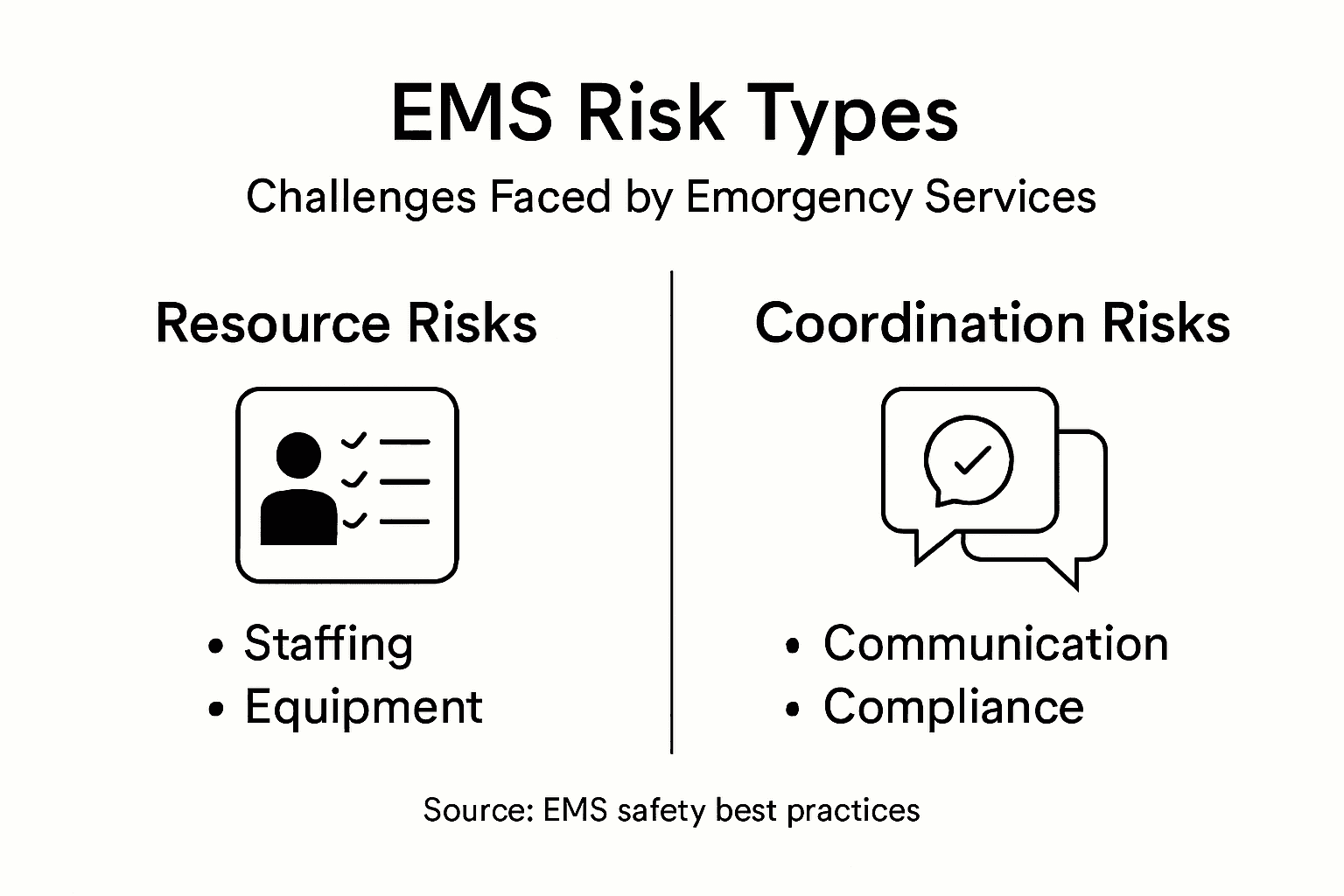
To clarify the main categories of EMS operational risks and their distinct impacts, here’s a summary table:
| Risk Category | Typical EMS Challenge | Potential Impact |
|---|---|---|
| Resource & Capacity | Staffing shortages, equipment downtime | Delayed response, reduced coverage |
| Infrastructure & Technology | Aging vehicles, outdated software | Increased errors, slower outcomes |
| Regulatory & Compliance | License lapses, billing errors | Fines, loss of certification |
| Human Factors & Crew Safety | Fatigue, exposure, stress trauma | Crew injuries, service unreliability |
| Coordination & Communication | Poor handoff, incompatible systems | Confusion, ineffective responses |
| Financial & Planning | Budget cuts, unclear priorities | Reduced readiness, service gaps |
Resource and Capacity Risks
Your EMS system depends on resources—personnel, vehicles, equipment, and supplies. When these run short, service delivery suffers.
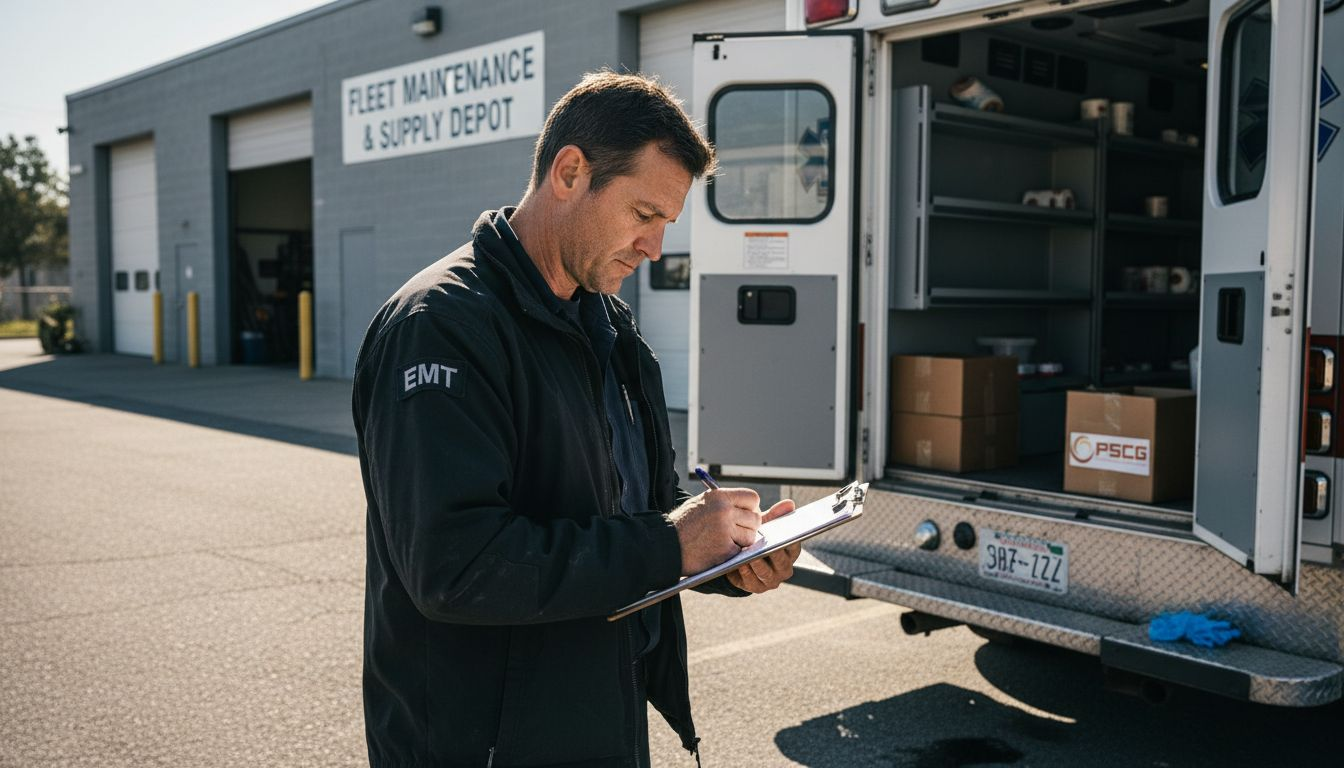
Increasing demand with limited resources creates operational strain that affects your ability to respond effectively during emergencies. Staffing shortages, overtime fatigue, equipment breakdowns, and inventory depletion all fall into this category.
Capacity risks also emerge when call volumes spike unexpectedly. Your system can handle routine demand, but what happens during a mass casualty incident or seasonal surge?
Infrastructure and Technology Risks
Aging vehicles, outdated communication systems, and failing medical equipment create vulnerabilities that can strike at critical moments.
Technology gaps compound these problems. Incompatible software, poor data integration, and manual processes slow down response coordination and clinical decision-making.
Infrastructure deterioration isn’t just an inconvenience. It directly impacts response times, patient care quality, and crew safety.
Regulatory and Compliance Risks
EMS operates in a heavily regulated environment. State licensing requirements, federal guidelines, billing regulations, and local ordinances all create compliance obligations.
Failing to meet these requirements can result in:
- License suspensions or revocations
- Financial penalties and audit costs
- Loss of reimbursement revenue
- Legal liability for the municipality
- Damage to your organization’s reputation
Human Factors and Crew Safety Risks
Your personnel face unique hazards daily. Vehicle crashes, bloodborne pathogen exposure, musculoskeletal injuries, and cumulative stress trauma create both immediate and long-term health risks.
Crew safety directly impacts service reliability—injured or traumatized paramedics and EMTs cannot deliver quality care consistently.
Training gaps, inadequate safety protocols, and insufficient mental health support all amplify these risks.
Coordination and Communication Risks
EMS doesn’t operate in isolation. You coordinate with fire departments, police, hospitals, and mutual aid partners. When communication breaks down, response effectiveness suffers.
Poor handoff procedures, unclear incident command, incompatible radio frequencies, and confusion during multi-agency operations create dangerous gaps in coordination.
Financial and Operational Planning Risks
Budget constraints, reimbursement uncertainties, and poor cost management create financial pressure that forces operational compromises.
When you can’t fund adequate staffing, training, or equipment maintenance, operational risks multiply.
Pro tip: Document which operational risks affect your system most severely by reviewing the past 12 months of incident reports, near-misses, and maintenance issues. This data-driven foundation makes it much easier to prioritize your risk reduction efforts effectively.
Core Strategies and Best Practices
Reducing operational risk in EMS requires more than good intentions. You need concrete strategies rooted in evidence and adapted to your specific context.
The most successful EMS systems implement practices that address safety systematically, learn from incidents, and continuously improve their operations. Here’s what actually works.
Here’s how continuous improvement strategies strengthen EMS operations:
| Strategy | Approach | Result |
|---|---|---|
| Safety-First Culture | Leadership puts safety above convenience | Fewer preventable accidents |
| Data-Driven Decisions | Regular benchmarking and analysis | Smarter prioritization |
| Evidence-Based Protocols | Ongoing education and revision | Improved clinical outcomes |
| Accountable Structures | Clear responsibility and authority | Sustained program effectiveness |
Build a Safety-First Culture
Risk management principles focused on safety form the foundation of effective operational risk reduction. This means making safety a core value, not an afterthought.
Your leadership must prioritize safety in decision-making. When budget cuts come, when call volumes surge, when staffing is tight—safety standards stay intact.
This requires visible commitment from the top. Your director, medical director, and command staff must demonstrate that safety matters more than convenience.
Conduct Thorough Investigations
Every accident, near-miss, and incident holds lessons. The difference between systems that improve and systems that stagnate is their approach to investigation.
Thorough accident investigations identify root causes, not just immediate triggers. Did the paramedic make a mistake, or did a flawed process set them up to fail?
Investigations should be blameless. When people fear punishment, they hide incidents instead of reporting them. You lose critical safety data.
Implement Comprehensive Workplace Safety Programs
Your crews encounter physical, biological, and psychological hazards daily. A complete safety program addresses all three.
Key components include:
- Health and wellness initiatives addressing fitness, nutrition, sleep, and mental health
- Vehicle operations standards covering maintenance, driver training, and safe driving practices
- Hazard identification programs where paramedics report workplace safety concerns
- Personal protective equipment protocols for bloodborne pathogen and infectious disease exposure
Use Data-Driven Decision Making
Data-driven assessment and benchmarking enable you to identify exactly where inequities and inefficiencies exist. You stop guessing and start measuring.
Compare your response times, clinical outcomes, and safety metrics against benchmarks. Where do you fall short? Those gaps become your priorities.
Adopt Evidence-Based Protocols
Your clinical and operational protocols should rest on current evidence, not tradition. Continuous education ensures your team stays current with best practices.
Systems that invest in ongoing training and evidence-based protocols consistently outperform those relying on outdated practices.
This includes addressing workforce challenges directly—staffing models, retention strategies, and recruitment practices that keep your best people.
Create Accountability Structures
Risk management only works when someone is responsible. Assign specific accountability for safety initiatives, investigations, and continuous improvement projects.
These individuals need authority to implement changes and resources to do the work.
Pro tip: Start by selecting one high-impact safety concern in your department—whether that’s vehicle crash prevention, needle stick injuries, or mental health support—and implement a complete strategy around it over 90 days. Document results, celebrate wins, and use that success to expand your program systematically.
Regulations and Standards for Compliance
EMS operates within a complex regulatory landscape. Federal standards, state licensing requirements, local ordinances, and medical direction protocols all shape what you can and cannot do.
Non-compliance isn’t just a paperwork problem. It threatens your agency’s certification, exposes your municipality to liability, and ultimately compromises patient safety.
Understanding the Federal Framework
EMS federal regulations ensure uniformity in patient care, ambulance operations, training standards, and medical direction across the healthcare system. The Department of Transportation, National Highway Traffic Safety Administration, and Centers for Medicare and Medicaid Services all establish requirements.
These regulations cover everything—vehicle specifications, equipment standards, personnel qualifications, training curriculum, and patient care protocols.
Ignoring federal standards doesn’t make them go away. It creates liability and jeopardizes your agency’s ability to operate.
State and Local Requirements
Your state EMS office sets licensure and certification standards for paramedics, EMTs, and agencies. These vary significantly by state.
Your local jurisdiction may impose additional requirements. Some municipalities require specific response time benchmarks, staffing levels, or equipment beyond state minimums.
You must understand all applicable requirements—federal, state, and local. Missing even one can trigger enforcement action.
Medical Direction and Clinical Protocols
Your medical director holds legal responsibility for clinical protocols and paramedic actions. This relationship requires clear documentation and ongoing physician oversight.
Protocol compliance is non-negotiable. When paramedics deviate from approved protocols, you create patient safety risks and regulatory exposure.
Regular review and updating of protocols keeps them aligned with current evidence and regulatory expectations.
Key Compliance Areas
Focus your compliance efforts on these critical areas:
- Personnel qualifications and current certifications for all clinical staff
- Vehicle maintenance and safety inspections documented and scheduled
- Equipment maintenance and replacement according to manufacturer specifications
- Quality assurance programs reviewing clinical care and response metrics
- Training documentation proving staff meet continuing education requirements
- Patient care records complete, accurate, and securely maintained
- Billing and reimbursement compliance with Medicare and insurance regulations
Leverage National Resources
The National Highway Traffic Safety Administration’s Office of EMS provides education standards, evidence-based guidelines, and safety resources. These frameworks support your compliance efforts and system preparedness.
You don’t need to create standards from scratch. Use established national guidelines as your foundation.
Treating compliance as a continuous process, not an annual audit, prevents costly violations and ensures consistent patient safety across your system.
Documentation as Your Defense
Compliance lives in documentation. When regulators inspect your agency, they want to see evidence of compliance—training records, maintenance logs, meeting minutes, quality assurance data.
If you didn’t document it, legally it didn’t happen. This applies to training, maintenance, safety meetings, and protocol adherence.
Pro tip: Assign one staff member as your compliance coordinator responsible for tracking regulatory deadlines, maintaining documentation, and coordinating annual compliance audits. This prevents critical requirements from slipping through the cracks and positions your agency to pass inspections confidently.
Common Pitfalls and How to Avoid Them
Operational risk reduction fails not because EMS leaders don’t care—it fails because organizations make predictable mistakes that derail their efforts. Recognizing these pitfalls gives you a chance to sidestep them.
Let’s look at what trips up most EMS systems and how to stay ahead of the problem.
Pitfall: Ignoring Workforce Shortages and Fatigue
Staffing shortages create a vicious cycle. Crews work overtime, get fatigued, make mistakes, causing safety incidents and burnout. This drives people away, making shortages worse.
Avoid this by addressing staffing realistically. You can’t maintain safety culture when people are exhausted. Invest in recruitment, retention strategies, and cross-training to build redundancy.
Scheduling practices matter too. Limit overtime, enforce rest periods, and monitor fatigue-related incidents. Your crew’s health directly impacts operational safety.
Pitfall: Failing to Adopt Technology Solutions
Inadequate technological adaption leaves your system vulnerable to communication gaps, data loss, and inefficient operations. Outdated systems can’t support modern response demands.
Modernizing doesn’t mean buying the newest flashy tool. It means identifying critical gaps—whether that’s CAD integration, mobile data terminals, or clinical decision support—and systematically addressing them.
Start with technology that directly reduces operational risk. Then expand methodically.
Pitfall: Treating Compliance as a One-Time Event
Compliance isn’t something you achieve and then forget. Regulations change, equipment ages, staff turnover happens, and best practices evolve.
Systems that view compliance as continuous—with regular audits, documentation reviews, and updates—stay ahead of problems. Those that wait for inspection failures play catch-up.
Pitfall: Poor Communication and Coordination
When crews don’t know protocols, when incident command isn’t clear, when information doesn’t flow between shifts—accidents happen.
Key strategies include coordinated team communication and situational awareness throughout operations. Regular briefings, clear handoff procedures, and redundant communication channels prevent dangerous gaps.
Make communication explicit. Don’t assume people know what to do.
Pitfall: Skipping the Root Cause Analysis
When incidents happen, many systems identify the immediate cause and move on. This misses systemic vulnerabilities that caused the incident in the first place.
Root cause analysis asks “why” multiple times. Why did the paramedic miss the protocol? Because they weren’t trained. Why weren’t they trained? Because training wasn’t scheduled. Why wasn’t it scheduled? Because staffing was too tight.
The real problem was staffing, not the individual paramedic.
Pitfall: Insufficient Training and Preparation
Your team can’t execute what they haven’t practiced. Ongoing training, scenario-based drills, and preformulated risk mitigation plans prepare people for real emergencies.
Training isn’t a burden. It’s insurance against catastrophe.
Organizations that invest in continuous training, proper equipment, and clear communication protocols reduce preventable errors substantially during critical operations.
Pitfall: Isolation Instead of Collaboration
Many EMS systems treat operational challenges as internal problems. Effective risk reduction comes through partnerships—with hospitals, fire departments, public health agencies, and mutual aid partners.
Share data, coordinate protocols, and build relationships before you need them.
Pro tip: Create a “lessons learned” database documenting every near-miss and incident, including root causes and corrective actions implemented. Review this quarterly with your leadership team to identify patterns and emerging risks before they become major problems.
Strengthen Your EMS Operational Risk Reduction Efforts Today
Operational risk reduction in EMS involves transparent accountability and continuous improvement to protect crews and improve patient care. If your system struggles with managing staffing shortages, compliance pressures, or communication breakdowns then developing a strategic, data-driven plan is critical. The challenges described in the article demand more than reactive fixes—they require expert guidance to build a resilient EMS system where safety and service thrive together.
Take control now by partnering with The Public Safety Consulting Group. Our Connecticut-based team specializes in EMS system design, operational risk reduction, and leadership development to help you tackle vulnerabilities effectively. Visit our website to learn how PSCG’s proven strategies can transform your EMS operations. Don’t wait until risks become emergencies. Explore expert insights on operational risk management and build a safer, more efficient service for your community today.
Frequently Asked Questions
What is operational risk reduction in EMS?
Operational risk reduction in EMS involves identifying potential hazards that could disrupt emergency medical services operations and implementing controls to prevent them, thereby enhancing both safety and service quality.
Why is understanding operational risks important for EMS systems?
Recognizing operational risks is crucial for EMS systems, as they can stem from various sources such as staffing shortages, equipment issues, and communication breakdowns. By understanding these risks, EMS organizations can target specific interventions to enhance safety and improve operational efficiency.
What are the core elements of a successful operational risk reduction program?
The three core elements are transparency, accountability, and continuous improvement. Transparency ensures that everyone understands the risks, accountability assigns clear responsibilities, and continuous improvement focuses on learning from incidents to refine processes.
How can EMS organizations start their own risk reduction program?
EMS organizations can start by conducting a comprehensive risk assessment to identify vulnerabilities, prioritize risks based on their impact, implement specific controls, monitor their effectiveness, and adjust strategies based on findings.
Recommended
- Public Safety Definition: Impact on EMS Operations
- Public Safety System Assessment Steps for Optimal EMS Results
- Practical examples of customer service principles in EMS | The Public Safety Consulting Group
- EMS Needs Smart Growth, Not Expensive Gadgets and Procedures | The Public Safety Consulting Group