



Every Emergency Medical Services executive knows that operational excellence hinges on more than just fast response times. In today’s dynamic public safety environment, aligning leadership skills with organizational goals is the foundation for real progress. By focusing on a clear assessment of current needs and building customized leadership development with ongoing evaluation, your EMS organization can drive measurable improvements that outlast any single training. Discover forward-thinking strategies that support resilient, adaptable teams from the ground up.
Table of Contents
- Step 1: Assess Leadership Needs And Organizational Goals
- Step 2: Develop Customized Leadership Training Programs
- Step 3: Implement Coaching And Mentorship Strategies
- Step 4: Evaluate Leadership Impact And Continuous Improvement
Summary
| Main Insight | Explanation |
|---|---|
| 1. Assess Current Leadership Needs | Understand your organization’s current state and goals to identify leadership skill gaps effectively. |
| 2. Customize Training Programs | Develop leadership training tailored to specific operational challenges based on identified gaps and objectives. |
| 3. Implement Coaching and Mentoring | Establish ongoing support systems that help leaders improve performance and navigate career development. |
| 4. Evaluate Leadership Impact | Measure success through data collection to ensure leadership initiatives lead to improvements and inform future efforts. |
Step 1: Assess Leadership Needs and Organizational Goals
You can’t build effective EMS leadership in a vacuum. Start by understanding where your organization stands today and where you want it to go. This foundation shapes every leadership decision that follows.
Begin with a clear-eyed look at your current state. What are your response time benchmarks? Where do staff turnover rates sit? What operational challenges consume your leadership’s attention? Document these metrics honestly. They reveal the real gaps between current performance and your vision.
Next, define what success looks like for your organization. Are you targeting a specific response time standard? Do you need to reduce call volume in certain areas? Perhaps you’re working toward financial sustainability or improved community trust. Your goals must be measurable and specific, not vague aspirations.
Aligning leadership skills with organizational goals creates the framework for identifying what leadership capabilities you actually need. Here’s how to structure this assessment:
- Map current leadership capacity: Identify which roles exist, who fills them, and what skills they bring today
- Identify skill gaps: Compare current capabilities against what your goals demand
- Assess readiness for change: Determine which leaders embrace your direction and which need additional support
- Evaluate system-wide needs: Consider whether gaps exist at the paramedic level, management tier, or executive function
Engage your team in this process. Talk directly with frontline paramedics, supervisors, and administrative staff. They see inefficiencies and challenges that spreadsheets miss. Their input shapes a realistic assessment and builds buy-in for what comes next.
Document your findings in a leadership assessment report. Include current state metrics, goal definitions, identified gaps, and stakeholder feedback. This becomes your roadmap for targeted leadership development and organizational change.
Here’s a summary of common EMS leadership skill gaps and their organizational impact:
| Skill Gap | Business Impact | Typical Role Affected |
|---|---|---|
| Weak communication | Delayed response times | Paramedic, Supervisor |
| Poor decision-making | Missed resource optimization | Management, Executive |
| Low change readiness | Resistance to new procedures | Supervisor, Management |
| Strategic blind spots | Lack of proactive planning | Executive |
| Limited empathy | Reduced staff retention | All leadership tiers |
Your leadership assessment reveals not just who needs training, but where your organization must focus its resources to achieve operational excellence.
Pro tip: Schedule stakeholder interviews early in this process and record themes in a simple matrix comparing each role’s current skills to your organizational goals. This makes priorities crystal clear when you move to the next step.
Step 2: Develop Customized Leadership Training Programs
Generic leadership training won’t solve your EMS organization’s specific challenges. You need programs built around your actual operational realities, culture, and strategic goals.
Start by translating your assessment findings into learning objectives. If your assessment revealed weak communication between paramedics and supervisors, your training must address that gap directly. If response time variability is the issue, your program tackles decision-making under pressure or resource allocation. Every training module should trace back to a real organizational need.
Customized leadership development programs are co-created around your organization’s unique context rather than delivered as one-size-fits-all solutions. This means involving your leaders in designing the content, selecting delivery methods, and defining what success looks like.
Work through these design steps collaboratively:
- Identify your target audience: Which leaders need development? Frontline supervisors, middle management, or executive staff?
- Select relevant topics: Based on gaps, choose 3-5 core competencies to develop (examples: strategic thinking, team conflict resolution, data-driven decision-making)
- Choose delivery formats: Consider blended approaches combining in-person workshops, peer learning cohorts, coaching, and self-directed modules
- Build in accountability: Define how participants will apply learning back on the job and how you’ll measure results
Involve your top performers and respected leaders in the design process. Their credibility and input make the program feel authentic to your culture rather than imposed from outside. They also become advocates who help peers embrace the training.
Schedule training at times that minimize operational disruption. Early morning sessions before peak call volume or designated training days work better than random scheduling. Consistency signals that leadership development matters as much as daily operations.
The most effective leadership programs aren’t purchased off-the-shelf; they’re built with your team, for your challenges, and measured by your results.
Pro tip: Assign each participant a real operational challenge they’ll address throughout the training using new skills. This forces immediate application and demonstrates tangible value to skeptical leaders.
Step 3: Implement Coaching and Mentorship Strategies
Training alone doesn’t sustain leadership growth. You need ongoing support systems that help leaders apply what they’ve learned and continue developing over time.
Coaching and mentoring serve different but complementary purposes in your leadership ecosystem. Coaching focuses on improving current job performance by addressing specific challenges leaders face right now. Mentoring supports longer-term career development and helps emerging leaders navigate organizational culture and strategic thinking.
Coaching and mentoring programs work together to foster learning cultures where leaders feel supported and accountable. Here’s how to build both into your leadership strategy:
Start with internal mentoring pairs. Match experienced leaders with rising talent. Pair a seasoned station commander with a promising shift supervisor. Match a seasoned district chief with an upcoming operations manager. These relationships create knowledge transfer while building organizational resilience. Meet at least monthly and establish clear expectations for both parties.

Bring in external coaches for intensive, targeted work. If a director struggles with delegation or a battalion chief needs to develop strategic communication skills, a professional coach can accelerate that growth. Coaches provide objectivity your internal leaders can’t, plus proven frameworks and accountability.
Make coaching and mentoring visible to your entire organization. When leaders invest in development, it signals that growth matters. Create a mentorship roster that identifies who mentors whom. Celebrate coaching wins publicly. This normalizes asking for help and reinforces that strong leaders continuously improve.
Structure these relationships with clear goals and timelines. Don’t assume mentoring partnerships develop naturally without direction. Define what success looks like, schedule regular check-ins, and assess progress quarterly.
The table below compares coaching and mentoring approaches for developing EMS leaders:
| Approach | Focus Area | Typical Outcome | Ideal Audience |
|---|---|---|---|
| Coaching | Immediate performance gaps | Faster skill improvement | Current leaders |
| Mentoring | Long-term career guidance | Stronger organizational culture | Emerging leaders |
Mentors shape culture; coaches transform performance. Your leadership pipeline depends on both working in parallel.
Pro tip: Train your internal mentors and coaches on active listening, feedback techniques, and goal-setting before they begin. A well-trained mentor accomplishes more in three months than an untrained one does in a year.
Step 4: Evaluate Leadership Impact and Continuous Improvement
Without measurement, you can’t know if your leadership development efforts actually work. Evaluation isn’t the end of the process—it’s the beginning of continuous improvement.
Start by defining what success looks like before your program even launches. Success might mean response times improve by 8 percent within six months. It could mean supervisor retention increases to 90 percent or staff satisfaction scores climb 15 points. Make these targets measurable and specific, not vague aspirations.
Evaluating leadership development programs requires collecting data on multiple levels. You’ll measure individual leader growth, team performance shifts, and organizational outcomes. Here’s what to track:
- Individual metrics: Leadership competency assessments, 360-degree feedback scores, and participant confidence levels
- Team metrics: Staff turnover rates, engagement survey results, and internal promotion numbers
- Organizational metrics: Response time performance, call volume trends, financial sustainability, and community satisfaction ratings
Collect baseline data before leadership development begins. This gives you a clear starting point to measure progress against. Six months and twelve months after implementation, gather the same data again to see what changed.
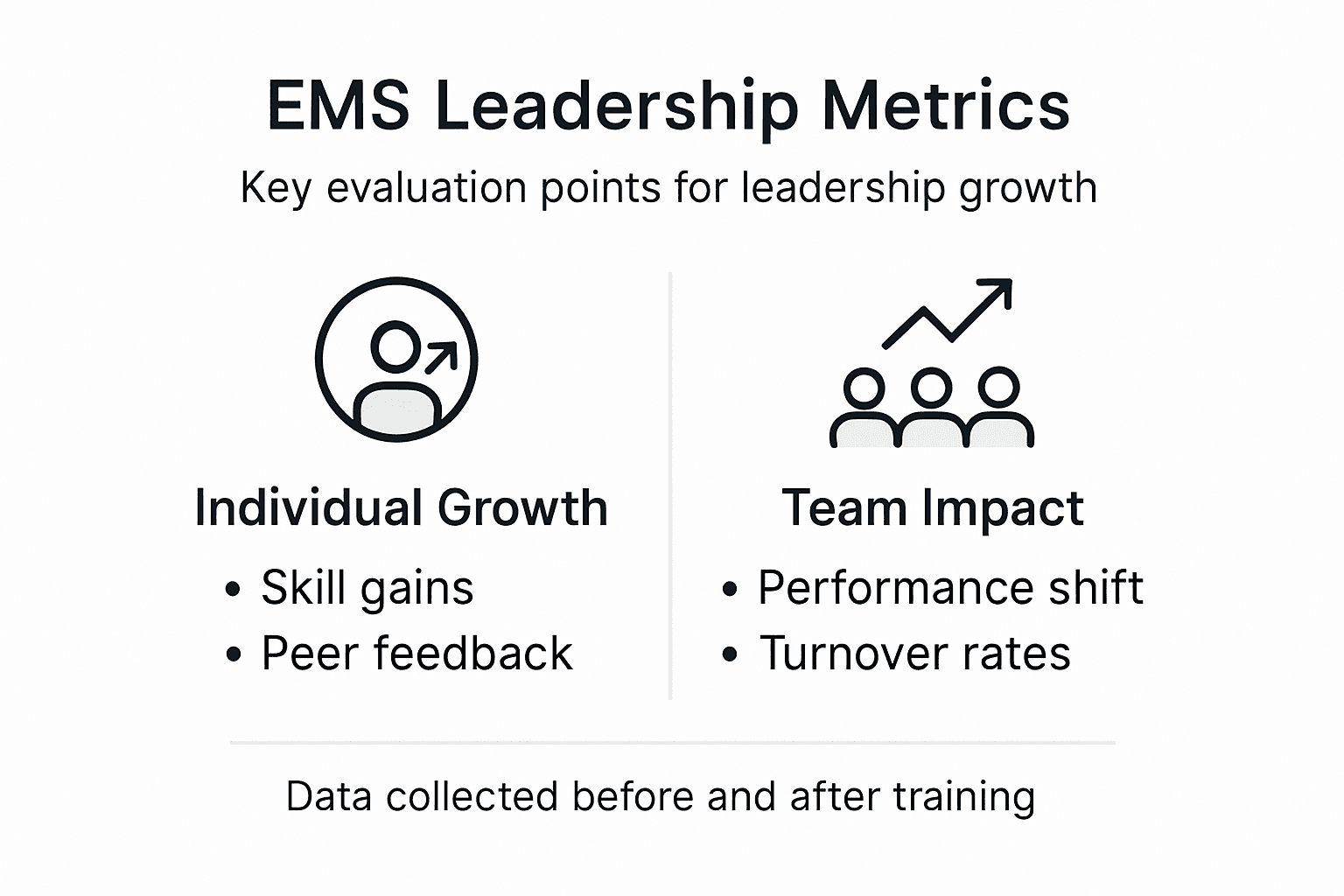
Implementing quality improvement processes in EMS ensures your evaluation drives real change. Share findings with your entire leadership team, not just executives. When leaders see how coaching improved communication or how training lifted response times, they become advocates for continued investment.
If data reveals a competency still lagging, adjust your approach. Add extra coaching, extend training timelines, or modify curriculum based on what leaders actually need. Continuous improvement means you’re always refining your strategy based on evidence.
Leadership development is never finished. Evaluation closes one cycle and opens the next opportunity for growth.
Pro tip: Assign one leader to own evaluation data collection and reporting. This person becomes accountable for tracking metrics quarterly and presenting findings to your team, keeping improvement efforts visible and sustained.
Elevate Your EMS Leadership with Expert Guidance from PSCG
Building strong public safety leadership takes more than training alone. This article highlights the critical need for precise leadership assessments, customized development programs, and ongoing coaching to close skill gaps and drive operational excellence. If your EMS organization struggles with weak communication, poor decision-making, or resistance to change, you are not alone. These challenges directly impact response times, staff retention, and community trust.
At The Public Safety Consulting Group (PSCG), we specialize in EMS leadership development tailored to your unique goals and challenges. Our expert team helps you assess current leadership capacity, design customized training solutions, and implement coaching strategies that foster lasting growth. We understand how to align leadership skills with your operational objectives and drive measurable improvement.
Take control of your EMS leadership future now with proven solutions from PSCG.
Explore how our comprehensive consulting services can help you overcome leadership gaps and achieve EMS success. Visit The Public Safety Consulting Group to learn more and start transforming your leadership capability today. Your next step toward stronger EMS leadership is one click away.
Frequently Asked Questions
How can I assess the current leadership needs of my EMS organization?
Start by evaluating your current operational metrics, such as response times and staff turnover rates. Documenting these metrics will help identify the gaps between your current performance and your desired goals.
What are effective ways to define specific leadership training goals for EMS leaders?
Translate the findings from your leadership assessment into measurable learning objectives. Focus on the skill gaps identified, such as decision-making or communication, to create targeted training modules that address your organization’s unique needs.
How should I implement coaching and mentorship within my EMS leadership development plan?
Develop internal mentoring pairs by matching experienced leaders with rising talent and establish scheduled check-ins. Additionally, consider bringing in external coaches for specific challenges to enhance performance and provide targeted feedback.
What metrics should I track to evaluate the effectiveness of EMS leadership training?
Collect data at multiple levels, including individual leader growth, team performance shifts, and overall organizational outcomes. Track metrics such as leadership competency scores and response time performance to measure progress effectively.
How often should I evaluate my EMS leadership development programs for improvement?
Conduct evaluations at multiple points: initially at program launch, then again six months and twelve months after implementation. This continuous feedback loop allows you to adjust and enhance your leadership development strategies as needed.