



When a hurricane strikes or a chemical spill threatens communities, ineffective crisis communication can cost lives. Many public safety agencies struggle with fragmented messaging, delayed alerts, and coordination breakdowns that leave residents confused or unprotected. This guide provides a practical, step-by-step approach to building robust crisis communication workflows that deliver timely, accurate information when it matters most.
Table of Contents
- Understanding The Problem: Why Crisis Communication Workflows Often Fail
- Preparing Your Crisis Communication Workflow: Aligning With Federal Frameworks And Planning
- Executing Effective Communication: Calibrated Messaging And Multi-Channel Dissemination
- Verifying And Adapting Workflow Effectiveness: Monitoring, Collaboration, And Continuous Improvement
- Enhance Your Public Safety Communication Today
- Frequently Asked Questions
Key takeaways
| Point | Details |
|---|---|
| Align with federal frameworks | Integrate NRF and NIMS principles to standardize roles and ensure interoperability across agencies. |
| Address the last-mile problem | Use redundant channels like SMS, apps, and radio to overcome infrastructure failures that block message delivery. |
| Calibrate risk messaging | Balance urgency and clarity to guide appropriate public responses without causing panic or complacency. |
| Leverage multi-channel dissemination | Deploy social media, FEMA alerts, and traditional media simultaneously to maximize reach and engagement. |
| Monitor and adapt continuously | Use real-time feedback and after-action reviews to refine workflows and improve future crisis responses. |
Understanding the problem: why crisis communication workflows often fail
Crisis communication breakdowns occur far too often in public safety operations. Infrastructure failures prevent 27% of disaster calls from reaching help centers, leaving survivors stranded without assistance. The “last-mile problem” describes how national warnings successfully broadcast to regional hubs but fail to reach individuals on the ground due to damaged cell towers, overloaded networks, or power outages.
Administrative bottlenecks compound these technical failures. When agencies lack standardized protocols, critical messages get delayed in approval chains or lost in translation between departments. Coordination failures create contradictory guidance that erodes public trust and compliance.
Misinformation spreads rapidly during crises, often outpacing official communications. Without clear, authoritative messaging, communities may overreact to minor threats or ignore genuine dangers. Public safety communication tips emphasize the importance of consistent, credible sources.
“Storm Kristin demonstrated how even excellent national crisis communication can fail when local infrastructure collapses, leaving communities isolated despite robust warning systems.”
Common workflow failures include:
- Siloed information systems that prevent real-time data sharing between agencies
- Inadequate backup communication methods when primary channels fail
- Unclear authority structures that delay decision-making during emergencies
- Insufficient training for staff managing public inquiries and social media
- Limited integration between traditional media, digital platforms, and emergency alerts
These challenges demand systematic solutions. Effective workflows must anticipate failures, provide redundancy, and enable seamless coordination across all communication channels.

Preparing your crisis communication workflow: aligning with federal frameworks and planning
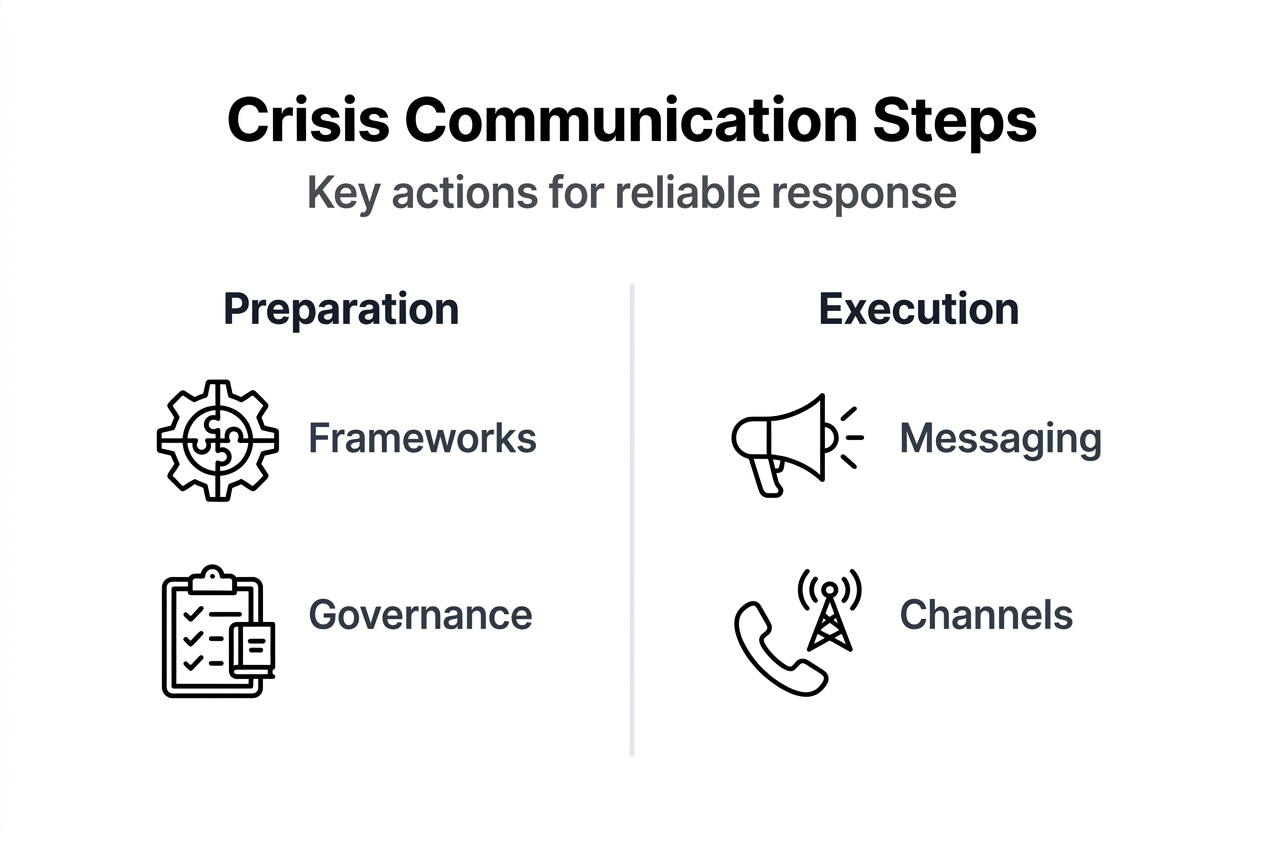
Strong workflows begin with solid preparation grounded in proven frameworks. The NRF provides scalable guidance using National Incident Management System concepts to align roles across jurisdictions. Your communication plan should map directly to these standardized structures.
Federal requirements shape workflow design. SAFECOM guidance mandates coordination for all grant-funded emergency communication projects to improve interoperability. Compliance isn’t optional; it’s essential for funding eligibility and operational effectiveness.
Governance structures provide the organizational foundation for coordinated responses. Establish clear command hierarchies that define who authorizes messages, who drafts content, and who manages dissemination across platforms. Document these roles in written protocols accessible to all team members.
Cybersecurity threats pose growing risks to communication infrastructure. Protect your systems with encrypted channels, secure authentication, and backup networks isolated from primary systems. Regular security audits identify vulnerabilities before adversaries exploit them.
Key preparation elements include:
- Creating unified incident command structures that integrate communication teams
- Developing message templates for common scenarios to accelerate response times
- Establishing mutual aid agreements with neighboring jurisdictions for resource sharing
- Testing communication systems quarterly through tabletop exercises and drills
- Training public information officers on NIMS principles and CERC protocols
| Planning Component | Timeline | Key Stakeholders |
|---|---|---|
| Framework alignment | Annual review | Emergency management, IT, legal |
| Template development | Quarterly updates | PIOs, subject matter experts |
| System testing | Monthly drills | All response agencies |
| Staff training | Biannual sessions | Communications staff, leadership |
Pro Tip: Schedule joint exercises with police, fire, EMS, and utility companies simultaneously to test real-world coordination. Simulations reveal workflow gaps that planning documents miss.
Interoperability strategies help balance local autonomy with regional coordination needs. Your workflow should enable seamless information exchange without requiring agencies to abandon existing systems.
Executing effective communication: calibrated messaging and multi-channel dissemination
Once crisis strikes, execution speed determines outcomes. Apply Crisis and Emergency Risk Communication principles: prioritize speed, accuracy, empathy, and clarity in every message. Fast, factual updates build credibility; delayed or vague communications breed confusion.
Calibrating risk messages requires matching tone and content to public psychology. Amplify warnings when communities underreact to genuine threats, using urgent language and specific protective actions. Attenuate messaging when panic spreads disproportionately, emphasizing calm reassurance and rational steps.
Multi-channel dissemination ensures maximum reach despite infrastructure variability. FEMA’s layered alert architecture combines smartphone apps, NOAA Weather Radio, Wireless Emergency Alerts, and traditional media to create redundancy. If cellular networks fail, radio and television still function.
Social media platforms enable two-way communication that traditional channels cannot match. Monitor trending topics to identify misinformation early and respond with authoritative corrections. Engage directly with community questions to demonstrate responsiveness and build trust.
Effective execution workflow:
- Activate incident command and designate communication lead within first 15 minutes
- Draft initial message using pre-approved templates adapted to specific circumstances
- Obtain rapid approval from authorized decision-maker using expedited protocols
- Disseminate simultaneously across all available channels: social media, alerts, media releases
- Monitor public response and media coverage for misunderstandings requiring clarification
- Update messaging every 2-4 hours or when significant developments occur
- Coordinate with neighboring jurisdictions to ensure consistent regional messaging
| Channel Type | Reach Potential | Speed | Best Use Case |
|---|---|---|---|
| Wireless Emergency Alerts | 90%+ of mobile users | Immediate | Life-threatening situations |
| Social media | 75% of adults | Minutes | Ongoing updates, two-way engagement |
| Traditional media | 60% of population | 30-60 minutes | Detailed explanations, press conferences |
| FEMA mobile app | 10 million+ downloads | Immediate | Supplemental alerts, resource information |
Pro Tip: Prepare message variants before crises occur. Create three versions of each template: high urgency, moderate concern, and informational update. This enables rapid customization during actual incidents.
Voice and tone matter significantly. Address audiences as partners in safety rather than passive recipients of orders. Explain why you’re requesting specific actions, not just what to do. Public safety communication strategies emphasize community-centered language.
Avoid technical jargon that confuses non-specialists. Replace “shelter in place” with “stay indoors with windows closed.” Use concrete instructions: “fill bathtubs with water now” rather than “prepare for water service disruption.”
Verifying and adapting workflow effectiveness: monitoring, collaboration, and continuous improvement
Effective workflows require continuous evaluation and refinement. Monitor message delivery rates, social media engagement metrics, and call center volumes to gauge reach and comprehension. Survey community members after incidents to identify gaps in information delivery.
Coordination across agencies builds trust and ensures consistent messaging that encourages public compliance. Establish real-time communication channels between police, fire, EMS, emergency management, and utility companies. Share situation updates every 30 minutes during active incidents.
Collaboration extends beyond government agencies. Partner with community organizations, faith leaders, and neighborhood groups who can relay messages to populations with limited digital access or language barriers. Building public trust in crises requires inclusive outreach.
Crisis collaboration dynamics show that effective partnerships emerge from addressing immediate needs rather than following predetermined plans. Remain flexible and responsive to evolving situations.
Common pitfalls to address:
- Message fatigue from excessive updates that lack new information
- Inconsistent terminology across different agencies creating confusion
- Slow correction of misinformation allowing false narratives to spread
- Inadequate translation services for non-English speaking populations
- Failure to archive communications for post-incident analysis
Compare communication approaches systematically:
| Approach | Strengths | Limitations | Optimal Application |
|---|---|---|---|
| Centralized messaging | Consistency, single authoritative source | Slower approval process | Large-scale disasters affecting multiple jurisdictions |
| Distributed messaging | Speed, local relevance | Risk of contradictions | Localized incidents with limited regional impact |
| Hybrid model | Balance of speed and consistency | Requires strong coordination | Most crisis scenarios |
Conduct structured after-action reviews within two weeks of incident resolution. Gather input from all participating agencies, community stakeholders, and affected residents. Document what worked, what failed, and specific improvements for future responses.
Update workflow documentation immediately based on lessons learned. Revise templates, modify approval processes, and address identified gaps in training or technology. Share findings with regional partners to strengthen collective preparedness.
Continuous improvement transforms reactive crisis response into proactive communication excellence. Your workflow becomes stronger with each iteration, building organizational capability and community resilience simultaneously.
Enhance your public safety communication today
Optimizing crisis communication workflows demands specialized expertise and strategic planning. The Public Safety Consulting Group helps agencies build resilient emergency communication systems that save lives during critical incidents. Our consultants assess current capabilities, identify vulnerabilities, and design customized workflows aligned with federal frameworks.
We provide comprehensive system assessments that evaluate interoperability, redundancy, and coordination protocols. Our strategic planning services develop actionable roadmaps for enhancing communication effectiveness. Partner with specialists who understand both technical requirements and operational realities to transform your crisis communication capabilities.
Frequently asked questions
What is a public safety crisis communication workflow?
A crisis communication workflow is a structured process coordinating timely, accurate messaging during emergencies. It defines roles, approval chains, message creation, and multi-channel dissemination to ensure consistent public information. Workflows align with federal frameworks like the National Response Framework and NIMS to standardize responses across jurisdictions.
How can agencies ensure message reach despite infrastructure failures?
Deploy redundant communication channels including SMS alerts, mobile apps, NOAA Weather Radio, and traditional broadcast media simultaneously. Coordinate with local partners like schools, businesses, and community organizations to reach populations with limited connectivity. Plan offline methods such as door-to-door notifications and public address systems when networks fail.
Why is calibration of risk communication crucial?
Calibration prevents public underreaction to genuine threats and overreaction to minor incidents. Properly calibrated messages guide appropriate protective behaviors without causing panic or complacency. Matching message urgency to actual risk levels improves compliance and reduces preventable harm.
What role does social media play in crisis communication?
Social media enables rapid two-way engagement that builds trust and corrects misinformation quickly. Platforms reach large audiences instantly and allow direct interaction with community concerns. Applying CERC principles on social channels increases message credibility and public information uptake during evolving crises.