


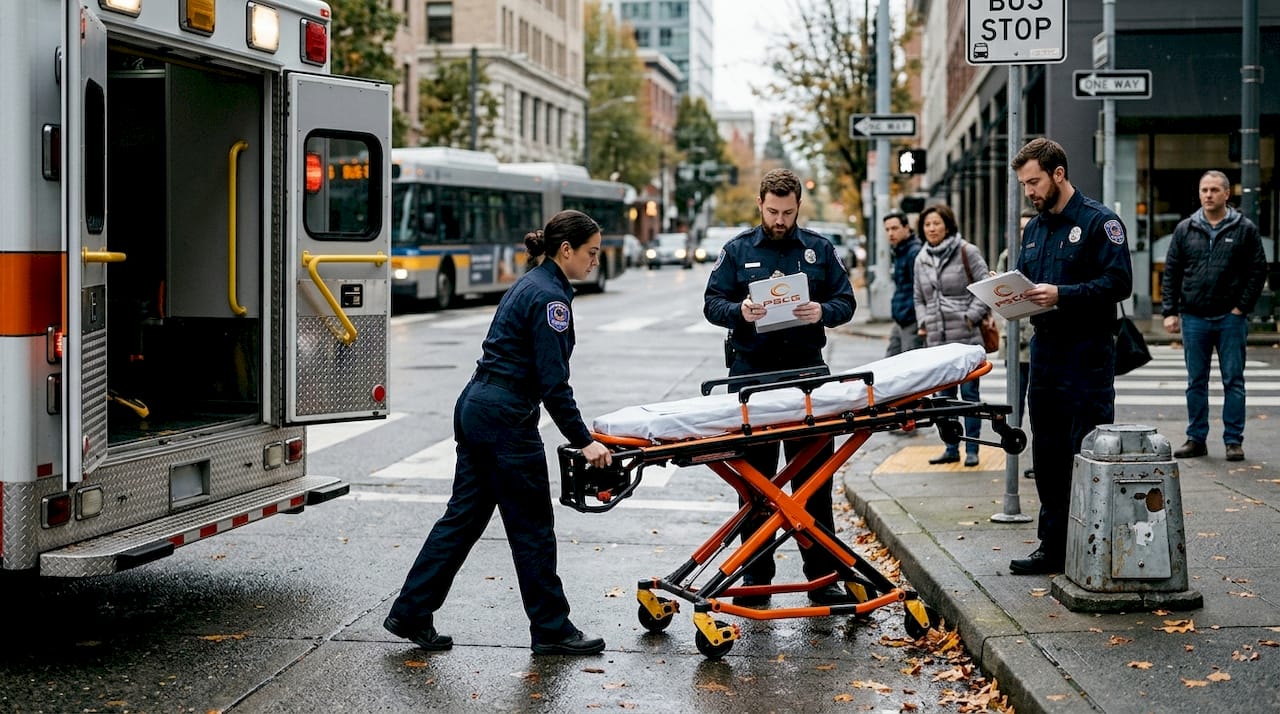
Many public safety leaders view mutual aid as a red flag, a sign their EMS system cannot handle demand alone. This misconception treats mutual aid as a weakness when it actually represents mature, resilient emergency response design. In 2026, effective EMS systems embrace mutual aid as strategic capacity building, not crisis management. Understanding why mutual aid strengthens rather than undermines your operations transforms how you plan, deploy resources, and serve communities. This article explains the real value mutual aid brings to modern emergency response.
Table of Contents
- What Is Mutual Aid And Why It’s Often Misunderstood
- Real-World Examples Showing Mutual Aid’s Effectiveness
- How Mutual Aid Builds Resilience And Evolves EMS Systems
- Applying Mutual Aid Principles In Public Safety Leadership And EMS
- Explore Expert EMS Consulting And System Design Solutions
- Frequently Asked Questions
Key takeaways
| Point | Details |
|---|---|
| Mutual aid builds surge capacity | Strategic partnerships provide flexible response during demand spikes without permanent staffing increases. |
| Community models improve outcomes | Alternative response programs divert appropriate calls and achieve faster response times than traditional models. |
| Relationships create resilience | Ongoing collaboration develops skills and trust that strengthen future emergency response capabilities. |
| Evolution beyond charity | Modern mutual aid operates as strategic partnership rather than one-way assistance during crises. |
| Integration requires planning | Successful mutual aid depends on communication protocols, interoperable systems, and transparent frameworks. |
What is mutual aid and why it’s often misunderstood
Mutual aid in EMS and public safety describes coordinated assistance between agencies, organizations, or community groups responding to emergencies. This can range from formal agreements between fire departments to community-based crisis response teams supporting traditional EMS. The term covers both regulatory frameworks governing inter-agency cooperation and grassroots models emphasizing horizontal solidarity over charity.
Public safety leaders often misinterpret mutual aid in EMS as evidence of inadequate system design. When your agency requests assistance from neighboring departments, it feels like admitting you cannot meet community needs independently. This perception treats mutual aid as failure rather than strategic resource allocation. The reality contradicts this view entirely.
Mutual aid exists on a spectrum. At one end, formal agreements create hierarchical structures where larger agencies support smaller ones during major incidents. At the other end, activist models emphasize peer networks providing direct support without traditional command structures. Both approaches serve legitimate purposes in comprehensive emergency response systems.
Understanding this spectrum matters because different situations demand different mutual aid approaches:
- Formal mutual aid coordinates multi-agency response to large-scale incidents through established command structures
- Informal networks fill gaps during disasters when official systems become overwhelmed
- Community-based programs address specific population needs traditional EMS struggles to serve effectively
- Volunteer organizations provide specialized capabilities or geographic coverage beyond career agency capacity
Misunderstanding mutual aid leads public safety leaders to undervalue partnerships that could significantly improve response capacity. When you view assistance as weakness, you miss opportunities to build resilience, develop relationships, and create flexible systems that adapt to changing demands. Recognizing mutual aid as strategic strength rather than operational failure opens pathways to more effective emergency response in 2026.
Real-world examples showing mutual aid’s effectiveness
Concrete programs demonstrate how mutual aid delivers measurable improvements in emergency response. Fire Mutual Aid coordinates dispatch and response for 78 fire and EMS agencies across three states, processing approximately 27,000 calls annually. This centralized coordination allows smaller departments to maintain local presence while accessing regional resources during complex incidents or simultaneous emergencies.
Volunteer EMS organizations prove mutual aid’s reliability in urban settings. Hatzalah volunteer ambulance services achieve response times under three minutes in dense neighborhoods by deploying community members trained as EMTs and paramedics. These volunteers know local geography intimately and position themselves throughout coverage areas, creating response capacity traditional EMS cannot match economically.
Community-based crisis response models show how alternative approaches improve outcomes. CAHOOTS in Eugene, Oregon diverts 17% of police calls to teams pairing medics with crisis workers. This mutual aid model reduces law enforcement burden while connecting people experiencing mental health crises with appropriate care rather than criminal justice system involvement.
The Jacksonville Emergency Medical Auxiliary demonstrates event staffing mutual aid. Trained volunteers staff community events alongside Jacksonville Fire and Rescue Department personnel, providing medical coverage without depleting operational units. This partnership ensures adequate event medical support while maintaining full emergency response capacity citywide.
Comparing these programs reveals consistent patterns:
| Program | Response Model | Annual Call Volume | Key Benefit |
| — | — |
| Fire Mutual Aid | Multi-agency coordination | 27,000+ calls | Regional surge capacity |
| Hatzalah | Community volunteers | Varies by chapter | Sub-3-minute response |
| CAHOOTS | Crisis specialists | 17% police diversion | Appropriate care pathways |
| JEMA | Event medical volunteers | 200+ events | Preserved operational capacity |
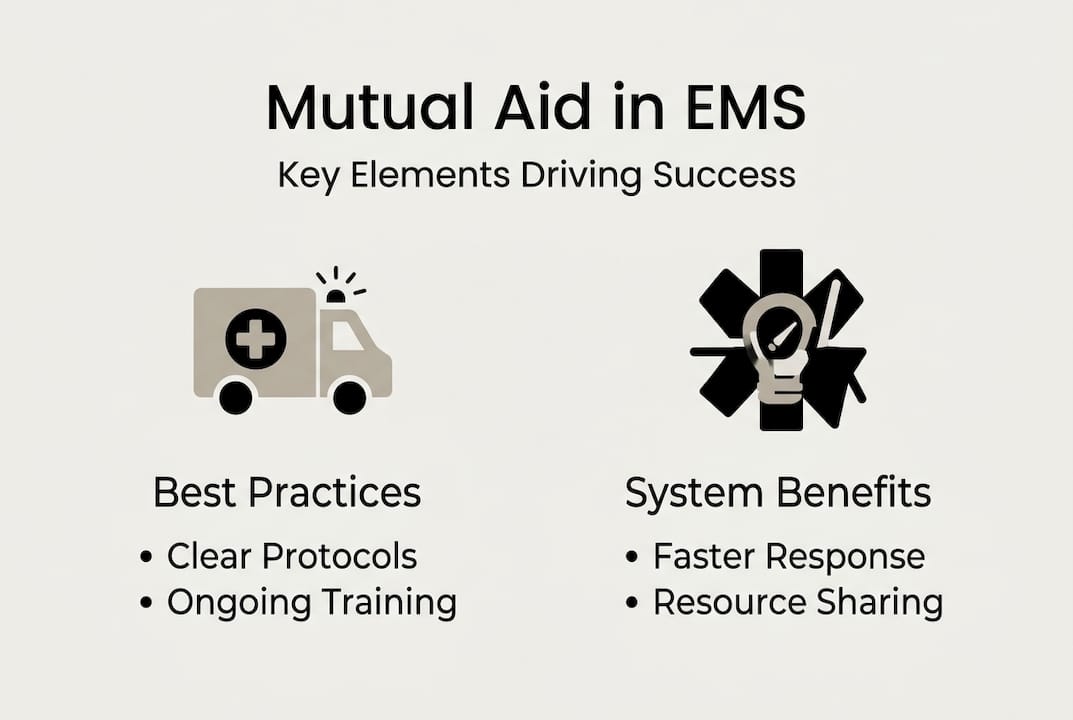
These examples share common elements: clear protocols, ongoing training, and integration with existing systems rather than replacement of professional services. They enhance benefits of EMS accountability by expanding response options while maintaining quality standards.
Pro Tip: Partner with community organizations for event medical coverage. Training volunteers to staff festivals, sporting events, and public gatherings preserves your operational units for emergency response while building relationships that strengthen overall system resilience.
Effective mutual aid requires interoperability strategies that allow different organizations to communicate and coordinate seamlessly. These real-world examples succeed because they invest in shared protocols, compatible equipment, and regular joint training that builds trust before crises occur.
How mutual aid builds resilience and evolves EMS systems
Mutual aid creates resilience by developing relationships and capabilities that strengthen future response. When agencies practice coordinated response during routine incidents, they build familiarity with each other’s procedures, equipment, and personnel. This preparation proves invaluable during major events requiring sustained multi-agency cooperation.
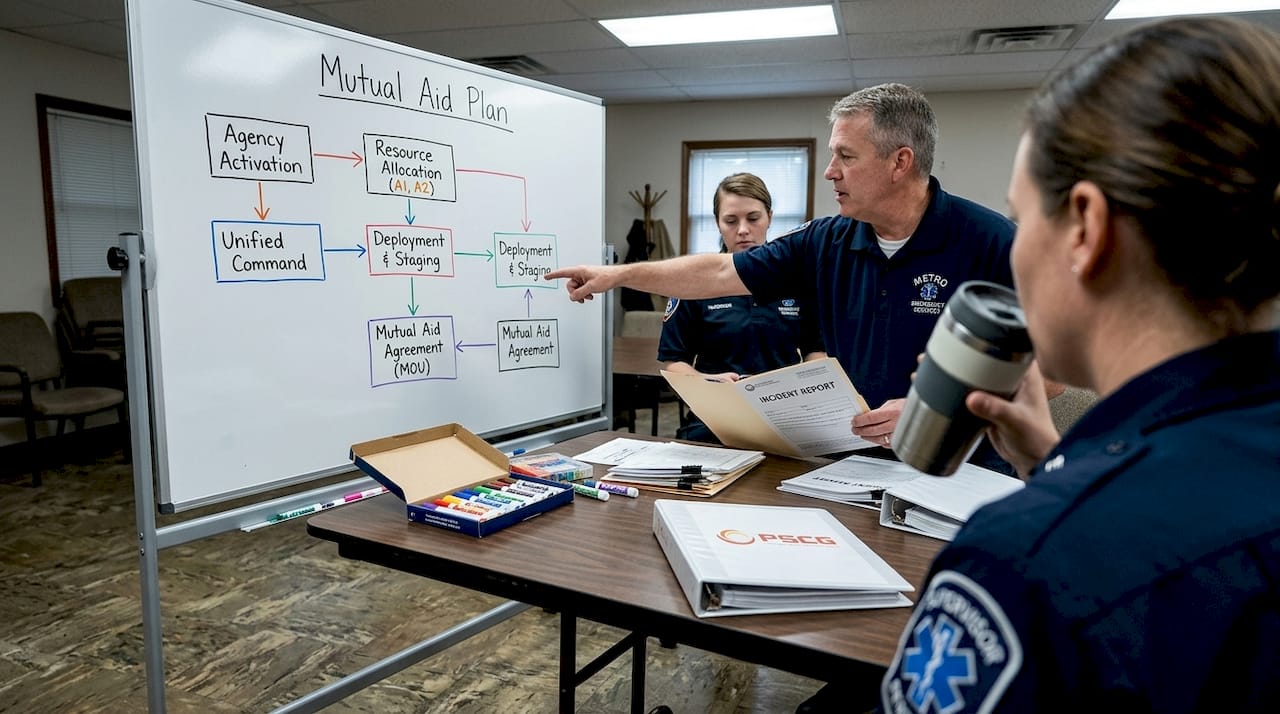
The concept extends beyond emergency response into community capacity building. Mutual aid networks function as counter-institutions that develop skills and relationships outside traditional hierarchies. Even when specific mutual aid initiatives end, participants retain knowledge and connections that enhance subsequent emergency response efforts.
Large-scale disasters demonstrate this principle clearly. During Hurricane Katrina, informal mutual aid networks filled critical gaps when official systems collapsed. Neighborhood groups organized rescue operations, distributed supplies, and provided medical care because they possessed local knowledge and established trust that external responders lacked initially.
This resilience operates through several mechanisms:
- Regular cooperation builds operational familiarity that reduces coordination friction during crises
- Shared training develops common language and procedures across organizational boundaries
- Personal relationships between agency members facilitate rapid information sharing when formal channels fail
- Community engagement creates early warning systems and local intelligence networks
EMS systems evolve toward greater collaboration when mutual aid becomes normalized rather than exceptional. You stop viewing assistance requests as admissions of inadequacy and start recognizing them as efficient resource allocation. This shift enables more flexible deployment strategies and reduces pressure to maintain excess capacity for rare surge events.
“Mutual aid transforms from emergency stopgap into strategic infrastructure. Organizations that embrace this evolution build adaptive capacity that responds effectively to both predictable surges and unexpected crises while maintaining sustainable staffing levels.”
The strategic value extends to EMS system growth strategies. Rather than expanding every agency to handle peak demand independently, coordinated mutual aid allows regional systems to share specialized resources, maintain adequate coverage during overlapping incidents, and provide backup when individual units face equipment failures or staffing shortages.
Recognizing mutual aid as fundamental system design rather than failure acknowledgment changes how public safety leaders approach capacity planning. You invest in relationships, protocols, and interoperability knowing these investments strengthen overall emergency response more effectively than isolated expansion of individual agencies.
Applying mutual aid principles in public safety leadership and EMS
Integrating mutual aid into EMS operations requires deliberate planning and relationship building. Public safety leaders must move beyond viewing mutual aid as crisis response and incorporate it into routine system design. This integration enhances response capacity while maintaining operational flexibility in 2026.
Start by assessing current mutual aid arrangements and identifying gaps. Review existing agreements to ensure they address realistic scenarios rather than only catastrophic events. Mutual aid stabilizes response during surges like flu season, major events, or temporary staffing shortages, not just disasters.
Implementing effective mutual aid requires systematic attention to several strategic considerations:
- Establish clear communication protocols that specify how agencies request assistance, coordinate response, and share information during incidents.
- Invest in interoperable systems for dispatch, patient care reporting, and resource tracking so mutual aid partners can integrate seamlessly.
- Develop community partnerships with volunteer organizations, specialty teams, and alternative response programs that complement traditional EMS capabilities.
- Create transparent cost-sharing frameworks that prevent financial barriers from delaying necessary assistance requests.
- Schedule regular joint training exercises that build familiarity and identify coordination challenges before real emergencies occur.
- Document mutual aid activations to analyze patterns, measure effectiveness, and refine procedures based on actual experience.
Align mutual aid planning with EMS system design examples that demonstrate successful integration. Study how other regions coordinate resources, manage surge capacity, and maintain service levels through strategic partnerships rather than isolated expansion.
Pro Tip: Schedule quarterly tabletop exercises with mutual aid partners to practice coordination for common scenarios. Regular interaction builds relationships and identifies procedural gaps before they cause problems during actual emergencies.
Connect mutual aid protocols to system status management procedures. Define specific triggers for requesting assistance based on unit availability, pending call volume, or geographic coverage gaps. Automated alerts can notify mutual aid partners when your system approaches predetermined thresholds, enabling proactive deployment rather than reactive scrambling.
Build accountability into mutual aid frameworks through performance metrics and after-action reviews. Track response times, patient outcomes, and resource utilization for mutual aid incidents just as you would for routine operations. This data demonstrates value to stakeholders while identifying improvement opportunities.
Conduct comprehensive public safety system assessment that evaluates mutual aid capacity alongside internal resources. Understanding your complete response ecosystem, including formal agreements and informal partnerships, reveals strengths to leverage and vulnerabilities to address through enhanced cooperation.
Successful mutual aid integration requires cultural change alongside operational planning. Train personnel to view assistance requests as professional resource management rather than personal failure. Celebrate effective mutual aid coordination as evidence of mature system design and regional cooperation that ultimately serves communities better than isolated self-sufficiency.
Explore expert EMS consulting and system design solutions
The Public Safety Consulting Group specializes in helping EMS leaders design resilient systems that leverage mutual aid effectively. Our consultants bring decades of experience optimizing emergency response through strategic partnerships, capacity planning, and operational improvements tailored to your community’s specific needs in 2026.
We help agencies develop mutual aid frameworks that enhance response capacity without unsustainable staffing increases. Our approach integrates EMS system design examples proven to improve outcomes while maintaining fiscal responsibility.
Explore our mutual aid in EMS consulting services to discover how strategic partnerships strengthen your emergency response capabilities. We also offer comprehensive system status management services that optimize resource deployment and integrate mutual aid protocols into daily operations. Contact us to discuss how we can support your public safety goals.
Frequently asked questions
What does mutual aid mean in EMS practice?
Mutual aid describes coordinated assistance between agencies, organizations, or community groups responding to emergencies. It ranges from formal inter-agency agreements to community-based programs that complement traditional EMS. Effective mutual aid in EMS enhances capacity without replacing professional services.
How does mutual aid differ from automatic aid?
Mutual aid involves requesting assistance when your resources become insufficient, while automatic aid dispatches the closest appropriate unit regardless of jurisdiction. Automatic aid requires pre-established agreements and integrated dispatch systems. Both approaches improve response times and resource availability.
Does requesting mutual aid indicate system failure?
No, requesting mutual aid demonstrates mature resource management and strategic planning. All EMS systems face demand surges, simultaneous incidents, or specialized situations requiring additional resources. Mutual aid provides flexible capacity that maintains service levels more efficiently than permanently staffing for peak demand.
How can agencies measure mutual aid effectiveness?
Track response times, patient outcomes, and resource utilization for mutual aid incidents compared to routine operations. Monitor request frequency, assistance duration, and reciprocity patterns. Conduct after-action reviews to identify coordination improvements. Effective measurement demonstrates value and guides continuous improvement.
What prevents mutual aid from working effectively?
Poor communication protocols, incompatible equipment, inadequate training, and unclear cost-sharing arrangements create mutual aid barriers. Cultural resistance to requesting assistance also limits effectiveness. Address these challenges through regular joint exercises, interoperable systems, transparent frameworks, and leadership that normalizes cooperation.
Recommended
- Mutual Aid in EMS: Not a Failure—A Sign of a System That’s Grown Up | The Public Safety Consulting Group
- Just a little push | The Public Safety Consulting Group
- 911 dispatcher has spotty record | The Public Safety Consulting Group
- Public Safety Legislative Process Guide For EMS 2026
- Emergency Response: Why it Matters for UK Security