



Many EMS leaders believe legislation affecting public safety follows a straightforward path from idea to law. The reality is far more complex. Federal and state legislative processes involve multiple stages, committees, stakeholder negotiations, and procedural hurdles that can stall or reshape bills dramatically. Understanding these mechanics empowers you to advocate effectively for your agency’s priorities. This guide clarifies how legislation moves through federal and state systems, highlights key 2026 EMS bills, examines common challenges, and provides actionable advocacy strategies to help you navigate this landscape successfully.
Table of Contents
- Understanding The Federal And State Legislative Process
- Key Public Safety EMS Legislation Shaping 2026 Policy
- Navigating Legislative Challenges And Contrasting Perspectives
- Effective Advocacy And Practical Steps For EMS Leaders In 2026
- Enhance Your EMS Success With Expert Public Safety Consulting
Key takeaways
| Point | Details |
|---|---|
| Federal vs state processes | Federal legislation follows committee review, floor votes, and reconciliation while states regulate EMS licensing and scope through varied statutes and administrative codes |
| 2026 legislative priorities | Key bills include CARE Act treatment pilots, PARA-EMT workforce expansion, EMS Counts data collection, and SIREN rural grants with 370 state bills enacted in 2025 |
| Common obstacles | Bills frequently stall at committee stages, face Senate filibusters requiring 60 votes, and encounter internal professional divisions over scope expansions |
| Advocacy best practices | Engage state EMS offices early during drafting, track bills via NCSL database, collaborate with NAEMT, and prepare evidence-based messaging on funding needs |
Understanding the federal and state legislative process
The U.S. public safety legislative process for EMS operates at both federal and state levels with distinct mechanics. At the federal level, bills begin with introduction in either the House or Senate. After introduction, legislation gets referred to relevant committees where hearings, markups, and amendments occur. This committee stage represents the first major filter where many bills die without advancing.
Successful committee passage leads to floor consideration in the originating chamber. Here, members debate and vote on the bill. If it passes, the legislation moves to the other chamber where the entire process repeats. When both chambers pass different versions, a conference committee reconciles the differences. The final version requires approval from both chambers before reaching the president for signature or veto.
State processes mirror this federal structure but vary significantly across jurisdictions. State EMS offices regulate services through statutes and administrative codes typically housed under health or public safety departments. Each state maintains unique procedures for bill introduction, committee review, and floor votes. Some states require supermajorities for certain legislation while others allow simple majority passage.
Common points of bill attrition include committee bottlenecks where chairs can prevent bills from advancing. At the federal level, Senate filibusters require 60 votes to overcome, creating a significant hurdle. Special procedures like budget reconciliation can bypass filibusters but apply only to fiscal matters. Understanding these legislative process details helps you identify strategic intervention points.
Key stages where EMS leaders can influence outcomes:
- Bill drafting phase when language and scope are still flexible
- Committee hearings where expert testimony shapes member perspectives
- Floor debates when amendments can strengthen or weaken provisions
- Conference committee negotiations that determine final bill language
- Implementation rulemaking after passage that defines operational details
Pro Tip: Engage with your state EMS office early during bill drafting phases to influence language and implementation before positions harden and political momentum builds.
Recognizing these stages and their timing allows you to deploy advocacy resources strategically. Early engagement typically yields better results than last minute opposition. Building relationships with key committee members and their staff creates channels for ongoing dialogue. Familiarizing yourself with public safety advocacy steps specific to your state enhances your effectiveness.
Key public safety EMS legislation shaping 2026 policy
Federal EMS legislation in 2026 focuses heavily on workforce development, data collection, and rural service sustainability. The CARE Act establishes treatment in place pilots allowing EMS to provide care without transport, addressing system capacity constraints. The PARA-EMT Act tackles workforce shortages by creating pathways for military medics to transition into civilian EMS roles. The EMS Counts Act mandates national EMS data collection to inform policy decisions with accurate system performance metrics.

The SIREN Act provides targeted grants supporting rural EMS agencies facing unique sustainability challenges. Recent federal activity also addresses controlled substance access for EMS providers and patient medication shortages that compromise emergency care quality. These bills represent coordinated efforts to strengthen EMS infrastructure nationwide.
State legislatures enacted 370 EMS bills in 2025 addressing funding mechanisms, workforce scope expansions, trauma system integration, and data reporting requirements. Maine established an EMS commission to coordinate statewide policy. Utah created a critical needs account providing emergency funding for struggling agencies. Multiple states expanded paramedic scope to include community paramedicine and mobile integrated healthcare services.
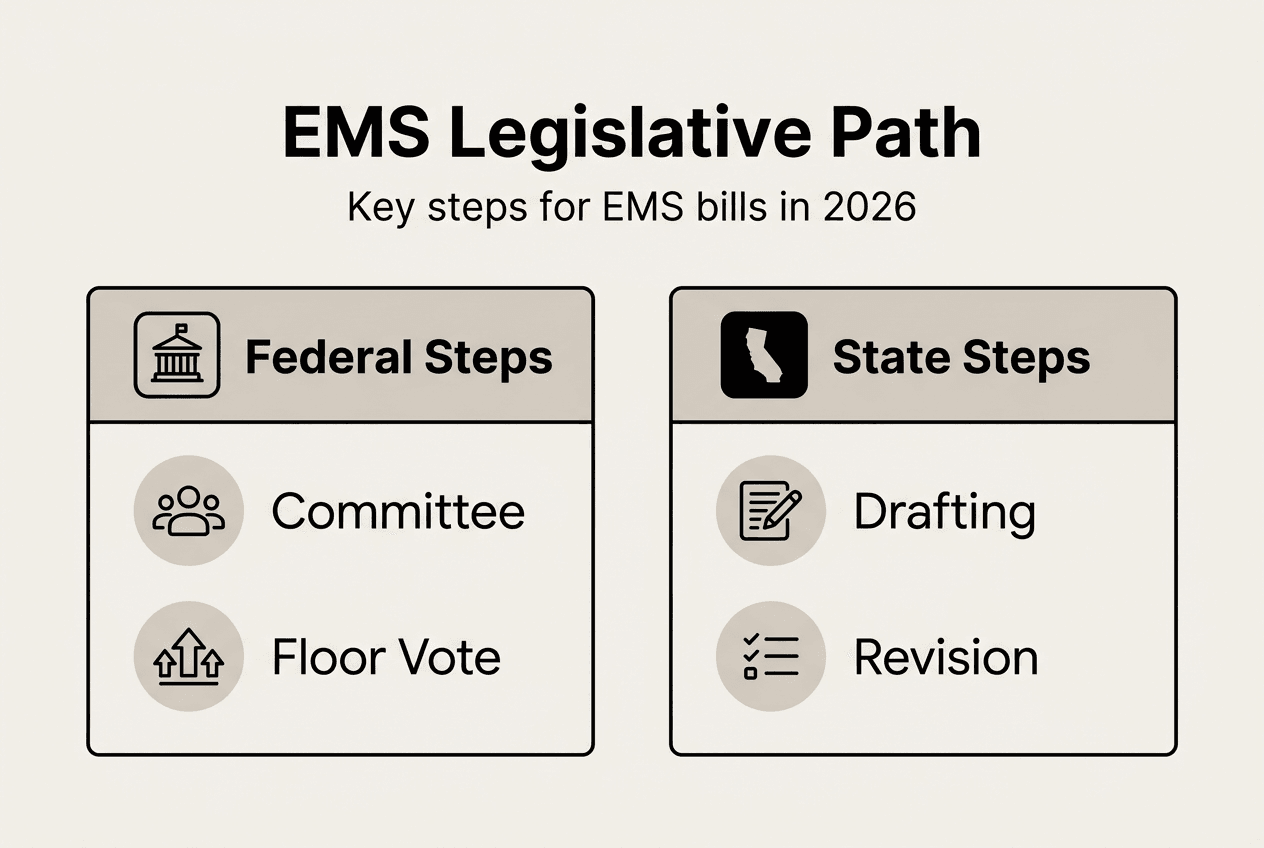
Key legislative priorities comparison:
| Level | Primary Focus Areas | Example Legislation |
| — | — |
| Federal | Workforce pathways, data infrastructure, rural sustainability, treatment alternatives | CARE Act, PARA-EMT Act, EMS Counts Act, SIREN Act |
| State | Funding stability, scope expansion, trauma systems, licensing reciprocity | Maine EMS Commission, Utah Critical Needs Account, community paramedicine authorizations |
These priorities reflect systemic challenges facing EMS nationally. Workforce shortages drive multiple federal and state initiatives. Funding instability prompts creative state solutions like dedicated tax revenues and regional service authorities. Scope expansion bills attempt to modernize paramedic practice for evolving healthcare delivery models.
Understanding current EMS legislation priorities helps you align agency strategic planning with policy trends. Anticipating regulatory changes allows proactive preparation rather than reactive scrambling. Tracking bills relevant to your service area positions you to capitalize on new funding opportunities and avoid compliance gaps.
Pro Tip: Track state bills via the NCSL database and leverage advocacy groups like NAEMT for legislative updates, model language, and coordinated influence campaigns that amplify individual agency voices.
Navigating legislative challenges and contrasting perspectives
EMS leaders face substantial procedural obstacles when engaging with legislation. Committee bottlenecks represent the most common failure point where bills die without floor consideration. Committee chairs wield significant power to advance or block legislation regardless of broader support. At the federal level, Senate filibusters require 60 votes to overcome, creating a supermajority threshold that kills many bills with simple majority support.
Reconciliation processes offer exceptions to filibuster rules but apply only to budget related matters. This procedural limitation means most EMS policy bills face the full gauntlet of committee review and potential filibuster. States maintain varied procedural rules with some requiring supermajorities for tax increases or emergency clauses that affect EMS funding bills.
Jurisdictional complexity adds another layer of difficulty. States regulate EMS licensing, scope of practice, and operational standards while the federal government influences funding through Medicare and Medicaid reimbursement policies. This division creates coordination challenges where federal funding incentives may conflict with state regulatory frameworks. Understanding which level of government controls specific policy levers is essential for effective advocacy.
Internal EMS professional conflicts complicate advocacy efforts. Scope expansion debates, particularly around procedures like IV therapy or medication administration, divide practitioners and professional organizations. These internal divisions weaken advocacy impact when competing EMS factions present conflicting testimony to legislators.
Opposition to funding expansions remains persistent. Budget hawks resist new dedicated revenue streams for EMS despite system sustainability concerns. Medicaid funding cuts threaten agency financial viability while advocates simultaneously push for expanded services. This tension between fiscal constraint and service demand creates difficult political dynamics.
Legislative success in EMS policy requires navigating not only procedural hurdles but also reconciling competing interests within the profession itself, where scope debates and funding priorities often divide advocates who should present unified positions to lawmakers.
Common legislative challenges EMS leaders encounter:
- Committee chairs blocking bills from advancing regardless of merit or support
- Partisan divisions preventing bipartisan coalitions on public safety issues
- Budget constraints limiting appetite for new EMS funding mechanisms
- Professional organization conflicts undermining unified advocacy messaging
- Rural versus urban service model differences creating policy tensions
- Reimbursement structures that incentivize transport over treatment in place
Recognizing these challenges allows strategic planning to overcome them. Building bipartisan support early mitigates partisan obstacles. Presenting unified professional positions requires internal coalition building before legislative engagement. Demonstrating cost effectiveness and return on investment addresses budget concerns. Analyzing public safety trend analysis helps frame EMS needs within broader emergency services context.
Effective advocacy and practical steps for EMS leaders in 2026
Successful legislative advocacy requires systematic preparation and strategic engagement. EMS leaders can maximize influence by following proven approaches tailored to the 2026 policy landscape. These practical steps build on understanding legislative mechanics and current policy priorities.
Know your state EMS statutes and administrative codes thoroughly. Familiarize yourself with licensing requirements, scope limitations, and operational regulations. This foundational knowledge allows you to identify where legislative changes could benefit your agency and ensure compliance with existing rules.
Track relevant bills using the NCSL database and state legislative websites. Set up alerts for keywords like EMS, emergency medical services, paramedic, and ambulance. Monitor committee assignments and hearing schedules to identify intervention opportunities before bills advance too far.
Engage legislators early, especially on funding stability issues. Contact representatives during bill drafting when language remains flexible. Provide specific examples from your service area illustrating policy impacts. Legislators value constituent input that demonstrates real world effects.
Collaborate with state EMS offices and national groups like NAEMT. These organizations coordinate advocacy efforts, provide model legislation, and amplify individual agency voices. Joining coalitions multiplies your influence beyond what isolated advocacy achieves.
Prepare clear, evidence-based messaging on workforce and funding needs. Use data showing call volume trends, response time impacts, and financial pressures. Legislators respond better to specific numbers than general concerns. Document how proposed policies would affect your operations concretely.
NAEMT legislative priorities and state EMS statutes knowledge form the foundation for effective advocacy. Early engagement in bill drafting, systematic tracking via databases, and congressional caucus advocacy represent best practices. Understanding rural disparities and targeting grants toward underserved areas strengthens arguments for funding.
Pro Tip: Prioritize advocacy around Medicaid funding threats and bills like the proposed ‘One Big Beautiful Bill Act’ that could devastate EMS system sustainability through reimbursement cuts affecting your agency’s financial foundation.
Building strong relationships with legislators pays long term dividends. Schedule regular meetings outside of active legislative sessions to educate representatives about EMS operations. Invite them to ride along shifts or tour your facilities. These relationship building efforts create trust that facilitates future policy discussions.
Leveraging data enhances credibility significantly. Compile statistics on call volumes, patient outcomes, response times, and financial metrics. Present this information in accessible formats like one page summaries or brief presentations. Concrete numbers demonstrate needs more effectively than anecdotal stories alone.
Strategic communication matters enormously. Frame EMS issues within broader public safety and healthcare contexts that resonate with diverse legislators. Connect workforce shortages to constituent access concerns. Link funding stability to emergency response reliability. Emphasize cost effectiveness of community paramedicine programs compared to emergency department utilization.
Coalition building with allied organizations amplifies advocacy impact. Partner with fire departments, law enforcement, hospitals, and public health agencies on shared priorities. Unified public safety messaging carries more weight than isolated EMS advocacy. Identify overlapping interests and coordinate testimony, lobbying visits, and public communications.
Applying public safety leadership tips to advocacy efforts strengthens your approach. Leadership skills in communication, coalition building, and strategic planning translate directly to legislative engagement. Viewing advocacy as an extension of operational leadership rather than a separate activity integrates it into your regular responsibilities.
Enhance your EMS success with expert public safety consulting
Navigating the complex legislative landscape while managing daily EMS operations demands specialized expertise. Understanding how policy changes affect system design, response protocols, and financial sustainability requires both operational experience and strategic insight. Professional consulting services help EMS leaders translate legislative developments into actionable improvements.
Expert guidance on EMS system design aligns your operations with emerging 2026 policy priorities. Consultants bring proven frameworks for optimizing deployment, integrating community paramedicine programs, and implementing treatment in place protocols consistent with new legislation. Strategic support for system status management ensures your agency adapts efficiently to regulatory changes while maintaining response performance. Specialized assistance with public safety advocacy steps amplifies your legislative influence through coordinated messaging and stakeholder engagement. Professional consulting transforms legislative complexity into strategic advantage.
Frequently asked questions
What are the key steps in the federal legislative process for EMS?
Federal bills move through introduction, committee review with hearings and markups, floor votes in both chambers, conference committee reconciliation of differences, and presidential signature or veto. EMS leaders can influence outcomes by testifying at committee hearings, meeting with legislators during floor consideration, and coordinating with advocacy organizations to mobilize grassroots support at critical decision points.
How can state EMS leaders effectively track and influence legislation?
Use the NCSL database to monitor state bills affecting EMS operations, funding, and scope of practice. Engage your state EMS office early during bill drafting to shape language before positions harden. Collaborate with advocacy organizations like NAEMT to coordinate testimony, amplify messaging, and leverage collective influence that individual agencies cannot achieve alone.
What are common challenges EMS advocates face in the legislative process?
Committee bottlenecks kill many bills before floor consideration when chairs refuse to advance legislation. Senate filibusters require 60 votes to overcome, creating supermajority thresholds that block bills with simple majority support. Internal professional divisions over scope expansions and funding priorities undermine unified advocacy when competing EMS factions present conflicting positions. Persistence, coalition building with allied organizations, and evidence-based messaging help overcome these obstacles.
How do federal and state roles differ in EMS regulation?
States regulate EMS licensing, scope of practice, operational standards, and system design through statutes and administrative codes. The federal government influences EMS primarily through Medicare and Medicaid reimbursement policies, grant programs like SIREN for rural agencies, and data collection mandates. Understanding this jurisdictional division helps target advocacy efforts to the appropriate governmental level for specific policy goals.
What 2026 EMS legislation should leaders prioritize?
Focus on the CARE Act establishing treatment in place pilots, PARA-EMT Act creating military medic transition pathways, EMS Counts Act mandating national data collection, and SIREN Act funding rural agencies. At the state level, monitor bills affecting Medicaid reimbursement, scope expansions for community paramedicine, dedicated EMS funding mechanisms, and trauma system integration. These priorities address critical workforce, funding, and service delivery challenges facing agencies nationwide.