



Operating without a clear view of your EMS system’s performance leaves your Connecticut municipality exposed to costly surprises. As public safety demands shift and new legislative frameworks reshape workforce regulation, gathering accurate trend data becomes your first line of defense. This guide uncovers the essentials you need to analyze multi-year patterns, interpret regional benchmarks, and align your agency’s strategy with both state guidelines and national best practices heading into 2026.
Table of Contents
- Step 1: Gather Relevant Public Safety Trend Data
- Step 2: Analyze Emerging EMS and Legislative Patterns
- Step 3: Interpret Local and Statewide Trend Impacts
- Step 4: Implement Strategic Improvements Based on Findings
- Step 5: Verify Effectiveness and Adjust Analysis Methods
Quick Summary
| Key Point | Explanation |
|---|---|
| 1. Collect Comprehensive EMS Data | Use NEMSIS incident data and other sources to benchmark performance against peers and identify operational gaps. |
| 2. Monitor Emerging EMS Patterns | Track changes in legislation, funding, and technology to prepare for future operational adjustments and opportunities. |
| 3. Contextualize Local Trends | Compare local performance with state benchmarks to understand unique community needs and adapt strategies accordingly. |
| 4. Implement Data-Driven Improvements | Prioritize initiatives based on their potential impact and resource feasibility to effectively address identified gaps. |
| 5. Evaluate and Adjust Strategies | Establish clear success criteria for changes and regularly assess their effectiveness to inform future decisions and adjustments. |
Step 1: Gather relevant public safety trend data
Your decision-making depends on solid data. Without understanding what’s happening in your EMS system and across the public safety landscape, you’re essentially operating blind. This step walks you through collecting the intelligence you need to make informed choices for 2026.
Start by accessing standardized data sources that give you a complete picture. NEMSIS incident data provides tens of millions of EMS records annually, letting you benchmark your system against state and national performance metrics. This isn’t just background information—it’s the foundation for understanding whether your response times, call volumes, and clinical outcomes align with peer organizations.
Gather data from multiple angles to avoid blind spots:
- Response time benchmarks: Track your 90th percentile response time against NEMSIS standards and comparable Connecticut municipalities
- Call volume trends: Document month-to-month and year-over-year growth patterns in your jurisdiction
- Resource utilization rates: Measure how often units are available versus committed to calls
- Personnel staffing data: Track full-time, part-time, and volunteer availability across shifts
- Clinical performance metrics: Review patient outcomes, protocol compliance, and quality improvement trends
- Financial data: Collect reimbursement rates, collection percentages, and operational costs
When you understand your baseline performance across multiple dimensions, you can identify which trends actually matter to your organization and where your operational gaps exist.
Don’t rely on a single month or quarter. Trend data requires looking at 12 to 24 months of history to separate normal variation from meaningful shifts. Your finance department, dispatch center, and clinical leadership each hold pieces of this puzzle.
Connect with your state EMS office and neighboring municipalities to gather regional trend data. Connecticut’s legislative environment and regional mutual aid agreements create context you’ll need when planning staffing and resource allocation. What works in Hartford differs from what works in smaller towns, and your peer data reveals those differences.
Pro tip: Start collecting this data now in a centralized spreadsheet or dashboard, even if you don’t analyze it immediately—you’ll thank yourself when you need 24 months of trend data for strategic planning decisions in the coming year.
Here’s a summary of how different EMS data sources contribute to a well-rounded analysis:
| Data Source | What It Reveals | Why It Matters |
|---|---|---|
| NEMSIS Incident Data | National/state EMS benchmarks | Enables peer comparisons |
| Staffing Schedules | Provider availability trends | Informs workforce planning |
| Financial Reports | Reimbursement and cost trends | Guides budgeting and funding requests |
| Clinical Outcome Stats | Protocol compliance, outcomes | Drives quality improvement efforts |
| Resource Utilization | Unit availability and deployment | Identifies operational bottlenecks |
Step 2: Analyze emerging EMS and legislative patterns
Your 2026 strategy depends on understanding what’s changing in the EMS landscape. Legislation, funding priorities, and workforce regulations shift constantly, and missing these patterns leaves you unprepared. This step helps you read the signals and anticipate what’s coming.

Start by monitoring national EMS policy developments. The Interstate Commission for EMS Personnel Practice recently adopted uniform criminal conviction standards affecting EMS licensure across states. This reflects a broader trend toward standardized workforce regulation. Connecticut municipalities need to understand how this framework affects your hiring practices and what documentation you’ll need moving forward.
Look at where federal funding and legislative attention are flowing. Twenty years of EMS research shows that funding priorities have shifted toward system modernization, workforce development, and integration with broader healthcare networks. This tells you what Congress considers important and where grant opportunities may emerge in 2026.
Identify three categories of patterns to track:
- Workforce regulations: Changes in certification standards, reciprocity agreements, and criminal history policies
- Funding mechanisms: Shifts in grant availability, reimbursement models, and state budget allocations
- Technology and integration: Trends toward EMS system data sharing, telemedicine, and interoperability with hospitals
Legislation affecting EMS moves slowly until it doesn’t. When you understand the pattern, you can position your system to adapt before the change is mandated.
Connect your team’s understanding of these patterns to your operational reality. A new licensure standard might require additional training investments. A funding shift might open doors for staffing expansion. Your job is translating national trends into local decisions.
Review Connecticut legislative session agendas and state EMS office announcements monthly. Talk with your regional EMS council and peer directors about what they’re seeing. These conversations reveal patterns faster than waiting for formal announcements.
Pro tip: Create a simple one-page monthly briefing document summarizing legislative changes, funding opportunities, and regulatory updates—share it with your board and medical director so everyone stays aligned on emerging trends.
The following table outlines the connection between legislative trends and local EMS operational decisions:
| EMS Trend Category | Possible Change | Example of Operational Impact |
|---|---|---|
| Workforce Regulation | New criminal history standards | Additional background checks required |
| Funding Mechanisms | Revised reimbursement models | Adjust staffing or billing practices |
| Tech & Integration | System interoperability push | Invest in new communication platforms |
| State Legislation | Scope of practice updates | Expand training for existing staff |
Step 3: Interpret local and statewide trend impacts
Raw data means nothing without context. You need to translate what the numbers tell you into decisions that matter for your municipality. This step shows you how to connect regional trends to your specific operational reality.
Start by comparing your local performance against statewide benchmarks. Localized EMS data interpretation helps you understand whether your call volume growth matches state trends or if you’re experiencing unique pressures. If Connecticut as a whole saw a 5 percent increase in cardiac calls but your jurisdiction jumped 12 percent, that’s a signal about your community’s demographics or health profile.
Place your findings in your regional context. What’s happening in your neighboring towns? Are they staffing more aggressively? Closing stations? Struggling with volunteer recruitment? Your peer systems face similar constraints, and their responses inform your options.
Use structured comparison to make sense of the patterns:
- Local versus state: Compare your response times, call volume growth, and resource utilization against Connecticut averages
- Demographic shifts: Track population changes, aging patterns, and economic factors affecting your community
- Peer performance: Benchmark against similar-sized municipalities to identify best practices and red flags
- Seasonal variations: Distinguish normal yearly fluctuations from emerging long-term trends
The gap between your performance and your peer systems reveals where you have competitive advantage and where you’re exposed to risk.
FEMA’s National Preparedness Report emphasizes that localized assessments of EMS readiness drive better resource allocation. This means your interpretation of trends should directly inform your 2026 budget and staffing decisions. If statewide trends show workforce shortages but your jurisdiction is relatively stable, you might invest differently than a community facing significant recruitment challenges.
Create a simple one-page summary for each major trend showing the data, your local context, and the operational implication. Does the trend require you to hire more paramedics? Invest in technology? Adjust protocols? Make that connection explicit.
Pro tip: Share your trend analysis with your medical director and board members in plain language—avoid jargon and focus on “what this means for us” rather than just presenting numbers.
Step 4: Implement strategic improvements based on findings
Analysis without action is just homework. Your trend data reveals opportunities and threats, but real improvement happens when you translate those insights into concrete changes. This step guides you through turning findings into operational reality.
Start by prioritizing improvements based on impact and feasibility. Not every trend requires immediate action. A workforce shortage affecting neighboring counties might warrant hiring investment now, while a technology trend might wait until your current systems need replacement. Ask yourself: What creates the biggest operational risk? What improvement delivers the fastest payoff?
Focus on three improvement categories that drive measurable results:
- Clinical protocols: Update treatment guidelines based on EMS data analysis insights about what works in your patient population
- Workforce strategy: Address staffing gaps through recruitment, training, or scheduling adjustments
- Technology and coordination: Implement interoperable communication platforms that connect EMS, fire, and police for faster coordination
Your strongest improvements align with both your data findings and your team’s capacity to execute them successfully.
Create a focused implementation plan for your top three improvements. Assign ownership, set timelines, and identify resource needs. A protocol change might take 90 days from approval to full implementation. A staffing adjustment might take 6 months. Technology adoption takes longer. Be realistic about your organization’s change capacity.
Involve your medical director, operations leadership, and field providers in implementation planning. The paramedics running calls will spot obstacles that your office analysis misses. Their buy-in also accelerates adoption when changes go live.
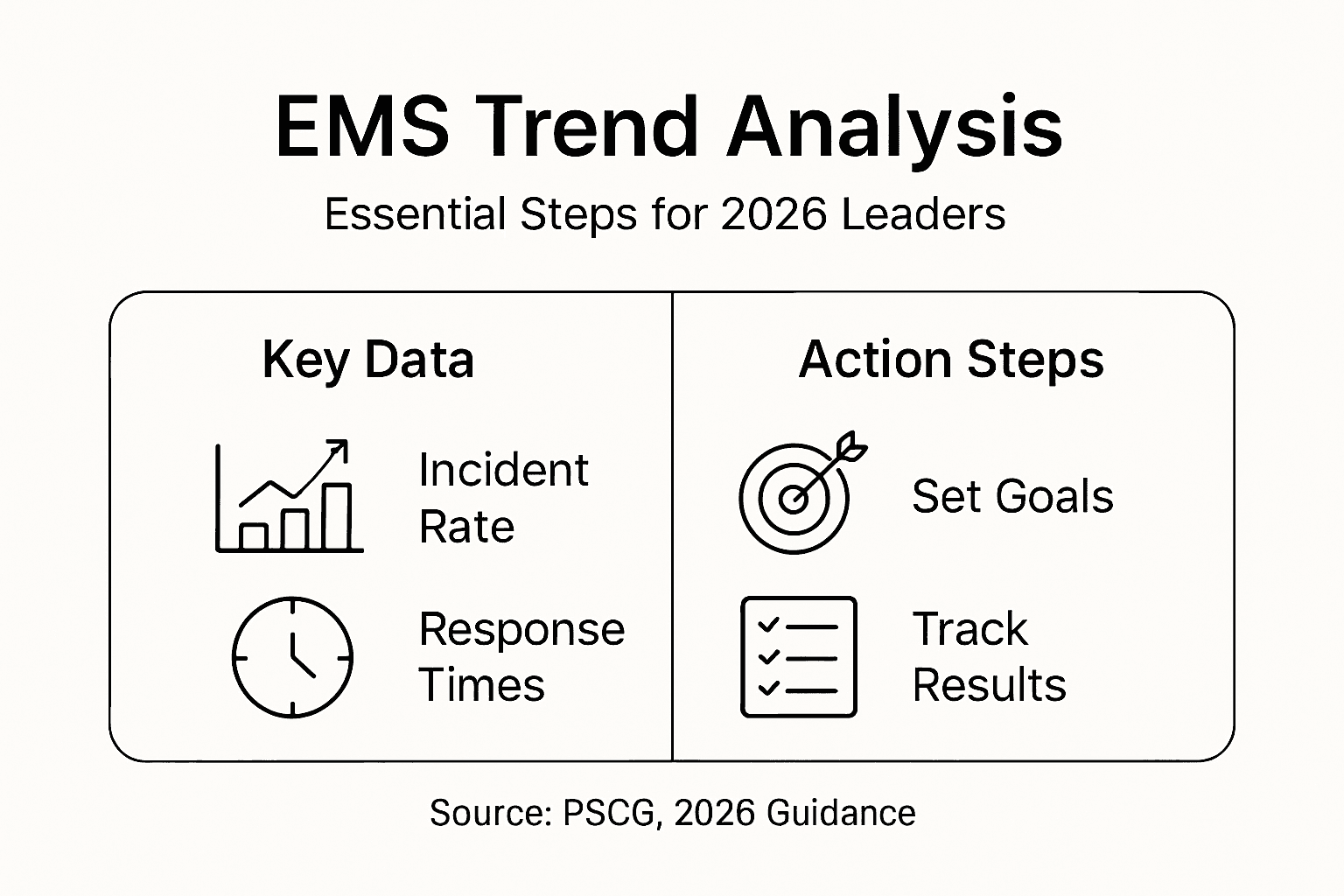
Measure results consistently. Track response times, protocol adherence, patient outcomes, or whatever metric drove the improvement. After 90 days, evaluate whether the change delivered expected results. If not, adjust and try again. This disciplined approach to testing improvements separates successful systems from those that chase trends without results.
Pro tip: Pick one improvement to launch first and nail it before moving to the next—early success builds momentum and credibility for larger changes ahead.
Step 5: Verify effectiveness and adjust analysis methods
You implemented improvements. Now comes the harder part: determining whether they actually worked. This step ensures your changes deliver real results and that your data analysis methods stay accurate and relevant.
Start by establishing clear measurement criteria before changes go live. Did you reduce response times by 10 percent? Improve protocol compliance? Increase staff retention? Vague success definitions make evaluation impossible. Your baseline data from Step 1 becomes your comparison point.
Use real-time monitoring tools to track performance continuously. NEMSIS public reports and analytics dashboards let you monitor system performance immediately after implementing changes. Don’t wait six months for annual reports. Watch the numbers weekly to catch problems early.
Evaluate improvements across multiple dimensions:
- Operational metrics: Response times, call volume, resource utilization, and staffing levels
- Clinical outcomes: Protocol adherence, patient transport decisions, and outcome data
- Staff indicators: Turnover rates, training completion, and field provider feedback
- Financial impact: Reimbursement changes, operational costs, and budget performance
If an improvement fails to deliver expected results, that’s not a setback—it’s valuable information that guides your next decision.
Refinement matters as much as implementation. Best practices for continuously assessing EMS effectiveness emphasize that agencies should regularly refine their data collection and analysis methods. Are you collecting the right data? Is your measurement process capturing what actually matters? Adjust your analysis framework based on what you learn.
Schedule quarterly reviews with your leadership team. Present the data honestly. Some improvements will exceed expectations. Others will disappoint. Either way, you’re building organizational intelligence about what works in your specific system.
Document what you learn and share it with your team. When an improvement succeeds, explain why so others understand the principles. When something fails, discuss the lessons openly without blame. This creates a culture of learning rather than fear.
Pro tip: Set up a simple monthly dashboard showing your key metrics against baseline data—share it with your board and medical director so everyone sees progress and understands where adjustments are needed.
Drive Your EMS Success with Expert Public Safety Trend Analysis Support
Navigating complex public safety trends and evolving legislative patterns can feel overwhelming. The challenge of gathering reliable data, understanding regulatory shifts, and translating those insights into effective operational decisions is critical yet demanding. You want to confidently implement strategic improvements that reduce risk and maximize impact in your EMS system.
The Public Safety Consulting Group (PSCG) specializes in helping Connecticut EMS leaders solve these exact challenges. With deep expertise in EMS system design, municipal strategy, reimbursement optimization, and legislative advocacy, PSCG partners with you to transform trend analysis into actionable solutions. From interpreting local and statewide data to streamlining workforce planning and technology adoption, PSCG ensures your 2026 strategy is grounded in clarity and ready for success.
Take control of your EMS system’s future now by working with trusted advisors who understand the intricacies of public safety trends and operational risk reduction. Visit The Public Safety Consulting Group to learn how our tailored consulting can empower your leadership team. Discover comprehensive support in EMS strategy and legislative insights at PSCG’s website.
Start turning your public safety trend analysis into measurable improvements with PSCG today.
Frequently Asked Questions
How can I gather relevant public safety trend data for my EMS system?
To gather relevant public safety trend data, start by accessing standardized data sources like NEMSIS incident data. Collect information on response times, call volume trends, resource utilization rates, and clinical performance metrics over the past 12 to 24 months to understand your system’s baseline performance.
What are the key emerging EMS and legislative patterns I should track for 2026?
Focus on monitoring three key categories: workforce regulations, funding mechanisms, and technology trends. Regularly review changes in certification standards, federal funding priorities, and emerging technological integrations to anticipate how they may impact your operations in 2026.
How do I interpret local and statewide trend impacts on my EMS operations?
To interpret local and statewide trend impacts, compare your EMS performance against state benchmarks and analyze demographic shifts in your community. Use structured comparisons to identify whether your call volume and response times align with state averages, which can inform your operational decisions.
What steps should I take to implement strategic improvements based on my trend analysis?
Prioritize your improvements based on their potential impact and feasibility by focusing on clinical protocols, workforce strategies, and technology implementations. Create a detailed implementation plan with assigned ownership and realistic timelines, ensuring you involve key stakeholders in the process.
How can I measure the effectiveness of the changes I implemented in my EMS system?
Establish clear measurement criteria to evaluate the effectiveness of your changes, such as reductions in response times or increases in protocol compliance. Use real-time monitoring tools to track performance continuously, adjusting your approach as needed based on what the data reveals after implementation.
Recommended
- 7 Essential Public Safety Leadership Tips for EMS Leaders
- Public Safety Definition: Impact on EMS Operations
- Best Practices for EMS Instructors: Shaping the Future of Emergency Medical Services Education | The Public Safety Consulting Group
- The Impact of Climate Change on EMS: Preparing for More Extreme Weather Events | The Public Safety Consulting Group