



Financial strain is a reality for many municipal Emergency Medical Services across the United States as fragmented and underfunded reimbursement models challenge administrators daily. This makes the expertise of reimbursement consultants vital, as they support EMS providers in maximizing revenue, aligning strategies with compliance requirements, and ensuring stability despite ever-changing healthcare regulations. By understanding how these professionals shape payment systems and identify new funding opportunities, EMS managers and consultants can make informed decisions that sustain high-quality emergency response in their communities.
Table of Contents
- Defining Reimbursement Consultants In EMS Systems
- Types Of Reimbursement Consultants And Their Services
- How Reimbursement Consultants Optimize EMS Revenue
- Legal Standards And Compliance In EMS Reimbursement
- Common Pitfalls And Risks In EMS Reimbursement
Key Takeaways
| Point | Details |
|---|---|
| Role of Reimbursement Consultants | They help EMS organizations navigate complex financial landscapes and develop effective reimbursement strategies while ensuring compliance with regulations. |
| Types of Consultants | Various categories include independent consultants, specialized firms, and industry-specific specialists, offering tailored expertise for unique EMS needs. |
| Revenue Optimization Techniques | Strategies like billing audits, coding optimization, and payer contract negotiation can significantly enhance financial sustainability for EMS providers. |
| Compliance Importance | Adhering to legal standards and regulatory requirements is essential for maintaining financial legitimacy and preventing penalties in EMS reimbursement practices. |
Defining Reimbursement Consultants in EMS Systems
Reimbursement consultants in Emergency Medical Services (EMS) are specialized professionals who navigate the complex financial landscape of healthcare emergency response systems. These experts bring critical strategic insights to help EMS organizations maximize their financial performance while maintaining high-quality patient care.
These professionals play a multifaceted role in modern EMS systems, focusing on several key strategic areas:
- Developing comprehensive reimbursement strategies
- Analyzing payment models and funding mechanisms
- Advocating for expanded recognition of EMS service value
- Optimizing billing and coding processes
- Identifying alternative revenue generation opportunities
Their work goes far beyond traditional billing functions. Reimbursement consultants help EMS providers navigate complex funding landscapes by understanding the nuanced payment structures that support emergency medical services. They bridge the gap between clinical care delivery and financial sustainability, ensuring that EMS organizations can continue providing critical community services.
Strategic Capabilities of reimbursement consultants include helping EMS systems transition from purely transport-based payment models to more comprehensive performance and patient-care-based reimbursement frameworks. This involves creating integrated strategies that align clinical evidence, regulatory requirements, and market access to secure appropriate insurance coverage.
Reimbursement consultants transform financial challenges into strategic opportunities for EMS providers.
Key responsibilities encompass detailed technical work such as insurance payer evaluation, coverage determination, precise medical coding, and strategic payment procurement. By understanding both healthcare regulations and EMS operational dynamics, these professionals provide invaluable guidance that directly impacts organizational financial health.
Pro tip: Invest in ongoing professional development for your reimbursement team to stay current with evolving healthcare financial regulations and emerging EMS payment models.
Types of Reimbursement Consultants and Their Services
Reimbursement consultants in the Emergency Medical Services (EMS) sector represent a diverse and specialized professional group with unique expertise across multiple domains of healthcare financial strategy. These professionals are not monolithic but rather bring targeted skills tailored to specific organizational needs and healthcare subsectors.
The primary categories of reimbursement consultants include:
- Independent Healthcare Consultants: Solo practitioners offering personalized strategic guidance
- Specialized Consulting Firms: Organizations focused on specific healthcare segments
- Academic Expert Consultants: Professionals with deep clinical and regulatory knowledge
- Industry-Specific Reimbursement Specialists: Experts dedicated to particular medical domains
Their comprehensive service offerings typically encompass reimbursement strategy development across multiple critical areas. These services include detailed technical work such as coding consultation, coverage policy navigation, payer strategy optimization, and health economic modeling.
The table below summarizes types of EMS reimbursement consultants and their distinct advantages for EMS organizations:
| Consultant Type | Typical Expertise | Key Benefit for EMS Providers |
|---|---|---|
| Independent Healthcare Consultants | Personalized financial strategy | Custom solutions for unique EMS needs |
| Specialized Consulting Firms | Deep knowledge of healthcare segments | Scalable resources and broad support |
| Academic Expert Consultants | Advanced clinical and regulatory insight | Compliance with evolving regulations |
| Industry-Specific Specialists | EMS or medical domain focus | High-impact interventions in niche areas |
Strategic Services provided by these consultants are multifaceted and designed to address complex financial challenges in healthcare delivery. They focus on generating cost-effectiveness evidence, facilitating market access, ensuring regulatory compliance, and developing nuanced reimbursement frameworks that align with evolving healthcare payment models.
Reimbursement consultants transform financial complexity into strategic opportunity for healthcare providers.
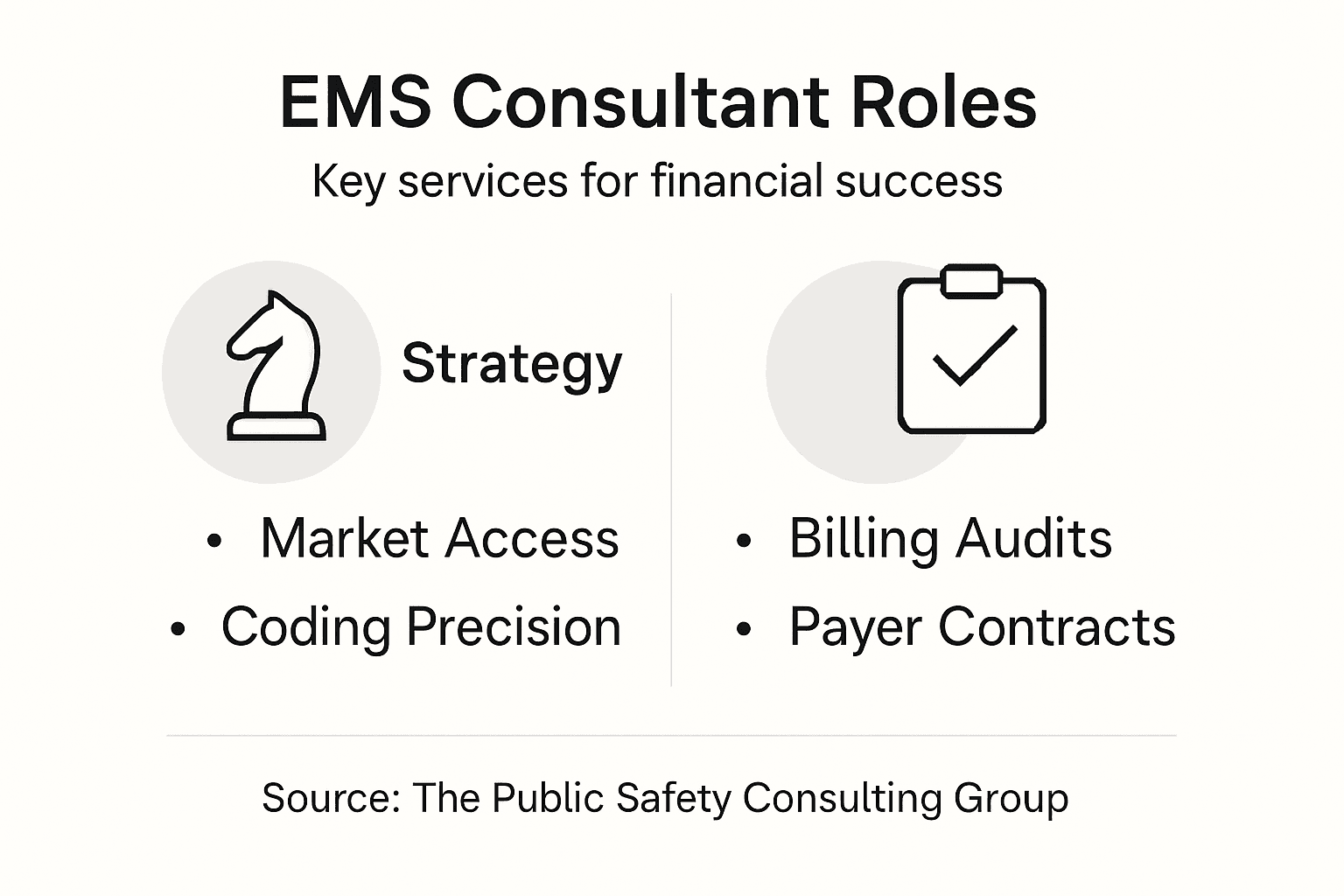
Key service areas for EMS reimbursement consultants include market access strategy development, precise medical coding optimization, insurance payer evaluation, and creating comprehensive evidence-based financial models. By bridging clinical understanding with financial expertise, these professionals help EMS organizations navigate increasingly complex reimbursement landscapes.
Pro tip: Select a reimbursement consultant with demonstrated experience in your specific EMS sector to ensure targeted, effective financial strategy development.
How Reimbursement Consultants Optimize EMS Revenue
Reimbursement consultants play a critical role in transforming the financial landscape of Emergency Medical Services (EMS) organizations by implementing strategic revenue optimization techniques. These professionals leverage deep understanding of healthcare financing, regulatory frameworks, and billing complexities to unlock significant financial potential for EMS providers.
Their revenue optimization strategies typically encompass several key approaches:
- Comprehensive Billing Audits: Identifying and correcting systematic billing inefficiencies
- Coding Optimization: Ensuring maximum reimbursement through accurate medical coding
- Payer Contract Negotiation: Securing more favorable reimbursement rates
- Alternative Revenue Stream Development: Exploring innovative funding mechanisms
- Compliance Risk Mitigation: Preventing revenue losses through regulatory adherence
Financial Recovery Mechanisms are particularly crucial in this process. Consultants conduct detailed forensic billing reviews, uncovering missed revenue opportunities and implementing corrective strategies that can potentially recover substantial funds that would otherwise remain uncollected.
Effective reimbursement consulting can transform financial challenges into sustainable revenue growth for EMS organizations.
The most sophisticated reimbursement consultants go beyond traditional billing optimization. They analyze entire organizational financial ecosystems, identifying systemic inefficiencies and developing comprehensive strategies that align clinical services with financial sustainability. This holistic approach ensures EMS providers can maintain critical community services while achieving financial stability.

Pro tip: Conduct quarterly comprehensive revenue cycle assessments to proactively identify and address potential financial optimization opportunities.
Legal Standards and Compliance in EMS Reimbursement
Legal standards and compliance form the critical backbone of financial integrity in Emergency Medical Services (EMS) reimbursement. These rigorous regulatory frameworks establish comprehensive guidelines that EMS providers must meticulously follow to maintain financial legitimacy and prevent potential legal complications.
Key compliance requirements encompass several critical areas:
- Documentation Accuracy: Maintaining precise medical records and patient care reports
- Billing Integrity: Ensuring transparent and accurate billing practices
- Regulatory Adherence: Following federal and state healthcare regulations
- Fraud Prevention: Implementing robust internal control mechanisms
- Audit Preparedness: Developing systematic documentation and reporting processes
Reimbursement consultants play a pivotal role in helping EMS organizations navigate complex compliance requirements. They provide expert guidance in developing comprehensive compliance programs that meet stringent federal agency standards established by the Centers for Medicare & Medicaid Services (CMS) and the Department of Health and Human Services Office of Inspector General (HHS-OIG).
Compliance is not just a legal requirement—it’s a strategic imperative for EMS financial sustainability.
Legal Monitoring involves continuous assessment of evolving regulatory landscapes. This includes tracking changes in Medicare and Medicaid regulations, understanding complex billing modifiers, and ensuring that transport necessity documentation meets exact legal standards. Non-compliance can result in severe penalties, including payment denials, financial audits, and potential exclusion from critical government reimbursement programs.
Pro tip: Implement a quarterly compliance review process with external legal experts to proactively identify and address potential regulatory gaps.
Common Pitfalls and Risks in EMS Reimbursement
EMS reimbursement presents a complex landscape fraught with potential financial and operational risks that can significantly impact organizational sustainability. Understanding these challenges is crucial for proactively developing strategies that mitigate financial vulnerabilities and ensure long-term operational resilience.
The most prevalent risks in EMS reimbursement include:
- Underfunding: Reimbursement rates falling below actual service costs
- Billing Errors: Coding mistakes leading to claim rejections
- Compliance Violations: Regulatory infractions causing financial penalties
- Documentation Gaps: Insufficient patient care reporting
- Payment Delays: Extended revenue cycle timelines
Reimbursement challenges are particularly acute in regions experiencing systemic geographic disparities. These disparities create significant operational challenges, where EMS providers in underserved areas struggle with limited financial resources and complex reimbursement structures that fail to adequately compensate for critical emergency services.
Financial sustainability in EMS requires constant vigilance and strategic adaptation.
Risk Mitigation Strategies demand a comprehensive approach that goes beyond traditional billing practices. EMS organizations must develop robust internal controls, invest in continuous staff training, implement advanced documentation technologies, and create flexible financial models that can adapt to changing reimbursement landscapes.
Below is a reference table highlighting common EMS reimbursement pitfalls and suggested strategic countermeasures:
| Common Pitfall | Impact on EMS Organization | Strategic Countermeasure |
|---|---|---|
| Underfunding | Service cost exceeds reimbursement | Negotiate better payer contracts |
| Billing Errors | Increased claim rejections | Implement accurate coding audits |
| Payment Delays | Cash flow disruption | Track claims and follow up promptly |
| Compliance Violations | Penalties or program exclusion | Conduct regular compliance reviews |
Pro tip: Conduct monthly financial audits and maintain a contingency fund to buffer against potential reimbursement shortfalls.
Maximize EMS Financial Success with Expert Reimbursement Consulting
The article highlights the critical challenge EMS organizations face in optimizing reimbursement amidst complex billing rules and evolving healthcare regulations. Key pain points include underfunding, billing errors, and compliance risks that can threaten financial stability. At The Public Safety Consulting Group (PSCG), we understand the importance of strategic reimbursement consulting to transform these challenges into sustainable growth. By aligning advanced reimbursement strategies with your EMS operational goals, you ensure your funding matches the vital community services you provide.
Unlock the full potential of your EMS system with tailored solutions that cover everything from billing optimization to regulatory compliance. Explore how our expertise in EMS system design and reimbursement optimization can safeguard your organization against revenue loss and compliance pitfalls. Start turning financial complexity into clarity today with The Public Safety Consulting Group.
Take action now to protect and enhance your EMS revenue stream.

Ready to overcome reimbursement roadblocks and secure your EMS financial future Visit The Public Safety Consulting Group to learn how our specialized consulting services can help you optimize revenue and maintain compliance. Don’t wait until reimbursement challenges impact your operations. Connect with us today and empower your EMS organization with proven strategies tailored to your unique needs.
Frequently Asked Questions
What is the role of reimbursement consultants in EMS?
Reimbursement consultants in Emergency Medical Services (EMS) help organizations optimize their financial performance by navigating complex reimbursement structures, developing reimbursement strategies, and ensuring compliance with healthcare regulations.
How do reimbursement consultants enhance EMS revenue?
Reimbursement consultants enhance EMS revenue through comprehensive billing audits, coding optimization, payer contract negotiation, and exploring alternative revenue streams to recover missed opportunities and streamline payment processes.
What are the key compliance requirements for EMS reimbursement?
Key compliance requirements include maintaining documentation accuracy, ensuring billing integrity, adhering to regulatory standards, preventing fraud, and being prepared for audits to avoid penalties or exclusions from reimbursement programs.
What common pitfalls do EMS organizations face in reimbursement?
Common pitfalls include underfunding, billing errors, compliance violations, documentation gaps, and payment delays, which can significantly impact the financial sustainability of EMS organizations.