



More ambulances and bigger budgets do not automatically produce better EMS outcomes. The municipalities that consistently outperform their peers share one trait: they treat EMS as a strategic system, not a reactive service. This guide walks through the frameworks, benchmarks, and funding models that help municipal leaders move from ad hoc emergency response to a data-driven operation that genuinely improves community health. Whether you oversee a dense urban system or a sprawling rural county, the principles here apply directly to your decisions.
Table of Contents
- The fundamentals: Why EMS strategic planning matters
- The 5-step municipal EMS strategy process
- Key program areas: From ALS/BLS to regional solutions
- Setting benchmarks: National standards and measurable goals
- Funding realities and adapting for community context
- Advance your EMS strategy with expert support
- Frequently asked questions
Key Takeaways
| Point | Details |
|---|---|
| Structure fosters success | A five-step strategy process grounds EMS planning and enables continuous adaptation. |
| Tailor programs locally | Different communities need different blends of ALS, BLS, and regional solutions for optimal coverage. |
| Data drives improvement | Tracking key benchmarks reveals gaps and supports better decision-making. |
| Stable funding is vital | Sustainable financing underpins resilience, especially in rural and mixed-service areas. |
| Expert support accelerates impact | External guidance can save time, maximize results, and build stakeholder confidence. |
The fundamentals: Why EMS strategic planning matters
EMS strategy is not just an operational concern. It is a public health commitment. Well-executed planning reduces mortality, keeps your system compliant with state and federal standards, and builds the community trust that sustains long-term funding. Municipalities that skip structured planning often find themselves reacting to crises rather than preventing them.
Strategic plans must be data-driven and adaptive, incorporating stakeholder input to balance growing demand with limited resources. Tools like NEMSQA (the National EMS Quality Alliance) provide standardized quality measures that give your data real meaning. Without that structure, performance gaps go undetected until they become headlines.
The national model worth studying is NHTSA’s people-centered vision known as EMS Agenda 2050. It reframes EMS beyond 911 response, integrating it into broader healthcare delivery and community well-being. State EMS plans outline goals across regulation, resource management, education, transportation, communications, data evaluation, medical direction, preparedness, and funding using this framework as a model.
Common oversights that derail municipal EMS include:
- Ad hoc staffing decisions made without workforce data or succession planning
- Undefined performance priorities that leave crews without clear targets
- Ignoring technology benchmarks such as ePCR integration and CAD analytics
- Siloed planning that excludes hospitals, public health, and community partners
“EMS is no longer just about getting to the scene fast. It is about integrating into the health system to improve outcomes before, during, and after the emergency.”
Understanding the public safety impact on EMS and how it connects to broader municipal readiness is the foundation for everything that follows. Leaders who invest in enhancing municipal readiness through structured planning consistently see better outcomes across every metric that matters.
The 5-step municipal EMS strategy process
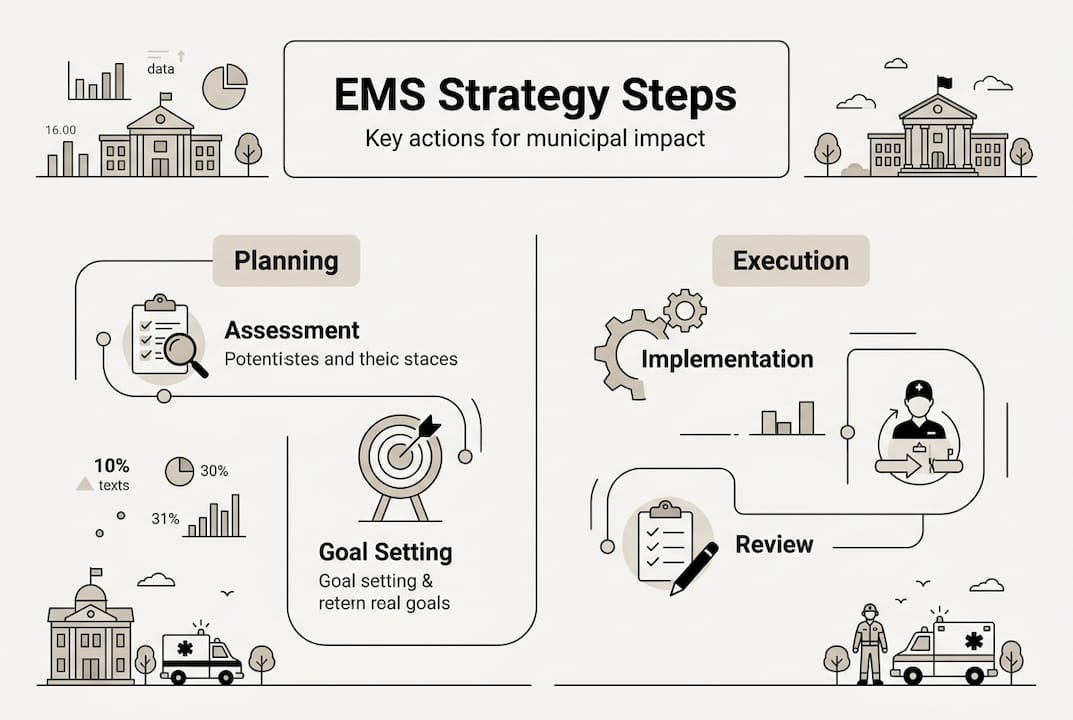
A repeatable process is what separates high-performing systems from those that drift. Municipal EMS strategic planning typically follows five structured steps that apply regardless of system size or service model.
- Assess current operations. Pull your KPIs: response times, run volumes, staff skill mix, and transport rates. A thorough EMS needs assessment surfaces gaps you cannot see from the budget spreadsheet alone.
- Engage all stakeholders. Field providers know things administrators do not. Include frontline staff, medical directors, city officials, and community representatives. Buy-in at this stage prevents resistance later.
- Set SMART goals. Vague targets produce vague results. Aim for specifics: reduce average response time by 60 seconds within 18 months, or lift stroke assessment compliance from 72% to 83% within one year.
- Allocate resources with clarity. Use a RACI matrix (Responsible, Accountable, Consulted, Informed) to assign ownership of every initiative. Ambiguity in resource allocation is where plans go to die.
- Monitor, review, and adapt. Build dashboards, schedule quarterly reviews, and treat the plan as a living document. The system assessment steps that launched the process should feed continuous improvement cycles.
Pro Tip: Do not wait for a full annual review to catch problems. Set monthly dashboard check-ins with your EMS medical director and operations chief. Small course corrections beat major overhauls.
| KPI | Urban benchmark | Rural benchmark |
|—|—|—|
| Response time (ALS) | Under 8 minutes | Under 14 minutes |
| Unit hour utilization | 0.30 to 0.45 | 0.10 to 0.25 |
| Stroke assessment rate | 80%+ | 72%+ |
| Airway success rate | 40%+ | 30%+ |
| Lights and sirens use | Under 50% of calls | Under 60% of calls |
These benchmarks are starting points, not ceilings. The EMS planning process in detail shows how to contextualize these numbers for your specific community profile.
Key program areas: From ALS/BLS to regional solutions
Choosing the right service model is one of the highest-leverage decisions a municipal leader makes. Get it wrong and you are either overspending on capability you rarely use or under-resourcing calls that demand it.

ALS vs. BLS: The core tradeoff. Advanced Life Support (ALS) units staffed by paramedics can perform interventions like cardiac monitoring, IV therapy, and advanced airway management. Basic Life Support (BLS) units staffed by EMTs handle a wide range of calls at significantly lower cost. Key program areas in leading EMS strategies include fully funded ALS, BLS enhancements, regional services, and financial planning via voter-approved levies.
| Feature | ALS | BLS |
|---|---|---|
| Staff credential | Paramedic | EMT |
| Scope of practice | Advanced interventions | Basic emergency care |
| Cost per unit | Higher | Lower |
| Best for | Cardiac, trauma, stroke | Lower-acuity calls, transport |
Regional agreements and mutual aid arrangements are underused tools in municipal EMS. Placeholder units, shared staffing agreements, and formal mutual aid compacts can dramatically improve coverage without proportional cost increases. Smaller municipalities especially benefit from pooling resources across jurisdictions.
Funding models vary widely in predictability and community acceptance:
- Voter-approved levies provide stable, dedicated revenue but require public engagement
- General fund allocations are flexible but vulnerable to budget cycles
- State and federal grants fill gaps but cannot substitute for core operational funding
- Inter-municipal agreements spread costs and improve service reliability
Pro Tip: For towns under 25,000 residents, smart EMS growth through regionalization often delivers better reliability than trying to sustain a fully independent ALS system. The math rarely works in isolation.
Rural systems face distinct tradeoffs between volunteer and paid staffing, and rural EMS challenges around distance, call volume, and recruitment require purpose-built strategies rather than scaled-down urban models.
Setting benchmarks: National standards and measurable goals
Benchmarking is how you know whether your strategy is working. Without external reference points, local data is just noise. National datasets give your numbers context and direction.
EMS benchmarks from national reports include stroke assessment rates of 72 to 83%, lights and sirens use limits, overdose response rates, and airway success rates around 20 to 44% without complications. These ranges reflect real-world variation across system types, not theoretical ideals.
Key stat: National airway success rates range from 20% to 44%. If your system sits at the low end, that gap represents preventable patient harm, not just a metric shortfall.
Here is how to build a functional benchmarking program:
- Pull your baseline data from your ePCR system for the past 12 months across all key measures.
- Compare to national datasets using resources like the EMS national dataset and NEMSQA quality measures.
- Identify your top three gaps and assign SMART improvement goals to each one.
- Build a public-facing dashboard that reports performance quarterly. Transparency builds trust and sustains political support for EMS investment.
- Review peer systems in comparable municipalities to understand what high performance actually looks like in practice.
| Benchmark | National low | National high | Your target |
|---|---|---|---|
| Stroke assessment compliance | 72% | 83% | 83% |
| Airway success rate | 20% | 44% | 40%+ |
| Lights and sirens use | Varies | Under 50% | Under 50% |
| Cardiac arrest survival | 8% | 12% | 10%+ |
Strong EMS system integration with hospitals and public health agencies amplifies the value of your benchmarking data. When EMS, ED, and public health share outcome data, improvement cycles accelerate. Building continuity of operations into your benchmarking process ensures that performance gains survive leadership transitions and budget pressures.
Funding realities and adapting for community context
Funding is where strategy meets political reality. The most elegant EMS plan fails without a sustainable revenue model behind it.
Funding challenges persist in many states where no dedicated local EMS funding exists and systems rely on general taxes that fluctuate with economic cycles. Stable, dedicated funding mechanisms are not a luxury. They are a prerequisite for consistent service delivery.
Creative funding sources worth pursuing include:
- Voter-approved EMS levies tied to assessed property value (e.g., $0.25 per $1,000)
- FEMA Assistance to Firefighters Grants for equipment and training
- HRSA rural health grants for qualifying communities
- Medicaid reimbursement optimization through proper billing and coding practices
- Inter-municipal service agreements that generate revenue from neighboring jurisdictions
Rural EMS faces unique challenges including longer distances, volunteer reliance, BLS dominance, and funding via grants and local taxes. Integration into regional trauma systems is essential for rural communities to maintain clinical standards without unsustainable costs.
“An estimated 29.7 million Americans lack access to a trauma center within 60 minutes. That gap is not a geography problem. It is a strategy and funding problem that demands innovation.”
Urban systems face different pressures: optimizing station locations for coverage efficiency, managing high call volumes with appropriate unit deployment, and avoiding the trap of smart growth over expensive tech that does not move the needle on outcomes. The right strategy is always context-specific. A rural county in eastern Connecticut has nothing in common operationally with a dense urban municipality, and the funding model must reflect that reality.
Advance your EMS strategy with expert support
Every municipality faces a unique combination of geography, demographics, political dynamics, and resource constraints. A strategy that works in one community may actively harm another. That is why generic templates fall short and why expert guidance accelerates results while reducing costly missteps.
The Public Safety Consulting Group works directly with municipal leaders to design EMS systems that perform. From benchmarking and system design to funding strategy and legislative advocacy, we bring the operational depth and policy knowledge your team needs. Explore EMS system design examples to see how other municipalities have transformed their services, review municipal public safety strategy tips for actionable guidance, or go deeper with our strategic planning guidance. Contact PSCG to start a conversation about what your community needs most.
Frequently asked questions
What are the first steps for starting an EMS strategic plan?
Start with a current-state assessment using key performance indicators, then engage stakeholders across all levels to identify priorities and build consensus before setting goals.
What is the difference between ALS and BLS in municipal EMS?
ALS provides advanced interventions performed by paramedics, including cardiac monitoring and IV therapy. BLS delivers foundational emergency care by EMTs, typically at lower cost and appropriate for a wide range of call types.
How can rural communities improve EMS with limited budgets?
Focus on regional partnerships and grants to pool resources, recruit and retain volunteers through structured programs, and integrate with regional trauma systems to extend clinical capability without proportional cost increases.
Which performance benchmarks should municipal EMS track?
Prioritize response times, stroke assessment rates, airway success rates, cardiac arrest survival, and lights and sirens utilization as your core dashboard metrics.
What funding options are available for municipal EMS systems?
Stable local funding sources include voter-approved levies, state and federal grants, Medicaid reimbursement optimization, and inter-municipal service agreements that distribute costs across jurisdictions.