

Unified Command Isn’t a Crown: Why “Staying in Your Lane” Protects Patients, Crews, and Communities
An operational reality check for third-service, private, and not-for-profit EMS in a mixed-discipline response environment.
If you’ve worked a busy street corner at 2 a.m.—or managed a multi-unit scene where the radio won’t stop—you already know this: most incidents don’t fail because responders don’t care. They fail because good people, under stress, make governance mistakes.
One of the most common governance mistakes is misunderstanding Unified Command.
Unified Command (UC) was not designed to let one discipline “lord over” the others. It was designed to do the opposite: prevent turf wars, reduce contradictory direction, and unify effort across agencies that each bring real authority, expertise, and responsibility to the incident. That’s not rhetoric—it’s the core intent of the National Incident Management System (NIMS) and the Incident Command System (ICS): a common approach so diverse entities can integrate and manage incidents effectively.
For EMS—especially third-service, commercial, or not-for-profit agencies operating alongside fire and law enforcement—this matters. A lot. Because when disciplines drift outside their competency and authority, the damage isn’t theoretical:
Patients get inappropriate care or delayed definitive interventions.
Crews get conflicting direction, increasing risk, errors, and scene friction.
Agencies inherit liability they never priced into the call.
Public trust gets injured, one preventable incident at a time.
Some states like Connecticut, have put the expectation into statutes to help stakeholders understand their role. Even some local medical direction entities have put MOUs in place because this is a real issue.
Let’s talk plainly about what Unified Command is, what it isn’t, and how to keep it from becoming a power struggle that compromises patient outcomes.
What Unified Command Is (and What It Isn’t) Under NIMS/ICS
ICS is a standardized management structure intended to organize incident response through clear roles, consistent terminology, and scalable sections (Operations, Planning, Logistics, Finance/Admin).
Unified Command is an ICS application used when multiple agencies/jurisdictions have legitimate responsibility for the incident—so they can establish shared objectives and make joint command decisions through a single, integrated structure. FEMA training materials emphasize that UC enables responsible agencies to manage an incident together by establishing common incident objectives and strategies—while maintaining unity of command (each person reports to one supervisor).
The key point
Unified Command is about unity of effort, not a single-agency takeover. NIMS is explicit that its purpose is to enhance unity of effort through a common approach for managing incidents.
“In Charge of the Scene” Doesn’t Mean “In Charge of Medicine”
Here’s where EMS often gets burned: the phrase “fire is in charge of the scene.”
There are contexts where fire has clear authority—hazard control, fire suppression, rescue, hazard zone management, mitigation strategy. There are also contexts where law enforcement has clear authority—scene security, criminal investigation, suspect control. None of that automatically grants authority to direct patient care decisions if the directing party is not credentialed, not operating under EMS medical direction, or is outside scope.
ICS doctrine itself reinforces that incident leadership requires clear authority and knowledge of agency policy.
In EMS, “agency policy” isn’t just an SOP binder—it includes scope of practice, protocols, and medical direction.
Practical example (common, costly, preventable)
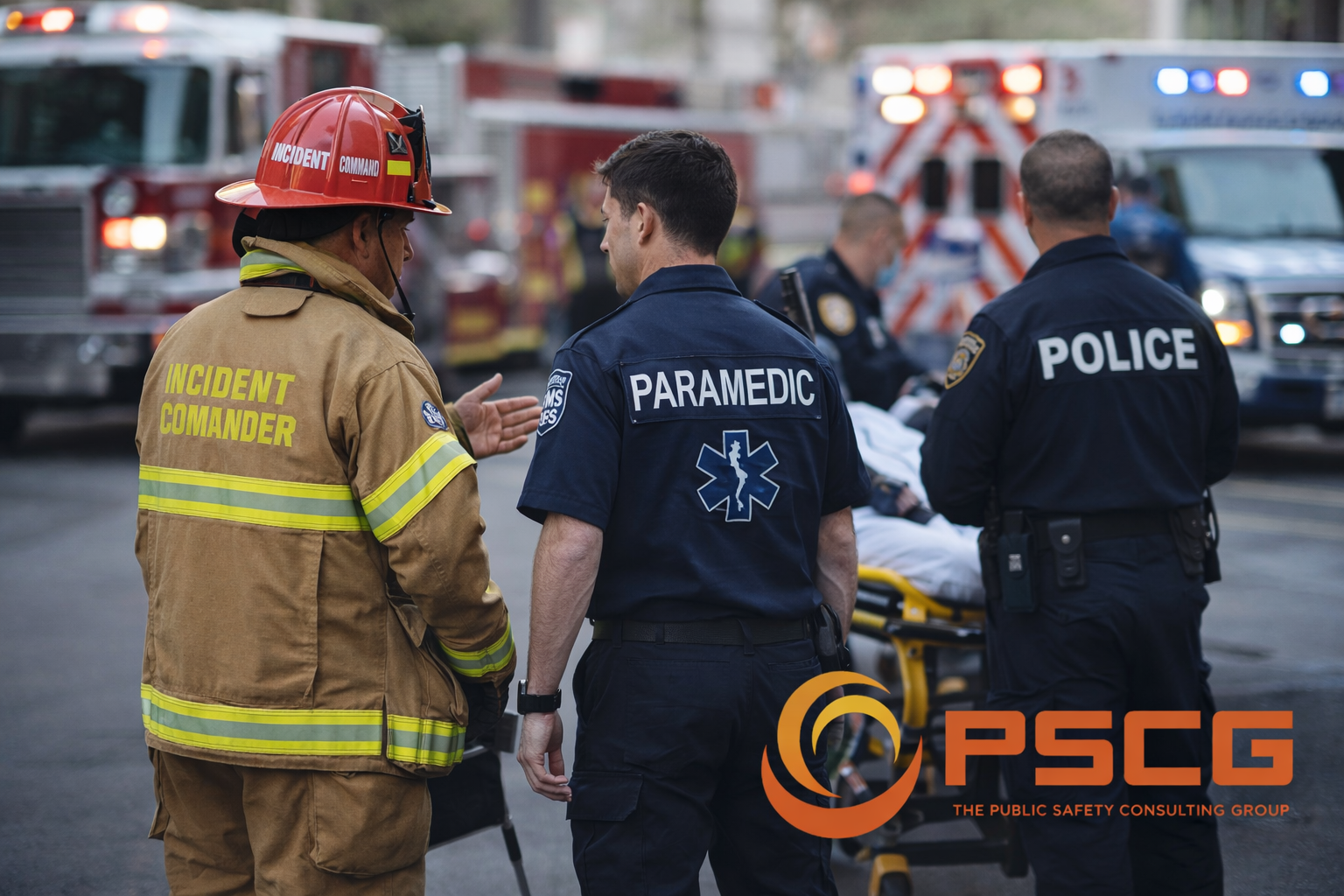
An engine company arrives first and declares “command.” A paramedic unit arrives and starts ALS care. Then someone without equivalent medical credentialing directs a treatment change (“Don’t give that,” “Move them now,” “Transport immediately,” “Wait for rescue,” “We’re doing it this way.”).
Even if everyone means well, that’s a governance failure. It creates:
Conflicting command signals at the point of care (a patient safety risk).
Scope-of-practice exposure for the EMS clinicians who comply.
Medical-legal exposure for the agency whose licensed staff delivered (or withheld) care.
Documentation and accountability chaos after the fact.
Unified Command was designed to reduce that chaos, not legitimize it.
Why Third-Service and Private/Nonprofit EMS Faces Unique Unified Command Friction
Third-service, commercial, and nonprofit EMS often operate as mission-focused medical organizations embedded in a broader public safety ecosystem. That creates predictable friction points:
1) Different “core product”
Fire: hazard mitigation and rescue; episodic but high-risk environments
Police: law enforcement and public order
EMS: clinical care, diagnosis/triage, medical decision-making under protocols and physician oversight
If Unified Command is treated as a single-agency hierarchy instead of a shared governance model, EMS becomes “help” rather than a co-equal discipline—despite being the clinical authority.
2) Asymmetry of institutional knowledge
Many fire agencies do EMS exceptionally well. Many do not. Likewise, private EMS may have deep clinical systems but less familiarity with fireground operations. UC exists because no one discipline owns the full operating picture.
When UC becomes “I’m here first, so I’m the boss,” you’re no longer doing ICS—you’re doing ego.
3) Payment model and liability misalignment
Private and nonprofit EMS carries clinical and billing risk differently than municipal departments. When another discipline directs EMS care outside protocol, the clinical liability still lands on EMS—not the person giving direction.
The Real Damage When Disciplines Don’t Stay in Their Lane
This isn’t about pride. It’s about outcomes and risk.
Patient harm pathways
Delayed care while crews argue over extrication vs. treatment priorities
Premature transport without stabilization because “we’re clearing the scene”
Denied interventions due to non-clinical command decisions
Mis-triage at MCIs when medical branch is overridden by non-medical priorities
Operational harm pathways
Freelancing and conflicting direction (the opposite of ICS)
Broken unity of command at the crew level—two bosses, two plans
Resource misallocation (e.g., tying up ALS for scene tasks that could be delegated)
Legal and reputational harm pathways
Scope-of-practice violations and protocol deviations
After-action blame shifting (“EMS made the call” / “Fire ordered it”)
Public credibility loss when the system looks disorganized
NIMS and ICS exist precisely because unmanaged multi-agency scenes produce these failures at scale.
What Unified Command Should Look Like in Mixed-Discipline EMS Responses
Unified Command works when everyone accepts a mature principle:
Command sets the incident objectives; disciplines execute within their legal authority and professional competence.
In practice, that means:
1) One Incident Action Plan, not one ego
Unified Command’s purpose is to align agencies under shared objectives and strategies, not to erase professional boundaries.
2) EMS owns patient care—through medical direction and delegated clinical leadership
Under ICS, the Incident Commander(s) can establish an organization that fits the incident. For EMS-centric operations, that often means:
Medical Group/Branch within Operations
A designated EMS Group Supervisor (credentialed and authorized)
Clear integration with rescue/extrication and hazard control so treatment and operations are sequenced—not competed
3) “Unity of command” down the chain—especially at the stretcher
FEMA training distinguishes Unity of Command from Unified Command: Unity of Command means each person reports to one supervisor; Unified Command is about shared command decision-making at the top when multiple agencies have responsibility.
So yes—UC at the top. But at the patient’s side, one clinical leader.
Answering the Big Question Directly
Was Unified Command intended for one discipline to dominate the others?
No. UC is explicitly framed as a mechanism for multiple responsible agencies to manage an incident together with common objectives and joint decisions—because no single agency has unilateral primary authority in complex incidents.
If one discipline is “lording over” the others—especially outside its competence—that’s not Unified Command functioning correctly. That’s Unified Command being misused.
How to Prevent Unified Command Failure: A Practical Playbook for EMS Leaders
If you’re running third-service, nonprofit, or private EMS, you don’t need a philosophy seminar. You need a playbook.
1) Put it in writing: MOU/MOA + clinical authority language
Your interagency agreements should explicitly define:
- Involve your local medical director or OEMS
Who establishes command (by incident type)
How Unified Command is formed
How EMS clinical authority is exercised
Who can direct patient care (credentials + medical direction requirements)
2) Train like you operate: joint ICS drills with clinical decision points
Most “Unified Command” training is command-post focused. Add friction into the exercise:
extrication vs. stabilization conflicts
termination of resuscitation governance
triage and transport group decisions
refusal/consent and law enforcement interface
3) Standardize communications: plain language and role clarity
ICS emphasizes common terminology for a reason.
If your scene sounds like “I’m in charge” instead of “Medical Group is established, extrication is coordinated through Operations,” you’re inviting failure.
4) Build a culture that respects competence, not costume
This is the human part: people will follow strong leadership—but they also test weak systems. When roles are ambiguous, the loudest voice wins. Your job is to make sure the most qualified voice wins, every time, by design.