


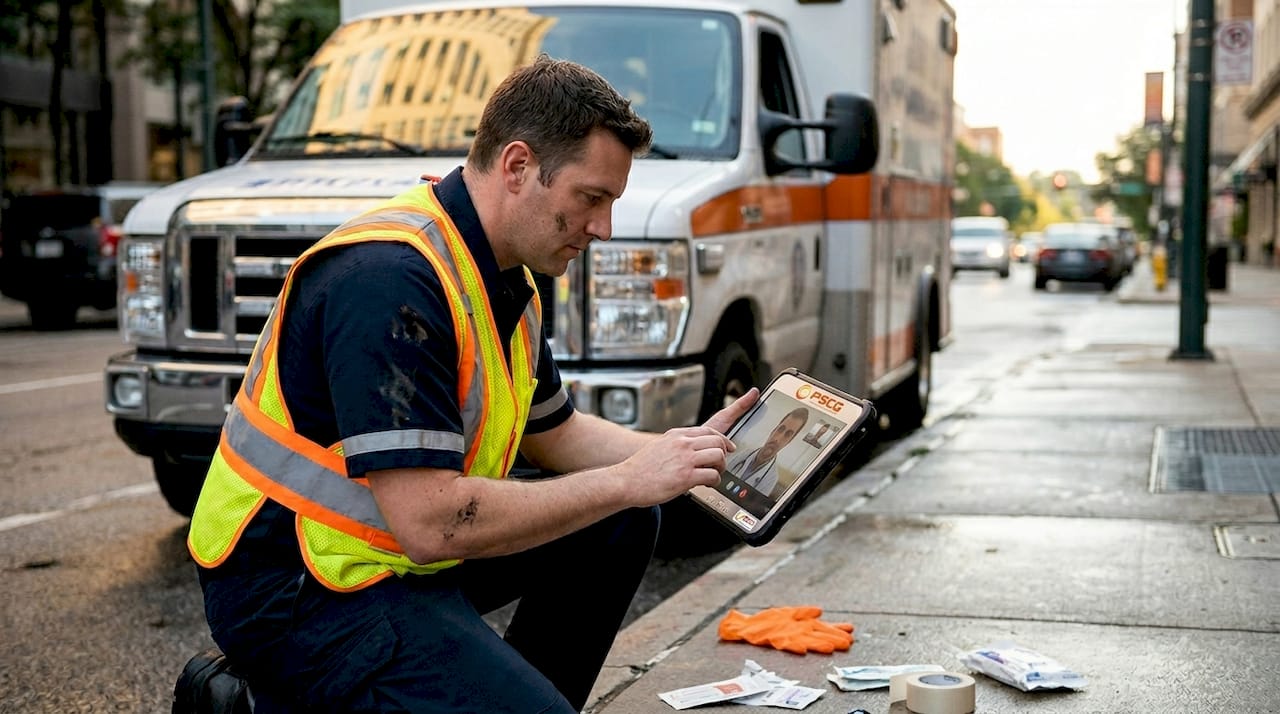
Most low-acuity emergency calls don’t require ambulance transport, yet until recently, few municipalities had a safe, scalable way to avoid them. Houston’s ETHAN telemedicine program reduced ambulance transports by 56% in its first year for low-acuity calls, demonstrating that remote clinical expertise can safely redirect resources while maintaining care quality. Telemedicine now offers evidence-backed solutions to this persistent inefficiency in public safety. This article explains telemedicine’s role in EMS, examines real-world results, addresses implementation challenges, and outlines first steps for municipal leaders ready to modernize emergency response systems.
Table of Contents
- What is telemedicine in EMS and public safety?
- How telemedicine improves EMS effectiveness
- Key considerations for implementing telemedicine in public safety
- Barriers and common challenges in EMS telemedicine adoption
- Emerging trends and the future role of telemedicine in public safety
- Connecting public safety strategy with telemedicine expertise
- Frequently asked questions
Key Takeaways
| Point | Details |
|---|---|
| Reduces unnecessary transports | Telemedicine enables EMS to safely resolve more calls without ambulance or ED trips. |
| Improves rural emergency care | Remote consultations enable field providers to deliver advanced care even in isolated areas. |
| Requires robust planning | Successful deployment demands technology, legal, training, reimbursement, and public education integration. |
| Barriers need active management | Cultural, technical, and regulatory resistance must be tackled for full adoption. |
| Future opportunities abound | Emerging use cases will expand as programs mature and data further supports telemedicine’s value. |
What is telemedicine in EMS and public safety?
Telemedicine in the EMS context refers to remote clinical service delivery that connects field providers with physicians, specialists, and advanced diagnostic tools in real time. This isn’t simply video calling. Modern EMS telemedicine integrates advanced monitoring, secure data sharing, and compliance frameworks to extend expert care beyond hospital walls.
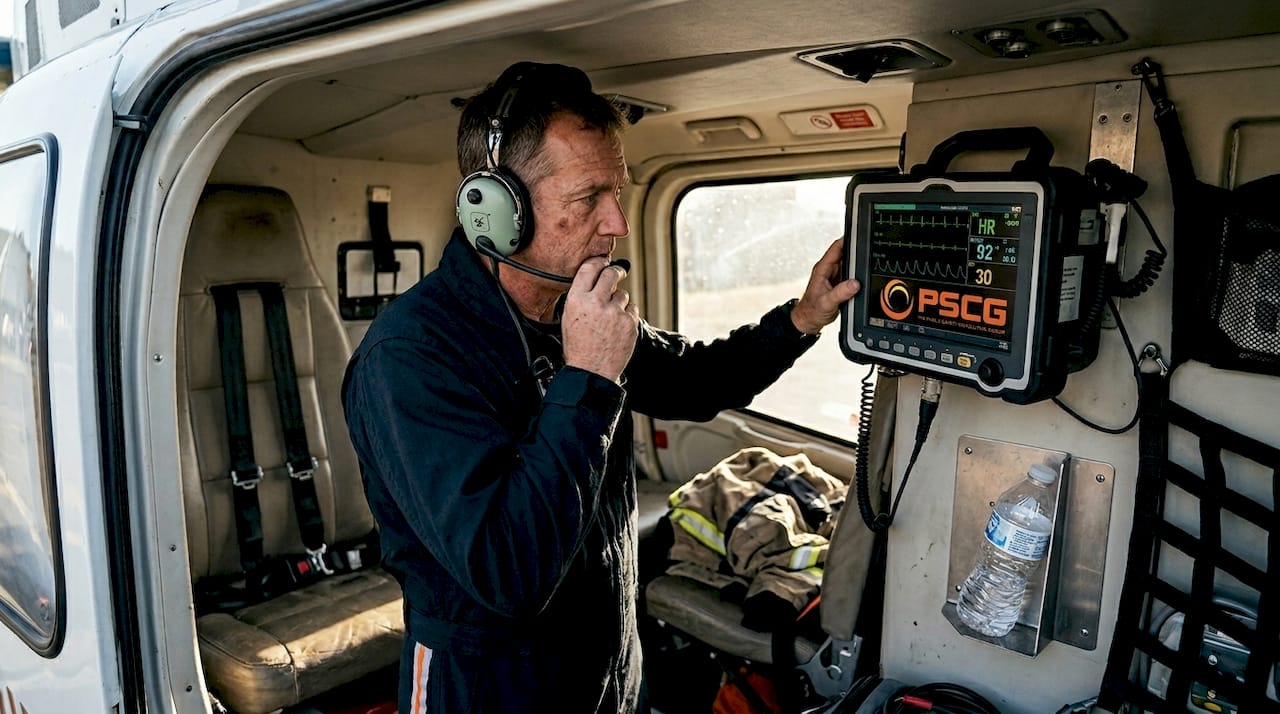
Telemedicine modalities include teleconsultation, telementoring, and telemonitoring. Teleconsultation enables remote stroke evaluation or cardiac assessment by specialists while paramedics remain on scene. Telementoring provides procedural coaching, guiding field providers through complex interventions they perform infrequently. Telemonitoring shares real-time vital signs, ECG data, and video feeds with receiving facilities, enabling earlier treatment decisions and better resource allocation.
| Modality | Primary Use Case | Key Technology | Typical Application |
|---|---|---|---|
| Teleconsultation | Remote diagnosis and treatment decisions | Secure video, audio, data transmission | Stroke assessment, psychiatric evaluation, alternate destination triage |
| Telementoring | Procedural guidance and skill support | Live video feed, two-way audio | Complex airway management, pediatric care, tactical medicine |
| Telemonitoring | Real-time vital sign and ECG sharing | Wireless monitoring devices, secure data platforms | Pre-hospital STEMI alerts, sepsis identification, trauma triage |
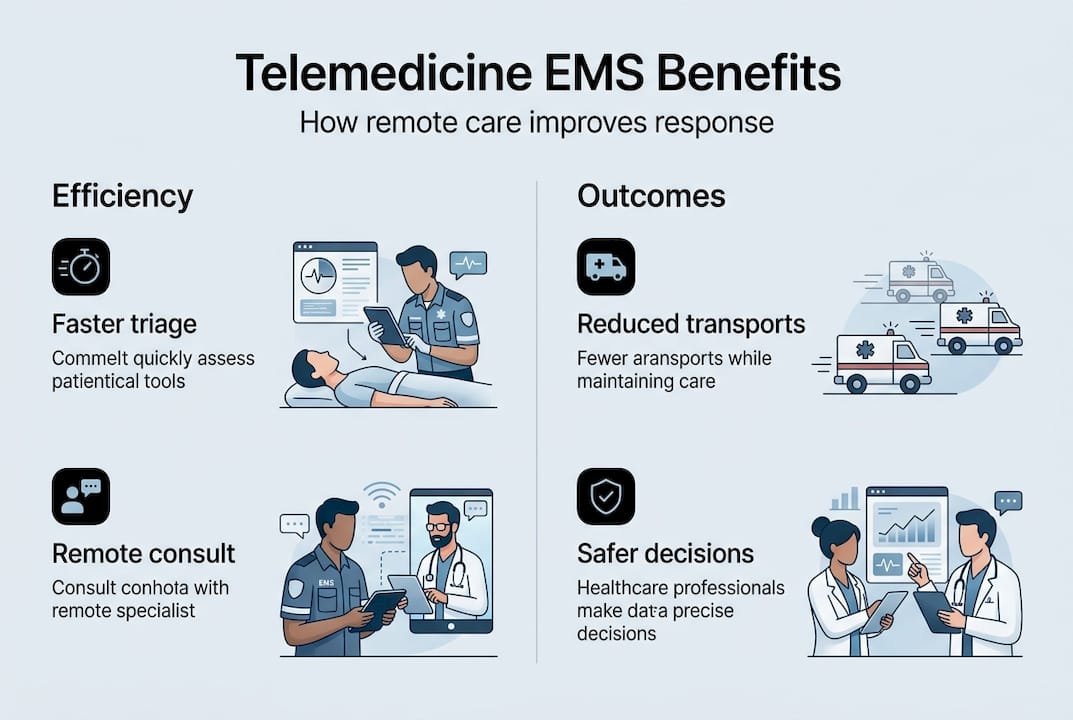
These capabilities deliver measurable benefits across the public safety ecosystem:
- Field providers gain immediate access to specialist expertise, reducing diagnostic uncertainty and improving confidence in treatment decisions
- Patients receive faster definitive care through early specialist consultation and appropriate destination selection
- Command centers optimize resource deployment by identifying true emergencies and coordinating alternate pathways for low-acuity cases
- Hospital systems benefit from advance notification, better bed management, and reduced ED overcrowding
The integration of telemedicine with smart technology growth in EMS requires careful attention to health data security and HIPAA compliance. Secure platforms must protect patient information while enabling seamless communication between field units, hospitals, and consulting physicians.
How telemedicine improves EMS effectiveness
Real-world programs demonstrate that telemedicine produces measurable improvements in public safety outcomes. Houston’s ETHAN program serves as a benchmark case study. Beyond the 56% reduction in low-acuity ambulance transports, the program achieved substantial cost savings and maintained care quality equivalent to on-site physician evaluation.
Taiwan’s experience with air medical services revealed similar results. Telemedicine consultation reduced air transport utilization by 36.2% for cases where ground transport or alternate care pathways proved appropriate. These reductions translate directly into resource availability for true emergencies and significant cost containment for public safety budgets.
| Metric | Pre-Telemedicine | Post-Telemedicine | Change |
|---|---|---|---|
| Low-acuity ambulance transports | Baseline | 44% of baseline | 56% reduction |
| Air medical transports (Taiwan) | Baseline | 63.8% of baseline | 36.2% reduction |
| Door-to-needle time (stroke) | 67 minutes | 52 minutes | 22% improvement |
| Unnecessary ED visits | Baseline | 40-60% of baseline | 40-60% reduction |
56% of low-acuity emergency calls can be safely managed without ambulance transport when telemedicine protocols are properly implemented.
“Telemedicine consultation demonstrated non-inferiority to on-site physicians in diagnostic accuracy and care quality across multiple emergency care settings, while significantly reducing unnecessary resource utilization.”
Rural, tactical, and wilderness EMS operations gain particularly strong advantages from telemedicine implementation. Remote areas often lack immediate access to specialty care, yet face complex medical situations requiring expert guidance. Telemedicine enables advanced supervision during mass-casualty incidents, provides remote care coordination during natural disasters, and supports tactical medics in austere environments where evacuation carries significant risk.
The EMS data-driven response capabilities enabled by telemedicine extend beyond individual patient encounters. Aggregate data from telemedicine consultations reveal patterns in call types, identify training gaps, and inform protocol refinement. Rural EMS telemedicine programs report improved trauma outcomes and reduced unnecessary emergency transports by connecting remote providers with specialists who guide treatment and destination decisions.
Key considerations for implementing telemedicine in public safety
Successful telemedicine programs rest on six essential pillars: regulatory compliance, technology infrastructure, provider training, hospital and physician partnerships, reimbursement strategy, and public awareness. Each pillar requires deliberate planning and sustained attention throughout implementation.
- Conduct a comprehensive needs assessment to identify call volume patterns, current transport rates, available hospital partnerships, and existing technology capabilities
- Establish regulatory and legal frameworks including HIPAA compliance, state telemedicine laws, medical direction agreements, and liability coverage
- Select and deploy appropriate technology with secure video platforms, reliable connectivity solutions, integration with existing CAD and patient care reporting systems
- Develop clinical protocols and medical oversight defining when telemedicine consultation is appropriate, which conditions qualify for alternate destinations, and how to handle technology failures
- Train all stakeholders including paramedics, EMTs, dispatchers, receiving facility staff, and consulting physicians on protocols, technology use, and communication standards
- Implement reimbursement and financial sustainability plans leveraging Medicare, Medicaid, and commercial payer policies that support telemedicine and alternate destination programs
- Launch public education campaigns explaining how telemedicine works, when it’s appropriate, and what patients should expect during telemedicine-assisted calls
Federal resources provide valuable implementation guidance. The federal EMS telemedicine framework offers evidence-based protocols and lessons learned from early adopter programs.
Pro Tip: Build early buy-in with paramedics by involving them in protocol design and technology selection. Field providers who help shape telemedicine programs become champions who drive adoption and identify practical improvements during rollout.
Reimbursement represents a critical sustainability factor. Medicare and many state Medicaid programs now support telemedicine services and alternate destination transports under specific conditions. Understanding these policies and documenting services appropriately ensures programs remain financially viable. Organizations benefit from consulting with specialists in reimbursement policy expertise who navigate the complex landscape of payer requirements and maximize revenue capture.
Strong public safety partnerships between EMS agencies, hospitals, physician groups, and municipal leadership create the collaborative foundation necessary for telemedicine success. These partnerships define roles, establish communication protocols, and ensure all parties commit to program goals.
Barriers and common challenges in EMS telemedicine adoption
Despite proven benefits, telemedicine adoption faces predictable obstacles that require proactive management. Understanding these barriers enables leaders to develop effective mitigation strategies before they derail implementation.
Common implementation challenges include:
- Paramedic and EMT resistance stemming from concerns about scope of practice changes, technology complexity, or perceived threats to clinical autonomy
- Technology limitations including unreliable cellular connectivity in rural areas, interoperability issues between systems, and equipment costs
- Patient expectations for traditional ambulance transport to the nearest ED, regardless of acuity or appropriateness
- Financial and reimbursement hurdles when payer policies lag behind clinical capabilities or documentation requirements prove burdensome
- Protocol adaptation challenges requiring medical directors to develop new clinical pathways and train providers on decision-making frameworks
Patient expectations present a particularly nuanced challenge. Many community members view ambulance transport as an entitlement or assume the nearest ED represents the only appropriate destination. Research shows that only 0.63% of respiratory emergency cases required on-site physicians, yet patients often resist telemedicine alternatives without understanding the clinical rationale.
Pro Tip: Public education campaigns reduce patient resistance and clarify what telemedicine offers. Share success stories, explain safety protocols, and emphasize how telemedicine connects patients with specialists faster than traditional transport in many situations.
Technology interoperability deserves special attention. EMS tech interoperability challenges arise when telemedicine platforms can’t communicate with existing CAD systems, electronic patient care reporting tools, or hospital information systems. These gaps create documentation burdens and limit the data integration necessary for quality improvement.
The evolution of dispatch technology plays a crucial role in telemedicine success. Dispatchers must understand when to recommend telemedicine consultation, how to prepare patients for the experience, and how to coordinate with field providers and consulting physicians.
Change management principles apply throughout implementation. Gradual protocol rollout, ongoing assessment of outcomes and provider satisfaction, and continuous refinement based on real-world experience help organizations navigate resistance and build sustainable programs. Investment in EMS training best practices ensures providers develop the clinical judgment and communication skills necessary for effective telemedicine consultation.
Emerging trends and the future role of telemedicine in public safety
Telemedicine’s role in public safety continues expanding beyond traditional emergency response into new applications that address evolving community needs and operational challenges.
Emerging applications and future directions include:
- Mass-casualty incident triage where remote physicians assist with patient sorting, resource allocation, and treatment prioritization during large-scale emergencies
- Disaster management coordination enabling medical oversight across multiple incident sites and facilitating specialist consultation when local resources are overwhelmed
- Integration with predictive analytics to optimize resource deployment, identify high-utilizer patterns, and target community paramedicine interventions
- Infectious disease and pandemic response providing remote evaluation and isolation guidance to protect field providers while maintaining care access
- Tactical and wilderness medicine support extending expert consultation to austere environments where evacuation carries significant risk or delay
Regulatory support for alternate destination reimbursement continues growing as payers recognize the cost-effectiveness of appropriate care pathways. This trend will accelerate telemedicine adoption by removing financial barriers that previously limited program sustainability.
Empirical benchmarks show consistent reductions in unnecessary transports, but more outcome data and specialty access are needed for next-generation adoption. Organizations that invest in continuous training and technology upgrades position themselves to capitalize on emerging capabilities and maintain competitive advantage in public safety service delivery.
Outcome benchmarking with new programs builds political and operational buy-in. When municipal leaders see documented improvements in response time reliability, cost per capita, and patient satisfaction, they become advocates for continued investment and program expansion. The principles of EMS customer service innovation apply directly to telemedicine implementation, where patient experience and community perception determine long-term program success.
Connecting public safety strategy with telemedicine expertise
Transforming EMS effectiveness through telemedicine requires more than technology deployment. It demands strategic planning, stakeholder alignment, and operational expertise that many municipalities lack internally. We work alongside public safety leaders to design telemedicine programs that fit community needs, regulatory requirements, and financial realities.
Our approach integrates telemedicine capabilities with broader EMS system design principles, ensuring technology investments support overall performance improvement rather than creating isolated capabilities. Whether you’re exploring telemedicine for the first time or refining an existing program, our municipal EMS strategy guide provides frameworks for optimizing services and achieving measurable results. We help you navigate implementation challenges, build sustainable partnerships, and demonstrate value to stakeholders who control funding and policy decisions.
Frequently asked questions
How does telemedicine reduce ambulance overuse in public safety?
Telemedicine enables real-time triage and remote physician consultation, preventing unnecessary ambulance transports for low-acuity cases. Houston’s ETHAN program reduced ambulance transports by 56% through systematic telemedicine protocols.
What are the main barriers to telemedicine adoption in EMS?
Common barriers include EMS provider training needs, patient resistance, technology and connectivity challenges, and reimbursement policy limitations. Successful programs address these obstacles through comprehensive planning and stakeholder engagement.
Is telemedicine effective for rural EMS systems?
Yes, evidence shows telemedicine improves trauma outcomes and reduces unnecessary rural emergency transports by connecting remote EMS providers with specialists who guide treatment and destination decisions.
What technology is essential for public safety telemedicine programs?
Secure high-resolution video, audio transmission, data monitoring, and HIPAA-compliant platforms are required for EMS telemedicine. Reliable connectivity and integration with existing systems ensure operational effectiveness.