


TL;DR:
- Connecticut EMS systems face response time challenges due to staffing shortages and funding issues.
- Tailored public safety consulting helps evaluate performance, develop strategic plans, and improve compliance.
- Financial planning through cost-of-service analysis and regionalization is key for sustainable EMS operations.
Connecticut’s Emergency Medical Services (EMS) system handled 732,000 emergency responses last year, yet rural response times reached up to 25 minutes while personnel shortages and funding deficits continue to widen. For municipal leaders, these numbers represent more than statistics. They represent real gaps in public safety readiness that demand strategic action. Designing a sustainable, high-performing EMS system requires more than good intentions. It requires structured assessments, evidence-based benchmarks, and financial strategies built for Connecticut’s unique regulatory and funding environment. This guide outlines how expert public safety consulting delivers exactly that.
Table of Contents
- What does public safety consulting offer Connecticut municipalities?
- Designing effective EMS systems: Framework and benchmarks
- Operational risk reduction: Tools, culture, and compliance
- Funding and reimbursement: Building financial sustainability
- Perspective: Why conventional EMS consulting misses the real solution
- Expert support for Connecticut EMS transformation
- Frequently asked questions
Key Takeaways
| Point | Details |
|---|---|
| Consulting services | Public safety consultants provide customized EMS system design, operational risk reduction, and financial planning for Connecticut. |
| System design frameworks | Successful EMS systems are built on evidence-based frameworks tailored to state standards and local needs. |
| Operational risk solutions | Quality improvement and data-driven risk reduction strategies can cut errors and improve patient outcomes. |
| Financial sustainability | Stable local funding and cost-of-service analysis are crucial for resilient EMS operations in Connecticut. |
What does public safety consulting offer Connecticut municipalities?
Public safety consulting is not a one-size-fits-all service. For Connecticut municipalities, it means working with specialists who understand the state’s regulatory framework, its regional EMS councils, and the funding pressures that vary from Bridgeport to Windham. The right consulting partner translates that knowledge into actionable strategies your team can implement.
At its core, public safety consulting solutions for EMS cover four primary areas:
- System assessments: A structured review of current operations, staffing models, response time data, and equipment to identify performance gaps before they become crises.
- Strategic planning: Building a multi-year roadmap aligned with Connecticut’s regulatory requirements and your community’s specific service demands.
- Operational risk reduction: Identifying liability exposures, protocol gaps, and compliance deficiencies that put patients and agencies at risk.
- Financial and reimbursement analysis: Evaluating billing practices, Medicaid recovery rates, and municipal funding structures to build a more predictable revenue base.
As outlined in the PSCG FAQ, these services are specifically designed for municipal EMS environments, not generic healthcare or corporate settings. That distinction matters because Connecticut’s EMS landscape operates under a specific blend of state oversight, local control, and regional coordination that generic consultants often misread.
The EMS consulting advantages extend beyond fixing immediate problems. Consultants help you build internal capacity so your leadership team can sustain improvements long after the engagement ends. According to a national EMS consulting overview, municipalities that engage specialized consultants consistently outperform peers on response time benchmarks and financial stability metrics.
Pro Tip: Before engaging any consulting firm, ask specifically whether they have direct experience with Connecticut’s Office of Emergency Medical Services (OEMS) compliance requirements. Generic public safety consultants may lack the state-specific knowledge your municipality needs.
Designing effective EMS systems: Framework and benchmarks
Effective EMS system design does not begin with purchasing new equipment or hiring more staff. It begins with a structured assessment of what you have, what you need, and what standards you are being measured against. Consultants use both state and national frameworks to guide this process.
The Connecticut State EMS Plan 2023-2028 defines core system elements ranging from regulation and resource management to regional council coordination and stable local funding. Aligning your system design with this plan is not optional. It is the foundation for receiving state support and maintaining compliance.
The municipal EMS strategy guide outlines a proven five-step process for building or restructuring an EMS system:
- Conduct a full operations assessment to establish baseline performance data.
- Engage stakeholders including elected officials, medical directors, and frontline crews.
- Set SMART goals (Specific, Measurable, Achievable, Relevant, Time-bound) tied to response time and clinical outcome targets.
- Allocate resources based on call volume analysis and geographic demand mapping.
- Establish a monitoring framework with regular performance reviews and corrective action protocols.
Benchmarks give your goals teeth. The table below shows standard response time targets consultants use when evaluating Connecticut EMS systems:
| Service area | Response time benchmark | Standard reference |
|---|---|---|
| Urban ALS (Advanced Life Support) | 8 minutes or less | NFPA 1710 |
| Suburban BLS (Basic Life Support) | 10 minutes or less | State EMS Plan |
| Rural ALS | 14 minutes or less | State EMS Plan |
| Critical cardiac events | First shock within 5 minutes | AHA Guidelines |
These benchmarks are not arbitrary. They are tied directly to patient survival rates. Every minute of delay in a cardiac arrest reduces survival probability by approximately 10%. Knowing where your system stands against these targets is the first step toward closing the gap. The system assessment steps we use ensure no performance variable is overlooked during that process.

Operational risk reduction: Tools, culture, and compliance
With the structural framework in place, sustainable EMS systems depend on actively managing risk. Operational risk in EMS is not limited to vehicle accidents or equipment failures. It includes clinical errors, protocol non-compliance, documentation gaps, and the slow erosion of safety culture that happens when leadership stops measuring what matters.
Evidence-based operational risk reduction approaches rely on four core methodologies:
- Data-driven assessment using NEMSIS (National EMS Information System) and NEMSQA (National EMS Quality Alliance) benchmarking to compare your performance against state and national peers.
- PDSA cycles (Plan, Do, Study, Act) to test and refine protocol changes before system-wide rollout.
- NFPA compliance reviews covering standards 1710, 1561, and 1911 to identify structural and operational gaps.
- Safety culture initiatives that build accountability at every level, from crew to command.
The results of structured quality improvement (QI) programs are measurable. QI programs using PDSA cycles and benchmarking can cut clinical errors by 30% and improve cardiac arrest survival rates by 18%. Those are outcomes worth pursuing deliberately.
“Quality improvement is not a project. It is a permanent operating condition for any EMS system that takes patient outcomes seriously.”
Pro Tip: Do not wait for an adverse event to trigger a QI review. Schedule quarterly performance audits using NEMSIS data and compare results against your SMART goals from the system design phase. Early detection of performance drift is far less costly than post-incident remediation.
Building a safety culture also means addressing the human side of risk. Crews that feel psychologically safe to report near-misses without fear of punishment generate the data leadership needs to prevent serious errors. The EMS quality improvement strategies we support are designed to make that reporting culture standard practice, not an exception.
Funding and reimbursement: Building financial sustainability
Even the most operationally excellent EMS system will struggle if its financial foundation is unstable. Connecticut municipalities face a particularly difficult funding environment. Medicaid covers only about one-third of billed EMS costs, and some towns are running deficits exceeding $200,000 annually, with at least one Connecticut ambulance service requesting a funding increase of 212% to remain solvent.
Those numbers reflect a structural problem, not a management failure. The core issue is that billing-dependent funding is inherently volatile. Call volume fluctuates. Payer mixes shift. Uninsured transport rates vary by season and economic conditions. A system funded primarily through billing revenue has no reliable floor.
Billing-dependent funding is volatile, and cost-of-service analysis (COSA) is the missing foundation in most EMS rate-setting conversations. COSA distinguishes between fixed readiness costs (staffing, equipment, facility overhead) and variable transport costs, giving municipalities the data they need to set rates that are both fair and financially sustainable.
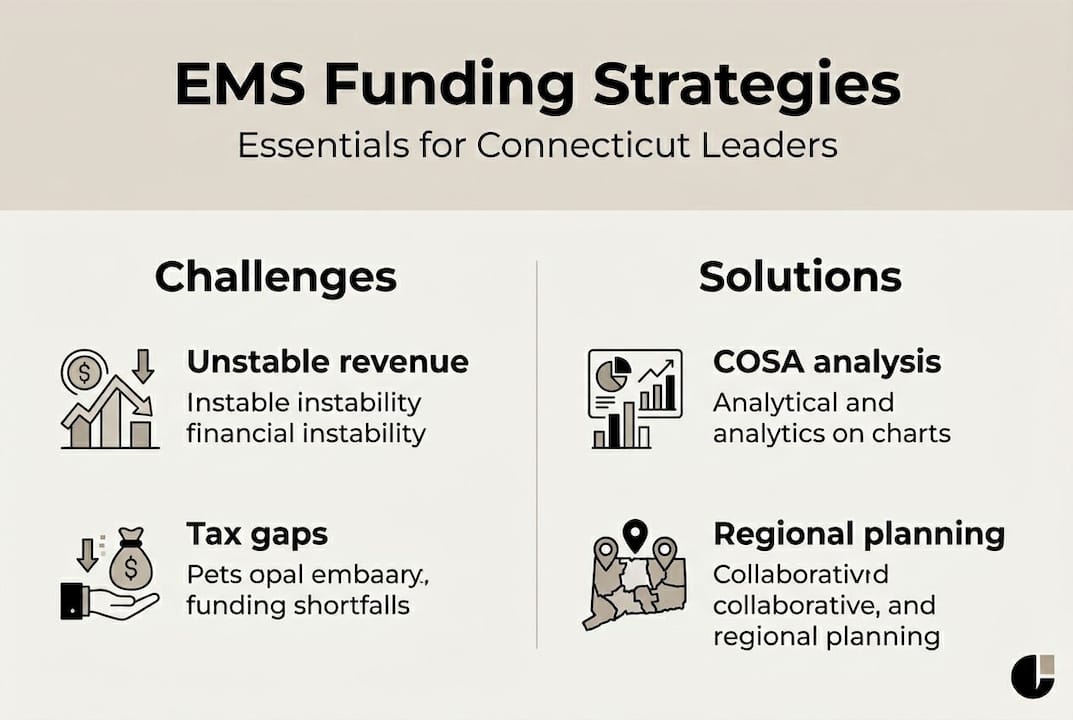
Here is how common EMS funding models compare:
| Funding model | Stability | Equity | Administrative burden |
|---|---|---|---|
| Billing only | Low | Variable | Moderate |
| Municipal levy only | High | High | Low |
| Hybrid (levy plus billing) | High | High | Moderate |
| Grant dependent | Very low | Variable | High |
Key actions EMS reimbursement consultants recommend for Connecticut municipalities include:
- Conduct a COSA to establish the true cost of maintaining readiness, not just the cost of each transport.
- Evaluate your payer mix to understand how much revenue is realistically recoverable through billing.
- Model a municipal levy structure that covers fixed readiness costs while billing offsets variable expenses.
- Pursue supplemental funding through state grants, regional cost-sharing agreements, and federal programs where eligible.
Financial sustainability is not a finance department problem. It is a leadership priority that requires the same strategic discipline as system design and risk reduction.
Perspective: Why conventional EMS consulting misses the real solution
Most EMS consulting engagements focus on what is visible and measurable: response times, compliance checklists, billing optimization, and technology upgrades. Those are legitimate concerns. But in our experience working with Connecticut municipalities, the deepest problems are rarely technical. They are structural and political.
The real barriers to EMS sustainability in Connecticut are fragmented regional funding, cultural resistance to regionalization, and a persistent failure to account for the true cost of readiness in rate-setting. Regionalization balances local control with system-wide efficiency, but state trends continue to favor commercial providers over the nonprofit and municipal services that built these systems.
Technology will not fix a town that refuses to share dispatch costs with its neighbors. A new billing platform will not close a $200,000 deficit rooted in Medicaid underpayment. Real progress requires honest conversations about regional EMS best practices, bold restructuring proposals, and the political will to act on data rather than tradition. We believe consulting’s highest value is providing the backbone for those difficult conversations, not just delivering a report that sits on a shelf.
Expert support for Connecticut EMS transformation
For municipal leaders committed to meaningful EMS improvement, the path forward requires more than good intentions. It requires a structured approach to system design, risk management, and financial planning that is built specifically for Connecticut’s operating environment.
At PSCG, we work alongside your team to deliver exactly that. Whether you are starting with the strategy guide for Connecticut leaders, addressing immediate gaps through operational risk reduction solutions, or exploring EMS design examples from communities that have already made meaningful progress, we are ready to help you move from challenge to solution. Contact us today to start the conversation your community cannot afford to delay.
Frequently asked questions
What are the most common EMS funding challenges in Connecticut?
Most EMS services face unpredictable billing revenue, limited Medicaid reimbursement, and tax funding gaps that can cause significant deficits. Agencies face major deficits and have sought municipal funding increases as high as 212% to remain operational.
How does consulting help rural towns with EMS challenges?
Consulting guides regionalization, SMART resource allocation, and alternative funding strategies to address declining volunteerism and extended response times. Rural volunteer decline has reached 41%, making regional coordination solutions especially critical for Connecticut’s smaller communities.
What risks do quality improvement programs address in EMS?
QI programs reduce clinical errors, improve patient outcomes, and ensure ongoing compliance with safety standards. PDSA cycles and QI cut errors by 30% and improve cardiac arrest survival rates by 18%.
Why is cost-of-service analysis important in EMS rate setting?
COSA ensures funding rates are fair by accounting for both readiness and transport costs, promoting long-term financial stability. COSA distinguishes fixed and variable EMS costs to help municipalities set rates that reflect the true cost of maintaining a ready system.