


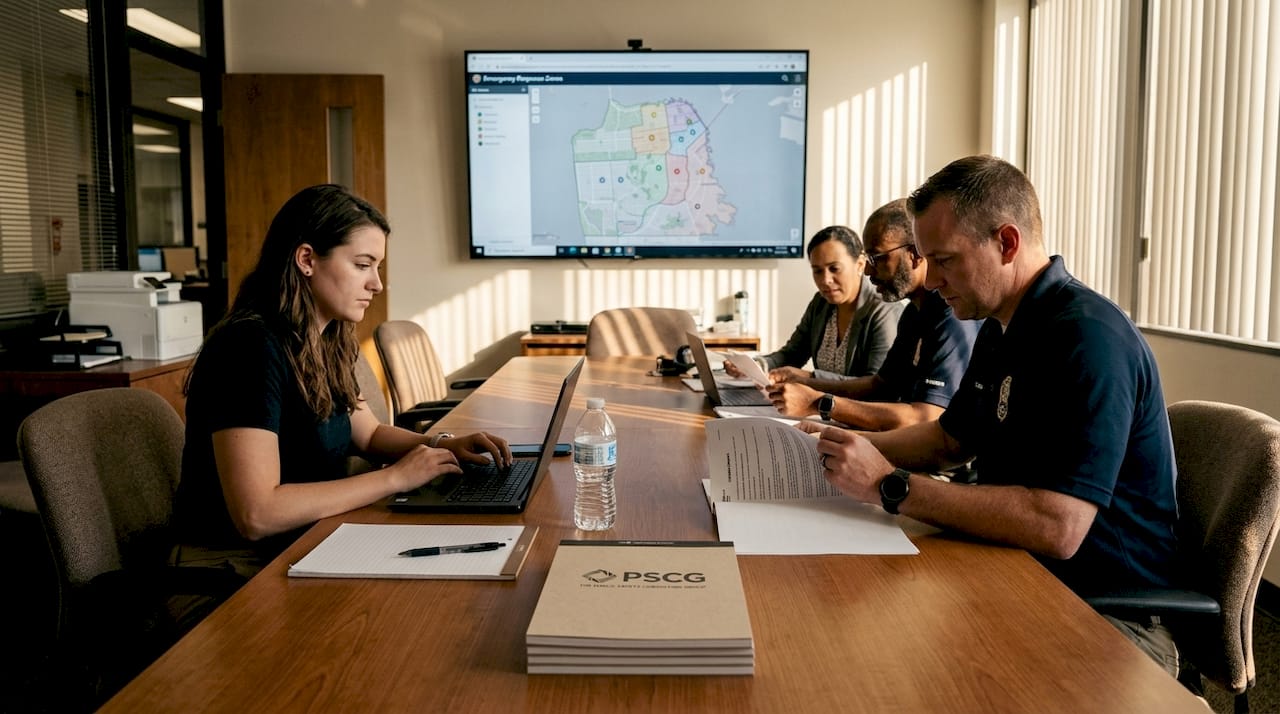
Many municipal leaders assume that public agencies alone must bear full responsibility for emergency services delivery, from staffing and equipment to coordination and recovery. That assumption leaves significant capability on the table. Public-private partnerships (P3s) are collaborative arrangements between public sector entities and private organizations designed to enhance community resilience, response, and recovery in emergency management. When structured correctly, these partnerships resolve historic resource gaps, accelerate response timelines, and distribute operational risk more effectively than any single agency can manage alone. This article walks you through how P3s work, what they deliver, and how to build one that lasts.
Table of Contents
- What are public-private partnerships in emergency management?
- How public-private partnerships improve public safety and response
- Navigating challenges and risks in public-private partnerships
- Best practices and benchmarks for successful P3s
- Beyond theory: What most articles miss about public-private partnerships
- Next steps: Leverage expertise for successful partnerships
- Frequently asked questions
Key Takeaways
| Point | Details |
|---|---|
| Formalize partnership structures | Use BEOCs, charters, and collaborative planning teams to establish trust and clarity in emergency management collaborations. |
| Measure outcomes with metrics | Evaluate P3 effectiveness through lifeline restoration, crime reduction, and economic recovery benchmarks. |
| Mitigate risks proactively | Address ambiguities and political influences early to protect public interests and partnership viability. |
| Leverage real-world data and tools | Integrate analytics, open data, and federal resources to improve response and safety. |
| Apply annual reviews | Refine partnership processes yearly to ensure resilience and adaptability. |
What are public-private partnerships in emergency management?
Public-private partnerships in emergency management are formal, structured collaborations between government entities and private sector organizations, including businesses, nonprofits, utilities, and healthcare systems. They are not informal handshake agreements. They carry defined roles, shared objectives, and accountability frameworks that align both parties around measurable outcomes.
The four-phase P3 process follows a clear sequence: Plan, Engage, Build, and Assess/Refine. In the Plan phase, municipal leaders identify gaps in current emergency capabilities and define what private sector capacity could fill them. The Engage phase brings potential partners to the table through structured outreach and mutual needs assessment. Build formalizes the relationship through charters, memoranda of understanding, and operational protocols. Finally, Assess/Refine uses performance data to continuously improve the partnership’s function and impact on EMS operations.
P3s in emergency management typically focus on three core areas:
- Shared risk management: Distributing financial and operational exposure across public and private partners
- Supply chain integration: Coordinating private logistics, medical supplies, and equipment during surge events
- Critical lifeline support: Engaging utilities, transportation companies, and communications providers to maintain essential services during disasters
The types of organizations that participate vary widely. Here is a comparison of common partner types and their primary contributions:
| Partner type | Primary contribution |
|---|---|
| Private healthcare systems | Surge capacity, clinical staffing, medical supplies |
| Utilities and energy companies | Power restoration, infrastructure continuity |
| Logistics and transportation firms | Resource movement, supply chain management |
| Nonprofits and community organizations | Shelter, food, vulnerable population support |
| Technology and data firms | Situational awareness, analytics, communications |
The shared goal across all these arrangements is community resilience. Municipal leaders who understand this structure can move from reactive crisis response to proactive, coordinated emergency management that draws on the full capacity of their region.
How public-private partnerships improve public safety and response
Understanding the structure of P3s is important, but seeing how they perform under real conditions is what builds confidence. The evidence across multiple jurisdictions shows consistent, measurable gains in disaster response speed, resource availability, and public safety outcomes.
Consider these documented outcomes from active P3 programs:
- The Nebraska Preparedness Partnership mobilized private sector logistics during the 2019 floods, accelerating resource distribution to affected communities.
- Houston’s Urban Area Security Initiative (UASI) coordinated private sector partners for COVID-19 response, enabling faster testing and supply chain continuity across a major metropolitan region.
- Harris County’s Long-Term Recovery Committee, with 80+ member organizations, linked emergency management directly to economic development, extending recovery impact well beyond the immediate disaster period.
- Missouri partnerships connected emergency management agencies with private economic development partners, creating a dual-purpose resilience model that strengthened both disaster response and post-event recovery.
On the public safety side, the National Public Safety Partnership (PSP) program demonstrates what federal and local collaboration can achieve. In Antioch, California, PSP participation produced enhanced crime analysis capabilities, stronger community engagement strategies, and measurable violence reduction through DOJ training and sustained federal collaboration over three years.
Here is a summary of documented P3 outcomes across key performance areas:
| Performance area | Documented outcome |
|---|---|
| Disaster resource mobilization | Faster logistics during Nebraska 2019 floods |
| Public health coordination | COVID-19 supply continuity in Houston |
| Long-term recovery | 80+ member coalition in Harris County |
| Crime and violence reduction | Enhanced analysis and engagement in Antioch, CA |
For municipal leaders focused on public safety risk reduction, these results are not theoretical. They reflect what happens when structured partnerships replace ad hoc coordination. You can also review partnership examples from comparable jurisdictions to identify models that fit your community’s profile.

Pro Tip: Formalize your P3 relationships with written charters and Business Emergency Operations Center (BEOC) structures before a crisis occurs. Partners who have trained and planned together perform significantly better when an actual event unfolds.
Navigating challenges and risks in public-private partnerships
P3s offer real operational advantages, but municipal leaders who enter these arrangements without a clear-eyed view of the risks often encounter avoidable failures. The challenges are structural, political, and contractual, and they require deliberate mitigation strategies.
The most common pitfalls include:
- Ambiguous contracts: Vague language around roles, responsibilities, and performance expectations creates disputes when conditions change during a real emergency.
- Incomplete risk sharing: Contractual ambiguities and political pressures can make projects feel “too big to fail,” which shifts disproportionate risk back onto the public sector.
- Procurement constraints: Public sector procurement rules can slow partner selection and limit flexibility, especially during fast-moving events.
- Mistrust and conflicting interests: Private partners operate with profit motives that do not always align with public interest, and communities with histories of regulatory hurdles or past corruption may resist private involvement in public safety functions.
These barriers are real, but they are not insurmountable. The key is transparency at every stage of the partnership lifecycle.
“The most resilient P3s are built on shared data, clearly defined accountability, and a mutual understanding that neither party transfers all risk to the other. When those conditions exist, partnerships survive stress. When they don’t, they fracture under it.”
Strategies that work include independent legal review of all partnership agreements, structured conflict resolution protocols, and public-facing reporting on partnership performance. Municipal leaders should also consult your emergency management guide and invest in municipal readiness planning before formalizing any P3 arrangement. Reviewing professional services best practices from comparable sectors can also surface useful governance frameworks.
The goal is not to eliminate risk. It is to allocate it clearly, monitor it consistently, and adjust quickly when conditions shift.
Best practices and benchmarks for successful P3s
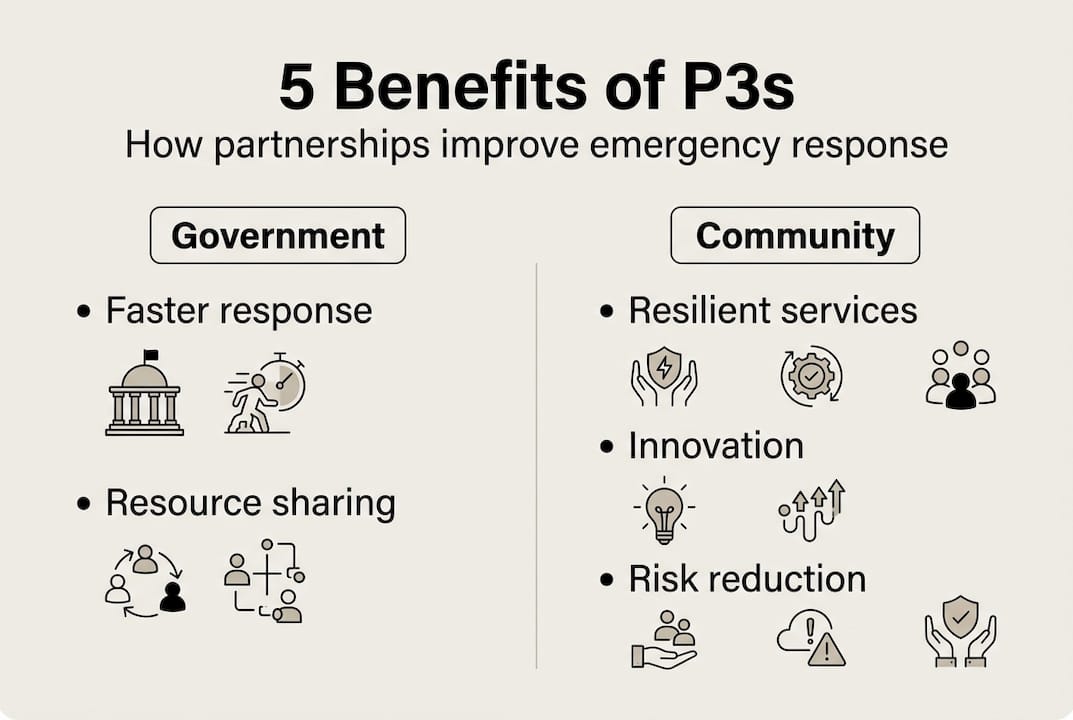
With risks properly managed, the focus shifts to building P3s that deliver sustained, scalable results for municipal emergency management. The difference between partnerships that thrive and those that stagnate usually comes down to structure, metrics, and the discipline to review both regularly.
Here are the foundational best practices we recommend:
- Establish formal engagement structures. BEOCs, charters, and CPTs (Collaborative Planning Teams) create the institutional framework that keeps partnerships functional between events, not just during them.
- Define performance metrics before activation. Agree on what success looks like in measurable terms: lifeline restoration timelines, crime reduction percentages, economic recovery indicators.
- Conduct annual reviews. Benchmark success metrics on lifeline restoration, crime reductions, and economic recovery, then refine partnership structures based on what the data reveals.
- Build adaptive learning into the process. After-action reviews following exercises and real events should feed directly into updated protocols and partner agreements.
- Engage community stakeholders. Public trust is a performance metric too. Partnerships that operate transparently and communicate outcomes to residents sustain political support over time.
Pro Tip: Integrate data-driven assessment tools from the start. Dashboards that track real-time performance against agreed benchmarks give both public and private partners a shared view of progress and flag problems before they become failures.
For more actionable guidance on applying these practices in your jurisdiction, our public safety strategy tips resource covers implementation frameworks designed specifically for municipal leaders. You can also explore benchmarking outcomes across comparable professional services sectors to adapt proven measurement approaches.
The strongest P3s we have seen share one trait: they treat the partnership itself as an operational system, one that requires maintenance, measurement, and continuous improvement, not just a signed agreement filed in a drawer.
Beyond theory: What most articles miss about public-private partnerships
Most guidance on P3s focuses on contracts and compliance. That is necessary, but it is not sufficient. In our experience working with municipal leaders across the country, the partnerships that deliver lasting results are built on something contracts cannot mandate: trust earned through consistent action.
Private partners need to see that public leaders will honor commitments even when political conditions shift. Public agencies need to see that private partners will prioritize community outcomes over short-term margin. Neither of those things happens automatically. They develop through joint planning exercises, shared data review, and honest after-action conversations.
We also see municipal leaders underestimate community skepticism. Residents who have watched public assets privatized poorly in the past will scrutinize any P3 arrangement. Addressing that skepticism early, through transparent communication and community feedback loops, is not a soft skill. It is a risk management strategy.
The strategic planning process for EMS and emergency management should incorporate P3 readiness as a core component, not an afterthought. Start with joint data review. Build from there.
Next steps: Leverage expertise for successful partnerships
Building an effective public-private partnership for emergency management requires more than good intentions. It requires structured planning, proven frameworks, and expertise in both public safety operations and municipal strategy.
At PSCG, we work alongside municipal leaders to design, evaluate, and strengthen public safety systems that deliver measurable results. Our public safety planning solutions provide the strategic foundation your P3 needs to succeed. Explore our strategy tips for municipalities for practical guidance you can apply immediately, or review our EMS system design examples to see how structured partnerships translate into operational improvements. Contact us today to start the conversation.
Frequently asked questions
What are the most important steps to formalize a public-private partnership for emergency management?
Municipal leaders should prioritize formal engagement structures like BEOCs, charters, and collaborative planning teams to build trust and operational capacity before a crisis occurs.
How can municipal leaders measure success in public-private partnerships for public safety?
Success is best measured through agreed metrics like lifeline restoration timelines, crime reduction rates, and economic recovery indicators, reviewed and refined on an annual basis to reflect real performance data.
What risks should municipalities watch for in public-private partnerships?
Municipalities should watch for contractual ambiguities, incomplete risk sharing, political pressures that distort accountability, and mistrust rooted in conflicting public and private interests.
Can P3s improve municipal response during disasters?
Yes. Documented examples like the Nebraska flood response and Houston’s COVID-19 coordination show that well-structured P3s accelerate resource mobilization and improve coordination across agencies and sectors.
What data-driven tools should P3s use for public safety?
P3s should integrate analytics platforms, open data portals, and federal collaboration tools like the National PSP program to enhance crime analysis, violence reduction, and operational efficiency across partner organizations.